Market Summary
Executive Summary and Global Market Analysis
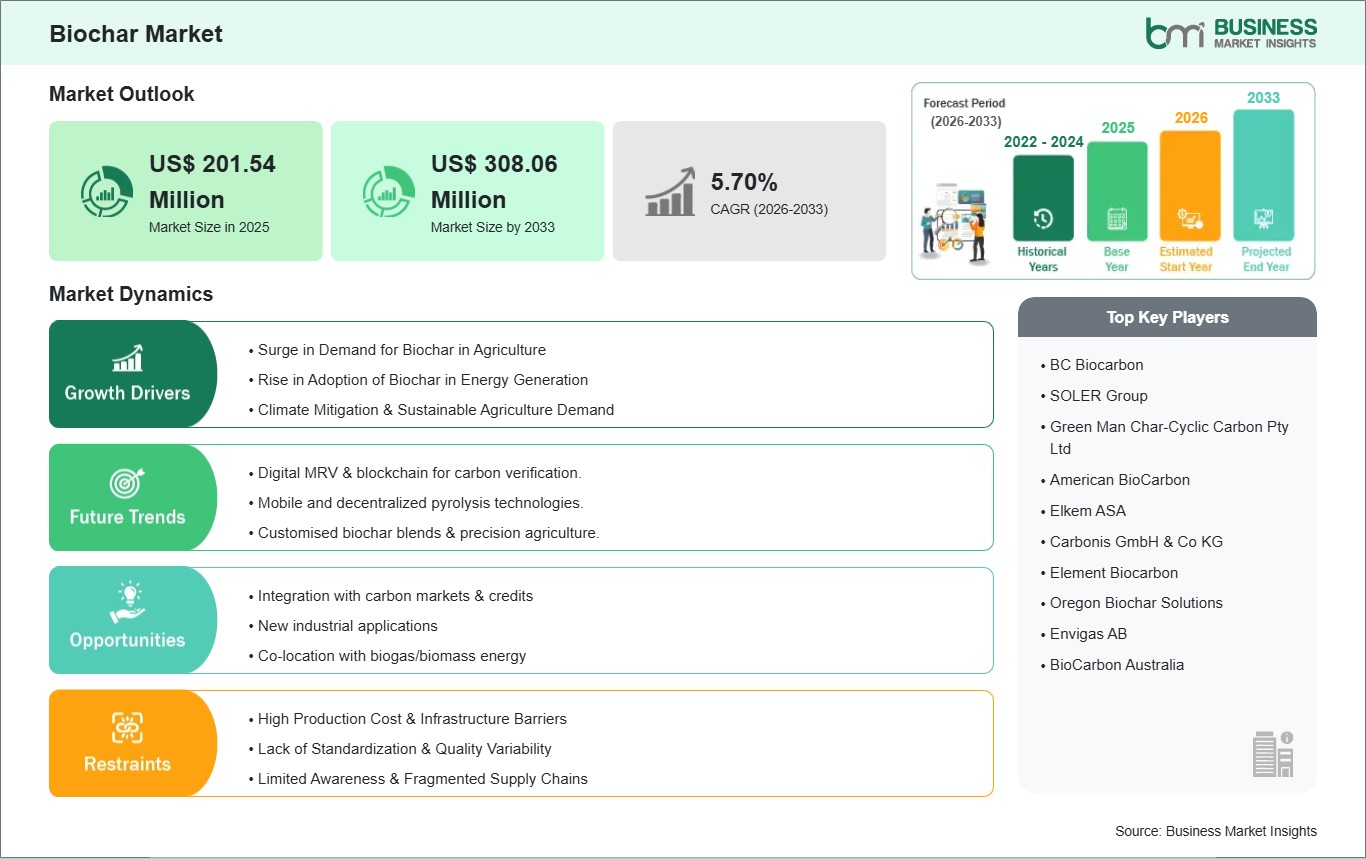
Biochar is an important part of sustainable agriculture and land clean-up, which provides beneficial effects on soil and lasting carbon storage through biomass pyrolysis. It is vital to industries like farming, waste disposal, forestry, and climate mitigation. Biochar has various benefits, such as increased nutrient storage, increased ability to hold water, and decreased emission of greenhouse gases. The market is being driven by the increased significance of regenerative practices worldwide, the emergence of carbon credit markets, and the increasing demand to create organic food products. Also, improved performance in pyrolysis, optimization of feedstock, and integrated biochar improve the scaling of production and environmental gains.
Nonetheless, there are a few issues that may hamper market expansion, which include high production costs, a lack of awareness among farmers, and inconsistency in product quality. Fluctuations in the supply of biomass and certification issues across regions also pose a sensitivity to the industry. Nevertheless, through these challenges, the market has substantial opportunities associated with the increasing adoption in soil restoration, the growth of waste valorization in developing economies, and the rising adoption of biochar in filtration technologies. The policy incentive and developed carbon removal strategies will also be invested in, and this is likely to create new opportunities for market growth.
Segment Analysis
Biochar Market Segmentation
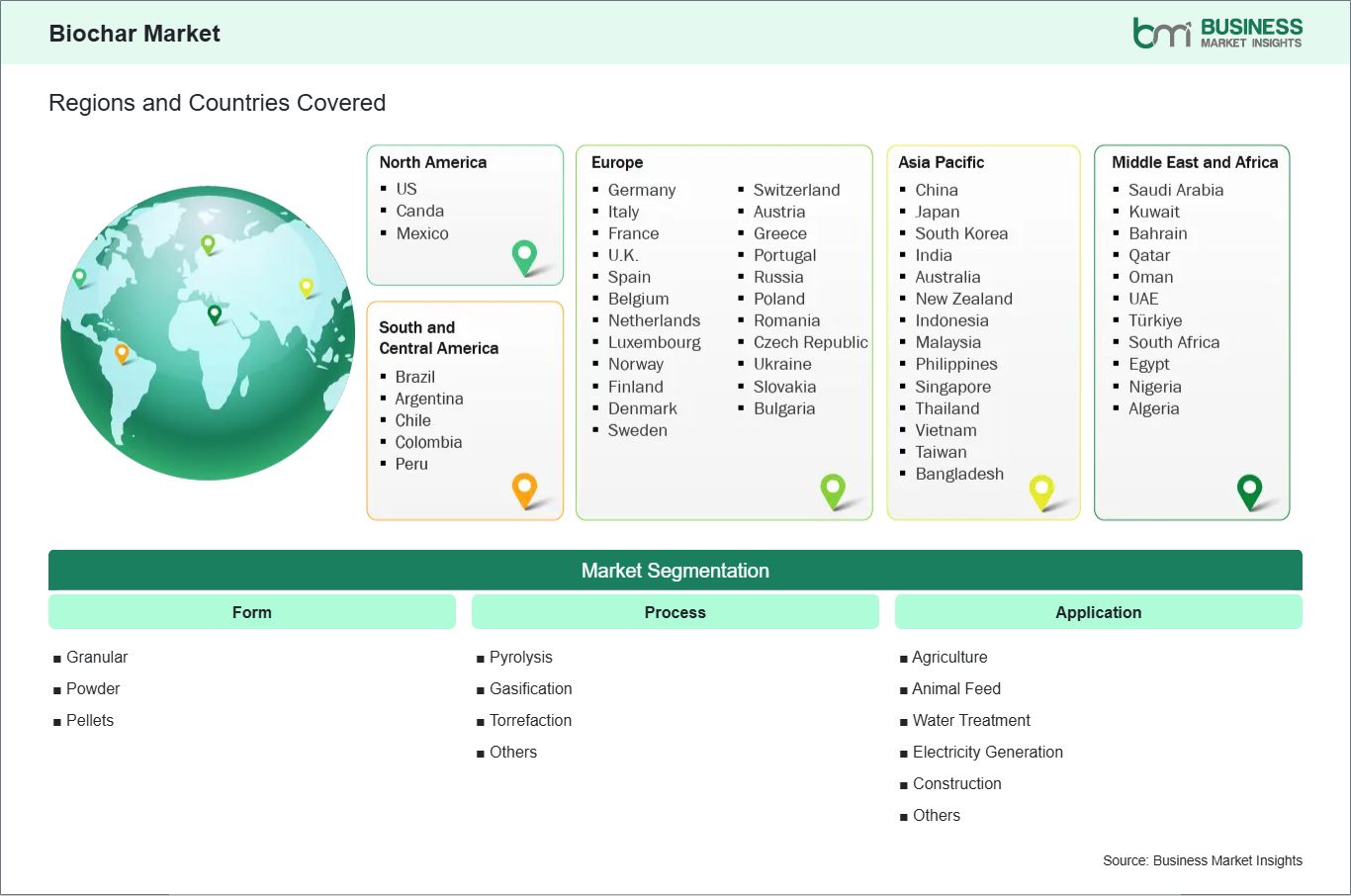
Key segments that contributed to the derivation of the Biochar market analysis are form, process, and application.
- By form, the biochar market is segmented into granular, powder, and pellets. The powder segment dominated the market in 2025.
- By process, the market is categorized into pyrolysis, gasification, torrefaction, and others. The pyrolysis segment held the largest share of the market in 2025.
- By application, the market is segmented into agriculture, animal feed, water treatment, electricity generation, construction, and others. The agriculture segment held the largest share of the market in 2025.
Market Forces
Biochar Market Drivers and Opportunities
Surge in Demand for Biochar in Agriculture
One of the key areas of application of biochar is agriculture. The use of biochar in agriculture has gained popularity in recent years. Treatment of temperate soil with biochar can enhance different indicators of soil health. The health of soil is defined in terms of the ability of the soil to act as a living system to support the biological productivity as well as the environmental quality. Biochar can considerably maintain soil nutrients, including ammonium, nitrate, and phosphorus, more easily observed in the light-textured soils. It is also used to enhance the fertility of soils as well as crop productivity.
The degradation of soil is one of the key issues that concerns the global agricultural industry. Biochar is used on soils that have been degraded to improve their quality. In North America, there are regional organizations that assist in the use and production of biochar in the agricultural industry. An example is the Pacific Northwest Biochar Atlas, which producers and users of biochar use. Pacific Northwest Biochar Atlas advises the farmers, gardeners, and other end users on the possible benefits of biochar. The California Biochar Association aims to create a robust and united state-wide voice that will support the production and use of biochar in agriculture and other sectors. Moreover, having a mission statement to involve stakeholders in the benefits of biochar as a climate policy and agricultural benefiting tool, the Sonoma Biochar Initiative would stimulate the demand for biochar to be applied in agriculture. Therefore, the growth of the biochar market is driven by the rise in the demand for biochar in agriculture.
Rise in Adoption of Biochar in Energy Generation
Biochar is manufactured by different processes that require the heating of organic matter (agriculture waste, forestry residues, and biomass) without the addition of oxygen, thereby producing biochar, syngas, and bio-oil. These by-products are useful in making renewable energy that can be utilized to produce electricity or heat, and are also a twofold advantage since the by-products can be used to sequester carbon as well as create renewable energy.
The aim of reducing the reliance on fossil fuels by various regions and countries has the goal of reducing climate change, and with biochar production being a type of energy production, it fits the objectives. Biochar production coupled with energy systems can also assist in reducing greenhouse gas emissions by substituting the use of more polluting sources of energy with a carbon-neutral source. Also, the biomass feedstocks will be a viable solution to waste management. There are numerous policies in the government that work on the development of renewable energy and the reduction of carbon emissions. The increasing significance and viability of biochar as a source of energy is growing as more efficient and less expensive methods of biochar production are developed as technology advances.
Report Coverage
Biochar Market Report Coverage and Deliverables
The Biochar Market Size and Forecast (2022-2033) report provides a detailed analysis of the market covering below areas:
By form, the biochar market is segmented into granular, powder, and pellets. The powder segment dominated the market in 2025. Smaller-intensive soil amendments are usually made with powder biochar, which can be incorporated into fertilizers and applied through regular application routes at reduced costs. This form of biochar is highly used in several industries because of its low cost and the ability to improve the soil on a large scale.
By process, the market is categorized into pyrolysis, gasification, torrefaction, and others. The pyrolysis segment held the largest share of the market in 2025. Pyrolysis technology is normally applied in the conversion of less specialized biomass that can be processed through a continuous system at low energy expense. This kind of technology is used extensively in different industries because of its scalability and ability to produce biochar in large volumes.
By application, the market is segmented into agriculture, animal feed, water treatment, electricity generation, construction, and others. The agriculture segment held the largest share of the market in 2025. The agricultural applications are generally applied to soil improvement in a less time-invasive manner and can be incorporated into the normal farming practices at reduced expenses. This kind of application is mostly used in most sectors of farming because it is cheap and can be used to improve crops on a large scale.
Geographic Insights
Biochar Market Geographic Insights
The geographical scope of the Biochar market report is divided into five regions: North America, Asia Pacific, Europe, Middle East & Africa, and South & Central America. The Biochar market in the Asia Pacific is expected to grow significantly during the forecast period.
The Asia-Pacific Biochar market is segmented into China, Japan, South Korea, India, Australia, New Zealand, Indonesia, Malaysia, the Philippines, Singapore, Thailand, Vietnam, Taiwan, Bangladesh, and the Rest of Asia. Agricultural sector in Asia Pacific is developing at a high pace, as a result of increasing demand of organic produce since there is a consciousness regarding the effects of fertilizers that are used chemically. Some of the largest producers of organic rice and other crops are India and China. The Chinese organic product market is expanding at a rate, and it generated sales of US$ 14 billion in 2023. The government enhances sustainable development objectives using favorable laws and programs.
The Agriculture Infrastructure Fund (AIF) was passed by the Union Cabinet of India in August 2024 to enhance the infrastructure and assist the farming sector in the nation. It is meant to drive the number of viable projects and introduce other positive actions to facilitate a healthy agricultural infrastructure. The Government of Japan declared a new economic stimulus plan of US$ 113 billion to promote agriculture, forestry, and fishery exportation in 2023. The increasing sustainable agriculture practices and supportive policies on agriculture are an impetus to the need for biochar to improve the structure and health of soils.
Industry Activity
Recent Developments
The Biochar market is evaluated by gathering qualitative and quantitative data post-primary and secondary research, which includes important corporate publications, association data, and databases. A few of the key developments in the biochar market are:
- In Dec 2025, Better Cotton Initiative (BCI) and Planboo are launching a biochar project in India to enhance environmental sustainability in cotton farming. Starting February 2026, the initiative will involve at least 75 farmers converting agricultural waste from the previous cotton harvest into biochar, which improves soil health and sequesters carbon for over a century.
- In Aug 2025, India's first State-supported Biochar program is set to launch in Himachal Pradesh, featuring a biochar plant in Hamirpur district within six months. A Memorandum of Agreement was signed in Shimla involving Dr. YS Parmar University, the Himachal Pradesh Forest Department, and ProClime Services. Chief Minister Thakur Sukhvinder Singh Sukhu emphasized the project's role in environmental conservation, specifically in mitigating forest fires and improving community livelihoods.
- In Feb 2025, Qualterra secured US$ 4.5 million to enhance its biochar production, initiate carbon credits, and increase plant propagation by tenfold through a new greenhouse campus. The company specializes in converting organic waste into biochar, which improves soil health and crop yields while also sequestering carbon. Additionally, it offers molecular plant testing and disease-resistant nursery plants.
Trust & Transparency
Research Methodology
The market analysis combines proprietary research with secondary data from government agencies, company disclosures, regulatory filings, industry databases and expert interviews. Market estimates are validated through data triangulation, cross-market benchmarking and analyst
review.
View Full Research Methodology
Key Sources Referred:
World Bank – Global Trade Indicators
European Chemicals Agency
International Council of Chemical Associations
(International Monetary Fund )IMF
World Trade Organization (WTO)
International Trade Administration (ITA)
Company website
Company annual reports
Company investor presentations