Market Summary
Executive Summary and Global Market Analysis
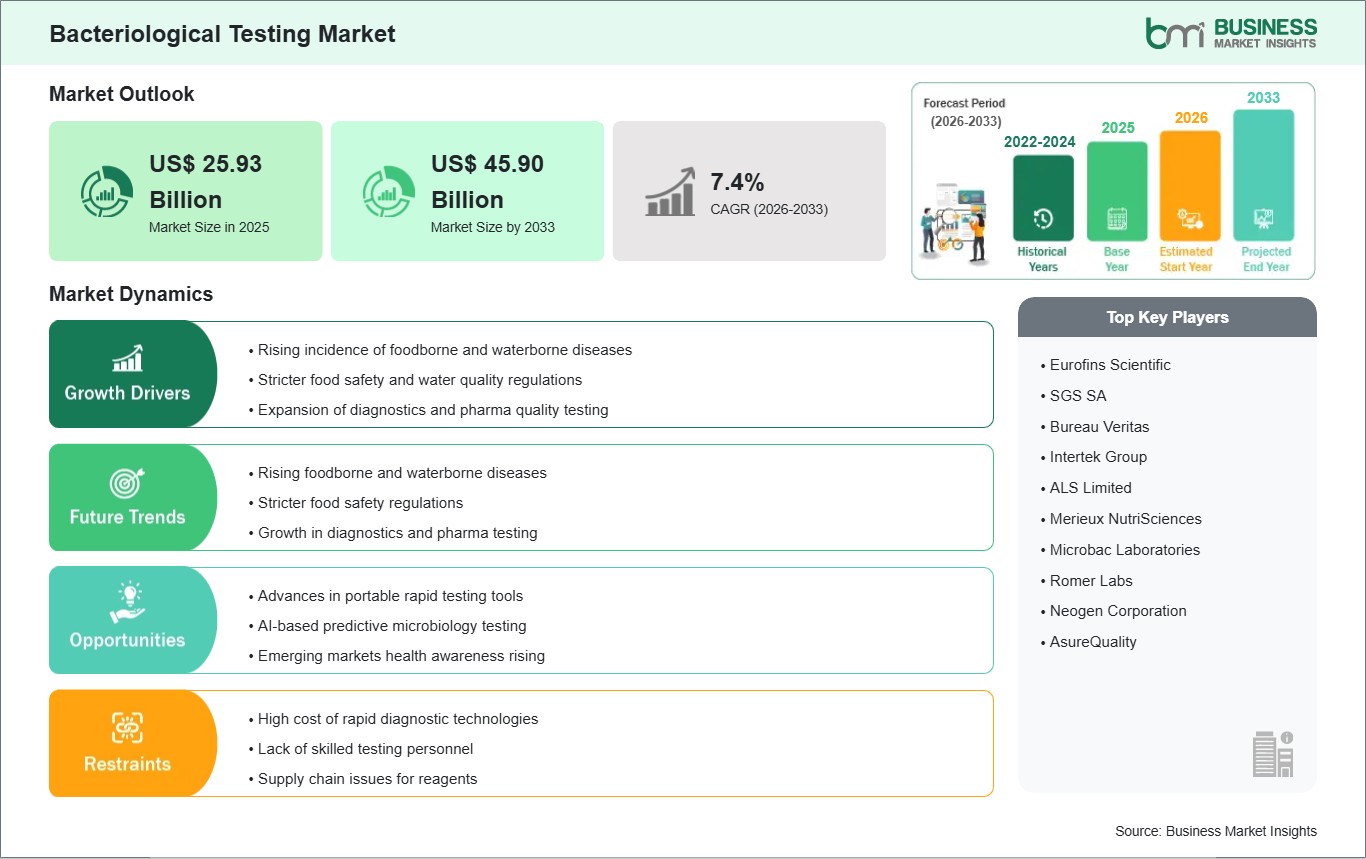
The global bacteriological testing market includes diagnostic solutions that detect, identify, and measure bacterial organisms in various fields like healthcare, pharmaceuticals, food and beverages, environmental monitoring, and water testing. These products and services are crucial for protecting public health, meeting regulations, and making quick clinical and industrial decisions. The market features a wide range of technologies, including culture-based assays, polymerase chain reaction (PCR) techniques, immunoassays, next-generation sequencing (NGS), rapid microbial methods, and automated identification systems. Each technology meets specific testing needs, sensitivity levels, and operational environments. Market growth has risen due to increased awareness of infectious diseases, strict safety and quality regulations, and the growing occurrence of hospital- and community-acquired infections. In healthcare, the demand for fast and accurate diagnostics to help manage antibiotic use and reduce death rates highlights the essential role of bacteriological testing.
Additionally, expanded programs for monitoring antibiotic resistance and global efforts to track outbreaks have boosted investments in diagnostic facilities and capabilities. Socioeconomic changes, such as rapid urbanization, aging populations, and growing middle-income groups, are influencing the global market landscape. In emerging economies, better healthcare access, improved laboratory capabilities, and increased public awareness of bacterial diseases have led to a surge in demand for reliable testing services. On the other hand, established markets are seeing strong adoption of cutting-edge technologies like real-time PCR platforms and automated systems, as clinicians and labs look for quicker results and higher throughput. In sectors such as food & beverage and environmental testing, strict hygiene standards and consumer demand for safe products drive the adoption of bacteriological assessments. Innovation is key to market growth. Companies are investing heavily in research and development to create new assays and platforms that enable multiplex detection, greater sensitivity, and point-of-care use.
There is rising interest in integrated systems that combine sample preparation, detection, and data analysis to make workflows more efficient and cut down on human error. Rapid tests using isothermal amplification, biosensors, and microfluidics are gaining popularity, especially in decentralized settings and resource-limited areas. The rise of digital tools and connectivity is changing traditional laboratory models. Cloud-based data management, AI-enhanced interpretations, and telehealth connections allow for real-time reporting, predictive modeling, and integrated tracking of disease patterns. E-commerce and direct procurement options are also helping to widen access to testing kits and lab supplies, particularly in regions with less established supply chains.
Additionally, subscription-based service models and outsourcing microbiological testing to contract research organizations (CROs) are becoming popular as scalable options for businesses looking for cost-effective solutions. Despite this progress, the global bacteriological testing market faces significant challenges. Fluctuating raw material costs, a shortage of skilled workers, and varying regulatory standards in different regions create hurdles to wide adoption. Meeting strict safety and quality standards, such as those for clinical diagnostics and food safety, requires thorough validation, certification, and continuous quality control, often delaying product development. Strong competition from both established multinational companies and local vendors increases pricing pressures, especially in budget-sensitive areas and developing markets. Regulatory compliance, concerns over data privacy, and the need to ensure tests align with local clinical guidelines complicate market entry and growth. Moreover, in some low- and middle-income countries, inadequate laboratory infrastructure and minimal healthcare funding may slow down the adoption of advanced testing technologies. However, strategic partnerships, public-private initiatives, and targeted investments in building capacity are gradually improving testing systems.
Looking ahead, the long-term outlook for the bacteriological testing market is promising. Continued focus on early infection detection, global efforts to combat antimicrobial resistance, and varied sector needs for safety assurance are expected to maintain strong demand. Ongoing innovation in molecular diagnostics, automation, and digital integration, alongside growing global surveillance networks, indicates a solid growth path. As stakeholders emphasize accuracy, speed, and efficiency, the global bacteriological testing market is set for steady growth, supported by changing consumer expectations, regulatory requirements, and technological progress.
Segment Analysis
Bacteriological Testing Market Segmentation
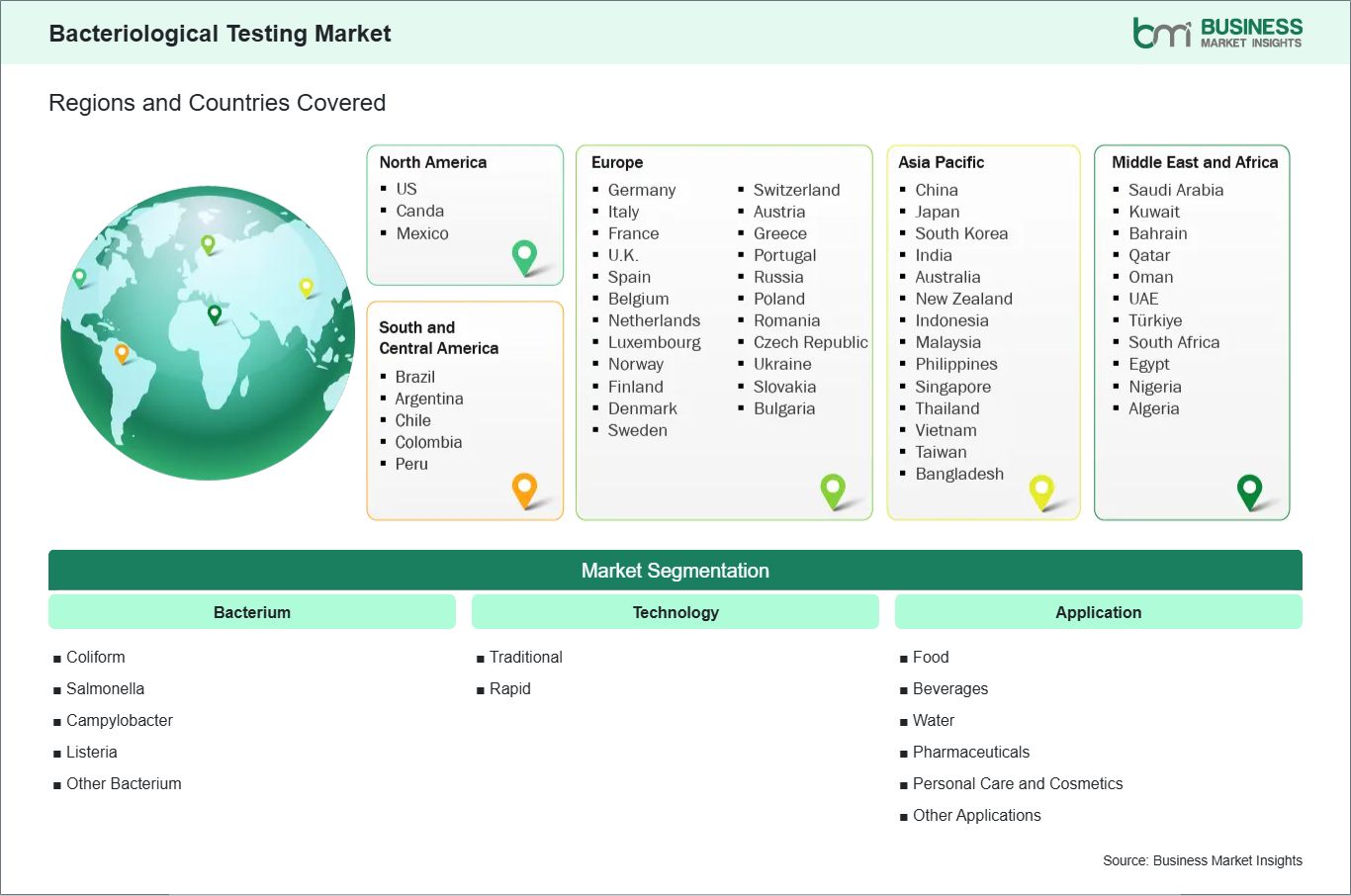
Key segments that contributed to the derivation of the Bacteriological Testing market analysis are bacterium, technology, and application.
- By bacterium, the Bacteriological Testing market is segmented into coliform, salmonella, campylobacter, listeria, and others. The Salmonella segment dominated the market in 2025.
- By technology, the Bacteriological Testing market is segmented into rapid and traditional. The rapid segment dominated the market in 2025.
- By application, the Bacteriological Testing market is segmented into food, beverages, water, pharmaceuticals, personal care and cosmetics, and others. The food segment dominated the market in 2025.
Market Forces
Bacteriological Testing Market Drivers and Opportunities
Rising Infectious Disease Incidence, Healthcare Awareness, and Expanding Testing Demand
The global bacteriological testing market is growing due to an increase in bacterial infections, greater public health awareness, and the expansion of healthcare infrastructure around the world. The rise in both hospital- and community-acquired infections, along with the spread of antimicrobial-resistant strains, has raised the need for timely and accurate bacterial diagnostics. Healthcare providers in both developed and developing regions are focusing on early detection and monitoring. This focus drives demand for rapid and reliable testing solutions. As hospitals, diagnostic laboratories, and research institutions enhance their capabilities, the use of automated and high-throughput testing systems is also rising. Government initiatives to improve infectious disease surveillance and the growth of private healthcare networks further promote the widespread use of bacteriological testing, ensuring that patients, clinicians, and public health authorities can access timely and valuable microbial data. Technological
Innovation, Digital Integration, and Focus on Accuracy and Safety
Technological progress, along with a greater emphasis on diagnostic accuracy, laboratory safety, and operational efficiency, is another major factor driving the bacteriological testing market. Companies are putting money into molecular diagnostic platforms, real-time PCR, biosensors, and automated culture-based systems that provide faster results with greater sensitivity and specificity. The integration of digital data management tools, analytics based on artificial intelligence, and telemedicine platforms helps laboratories improve workflows, minimize human error, and speed up reporting. In the areas of food, water, and pharmaceutical testing, stricter regulations for hygiene and safety are leading manufacturers and service providers to adopt better bacteriological testing methods. There is also an increasing interest in point-of-care and decentralized testing solutions that make accurate bacterial detection possible in clinics, remote areas, and field settings. Overall, these innovations are improving reliability, convenience, and safety, leading to more widespread use of bacteriological testing across various sectors.
Size and Share Analysis
Bacteriological Testing Market Size and Share Analysis
The Salmonella segment leads the market because it is common in foodborne outbreaks and is closely monitored by regulations in the food, beverage, and water industries. Growing consumer awareness about food safety and frequent contamination cases pushes for routine testing for Salmonella. Industries focus on early detection to avoid large recalls and ensure they meet safety standards.
The rapid testing segment is the largest due to the increasing demand for fast, accurate, and on-site detection of bacterial pathogens. Quick methods like PCR, immunoassays, and biosensors provide shorter turnaround times compared to traditional culture techniques. This speed allows for timely decision-making in healthcare, food safety, and environmental monitoring. More diagnostic labs and regulatory programs adopting these methods help the market grow.
The food segment is the leader due to strict rules on microbial safety, rising cases of foodborne illnesses, and increasing consumer demand for high-quality, contamination-free products. Regular bacteriological testing helps meet international safety standards, protects brand reputation, and reduces the risk of recalls, encouraging consistent use in this sector.
Report Coverage
Bacteriological Testing Market Report Coverage and Deliverables
The "Bacteriological Testing Market Size and Forecast (2022–2033)" report provides a detailed analysis of the market covering below areas:
- Bacteriological Testing market size and forecast at global, regional, and country levels for all the key market segments covered under the scope
- Bacteriological Testing market trends, as well as market dynamics such as drivers, restraints, and key opportunities
- Bacteriological Testing market analysis covering key market trends, global and regional framework, major players, regulations, and recent market developments
- Industry landscape and competition analysis covering market concentration, heat map analysis, prominent players, and recent developments for the Bacteriological Testing market
- Detailed company profiles, including SWOT analysis
Geographic Insights
Bacteriological Testing Market Geographic Insights
The geographical scope of the Bacteriological Testing market report is divided into five regions: North America, Asia Pacific, Europe, Middle East & Africa, and South & Central America. The Bacteriological Testing market in the Asia Pacific is expected to grow significantly during the forecast period.
The Asia-Pacific Bacteriological Testing market is segmented into China, Japan, South Korea, India, Australia, New Zealand, Indonesia, Malaysia, the Philippines, Singapore, Thailand, Vietnam, Taiwan, Bangladesh, and the Rest of Asia.
The Asia-Pacific region is quickly becoming one of the fastest-growing markets for bacteriological testing worldwide. This growth results from more cases of infectious diseases, improved healthcare systems, and increased awareness of bacterial contamination in hospitals, food, and the environment. Countries like China, India, Japan, and South Korea are experiencing high demand for rapid diagnostic kits, automated culture systems, PCR-based tests, and molecular testing platforms. Urbanization, a growing middle class, and government efforts to improve laboratory networks are also driving market growth. More modern hospitals, private diagnostic labs, and e-commerce channels are making advanced testing solutions easier to access in urban and semi-urban areas. Additionally, stronger regulatory oversight and awareness programs about antimicrobial resistance, hygiene, and food safety are encouraging healthcare providers, research institutions, and industries to use reliable and consistent bacteriological testing methods, supporting long-term growth in the region.
Industry Activity
Recent Developments
The Bacteriological Testing market is evaluated by gathering qualitative and quantitative data post primary and secondary research, which includes important corporate publications, association data, and databases. A few of the key developments in the Bacteriological Testing market are:
- In September 2025, Nelson Laboratories, LLC, a business unit of Sotera Health Company and a global leader in outsourced microbiological and analytical chemistry testing and advisory services for the medical device and pharmaceutical industries, announced the launch of RapidCert, a new and innovative rapid biological indicator (BI) sterility testing service using a combination of traditional BIs and rapid microbiological methods (RMMs).
- In February 2026, SGS, the world's leading testing, inspection, and certification company, is pleased to announce the acquisition of Murray-Brown Laboratories, a nationally recognized food testing laboratory based in Denver, Colorado (United States). Murray-Brown Laboratories supports North American producers, manufacturers, and retailers by ensuring that their food, pet food, and nutraceutical products meet safety and compliance standards through advanced microbial and analytical chemistry capabilities, including pesticide and mycotoxin detection. With North America leading the global food safety testing market in terms of regulatory frameworks and food recall management, this move marks SGS's commitment to expanding its service to the industry.
Trust & Transparency
Research Methodology
The market analysis combines proprietary research with secondary data from government agencies, company disclosures, regulatory filings, industry databases and expert interviews. Market estimates are validated through data triangulation, cross-market benchmarking and analyst
review.
View Full Research Methodology
Key Sources Referred:
World Bank – Global Trade Indicators World Trade Organization (WTO) International Trade Administration (ITA) Company website Company annual reports Company investor presentations