Analysis By Product (Adult Patient Simulator, Infant Simulator, and Childbirth Simulator) and End User (Academic Institutes, Hospitals, and Military Organizations)
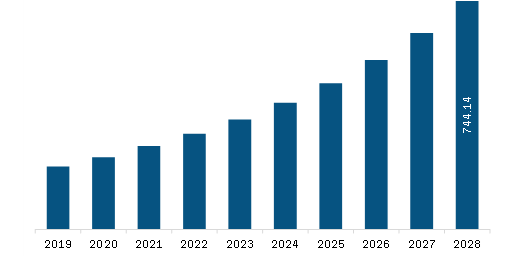
The Asia Pacific patient simulators market is expected to grow from US$ 310.55 million in 2022 to US$ 744.14 million by 2028. It is estimated to register a CAGR of 15.7% from 2022 to 2028.
Increase in Demand for Minimally Invasive Treatment Methods Fueling Asia Pacific Patient Simulators Market Growth
A minimally invasive medical procedure is generally performed by entering the device in the body through the skin, a body cavity, or an anatomical opening, but with the least damage possible to these structures. In recent years, significant improvement has been made in cardiovascular disease treatment. However, these complex medical procedures require rich experience and technical expertise. The complex treatment of cardiovascular diseases is made more comfortable with the help of simulators. The system can produce realistic 3D vascular models segmented from patient datasets, which include a beating heart, and give a real-time computation of force and force feedback module for patient simulators. Robotic surgery and patient simulators both use a mechanized interface that provides visual patient reactions in response to the actions of the health care professional, monitors to visualize the change of the procedure, and computer software applications through which the health care professional interacts. Both technologies are undergoing rapid adoption and are viewed as modalities that allow physicians to perform increasingly complex minimally invasive procedures while enhancing patient safety. Advanced minimally invasive surgery (MIS), which is robot-assisted surgery, is becoming increasingly accepted. There is a growing need for training residents in this type of surgery. The increasing demand for MIS is boosting the growth of the Asia Pacific patient simulators market.
Asia Pacific Patient Simulators Market Overview
The Asia Pacific patient simulators market is segmented into China, Japan, India, South Korea, Australia, and the Rest of Asia Pacific. China dominated the Asia Pacific patient simulators market in 2022. Simulation involves replicating the behavior of a situation or process through appropriate scenarios or devices, primarily for study or personnel training. This technique is widely used in medical education to ensure the safety of patients and train medical professionals. In China, during COVID-19, a module was designed to provide a safe training environment for medical staff to comprehensively practice their infection management skills. In December 2021, Chinese scientists developed two simulations of a human body infected with COVID-19. Research teams from the Institute of Microbiology of the Chinese Academy of Sciences (IMCAS), Tsinghua University, and China Agricultural University developed these two models that demonstrate clinical features similar to actual COVID-19 patients to support future research on precision therapy and the testing of efficacy and safety of vaccines and drugs. Moreover, the increasing funding by companies is expected to fuel the growth of healthcare simulators in the country.
Asia Pacific Patient Simulators Market Revenue and Forecast to 2028 (US$ Million)
Asia Pacific Patient Simulators Market Segmentation
The Asia Pacific patient simulators market is segmented based on product, end user, and country.
Based on product, the Asia Pacific patient simulators market is segmented into adult patient simulator, infant simulator, and childbirth simulator. The adult patient simulator segment held the largest Asia Pacific patient simulators market share in 2022.
Based on end user, the Asia Pacific patient simulators market is segmented into academic institutes, hospitals, and military organizations. The academic institutes segment held the largest Asia Pacific patient simulators market share in 2022.
Based on country, the Asia Pacific patient simulators market has been categorized into China, India, Japan, South Korea, Australia, and the Rest of Asia Pacific. China dominated the Asia Pacific patient simulators market in 2022.
CAE Inc, Gaumard Scientific Co Inc, Kyoto Kagaku Co Ltd, Laerdal Medical AS, Limbs & Things Ltd, Mentice AB, Simulab Corp, Surgical Science Sweden AB, and VirtaMed AG are among the leading companies operating in the Asia Pacific patient simulators market.
Asia Pacific Patient Simulators Market Strategic Insights
Get more information on this report
Asia Pacific Patient Simulators Market Segmentation Analysis
Asia Pacific Patient Simulators Market Report Highlights
Asia Pacific Patient Simulators Report Scope
Report Attribute
Details
Market size in 2022
US$ 310.55 Million
Market Size by 2028
US$ 744.14 Million
CAGR (2022 - 2028)
15.7%
Historical Data
2020-2021
Forecast period
2023-2028
Segments Covered
By Product
Adult Patient Simulator
Infant Simulator
Childbirth Simulator
By End User
Academic Institutes
Hospitals
Military Organizations
Regions and Countries Covered
Asia-Pacific
China, India, Japan, Australia, Rest of Asia-Pacific
Market leaders and key company profiles
CAE Inc
Gaumard Scientific Co Inc
Kyoto Kagaku Co Ltd
Laerdal Medical AS
Limbs & Things Ltd
Mentice AB
Simulab Corp
Surgical Science Sweden AB
VirtaMed AG
Get more information on this report
Asia Pacific Patient Simulators Market Country and Regional Insights
Get more information on this report
Identical Market Reports with other Region/Countries
The List of Companies - Asia Pacific Patient Simulators Market
CAE IncGaumard Scientific Co IncKyoto Kagaku Co LtdLaerdal Medical ASLimbs & Things LtdMentice ABSimulab Corp Surgical Science Sweden AB VirtaMed AG
Frequently Asked Questions
How big is the Asia Pacific Patient Simulators Market?
The Asia Pacific Patient Simulators Market is valued at US$ 310.55 Million in 2022, it is projected to reach US$ 744.14 Million by 2028.
What is the CAGR for Asia Pacific Patient Simulators Market by (2022 - 2028)?
As per our report Asia Pacific Patient Simulators Market, the market size is valued at US$ 310.55 Million in 2022, projecting it to reach US$ 744.14 Million by 2028. This translates to a CAGR of approximately 15.7% during the forecast period.
What segments are covered in this report?
The Asia Pacific Patient Simulators Market report typically cover these key segments-
End User (Academic Institutes, Hospitals, Military Organizations)
What is the historic period, base year, and forecast period taken for Asia Pacific Patient Simulators Market?
The historic period, base year, and forecast period can vary slightly depending on the specific market research report. However, for the Asia Pacific Patient Simulators Market report:
Historic Period : 2020-2021
Base Year : 2022
Forecast Period : 2023-2028
Who are the major players in Asia Pacific Patient Simulators Market?
The Asia Pacific Patient Simulators Market is populated by several key players, each contributing to its growth and innovation. Some of the major players include:
CAE Inc
Gaumard Scientific Co Inc
Kyoto Kagaku Co Ltd
Laerdal Medical AS
Limbs & Things Ltd
Mentice AB
Simulab Corp
Surgical Science Sweden AB
VirtaMed AG
Who should buy this report?
The Asia Pacific Patient Simulators Market report is valuable for diverse stakeholders, including:
Investors: Provides insights for investment decisions pertaining to market growth, companies, or industry insights. Helps assess market attractiveness and potential returns.
Industry Players: Offers competitive intelligence, market sizing, and trend analysis to inform strategic planning, product development, and sales strategies.
Suppliers and Manufacturers: Helps understand market demand for components, materials, and services related to concerned industry.
Researchers and Consultants: Provides data and analysis for academic research, consulting projects, and market studies.
Financial Institutions: Helps assess risks and opportunities associated with financing or investing in the concerned market.
Essentially, anyone involved in or considering involvement in the Asia Pacific Patient Simulators Market value chain can benefit from the information contained in a comprehensive market report.





 Get Free Sample For Asia Pacific Patient Simulators Market