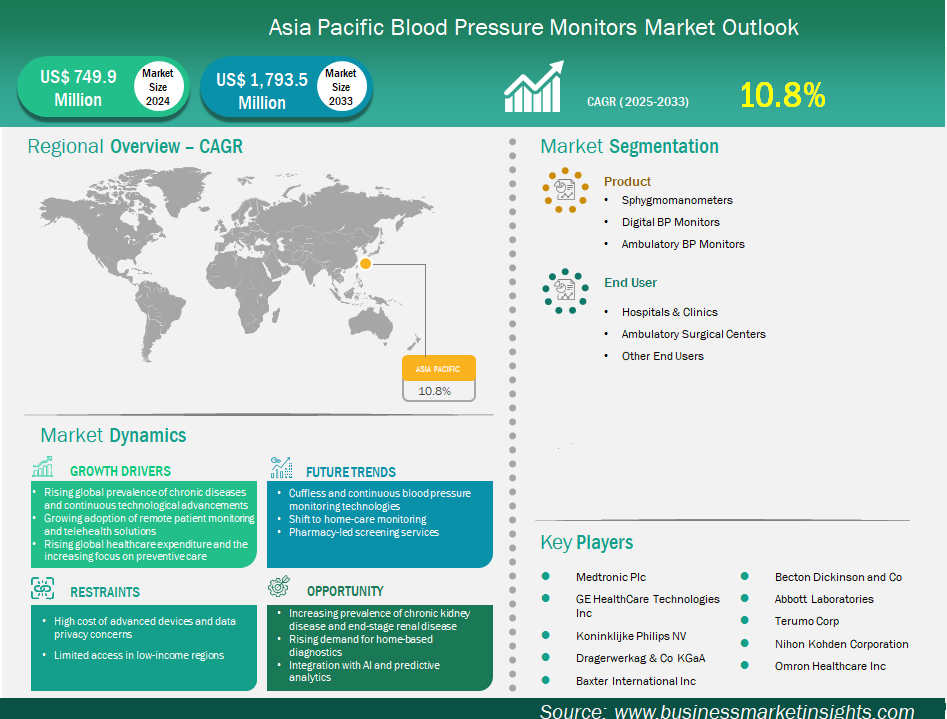
The Asia Pacific blood pressure monitors market size is expected to reach US$ 1,793.5 million by 2033 from US$ 749.9 million in 2024. The market is estimated to record a CAGR of 10.8% from 2025 to 2033.
Executive Summary and Asia Pacific Blood Pressure Monitors Market Analysis:
The blood pressure monitors market in the Asia Pacific is experiencing significant growth driven by rising global prevalence of hypertension and cardiovascular diseases, increasing adoption of home-based and wearable BP monitors, and technological advancements in cuffless and AI-integrated devices. The Asia Pacific blood pressure monitors market is changing quickly owing to the impacts of major demographic changes, the increasing prevalence of chronic diseases, and the expansion of healthcare access in the region. The wealthy and the poor countries in the region constitute a very complex demand environment for the products and services, as the region houses, for example, not only the high-income markets such as Japan and Australia but also the emerging economies like India, Indonesia, and Vietnam. Urbanization and changing lifestyles have caused hypertension to rise rapidly, which, in turn, has made governments and private players focus on early detection and monitoring. The market is divided into segments based on product types, where the digital BP monitors hold the first position due to their low cost, easy-to-carry nature, and compatibility with the mHealth apps. Sphygmomanometers are still widely used in clinical settings, while ambulatory devices are being accepted in the care of the critically ill more and more. The competitive situation is affected by the activities of world-famous brands such as Omron, along with the regional manufacturers who provide cost-effective alternatives. Regulatory authorities for the healthcare products have different requirements for the countries in the region, with some markets allowing fast-track approvals for the connected health devices and others maintaining strict import controls. Mobile health projects and local screening programs, however, are gradually increasing the device penetration rate in the countryside areas where there are still some infrastructure issues. In general, the Asia Pacific market is a mixture of innovation, accessibility, and public health urgency, which makes it a high-growth region for the blood pressure monitoring technologies market.
Asia Pacific Blood Pressure Monitors Market Segmentation Analysis:
Key segments that contributed to the derivation of the blood pressure monitors market analysis are product and end user.
- By product, the blood pressure monitors market is segmented into sphygmomanometers, digital BP monitors, and ambulatory BP monitors. The digital BP monitors segment dominated the market in 2024. Digital BP monitors are the largest segment due to rising consumer health awareness, smartphone integration, and demand for affordable home-use devices.
- By end user, the market is segmented into hospitals and clinics, home-care Settings, ambulatory surgical centers, and other end users. The hospitals and clinics segment held the largest market share in 2024. Hospitals and clinics are the largest end-user segment due to their role in large-scale hypertension screening, government-led health programs, and centralized chronic care delivery.
Asia Pacific Blood Pressure Monitors Market Outlook
The Asia Pacific blood pressure monitors market is responding to various factors such as digital health integration, aging populations, and strategic healthcare reforms. The governments across the region are actively supporting non-communicable disease management, where hypertension screening is becoming the central part of national health agendas. As telemedicine and remote care platforms are becoming more popular, there is an increasing demand for connected BP monitors that facilitate real-time data sharing and longitudinal tracking. The introduction of cuffless monitors, AI-powered analytics, and solar-powered devices, for example, might become popular in areas that are remote areas in the near future. The private sector, which includes insurers, retail pharmacies, and diagnostic chains, is getting more involved by incorporating BP monitoring into wellness programs and chronic care packages. Consumers are increasingly choosing self-monitoring, which is made possible by smartphone penetration and health app ecosystems. Reimbursement policies are changing, notably in markets such as South Korea and Australia, where remote monitoring is being considered as part of public health coverage.
On the other hand, interoperability and data privacy are some of the concerns that are affecting product design and vendor selection. As digital infrastructure in the region improves, the integration of wearable tech, cloud platforms, and predictive care models will change how blood pressure is monitored and managed. The market's direction indicates a move towards continuous, personalized health management instead of episodic diagnostics.
Asia Pacific Blood Pressure Monitors Market Country Insights
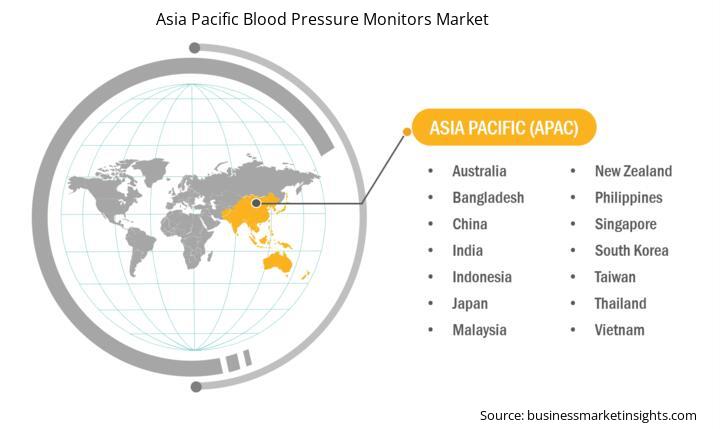
Based on country, the Asia Pacific blood pressure monitors market is segmented into China, India, Japan, Australia, Bangladesh, Indonesia, Malaysia, New Zealand, the Philippines, Singapore, South Korea, Taiwan, Thailand, and Vietnam. China held the largest share in 2024.
There are different adoption patterns and strategic priorities in the Asia Pacific blood pressure monitors market's country-level dynamics. Owing to urbanization and health digitization led by the government, China is experiencing rapid growth. Domestic manufacturers have a stronghold as they provide competitively priced monitors for both clinical and home use. The market is mature in Japan, where consumers are highly aware, and the use of advanced digital monitors is widespread. The country’s aging population and tech-savvy consumers are the main factors that contribute to the demand for wearable and app-integrated devices. India has a dual-market potential: urban areas prefer connected digital monitors, while rural areas are dependent on low-cost, manual devices and NGO-led screening programs to support them. Access and affordability are being improved by regulatory reforms and telehealth expansion. Australia is focusing on preventive care and remote monitoring, where there is a strong public-private collaboration and reimbursement for home-based BP tracking. South Korea is turning into a center for innovation, where local companies are creating AI-powered and wearable monitors for tech-savvy consumers. In the case of Southeast Asia, countries like Indonesia, Thailand, and Vietnam are growing through public health investments and mobile health initiatives, but there are still some gaps in infrastructure. Regulatory diversity in the region is demanding different strategies to enter the market, with some countries implementing harmonized standards and others continuing with localized approval processes. This local-level intel emphasizes that it is crucial to product domestic health priorities, consumer behaviour, and distribution ecosystems.
Asia Pacific Blood Pressure Monitors Market Company Profiles
Medtronic Plc, GE HealthCare Technologies Inc, Koninklijke Philips NV, Omron Healthcare Inc, Baxter International Inc, Becton Dickinson and Co, Abbott Laboratories, Terumo Corp, Nihon Kohden Corporation, and Dragerwerk AG & Co KGaA are among the key players operating in the market. These players adopt strategies such as expansion, product innovation, and mergers and acquisitions to stay competitive in the market and offer innovative products to their consumers.
Asia Pacific Blood Pressure Monitors Market Research Methodology:
The following methodology has been followed for the collection and analysis of data presented in this report:
-
Secondary Research
The research process begins with comprehensive secondary research, utilizing both internal and external sources to gather qualitative and quantitative data for each market. Commonly referenced secondary research sources include, but are not limited to:
- Company websites, annual reports, financial statements, broker analyses, and investor presentations
- Industry trade journals and other relevant publications
- Government documents, statistical databases, and market reports
- News articles, press releases, and webcasts specific to companies operating in the market
Note: All financial data included in the Company Profiles section has been standardized to US$. For companies reporting in other currencies, figures have been converted to US$ using the relevant exchange rates for the corresponding year.
-
Primary Research
Business Market Insights conducts a significant number of primary interviews each year with industry stakeholders and experts to validate and analyze the data and gain valuable insights. These research interviews are designed to:
- Refine findings from secondary research
- Enhance the expertise and market understanding of the analysis team
- Gain insights into market size, trends, growth patterns, competitive dynamics, and future prospects
Primary research is conducted via email interactions and telephone interviews with industry experts across various markets, categories, segments, and sub-segments in different regions. Participants typically include:
- Industry stakeholders: Vice Presidents, business development managers, market intelligence managers, and national sales managers
- External experts: Valuation specialists, research analysts, and key opinion leaders with industry-specific expertise
Key Sources Referred:
- World Health Organization (WHO)
- Organisation for Economic Co-operation and Development (OECD)
- The World Bank Group
- Worldometer
- The Lancet
- BMC Medical Education
- Eurostat
Asia Pacific Blood Pressure Monitors Market Strategic Insights
Asia Pacific Blood Pressure MonitorsMarket Report Highlights
| Report Attribute | Details |
| Market size in 2024 | US$ 749.9 Million |
| Market Size by 2033 | US$ 1,793.5 Million |
| CAGR (2025 - 2033) | 10.8% |
| Historical Data | 2022-2023 |
| Forecast period | 2025-2033 |
| Segments Covered |
By Product
|
|
Regions and Countries Covered
|
|
| Asia Pacific | China, Japan, South Korea, India, Australia, New Zealand, Indonesia, Malaysia, Philippines, Singapore, Thailand, Vietnam, Taiwan, Bangladesh |
| Market leaders and key company profiles |
|
Asia Pacific Blood Pressure Monitors Market Country and Regional Insights