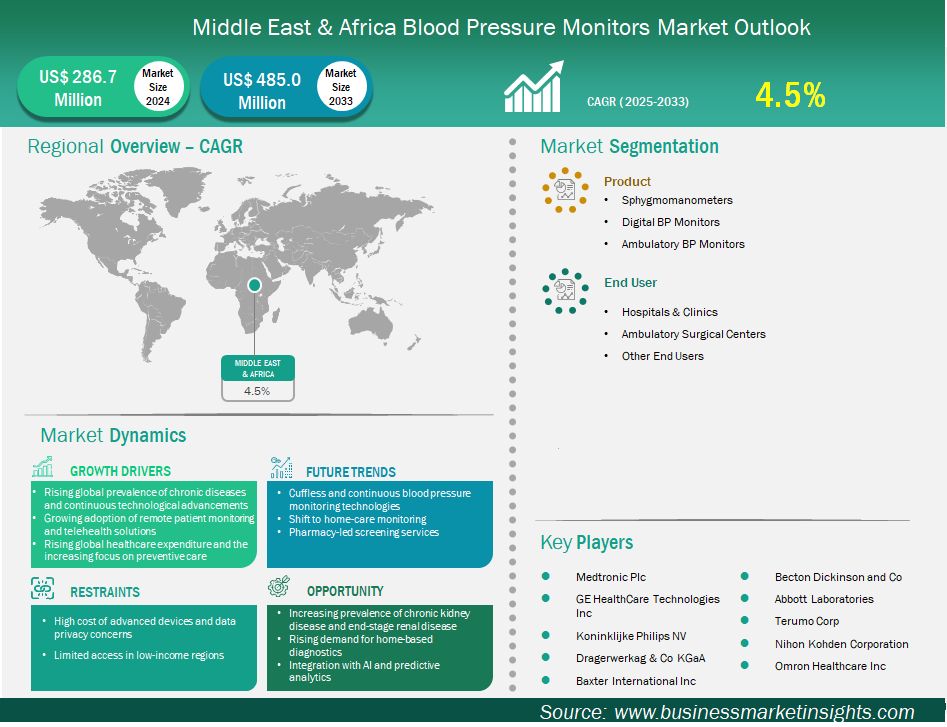
The Middle East and Africa blood pressure monitors market size is expected to reach US$ 485.0 million by 2033 from US$ 286.7 million in 2024. The market is estimated to record a CAGR of 4.5% from 2025 to 2033.
Executive Summary and Middle East and Africa Blood Pressure Monitors Market Analysis:
The blood pressure monitors market in the Middle East and Africa is experiencing significant growth driven by rising global prevalence of hypertension and cardiovascular diseases, increasing adoption of home-based and wearable BP monitors, and technological advancements in cuffless and AI-integrated devices. The blood pressure monitors market in the Middle East and Africa is changing significantly; to a large extent, the changes are attributed to increased awareness of cardiovascular health, the growth of the healthcare sector, and the prioritization of non-communicable diseases such as cardiovascular diseases. Consequently, in these two regions, hypertension has become the major cause of poor health among the population. It has therefore impelled governments and private stakeholders to invest in early detection and monitoring technologies.
Currently, the market is segmented by product type. Digital blood pressure monitors are most affordable, easy to use, and compatible with mobile health platforms; thus, these types of devices are the ones leading in the market. Sphygmomanometers are still used in clinical settings, whereas ambulatory monitors are becoming more popular in specialized care environments. The competitive landscape comprises global brands such as Omron, which coexist with regional players that are providing cost-effective alternatives tailored to local needs. Regulatory frameworks are very different for countries that have adopted fast-track approvals for connected devices and others that still have conservative standards. Although there are disparities in terms of infrastructure and access, the market is linked by a growing demand for scalable, user-friendly monitoring solutions that can be used both in clinical and home-based care.
Middle East and Africa Blood Pressure Monitors Market Segmentation Analysis:
Key segments that contributed to the derivation of the blood pressure monitors market analysis are product and end user.
- By product, the blood pressure monitors market is segmented into sphygmomanometers, digital BP monitors, and ambulatory BP monitors. The digital BP monitors segment dominated the market in 2024. Digital BP monitors are the largest segment due to increasing demand for affordable, user-friendly devices suitable for home and community-based monitoring.
- By end user, the market is segmented into hospitals and clinics, home-care Settings, ambulatory surgical centers, and other end users. The hospitals and clinics segment held the largest market share in 2024. Hospitals and clinics are the largest end-user segment due to their central role in formal diagnosis, government-led screening programs, and reliance on clinical-grade equipment.
Middle East and Africa Blood Pressure Monitors Market Outlook
The Middle East and Africa blood pressure monitors market forecast is largely influenced by digital health acceleration, demographic changes, and healthcare reforms. As governments across regions are investing more in chronic disease management, blood pressure monitoring is becoming a key instrument of national health strategies. The growth of telemedicine and mobile health platforms is attracting more users to connected devices that support remote monitoring and instant data sharing. Some of the innovations, like solar-powered monitors, AI-driven analytics, and wearable technologies, are expected to become popular, especially in areas that are less developed. The private sector has not only been more active but also more aggressive thus far, with insurers, corporate wellness programs, and retail health providers incorporating BP monitoring into a broader range of services. The behaviour of consumers is changing in such a way that they decide to monitor themselves, and the rising number of smartphones and health apps facilitates this. Reimbursement models are changing gradually, for instance, in Gulf Co-operation Council (GCC) countries, where public-private partnerships are creating new opportunities for digital health. On the other hand, donor agencies and NGOs are still the main players who facilitate access in low-resource settings throughout Africa. As digital infrastructure gets better and healthcare systems become more modern, the market is ready for continued innovation, widening its reach to other regions and becoming more deeply integrated with preventive care ecosystems.
Middle East and Africa Blood Pressure Monitors Market Country Insights
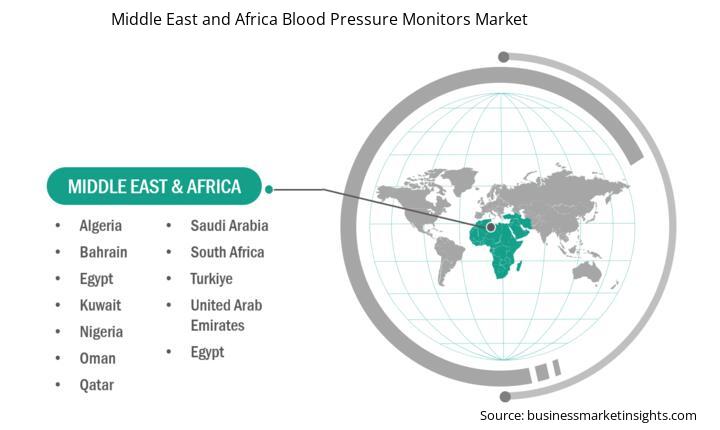
Based on country, the Middle East and Africa blood pressure monitors market is segmented into Turkiye, the United Arab Emirates, Saudi Arabia, Bahrain, Oman, Egypt, South Africa, Algeria, Nigeria, Kuwait, and Qatar. Saudi Arabia held the largest share in 2024.
Country-level dynamics across the Middle East and Africa reveal different adoption, infrastructure maturity, and strategic priorities. Saudi Arabia and the United Arab Emirates are the ones leading the innovation and adoption in the Middle East. With the support of their vibrant private healthcare sectors and national health digitization initiatives, these countries are successfully integrating blood pressure monitoring into chronic disease programs and telehealth platforms. The connected devices also find strong regulatory support in these countries. To expand the reach of health and wellness, Qatar and Kuwait have adopted employer-sponsored wellness programs and pharmacy-led screening services. On the African continent, South Africa is a country with a mature market for digital health solutions owing to the wide availability of digital monitors and the active participation of the private sector. Nigeria is fast becoming a high-growth market, and this growth is largely fuelled by urbanization, rising hypertension rates, and expanding retail health networks. The North African countries, like Egypt and Algeria, have embarked on the integration of BP monitoring into comprehensive public health campaigns that are supported by regional procurement initiatives. Regulatory diversity is a prominent feature in the region of the Middle East and Africa, which necessitates the need for customized market entry strategies. While some countries are conforming to the international standards, others are keeping their localized approval processes. These revelations highlight the criticality of tailoring product offers, distribution models, and engagement strategies to fit the specific requirements of each national context.
Middle East and Africa Blood Pressure Monitors Market Company Profiles
Medtronic Plc, GE HealthCare Technologies Inc, Koninklijke Philips NV, Omron Healthcare Inc, Baxter International Inc, Becton Dickinson and Co, Abbott Laboratories, Terumo Corp, Nihon Kohden Corporation, and Dragerwerk AG & Co KGaA are among the key players operating in the market. These players adopt strategies such as expansion, product innovation, and mergers and acquisitions to stay competitive in the market and offer innovative products to their consumers.
Middle East and Africa Blood Pressure Monitors Market Research Methodology:
The following methodology has been followed for the collection and analysis of data presented in this report:
-
Secondary Research
The research process begins with comprehensive secondary research, utilizing both internal and external sources to gather qualitative and quantitative data for each market. Commonly referenced secondary research sources include, but are not limited to:
- Company websites, annual reports, financial statements, broker analyses, and investor presentations
- Industry trade journals and other relevant publications
- Government documents, statistical databases, and market reports
- News articles, press releases, and webcasts specific to companies operating in the market
Note: All financial data included in the Company Profiles section has been standardized to US$. For companies reporting in other currencies, figures have been converted to US$ using the relevant exchange rates for the corresponding year.
-
Primary Research
Business Market Insights conducts a significant number of primary interviews each year with industry stakeholders and experts to validate and analyze the data and gain valuable insights. These research interviews are designed to:
- Refine findings from secondary research
- Enhance the expertise and market understanding of the analysis team
- Gain insights into market size, trends, growth patterns, competitive dynamics, and future prospects
Primary research is conducted via email interactions and telephone interviews with industry experts across various markets, categories, segments, and sub-segments in different regions. Participants typically include:
- Industry stakeholders: Vice Presidents, business development managers, market intelligence managers, and national sales managers
- External experts: Valuation specialists, research analysts, and key opinion leaders with industry-specific expertise
Key Sources Referred:
- World Health Organization (WHO)
- Organisation for Economic Co-operation and Development (OECD)
- The World Bank Group
- Worldometer
- The Lancet
- BMC Medical Education
- Eurostat
Middle East and Africa Blood Pressure Monitors Market Strategic Insights
Middle East and Africa Blood Pressure MonitorsMarket Report Highlights
| Report Attribute | Details |
| Market size in 2024 | US$ 286.7 Million |
| Market Size by 2033 | US$ 485.0 Million |
| CAGR (2025 - 2033) | 4.5% |
| Historical Data | 2022-2023 |
| Forecast period | 2025-2033 |
| Segments Covered |
By Product
|
|
Regions and Countries Covered
|
|
| Middle East and Africa | Saudi Arabia, United Arab Emirates, Kuwait, Bahrain, Qatar, Oman, Turkiye, South Africa, Egypt, Nigeria, Algeria |
| Market leaders and key company profiles |
|
Middle East and Africa Blood Pressure Monitors Market Country and Regional Insights