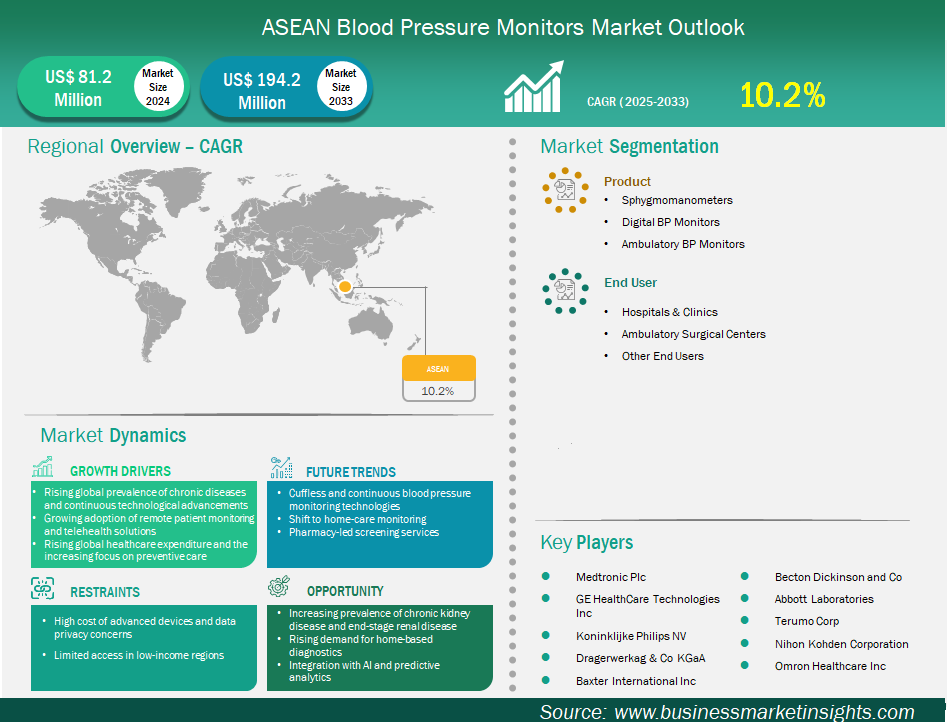
The ASEAN blood pressure monitors market size is expected to reach US$ 194.2 million by 2033 from US$ 81.2 million in 2024. The market is estimated to record a CAGR of 10.2% from 2025 to 2033.
Executive Summary and ASEAN Blood Pressure Monitors Market Analysis:
The blood pressure monitors market in ASEAN is experiencing significant growth driven by rising global prevalence of hypertension and cardiovascular diseases, increasing adoption of home-based and wearable BP monitors, and technological advancements in cuffless and AI-integrated devices. The ASEAN blood pressure monitors market is undergoing a fundamental change as a result of increased hypertension prevalence, health awareness, and primary care access. Non-communicable diseases are becoming a major health problem in countries across the region, such as Indonesia, Thailand, Vietnam, Malaysia, and the Philippines, which has led the public and private stakeholders to cooperate in the early detection and monitoring of the diseases. The market is segmented by product type, and digital blood pressure monitors are the leading segment because they are relatively cheap, can be carried anywhere, and can be easily used both at home and in a clinic. Manual sphygmomanometers are still used in public hospitals and rural clinics, while ambulatory monitors are being used more and more in urban specialty centers. The competitive landscape consists of global players, such as Omron, which are supported by regional manufacturers that provide affordable alternatives that are suitable for the local market. Regulatory frameworks differ among the ASEAN countries. Some nations have adopted harmonized standards under the ASEAN Medical Device Directive (AMDD), while others retain localized approval processes. Although there are differences in infrastructure, the market is bound by the same imperative to upgrade healthcare delivery and facilitate chronic disease management.
ASEAN Blood Pressure Monitors Market Segmentation Analysis:
Key segments that contributed to the derivation of the blood pressure monitors market analysis are product and end user.
- By product, the blood pressure monitors market is segmented into sphygmomanometers, digital BP monitors, and ambulatory BP monitors. The digital BP monitors segment dominated the market in 2024. Digital BP monitors are the largest segment due to rising demand for affordable, easy-to-use devices suited for home and community health settings.
- By end user, the market is segmented into hospitals and clinics, home-care settings, ambulatory surgical centers, and other end users. The hospitals and clinics segment held the largest market share in 2024. Hospitals and clinics are the largest end-user segment due to their central role in public health screening, chronic disease management, and government-supported healthcare delivery.
ASEAN Blood Pressure Monitors Market Outlook
The ASEAN blood pressure monitors market forecast is influenced by factors such as the rapid digital health transition, the changes in the population, and different healthcare delivery models. With governments in the region investing in universal health coverage and non-communicable disease prevention, blood pressure monitoring is becoming a basic instrument in national health strategies. The use of telemedicine and mobile health platforms is attracting customers to use connected BP monitors that facilitate remote tracking and sharing of data in real-time. The introduction of Bluetooth-enabled devices, AI-powered analytics, and solar-powered monitors is becoming popular, especially in remote and less advantaged areas. The private sector is opening up more opportunities, with insurers, corporate wellness programs, and retail health providers integrating BP monitoring into broader care offerings. Consumer behaviour is changing towards self-monitoring, which is supported by increasing smartphone penetration and health app usage. Reimbursement models are changing slowly, with pilot programs in countries like Thailand and Malaysia that are testing public-private partnerships for remote monitoring. At the same time, NGOs and international health organizations remain critical in providing access to blood pressure monitoring in low-resource settings. As digital infrastructure gets better and healthcare systems become more integrated, the region is ready for long-term growth in blood pressure monitoring adoption, with a focus on affordability, accessibility, and preventive care.
ASEAN Blood Pressure Monitors Market Country Insights
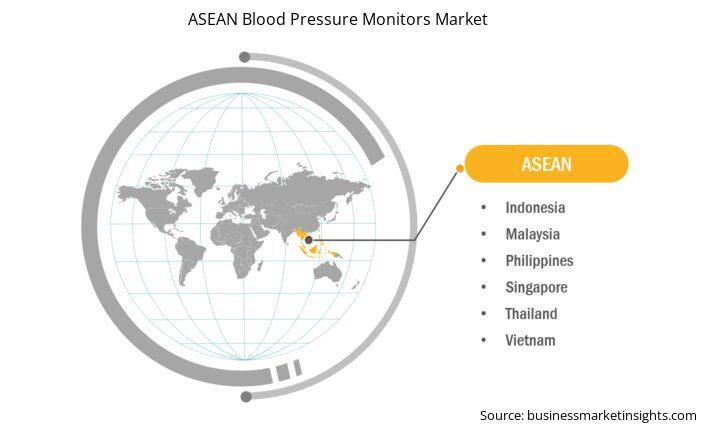
Based on country, the ASEAN blood pressure monitors market is segmented into Indonesia, Malaysia, the Philippines, Singapore, Thailand, and Vietnam. Indonesia held the largest share in 2024.
Different levels of healthcare maturity, regulatory readiness, and consumer engagement have created country-level dynamics across ASEAN that reveal a diverse and evolving market landscape. The market in Indonesia is very advanced, and the demand for connected and wearable BP monitors is extremely strong as a result of tech-savvy consumers and a healthy digital health ecosystem. Public health infrastructure in Malaysia and Thailand is being expanded, and BP monitoring is being integrated into programs for chronic diseases as well as into community health initiatives. Being the region’s most populous country, Singapore offers a dual-market opportunity: urban centers are rapidly adopting digital monitors, whereas rural areas depend on low-cost manual devices, which are supported by government and NGO-led outreach. Vietnam is effectively implementing pharmacy-led screening and mobile health campaigns to scale up, whereas the Philippines is utilizing telehealth platforms to make access easier in remote regions. The variety of regulations in different parts of the region requires tailored strategies for entering the market, as some countries have agreements with AMDD, while others need country-specific certifications. These findings emphasize that it is very important to tailor product features, price models, and distribution strategies in each country to adapt to its healthcare priorities, level of digital maturity, and consumer behaviour.
ASEAN Blood Pressure Monitors Market Company Profiles
Medtronic Plc, GE HealthCare Technologies Inc, Koninklijke Philips NV, Omron Healthcare Inc, Baxter International Inc, Becton Dickinson and Co, Abbott Laboratories, Terumo Corp, Nihon Kohden Corporation, and Dragerwerk AG & Co KGaA are among the key players operating in the market. These players adopt strategies such as expansion, product innovation, and mergers and acquisitions to stay competitive in the market and offer innovative products to their consumers.
ASEAN Blood Pressure Monitors Market Research Methodology:
The following methodology has been followed for the collection and analysis of data presented in this report:
-
Secondary Research
The research process begins with comprehensive secondary research, utilizing both internal and external sources to gather qualitative and quantitative data for each market. Commonly referenced secondary research sources include, but are not limited to:
- Company websites, annual reports, financial statements, broker analyses, and investor presentations
- Industry trade journals and other relevant publications
- Government documents, statistical databases, and market reports
- News articles, press releases, and webcasts specific to companies operating in the market
Note: All financial data included in the Company Profiles section has been standardized to US$. For companies reporting in other currencies, figures have been converted to US$ using the relevant exchange rates for the corresponding year.
-
Primary Research
Business Market Insights conducts a significant number of primary interviews each year with industry stakeholders and experts to validate and analyze the data and gain valuable insights. These research interviews are designed to:
- Refine findings from secondary research
- Enhance the expertise and market understanding of the analysis team
- Gain insights into market size, trends, growth patterns, competitive dynamics, and future prospects
Primary research is conducted via email interactions and telephone interviews with industry experts across various markets, categories, segments, and sub-segments in different regions. Participants typically include:
- Industry stakeholders: Vice Presidents, business development managers, market intelligence managers, and national sales managers
- External experts: Valuation specialists, research analysts, and key opinion leaders with industry-specific expertise
Key Sources Referred:
- World Health Organization (WHO)
- Organisation for Economic Co-operation and Development (OECD)
- The World Bank Group
- Worldometer
- The Lancet
- BMC Medical Education
- Eurostat
ASEAN Blood Pressure Monitors Market Strategic Insights
ASEAN Blood Pressure MonitorsMarket Report Highlights
| Report Attribute | Details |
| Market size in 2024 | US$ 81.2 Million |
| Market Size by 2033 | US$ 194.2 Million |
| CAGR (2025 - 2033) | 10.2% |
| Historical Data | 2022-2023 |
| Forecast period | 2025-2033 |
| Segments Covered |
By Product
|
|
Regions and Countries Covered
|
|
| ASEAN | Indonesia, Malaysia, Philippines, Singapore, Thailand, Vietnam |
| Market leaders and key company profiles |
|
ASEAN Blood Pressure Monitors Market Country and Regional Insights