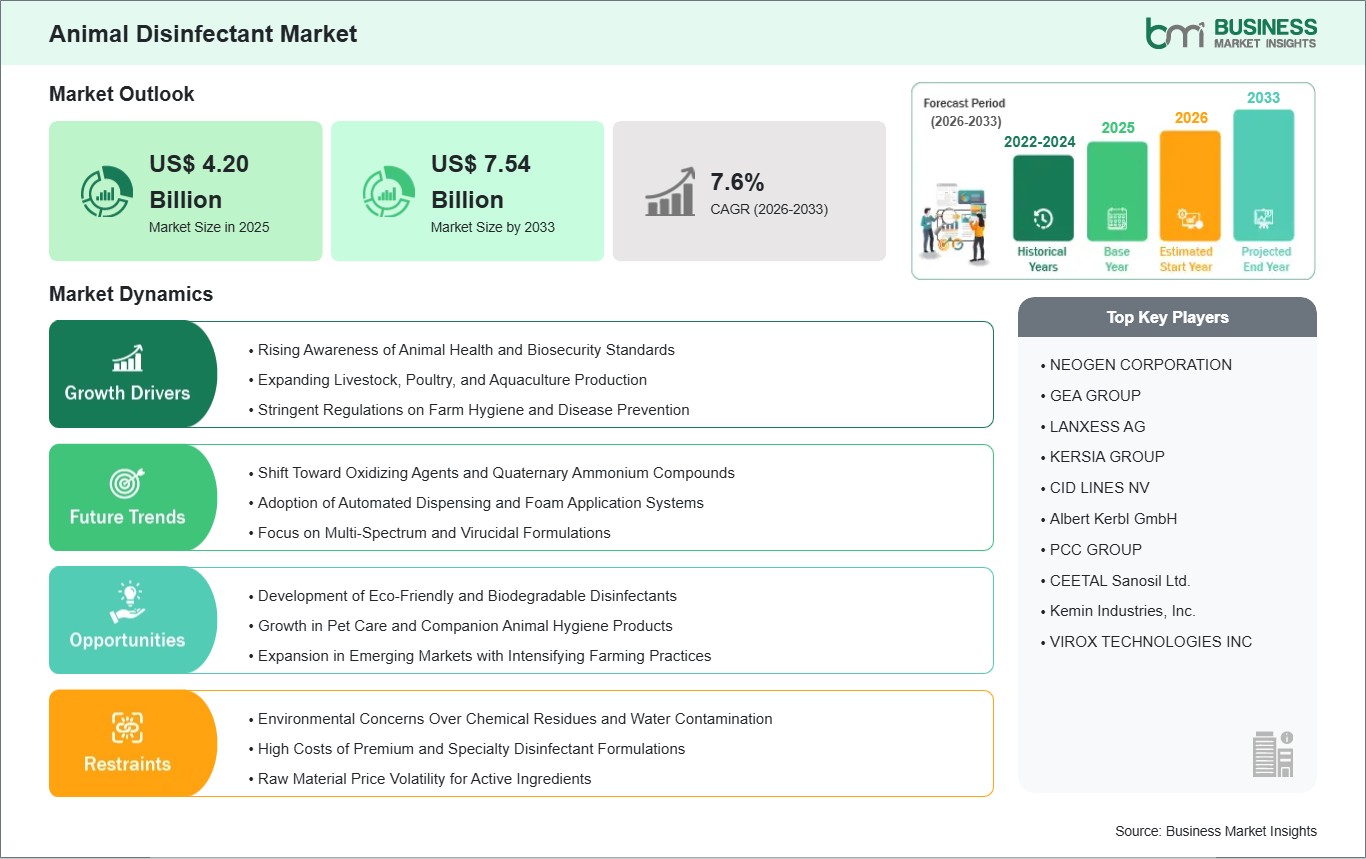
The Animal Disinfectant market size is expected to reach US$ 7.54 billion by 2033 from US$ 4.20 billion in 2025. The market is estimated to record a CAGR of 7.6% from 2026 to 2033.
Animal disinfectants are crucial for maintaining biosecurity, animal health, and hygiene in livestock farming, veterinary clinics, poultry operations, and animal housing. These disinfectants play a key role in controlling pathogens, preventing disease outbreaks, and ensuring safe living environments for animals, supporting productivity and animal welfare. Demand for animal disinfectants is consistently rising in both developed and developing areas. This growth is driven by the expanding livestock and poultry industries, increasing consumption of animal protein, and greater awareness of disease prevention. The market also benefits from stricter rules regarding animal health, food safety, and biosecurity, which promote regular sanitation practices on farms and in processing facilities. The rising number of zoonotic diseases and outbreaks has led to a stronger focus on hygiene measures, underscoring the importance of effective disinfection. Manufacturers are working on creating high-efficacy, broad-spectrum disinfectants that have better safety profiles, controlled toxicity, and compatibility with different surfaces and environments. Innovations in formulations, such as low-residue, fast-acting, and eco-friendly disinfectants, are driving greater adoption and efficiency. Improvements in packaging, application methods, and stability also enhance usability and consistent performance.
Despite challenges like regulatory compliance, cost concerns for small-scale farmers, and worries about chemical residues, the market outlook is positive. Ongoing improvements in formulation technology, a growing focus on animal health management, and the rise of commercial farming are expected to support continued growth. The global animal disinfectant market is likely to stay strong, fueled by increasing hygiene standards, preventive healthcare practices, and a commitment to sustainable and responsible animal production systems.

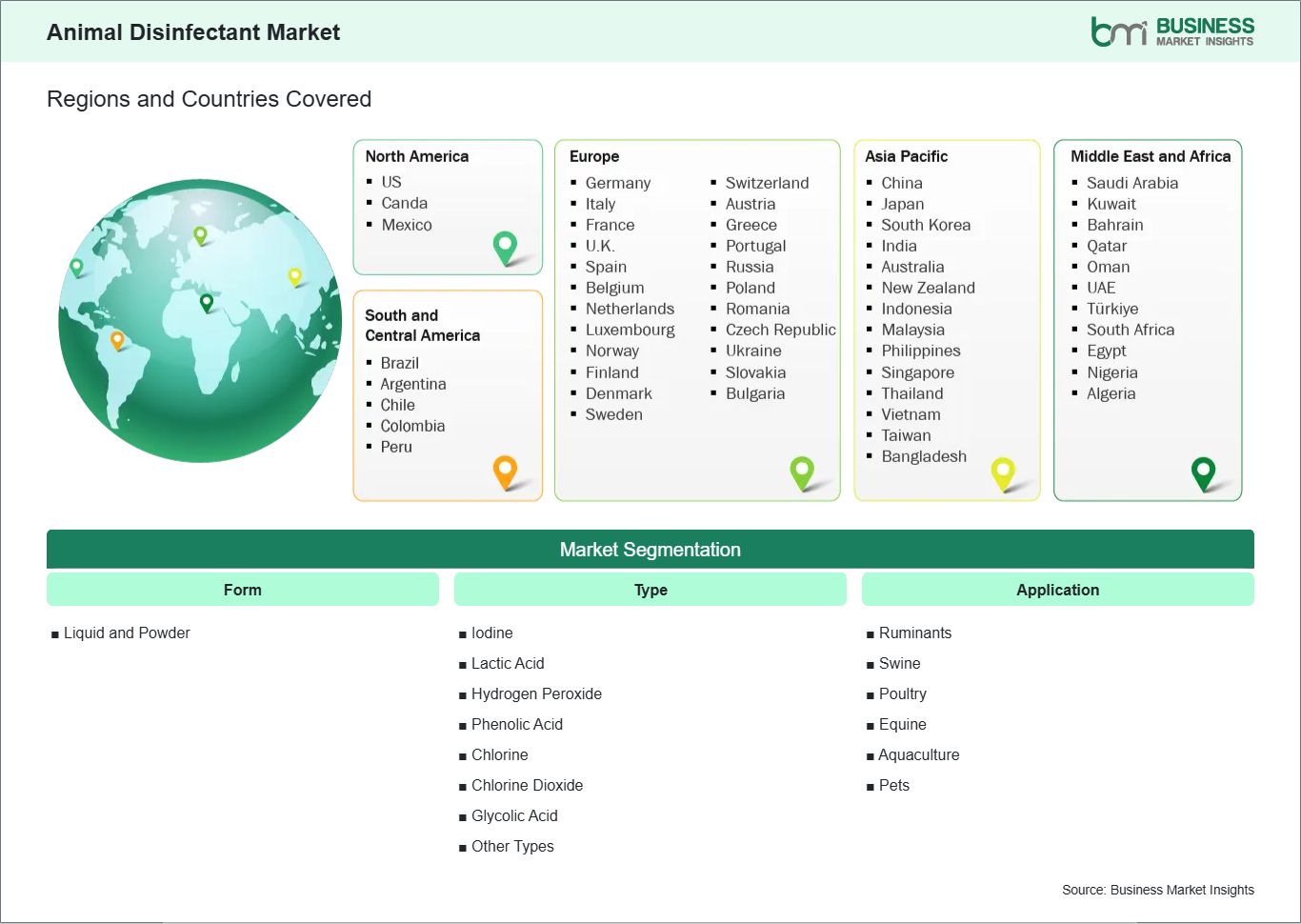
Key segments that contributed to the derivation of the Animal Disinfectant market analysis are form, type, and application.
Animal disinfectants are essential for preventing the spread of infectious diseases and maintaining hygiene in farms, veterinary clinics, hatcheries, and animal housing facilities. The rapid growth in commercial livestock and poultry farming, especially in emerging economies, has increased the need for effective sanitation solutions to protect animal health and ensure productivity. The rising consumption of meat, dairy, and eggs has also prompted producers to adopt regular disinfection practices to meet food safety and quality standards. The growing occurrence of zoonotic diseases and infectious outbreaks has increased awareness of biosecurity measures, boosting the reliance on animal disinfectants. Additionally, the expansion of veterinary services and preventive healthcare programs supports steady demand. Increased investments in modern farming infrastructure and biosecurity management systems are expected to continue driving growth in the global animal disinfectant market.
The animal disinfectant market is influenced by the expansion of biosecurity regulations and the rising need for effective hygiene management practices. Governments and regulatory bodies worldwide are enforcing stricter guidelines for disease control, sanitation, and animal welfare in agricultural and veterinary operations. These regulations encourage the routine use of disinfectants in animal housing, transportation equipment, and processing facilities. As producers aim to improve operational efficiency and reduce disease-related losses, the use of reliable, broad-spectrum disinfectants has increased. Advances in formulation technology, including fast-acting, low-toxicity, and environmentally friendly products, are enhancing usability and safety. Better application methods and improved stability are also contributing to consistent performance in various environments. This focus on regulatory compliance, disease prevention, and efficient hygiene management is expected to support long-term growth in the global animal disinfectant market.
The Animal Disinfectant Market demonstrates steady growth, with size and share analysis revealing evolving trends and competitive positioning among key players. The report examines subsegments categorized within form, type, and application, offering insights into their contribution to overall market performance. By form, the powder subsegment dominates the market because it lasts longer, costs less, and is easy to store and transport. It is often used in large livestock and poultry operations where bulk application and dilution are important. Its stability in different environments also helps powdered animal disinfectant gain popularity.
Based on type, the chlorine subsegment holds the largest share of the market because chlorine-based disinfectants work well against many pathogens and are generally cheaper than other options. Their quick action and wide availability make them a good choice for routine cleaning on farms, in animal housing, and for equipment. Existing usage practices and acceptance by regulators also help maintain their popularity
In terms of application, the ruminants segment dominates the market. Ruminants need regular disinfection because of high stocking densities and their vulnerability to infectious diseases in commercial dairy and meat production. Large herd sizes and the frequent cleaning of barns, milking parlors, and equipment lead to consistent use of disinfectants. The growing demand for milk and beef further encourages the ongoing use of animal disinfectants.
| Report Attribute | Details |
|---|---|
| Market size in 2025 | US$ 4.20 Billion |
| Market Size by 2033 | US$ 7.54 Billion |
| Global CAGR (2026 - 2033) | 7.6% |
| Historical Data | 2022-2024 |
| Forecast period | 2026-2033 |
| Segments Covered | By Form
|
|
Regions and Countries Covered
| |
| North America | US, Canada, Mexico |
| Europe | Belgium, Austria, Finland, Denmark, Greece, Poland, Romania, Russia, Ukraine, Czech Republic, Slovakia, Bulgaria, Italy, Luxembourg, Germany, Switzerland, France, Netherlands, Norway, Portugal, Spain, Sweden, United Kingdom |
| Asia-Pacific | Australia, China, India, Japan, South Korea, Indonesia, Malaysia, Philippines, Singapore, Thailand, Vietnam, Bangladesh, New Zealand, Taiwan |
| South and Central America | Brazil, Argentina, Peru, Chile, Colombia |
| Middle East and Africa | Bahrain, Kuwait, Oman, Qatar, Saudi Arabia, United Arab Emirates, Turkiye, South Africa, Egypt, Algeria, Nigeria |
| Market leaders and key company profiles |
|
The "Animal Disinfectant Market Size and Forecast (2022–2033)" report provides a detailed analysis of the market covering below areas:
The geographical scope of the Animal Disinfectant market report is divided into five regions: North America, Asia Pacific, Europe, the Middle East & Africa, and South & Central America. The Animal Disinfectant market in the Asia Pacific is expected to grow significantly during the forecast period. The Asia Pacific Animal Disinfectant market is segmented into China, Japan, South Korea, India, Australia, New Zealand, Indonesia, Malaysia, the Philippines, Singapore, Thailand, Vietnam, Taiwan, Bangladesh, and the Rest of the Asia Pacific.
The animal disinfectants market in the Asia Pacific is driven by the rapid increase in livestock and poultry farming, greater awareness of animal health, and a rising need for biosecurity solutions. China, India, Japan, Australia, and Southeast Asian countries are among the key contributors in the market. Population growth and higher consumption of meat, dairy, and poultry products are prompting the adoption of effective hygiene and disease prevention methods in these countries. The expansion of commercial farming and the modernization of veterinary services and animal housing are significantly increasing the demand for animal disinfectants. More cases of infectious and zoonotic diseases have highlighted the need for routine disinfection, further supporting market growth in both developed and emerging economies in the region. Another crucial trend influencing the Asia Pacific animal disinfectant market is the development of new formulations and better application practices. Manufacturers are concentrating on creating broad-spectrum, fast-acting, and low-toxicity disinfectants that work well in various farm environments and for different animal species.
Innovations in eco-friendly formulations, safer handling, and easy-to-use delivery systems are becoming more popular as regulatory scrutiny and sustainability concerns grow. Setting up local manufacturing facilities and forming partnerships with veterinary service providers helps reduce reliance on imports and ensure consistent product availability.
Furthermore, increasing investments in animal health infrastructure, compliance with biosecurity regulations, and government initiatives aimed at boosting livestock productivity are factors positioning the Asia Pacific as a major center for producing and consuming animal disinfectants. Continued growth in industrial farming, along with regulatory support and rising hygiene standards, is expected to enhance the region’s market outlook in the long run.

The Animal Disinfectant market is evaluated by gathering qualitative and quantitative data post-primary and secondary research, which includes important corporate publications, association data, and databases. A few of the key developments in the Animal Disinfectant market are:
The Animal Disinfectant Market is valued at US$ 4.20 Billion in 2025, it is projected to reach US$ 7.54 Billion by 2033.
As per our report Animal Disinfectant Market, the market size is valued at US$ 4.20 Billion in 2025, projecting it to reach US$ 7.54 Billion by 2033. This translates to a CAGR of approximately 7.6% during the forecast period.
The Animal Disinfectant Market report typically cover these key segments-
The historic period, base year, and forecast period can vary slightly depending on the specific market research report. However, for the Animal Disinfectant Market report:
The Animal Disinfectant Market is populated by several key players, each contributing to its growth and innovation. Some of the major players include:
The Animal Disinfectant Market report is valuable for diverse stakeholders, including:
Essentially, anyone involved in or considering involvement in the Animal Disinfectant Market value chain can benefit from the information contained in a comprehensive market report.
Please tell us your area of interest
(Market Segments/ Regions and Countries/ Companies)