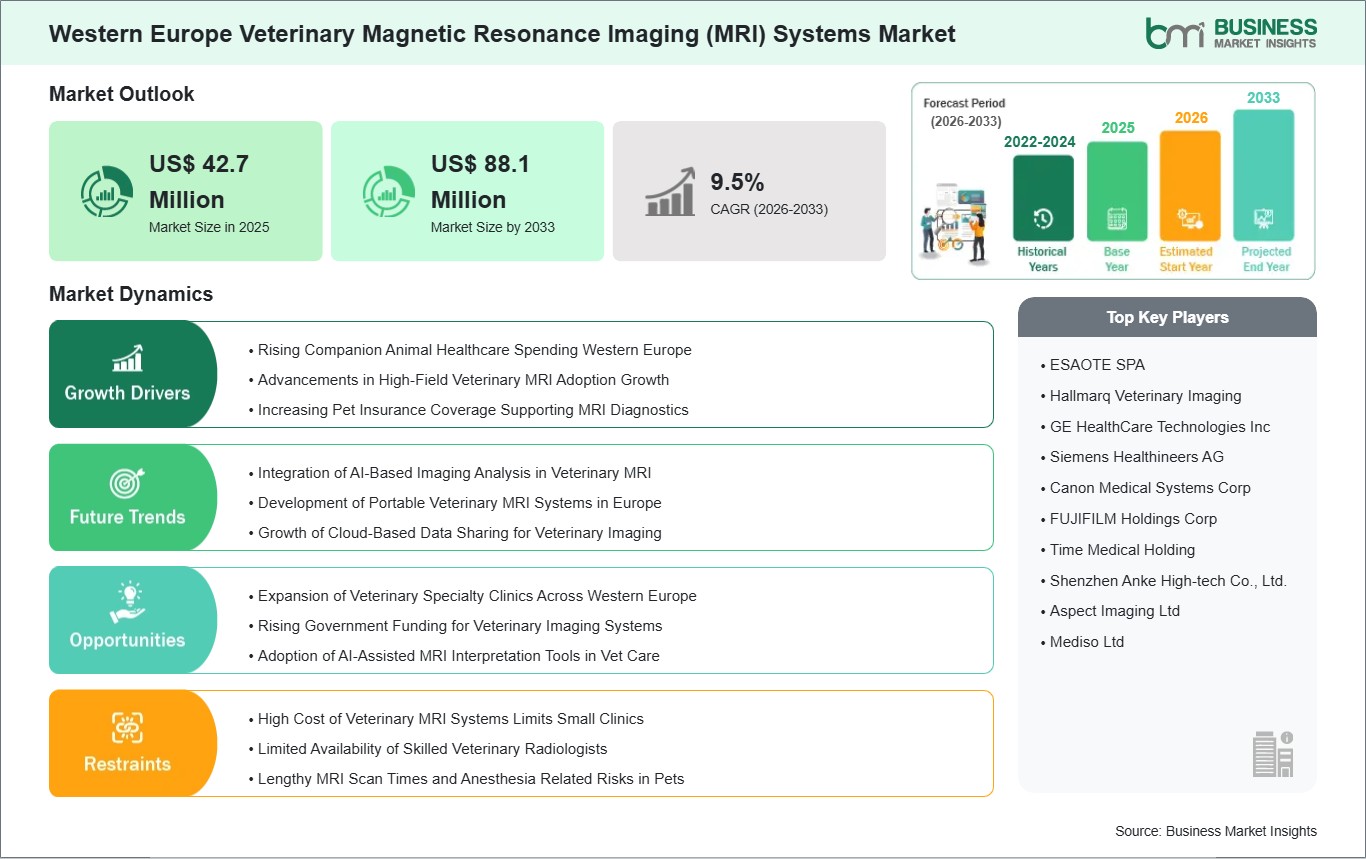
Market Summary
Executive Summary and Market Analysis
The Western Europe Veterinary Magnetic Resonance Imaging (MRI) Systems market represents a mature yet steadily evolving segment within the broader veterinary diagnostics landscape, which combines advanced imaging technology adoption with established veterinary healthcare systems. The region benefits from high awareness of animal health, particularly among companion animal owners, where pets are increasingly treated as family members. The cultural shift has raised the requirement for accurate noninvasive diagnostic equipment, which includes MRI systems to identify neurological disorders, musculoskeletal injuries and soft tissue damage in all animal sizes. The growing number of chronic and degenerative pet conditions, which include orthopedic problems and age-related neurological disorders, represents a major growth factor for Western Europe because these conditions demand high-resolution imaging to achieve correct diagnosis and treatment strategies. The development of specialized veterinary hospitals and diagnostic facilities that use advanced imaging technologies now strengthens the integration of MRI systems into everyday veterinary practices. The development of technological advancements, which enable faster imaging sequences and improved resolution and smaller system designs, has made clinical operations more efficient while promoting system use among urban veterinary facilities. The market development requires the ongoing construction of veterinary healthcare infrastructure throughout the United Kingdom, Germany, France and the Netherlands. The referral-based veterinary practices in these countries experience growth because their advanced diagnostic procedures require sending patients to facilities that have imaging technology, which proves MRI systems to be essential for their diagnostic needs. The partnership between veterinary clinics and imaging technology providers enables better access to diagnostic tests while increasing the efficiency of their testing processes. The market operates under significant restrictions because MRI system expenses render ownership impractical for smaller clinic operators who need affordable solutions. Veterinary facilities need specialized personnel who can manage MRI machinery and analyze image data, which creates reliance on veterinary radiologists with training that exists in only specific parts of the region. Multiple factors, including existing budget limitations in veterinary clinics, create obstacles that prevent wider adoption of veterinary medical services despite strong demand from the medical community. The veterinary MRI systems market in Western Europe exists under two opposing forces, which include high demand for diagnosis and advances in technology, yet face implementation challenges because of expenses and needed specialized knowledge.
Segment Analysis
Western Europe Veterinary Magnetic Resonance Imaging (MRI) Systems Market Segmentation
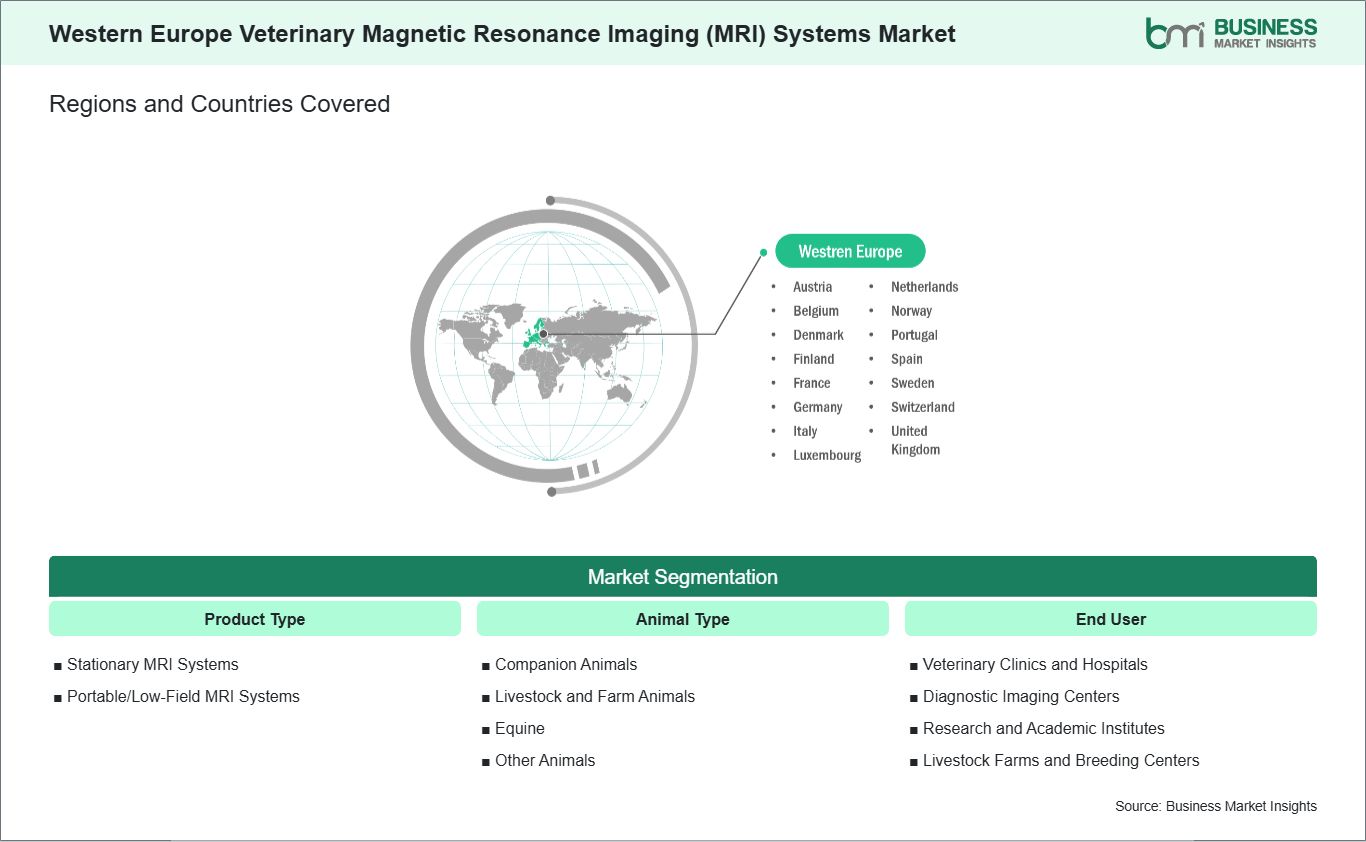
Key segments that contributed to the derivation of the Western Europe veterinary magnetic resonance imaging (MRI) systems market analysis are product type, animal type, and end user.
- By product type, the veterinary magnetic resonance imaging (MRI) systems market is segmented into stationary MRI systems, portable/low-field MRI systems. The stationary MRI systems segment dominated the market in 2025.
- Based on animal type, the veterinary magnetic resonance imaging (MRI) systems market is categorized into companion animals, livestock and farm animals, equine, others. The companion animals segment dominated the market in 2025.
- In terms of end user, the veterinary magnetic resonance imaging (MRI) systems market is categorized into veterinary clinics and hospitals, diagnostic imaging centers, research and academic institutes, livestock farms and breeding centers. The veterinary clinics and hospitals segment dominated the market in 2025.
Market Forces
Western Europe Veterinary Magnetic Resonance Imaging (MRI) Systems Market Drivers and Opportunities
Rising Companion Animal Healthcare Spending Western Europe
The Western Europe veterinary MRI systems market experiences continuous expansion because people spend more money on their pet medical needs. The countries of Germany, France, and the UK make substantial financial investments to develop their advanced diagnostic systems. The increased number of pet owners, together with their knowledge about early disease detection programs, leads veterinary hospitals to implement MRI technology for better diagnostic imaging results.
The adoption of MRI systems in Western European clinics moves forward because of two factors, which include high veterinary insurance coverage and government-funded animal welfare programs. Pet owners now choose high-field MRI systems to diagnose neurological and orthopedic conditions that affect their pets. Veterinary universities work together with imaging equipment manufacturers to improve clinical training programs and system implementation processes throughout the entire region.
Western European countries develop their veterinary MRI programs through public-private partnerships, which establish specialized referral centers. The market expansion path receives support from London, Paris and Amsterdam, which house advanced veterinary hospitals that attract customers. The development of compact MRI systems will lead to lower costs, which will enable smaller clinics to purchase them.
Expansion of Veterinary Specialty Clinics Across Western Europe
Western Europe is currently undergoing a rapid growth period because new veterinary specialty clinics require advanced MRI technology. The trend of pet humanization, which is rising in both Germany and the Netherlands, results in pet owners choosing expensive medical tests for their animals. The expansion of the organization receives support through increased funding for veterinary facilities and the establishment of multiple animal hospitals that provide diverse medical services.
Clinics now find it easier to acquire expensive MRI machines because of technological progress and new financing methods. The veterinary networks in the United Kingdom and France enable these two countries to maintain their position as industry leaders. Private equity investments are driving veterinary chain expansions, which result in the opening of new clinics throughout both urban and semi-urban areas.
Veterinary service providers need to establish unique identities through advanced diagnostic services because pet owners now understand these new medical technologies. Urban centers such as Stockholm and Milan are emerging as key growth hubs. The trend of consolidation among veterinary practices is also expected to enhance MRI system utilization rates across Western European markets.
Size and Share Analysis
Western Europe Veterinary Magnetic Resonance Imaging (MRI) Systems Market Size and Share Analysis
The Western Europe veterinary magnetic resonance imaging (MRI) systems market is experiencing steady growth, with market size and share analysis reflecting evolving treatment preferences and competitive dynamics among key players. The report evaluates important subsegments categorized within product type, animal type, and end user, highlighting their respective contributions to market performance.
By product type, the stationary MRI systems subsegment dominated the market in 2025, driven by higher image quality, greater throughput, and widespread adoption in hospitals for comprehensive diagnostic imaging.
Based on animal type, the companion animals subsegment dominated the market in 2025, driven by increasing pet ownership and rising demand for advanced diagnostic imaging in routine veterinary care.
In terms of end user, the veterinary clinics and hospitals subsegment dominated the market in 2025, driven by the widespread adoption of x-ray systems for comprehensive diagnostic and treatment services.
Report Coverage
Western Europe Veterinary Magnetic Resonance Imaging (MRI) Systems Market Report Coverage and Deliverables
The "Western Europe Veterinary Magnetic Resonance Imaging (MRI) Systems Market Size and Forecast (2022–2033)" report provides a detailed analysis of the market covering below areas:
- Market size and forecast at regional and country levels for all market segments covered under the scope
- Market trends, as well as drivers, restraints, and opportunities
- Market analysis covering key trends, regional framework, major players, regulations, and recent developments
- Market concentration, heat map analysis, prominent players, and recent developments for the Market
- Detailed company profiles, including SWOT analysis
Geographic Insights
Western Europe Veterinary Magnetic Resonance Imaging (MRI) Systems Market Geographic Insights
The geographical scope of the Western Europe Veterinary Magnetic Resonance Imaging (MRI) Systems Market report is divided into Belgium, the Netherlands, Luxembourg, Germany, France, Italy, Spain, Switzerland, Sweden, Austria, the UK, Denmark, Portugal, Norway, and Finland. Germany held the largest share in 2025.
The Western European veterinary MRI systems market experiences growth through irregular adoption of advanced diagnostic imaging, which progresses at a steady pace for both companion animal and equine medical sectors. The market growth derives from three main factors, which include veterinary practices that adopt human-grade diagnostic standards, increased pet humanization and escalating clinical requirements. The German market leads the region because it has numerous specialized veterinary hospitals which provide particular medical services, and it uses advanced imaging technology for routine medical procedures, and its network of veterinary specialists who work in neurology, orthopedics and oncology provides medical services. The German market serves as the primary center for veterinary MRI technology because it contains both high-field MRI systems and advanced veterinary infrastructure, which people use throughout the region. The United Kingdom serves as another significant market because it has a developed veterinary services industry and pet healthcare with insurance coverage and veterinarians who require advanced imaging technology for their multi-site practices. France maintains steady growth because veterinarians modernize their clinics and patients choose non-invasive methods for complex medical cases. The Netherlands and Belgium create a technologically advanced region that veterinarians use because they have strong referral systems and specialty clinics that cooperate across national boundaries. Luxembourg exists as a high-value market that operates within a small niche because it serves a limited market while providing premium veterinary services. The Swiss veterinary medical system shows advanced use of magnetic resonance imaging because its population base has a strong demand for high-quality animal medical treatment services. The two Southern European countries of Italy and Spain are adopting MRI technology at a slow pace because urban referral centers lack the appropriate funding to obtain the equipment needed for early disease detection. The Nordic countries of Sweden, Denmark, Norway and Finland show continuous development because their animal welfare regulations and veterinary education systems and their growing interest in advanced diagnostic equipment, especially for equine and companion animal treatment. The veterinary market in Austria and Portugal has not yet reached its full potential, but advanced imaging technology is starting to become standard in their veterinary specialty hospitals through existing infrastructure development. The veterinary MRI market in Western Europe shows two distinct patterns, with Germany serving as the main market leader while other countries display varying degrees of technology adoption throughout the region.
Industry Activity
Recent Developments
The Western Europe Veterinary Magnetic Resonance Imaging (MRI) Systems Market is evaluated by gathering qualitative and quantitative data post primary and secondary research, which includes important corporate publications, association data, and databases. A few of the key developments in the Western Europe veterinary magnetic resonance imaging (MRI) systems market are:
- In July 2025, Time Medical, announced that it had signed a strategic partnership agreement with Hawkcell, to integrate AI-powered imaging software (HawkAI) into veterinary MRI systems across installations in Europe and future systems.
- In February 2025, GE HealthCare, announced the launch of its Freelium MRI platform, designed to significantly reduce helium use in MRI systems, improving sustainability and operational efficiency across global markets including Europe, where veterinary MRI systems are deployed through regional healthcare and veterinary imaging channels.
Trust & Transparency
Research Methodology
The market analysis combines proprietary research with secondary data from government agencies, company disclosures, regulatory filings, industry databases and expert interviews. Market estimates are validated through data triangulation, cross-market benchmarking and analyst
review.
View Full Research Methodology
Key Sources Referred:
American College of Veterinary Radiology (ACVR)World Small Animal Veterinary Association (WSAVA)British Veterinary Association (BVA)International Veterinary Radiology Association (IVRA)American Veterinary Medical Association (AVMA)European College of Veterinary Diagnostic Imaging (ECVDI)World Organisation for Animal Health (WOAH / OIE)Veterinary Imaging & Radiation Oncology Society (VIROS)