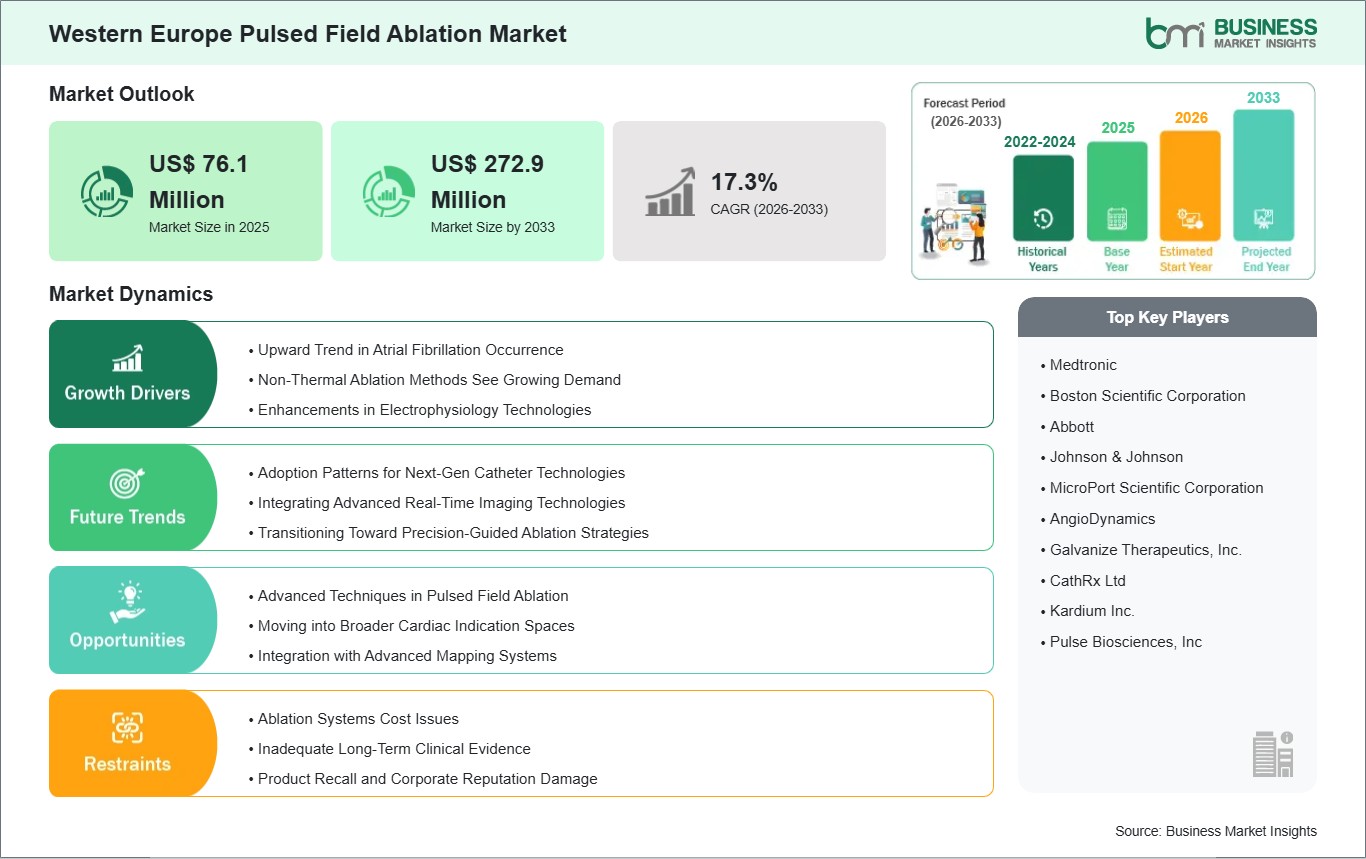
The Western Europe pulsed field ablation market size is expected to reach US$ 272.9 million by 2033 from US$ 76.1 million in 2025. The market is estimated to register a CAGR of 17.3% from 2026 to 2033.
The Western Europe pulsed field ablation market is experiencing continuous adoption with an increase in the implementation of minimally invasive treatment methods in healthcare facilities in the region. The increasing number of patients diagnosed with conditions such as atrial fibrillation, with a need for safe and effective procedures that guarantee patient satisfaction, is encouraging the use of pulsed field ablation. The technology offers a high degree of specificity by targeting only cardiac tissues without damaging adjacent areas, which is an essential requirement in this region.
The availability of well-developed infrastructure, electrophysiology laboratories, and advanced imaging and mapping technologies drives the market development. The hospitals and cardiac treatment centers have started developing structured training modules for cardiologists to ensure the competency and safety of the procedure. Collaboration with international technology suppliers is promoting the adoption of advanced PFA techniques, procedures, and latest technology updates in the process. However, there are some restraints that might hinder the expansion of the market, such as high costs associated with the procedure and equipment. The requirement for skilled personnel limits its application to cardiac centers. However, the emphasis of Western Europe on innovation, healthcare services, and technology ensures that the market is poised for success.

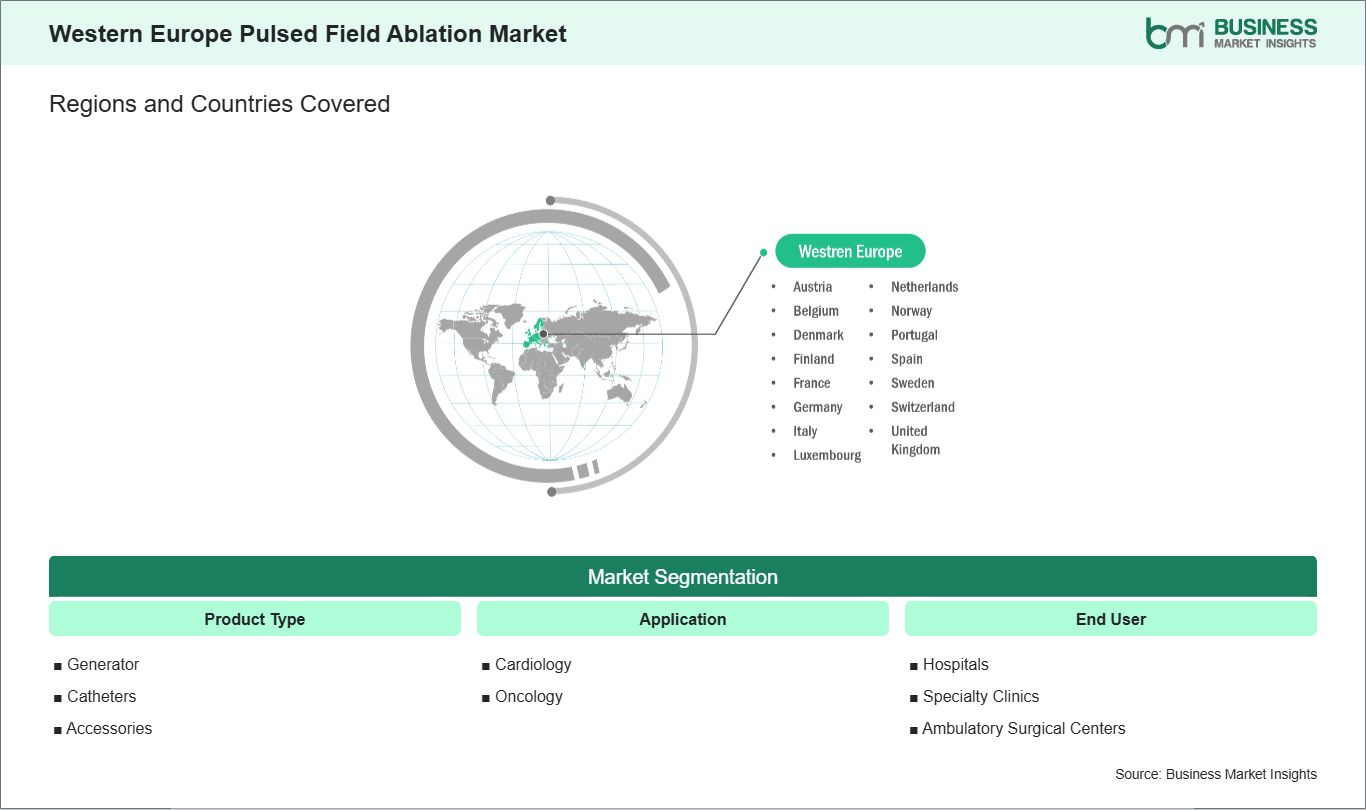
Key segments that contributed to the derivation of the Western Europe pulsed field ablation market analysis are product type, application, and end user.
There is an increase in the prevalence of atrial fibrillation (AFib) in Western Europe, largely influenced by aging populations and rising lifestyle-related cardiovascular risk factors. Healthcare systems in the region have strengthened screening and early detection initiatives, resulting in more patients being diagnosed at earlier stages. Primary care providers are more proactive in identifying potential arrhythmias and referring patients for specialized cardiac evaluation, which has contributed to a growing demand for effective treatment strategies.
Shifts in lifestyle patterns, including reduced physical activity and increasing levels of metabolic and cardiovascular comorbidities, are expanding the AFib patient population. Even among populations traditionally considered active, more individuals are reporting symptoms such as palpitations, fatigue, or irregular heartbeats, prompting physicians to recommend diagnostic testing and closer monitoring. Public awareness campaigns focusing on heart health have also encouraged individuals to seek care sooner, driving the number of patients entering arrhythmia management pathways.
The rise in AFib has heightened the focus on procedural interventions beyond medication. Electrophysiologists across the region are considering advanced ablation techniques for patients who are not well controlled with drugs. Pulsed field ablation (PFA), with its ability to selectively target cardiac tissue while minimizing collateral damage, is emerging as a preferred treatment modality. As awareness and clinical experience grow, PFA is becoming an integral component of modern arrhythmia management strategies in Western Europe.
Pulsed field ablation (PFA) technology has evolved rapidly in Western Europe, offering a nonthermal, tissue-selective approach to treating atrial fibrillation. Unlike conventional methods that rely on heat or extreme cold, PFA delivers precise electrical energy that minimizes injury to surrounding cardiac structures. This safety advantage has made the technique appealing to electrophysiologists aiming to optimize patient outcomes while reducing procedural complications.
Integration with high-resolution cardiac mapping and imaging technologies is enhancing procedural accuracy and efficiency. Modern PFA systems allow clinicians to visualize the heart’s anatomy in real time, guiding energy delivery to the targeted tissue while avoiding unnecessary collateral damage. This level of precision improves success rates and supports consistent outcomes, even in patients with complex atrial substrates. The combination of advanced mapping and pulsed energy delivery is shaping how arrhythmia procedures are performed in the region.
User-centric design improvements are also contributing to wider adoption. Catheters that provide greater maneuverability and control, along with systems that streamline workflow, allow clinicians to perform procedures more efficiently and confidently. Training programs focusing on PFA techniques have become more prevalent, helping specialists integrate this technology into their routine practice. As a result, pulsed field ablation is regarded as a cornerstone of modern atrial fibrillation management in Western Europe, reflecting both clinical innovation and patient-centered care priorities.

The Western Europe pulsed field ablation market demonstrates consistent growth, with market size and share analysis reflecting evolving treatment preferences and competitive dynamics among leading players. The report evaluates important subsegments categorized within product type, application, and end user, highlighting their respective contributions to market performance.
By product type, the catheters subsegment dominated the market in 2025. Catheter devices offer improved procedural efficiency, reduced risk of complications, and real-time control for electrophysiologists, making them a crucial component for effective PFA therapy and a key revenue driver for manufacturers.
In terms of application, the cardiology subsegment dominated the market in 2025. The leadership of cardiology applications is attributed to the rising prevalence of atrial fibrillation and other cardiac arrhythmias, growing preference for nonthermal and tissue-selective ablation techniques, and increasing awareness among healthcare providers about the clinical benefits of PFA.
Based on end user, the hospitals subsegment dominated the market in 2025. Hospitals maintain a stronghold due to their established cardiology and electrophysiology departments, access to advanced PFA systems, trained physicians and clinical staff, and the capability to perform specialized cardiac procedures with comprehensive patient monitoring and post-procedure care.
| Report Attribute | Details |
|---|---|
| Market size in 2025 | US$ 76.1 Million |
| Market Size by 2033 | US$ 272.9 Million |
| CAGR (2026 - 2033) | 17.3% |
| Historical Data | 2022-2024 |
| Forecast period | 2026-2033 |
| Segments Covered | By Product Type
|
|
Regions and Countries Covered
| |
| Western Europe | Belgium, Netherlands, Luxembourg, Germany, France, Italy, Spain, Switzerland, Sweden, Austria, United Kingdom, Denmark, Portugal, Norway, Finland |
| Market leaders and key company profiles |
|
The "Western Europe Pulsed Field Ablation Market Size and Forecast (2022–2033)" report provides a detailed analysis of the market covering below areas:
The geographical scope of the Western Europe pulsed field ablation market report is divided into: Belgium, the Netherlands, Luxembourg, Germany, France, Italy, Spain, Switzerland, Sweden, Austria, the UK, Denmark, Portugal, Norway, and Finland. Germany held the largest share in 2025.
The German healthcare system stands out as the key player in the Western Europe pulsed field ablation market due to the sophisticated healthcare infrastructure that it has, coupled with the strong emphasis that the country places on providing high-quality treatment for cardiovascular disorders. The prevalence of heart disorders such as atrial fibrillation has created an environment conducive to embracing minimally invasive therapies. The ability of PFA therapy to provide tissue selectivity and a nonthermal approach makes it very appealing from the perspective of safety and efficacy.
Medical facilities have been investing in modern electrophysiology laboratories, highly advanced mapping devices, and imaging devices that help perform such procedures efficiently. Structured clinician training initiatives, with strategic cooperation with medical device suppliers, contribute to improving clinical outcomes in the region. Challenges include the high cost of PFA systems and the limited availability of trained electrophysiologists in smaller or regional hospitals, which can slow broader implementation. Germany’s emphasis on early adoption of cutting-edge cardiac technologies, procedural efficiency, and patient outcomes positions it as the key driver of PFA adoption in Western Europe, setting clinical and operational benchmarks for neighboring countries in the region.

The Western Europe pulsed field ablation market is evaluated by gathering qualitative and quantitative data post primary and secondary research, which includes important corporate publications, association data, and databases. A few of the key developments in the Western Europe pulsed field ablation market are:
The Western Europe Pulsed Field Ablation Market is valued at US$ 76.1 Million in 2025, it is projected to reach US$ 272.9 Million by 2033.
As per our report Western Europe Pulsed Field Ablation Market, the market size is valued at US$ 76.1 Million in 2025, projecting it to reach US$ 272.9 Million by 2033. This translates to a CAGR of approximately 17.3% during the forecast period.
The Western Europe Pulsed Field Ablation Market report typically cover these key segments-
The historic period, base year, and forecast period can vary slightly depending on the specific market research report. However, for the Western Europe Pulsed Field Ablation Market report:
The Western Europe Pulsed Field Ablation Market is populated by several key players, each contributing to its growth and innovation. Some of the major players include:
The Western Europe Pulsed Field Ablation Market report is valuable for diverse stakeholders, including:
Essentially, anyone involved in or considering involvement in the Western Europe Pulsed Field Ablation Market value chain can benefit from the information contained in a comprehensive market report.
Please tell us your area of interest
(Market Segments/ Regions and Countries/ Companies)