Market Summary
Executive Summary and Global Market Analysis
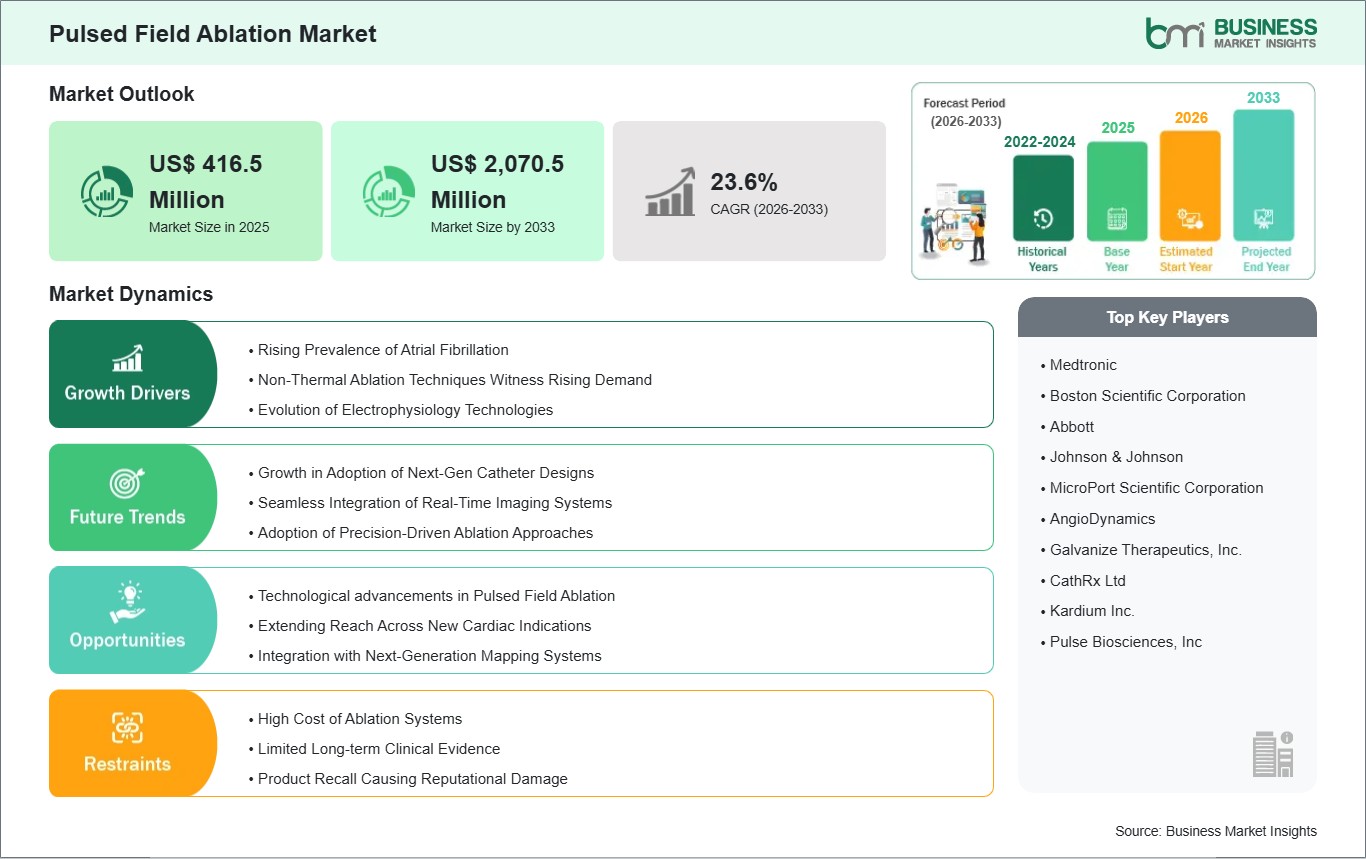
The pulsed field ablation (PFA) market represents a transformative segment within interventional cardiac care, driven by the rising prevalence of arrhythmias and a broad shift toward minimally invasive therapies. PFA has gained recognition for its ability to selectively ablate diseased cardiac tissue while minimizing collateral damage compared to traditional thermal modalities. Clinical confidence in PFA stems from its non‑thermal mechanism, which preserves surrounding structures, shortens procedural times, and offers promising safety outcomes for atrial fibrillation patients. These advantages have encouraged rapid adoption across advanced healthcare centers and specialized electrophysiology facilities.
Market growth is supported by robust healthcare infrastructure, regulatory support for innovative cardiac technologies, and a high burden of cardiovascular illnesses, particularly atrial fibrillation, which drives demand for new ablation solutions. However, the market faces challenges, including the high cost of PFA systems and the requirement for specialized clinician training, which can limit adoption in smaller healthcare settings. Ongoing evidence gaps regarding long-term efficacy in complex arrhythmias lead some providers to adopt a cautious procurement approach, balancing innovation with clinical validation.
Segment Analysis
Pulsed Field Ablation Market Segmentation
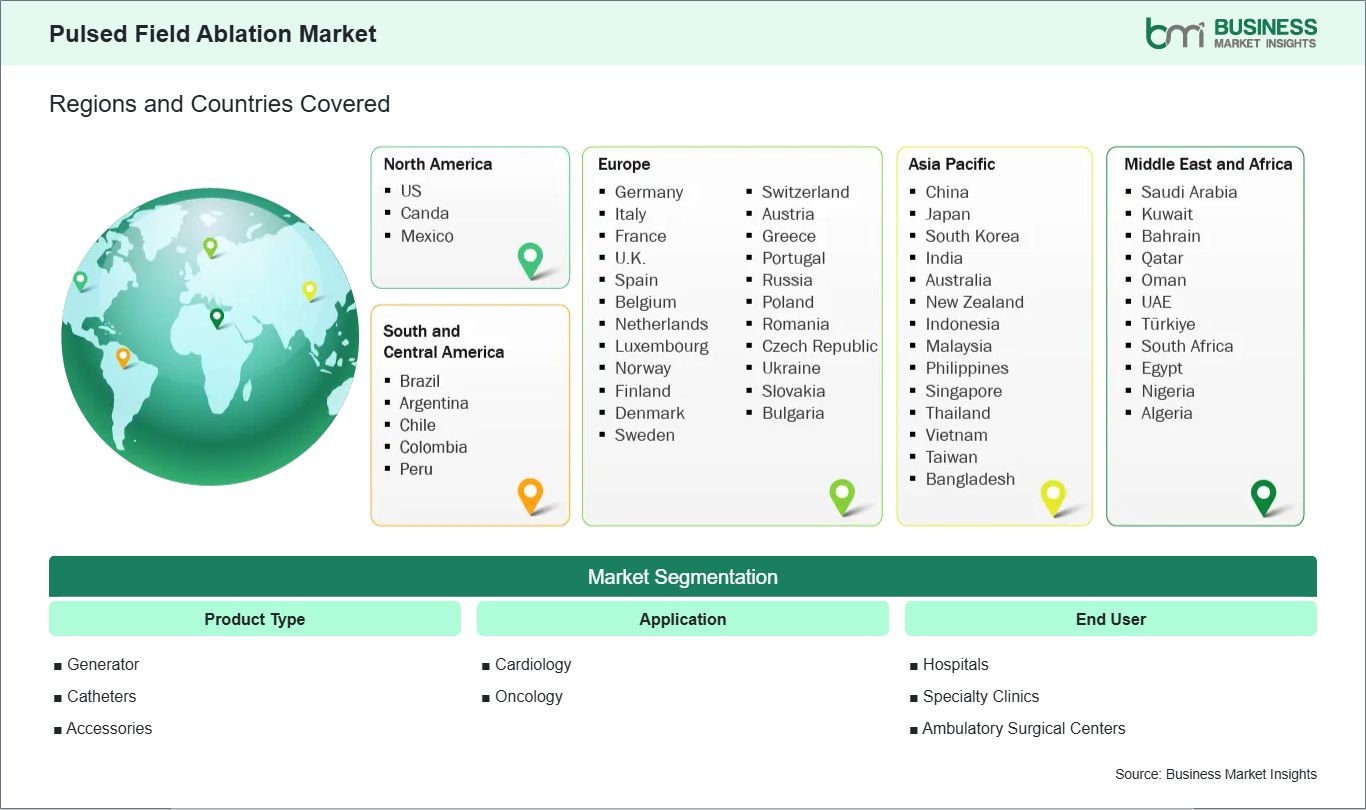
Key segments that contributed to the derivation of the pulsed field ablation market analysis are product type, application, and end user.
- By product type, the pulsed field ablation market is segmented into generators, catheters, and accessories. The catheters segment dominated the market in 2025.
- Based on application, the pulsed field ablation market is classified into cardiology and oncology. The cardiology segment dominated the market in 2025.
- In terms of end user, the pulsed field ablation market is categorized into hospitals, specialty clinics, and ambulatory surgical centers. The hospitals segment dominated the market in 2025.
Market Forces
Pulsed Field Ablation Market Drivers and Opportunities
Rising Prevalence of Atrial Fibrillation
Atrial fibrillation (AF) is becoming common worldwide. As populations age and lifestyle-related risk factors such as high blood pressure, obesity, and diabetes rise, more patients are developing AF, which increases the need for effective and minimally invasive treatments. PFA offers a non-thermal approach that targets cardiac tissue while reducing damage to surrounding areas, making it an attractive alternative to traditional ablation methods for both physicians and patients.
The advantages of PFA are significant in complex AF cases where traditional procedures may pose higher risks. Unlike thermal ablation, which relies on heat or cold to destroy tissue, PFA uses rapid electrical pulses to affect cardiac cells. This reduces the likelihood of complications such as esophageal injury or pulmonary vein stenosis, which has encouraged more clinicians to adopt this method in their treatment protocols. Patients also benefit from shorter recovery times and lower post-procedural discomfort, making PFA a preferred option.
The increase in AF cases has led to wider clinical acceptance of pulsed field ablation as a standard treatment approach. Hospitals and cardiology centers are incorporating PFA into their arrhythmia management programs to provide a safer, more efficient alternative to conventional methods. As awareness of AF grows and more patients seek advanced treatment options, PFA is positioned to meet the rising demand for effective cardiac interventions.
Technological advancements in Pulsed Field Ablation
Technological improvements in pulsed field ablation are enhancing its precision, safety, and clinical utility. Modern PFA systems are equipped with multi-electrode catheters and refined energy delivery controls that allow clinicians to create uniform lesions in targeted cardiac tissue. These developments improve procedural consistency and reduce variability, enabling practitioners to perform ablation efficiently and with greater confidence.
Integration with advanced imaging and mapping technologies has strengthened PFA capabilities. Real-time visualization of cardiac anatomy and automated guidance systems allow electrophysiologists to deliver pulses with higher accuracy and tailor procedures to individual patient anatomy. These tools make it easier to navigate complex arrhythmias and enhance treatment effectiveness while minimizing the risk of collateral tissue damage.
Emerging innovations are also exploring the use of artificial intelligence and machine learning to optimize PFA procedures. AI can analyze procedural data to fine-tune pulse delivery, predict lesion formation, and assist clinicians in decision-making during ablation. These technological advancements are making PFA more versatile, effective, and accessible, solidifying its role as a key treatment option in the management of atrial fibrillation.
Size and Share Analysis
Pulsed Field Ablation Market Size and Share Analysis
The pulsed field ablation market is experiencing steady growth, with market size and share analysis reflecting evolving treatment preferences and competitive dynamics among key players. The report evaluates important subsegments categorized within product type, application, and end user, highlighting their respective contributions to market performance.
By product type, the catheters subsegment dominated the market in 2025. Catheter devices offer improved procedural efficiency, reduced risk of complications, and real-time control for electrophysiologists, making them a crucial component for effective PFA therapy and a key revenue driver for manufacturers.
In terms of application, the cardiology subsegment dominated the market in 2025. The leadership of cardiology applications is attributed to the rising prevalence of atrial fibrillation and other cardiac arrhythmias, growing preference for non-thermal and tissue-selective ablation techniques, and increasing awareness among healthcare providers about the clinical benefits of PFA.
Based on end user, the hospitals subsegment dominated the market in 2025. Hospitals maintain a stronghold due to their established cardiology and electrophysiology departments, access to advanced PFA systems, trained physicians and clinical staff, and the capability to perform specialized cardiac procedures with comprehensive patient monitoring and post-procedure care.
Report Coverage
Pulsed Field Ablation Market Report Coverage and Deliverables
The "Pulsed Field Ablation Market Size and Forecast (2022–2033)" report provides a detailed analysis of the market covering below areas:
- Pulsed Field Ablation market size and forecast at global, regional, and country levels for all the key market segments covered under the scope
- Pulsed Field Ablation market trends, as well as drivers, restraints, and opportunities
- Pulsed Field Ablation market analysis covering key trends, regional framework, major players, regulations, and recent developments
- Industry landscape and competition analysis covering market concentration, heat map analysis, prominent players, and recent developments for the Pulsed Field Ablation market
- Detailed company profiles, including SWOT analysis
Geographic Insights
Pulsed Field Ablation Market Geographic Insights
The geographical scope of the pulsed field ablation market report is divided into five regions: North America, Asia Pacific, Europe, Middle East & Africa, and South & Central America. The pulsed field ablation market in North America is expected to grow during the forecast period.
In North America, the adoption of pulsed field ablation (PFA) has been pronounced due to the region’s advanced cardiac care infrastructure and extensive clinical expertise in electrophysiology. PFA is recognized for its ability to treat arrhythmias effectively while minimizing damage to surrounding cardiac tissue, prompting major hospitals and specialized cardiac centers to incorporate this technology into their procedural offerings. Clinicians across the US and Canada are exploring procedural innovations, including refined catheter designs, improved energy delivery systems, and integrated mapping technologies. These developments support safer, more efficient procedures and foster growing confidence among practitioners in using PFA to manage atrial fibrillation and other complex cardiac arrhythmias. Emphasis on procedural standardization, training programs, and skill development ensures that healthcare teams can deliver consistent, high-quality outcomes. The adoption in some centers requires careful planning, as training requirements, procedural complexity, and integration into existing workflows influence implementation. Hospitals and cardiac centers continue to balance the integration of innovative PFA technology with patient care priorities and operational considerations. North America’s mature healthcare systems, combined with strong clinical networks and expertise, have positioned the region as a leading hub for the advancement and refinement of pulsed field ablation practices.
Industry Activity
Recent Developments
The pulsed field ablation market is evaluated by gathering qualitative and quantitative data post primary and secondary research, which includes important corporate publications, association data, and databases. A few of the key developments in the pulsed field ablation market are:
- In September 2025, Kardium announced that it received US FDA pre‑market approval (PMA) for its Globe Pulsed Field Ablation System, along with 510(k) clearance for the Globe Introducer sheath and Globe PFA mapping software, positioning the integrated system for commercial launch in treating atrial fibrillation globally.
- In July 2025, Boston Scientific announced that the FARAPULSE Pulsed Field Ablation System received expanded US FDA labeling approval to include treatment for persistent atrial fibrillation, broadening its clinical indications beyond earlier approvals.
Trust & Transparency
Research Methodology
The market analysis combines proprietary research with secondary data from government agencies, company disclosures, regulatory filings, industry databases and expert interviews. Market estimates are validated through data triangulation, cross-market benchmarking and analyst
review.
View Full Research Methodology
Key Sources Referred:
The World Bank
World Health Organization (WHO)
Center for Disease Control and Prevention (CDC)
Food and Drug Administration (FDA)
European Database on Medical Devices (EUDAMED)
European Society of Cardiology (ESC)
American College of Cardiology (ACC)
American Heart Association (AHA)
Company Websites
Company Annual Reports
Company Investor Presentations