Market Summary
Executive Summary and Market Analysis
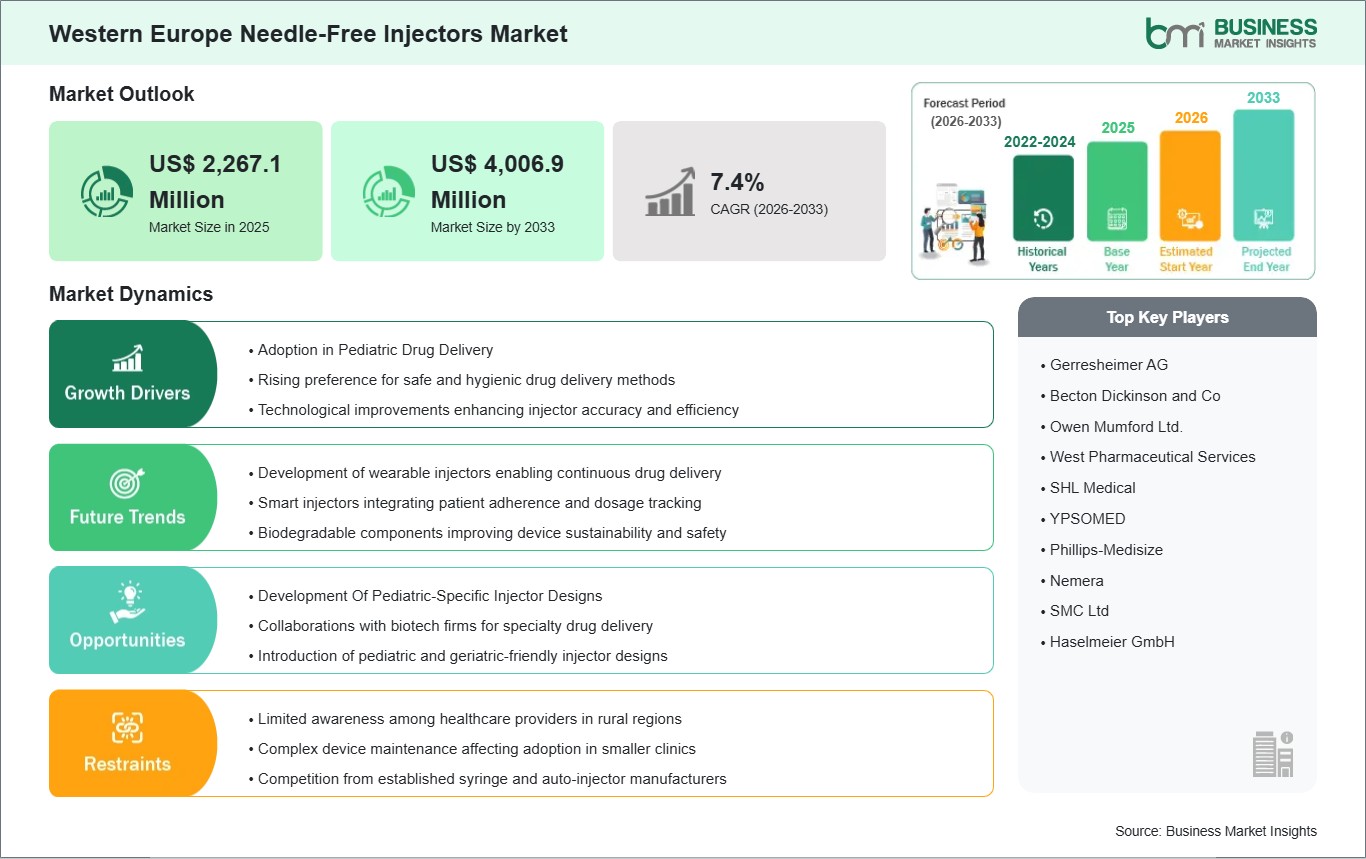
Countries such as Germany, France, the UK, Italy, and Spain lead adoption due to increasing public and private investment in modern medical technologies. Market dynamics are driven by collaborations between global device manufacturers and regional distributors who prioritize regulatory compliance, device reliability, and alignment with hospital workflow requirements. Clinical adoption is influenced by evidence demonstrating reduced needle-stick injuries, enhanced dosing precision, and improved patient adherence across vaccinations, biologics, and chronic therapy administration. Regulatory frameworks in Western Europe are rigorous, with agencies such as the European Medicines Agency (EMA) emphasizing clinical validation, post-market surveillance, and safety monitoring. Procurement decisions are guided by total cost of ownership, incorporating training, maintenance, and consumables management alongside device performance. Innovation is a key differentiator, with advanced systems offering ergonomic designs, disposable and reusable options, digital tracking capabilities, and multi-drug compatibility to meet diverse clinical needs. Hospital-led demonstration projects and pilot programs are employed to validate device efficacy, ease of use, and operational workflow integration. The market reflects a technologically advanced and regulation-driven environment where patient safety, workflow efficiency, and evidence-based performance are central to competitive positioning and adoption strategies.
Segment Analysis
Western Europe Needle-Free Injectors Market Segmentation
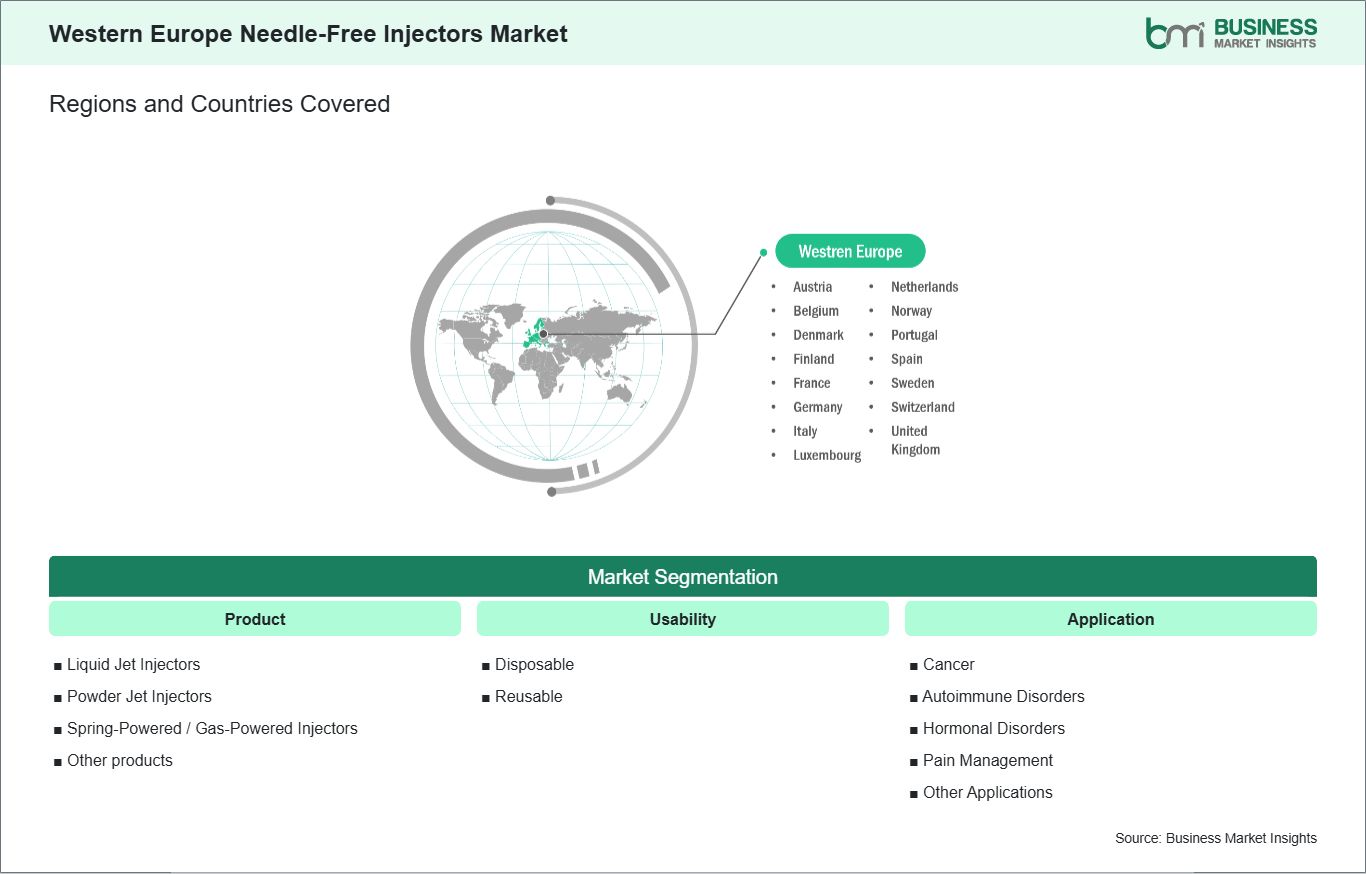
Key segments that contributed to the derivation of the Western Europe needle-free injectors market analysis are product, usability, and application.
- By product, the needle-free injectors market is segmented into liquid jet injectors, powder jet injectors, spring-powered / gas-powered injectors, and other products. The liquid jet injectors segment dominated the market in 2025.
- Based on usability, the needle-free injectors market is categorized into disposable and reusable. The disposable segment dominated the market in 2025.
- In terms of application, the market is classified into cancer, autoimmune disorders, hormonal disorders, pain management, and other applications. The autoimmune disorders segment dominated the market in 2025.
Market Forces
Western Europe Needle-Free Injectors Market Drivers and Opportunities
Adoption in Pediatric Drug Delivery
Traditional injections create fear and discomfort, leading to resistance in young patients, missed doses, and challenges in chronic disease management. Needle-free injectors provide a pain-free and accurate alternative, improving both the patient experience and therapeutic compliance. Countries such as Germany, France, and the Netherlands have integrated needle-free injectors into pediatric vaccination programs, outpatient clinics, and hospital care. These devices enable healthcare providers to administer vaccines and other essential medications quickly and safely, reducing procedural stress for children and caregivers. Their ease of use and minimal risk of needle-stick injuries make them attractive for high-volume pediatric care settings. Adoption is supported by awareness campaigns and education programs for healthcare professionals and parents, highlighting the benefits of needle-free technology for children. By improving the safety, comfort, and efficiency of pediatric treatments, needle-free injectors are becoming a preferred choice across Western Europe. As pediatric healthcare initiatives expand, the use of these devices is expected to grow steadily, enhancing compliance and patient satisfaction in the region.
Development Of Pediatric-Specific Injector Designs
Manufacturers are developing devices with smaller doses, ergonomic designs suitable for young patients, and features that reduce noise and visual cues associated with injections, addressing common sources of anxiety. Healthcare providers in countries such as the UK, Sweden, and Spain are adopting these specialized devices in hospitals, clinics, and vaccination campaigns. Pediatric-specific injectors allow for accurate delivery of vaccines, insulin, and other medications in children with minimal discomfort. The emphasis on tailored designs ensures that the child and the caregiver experience a safer and more manageable administration process. Ongoing research and clinical studies focus on optimizing injector mechanics and drug delivery profiles for pediatric populations. Collaboration between medical device companies, hospitals, and regulatory authorities ensures that these devices meet strict safety and usability standards. As the demand for child-friendly medical solutions grows, pediatric-specific needle-free injectors are expected to see widespread adoption, enhancing therapeutic adherence and improving outcomes in healthcare systems.
Size and Share Analysis
Western Europe Needle-Free Injectors Market Size and Share Analysis
The Western Europe Needle-free Injectors Market demonstrates steady growth, with size and share analysis highlighting evolving trends and competitive dynamics among key players. The report examines subsegments categorized within product, usability, and application, offering insights into their contribution to overall market performance.
By product, the liquid jet injectors subsegment dominated the market in 2025, driven by their ability to deliver precise, rapid, and pain-free doses, making them suitable for pediatric, clinical, and home-based applications.
Based on usability, the disposable subsegment dominated the market in 2025, driven by the focus on hygiene, infection prevention, and ease of use in hospitals, clinics, and home-care settings.
In terms of application, the autoimmune disorders subsegment dominated the market in 2025, driven by the high demand for frequent, long-term injectable therapies where patient comfort, adherence, and safety are critical for disease management.
Report Coverage
Western Europe Needle-Free Injectors Market Report Coverage and Deliverables
The "Western Europe Needle-free Injectors Market Size and Forecast (2022–2033)" report provides a detailed analysis of the market covering below areas:
- Western Europe Needle-free Injectors Market size and forecast at regional and country levels for all market segments covered under the scope
- Western Europe Needle-free Injectors Market trends, as well as drivers, restraints, and opportunities
- Western Europe Needle-free Injectors Market analysis covering key trends, regional framework, major players, regulations, and recent developments
- Industry landscape and competition analysis covering market concentration, heat map analysis, prominent players, and recent developments for the Western Europe Needle-free Injectors Market
- Detailed company profiles, including SWOT analysis
Geographic Insights
Western Europe Needle-Free Injectors Market Geographic Insights
The geographical scope of the Western Europe Needle-free Injectors Market report is divided into Belgium, the Netherlands, Luxembourg, Germany, France, Italy, Spain, Switzerland, Sweden, Austria, the UK, Denmark, Portugal, Norway, and Finland. Germany held the largest share in 2025.
Germany is a dominant market due to its advanced hospital infrastructure, high adoption of innovative medical devices, and focus on operational efficiency and patient safety. France demonstrates strong adoption in public hospitals and private clinics, with procurement influenced by cost-effectiveness and clinical validation studies. The UK prioritizes integration with digital health systems, adherence monitoring, and workflow optimization in large healthcare networks. Italy and Spain show gradual adoption, particularly in urban hospitals, outpatient facilities, and public vaccination campaigns, with pilot programs and multi-hospital initiatives guiding broader deployment. Across all countries, distributor capabilities, clinician training, and after-sales support are critical to successful market penetration. Urban healthcare centers serve as reference sites, influencing smaller hospitals and regional facilities. Variations in regulatory requirements, procurement mechanisms, and healthcare delivery models necessitate tailored country-specific commercialization strategies. These insights indicate that while Germany and France lead in scale and sophistication, adoption across Western Europe is shaped by innovation, regulatory compliance, operational efficiency, and integration with modern healthcare practices.
Industry Activity
Recent Developments
The Western Europe Needle-free Injectors Market is evaluated by gathering qualitative and quantitative data post primary and secondary research, which includes important corporate publications, association data, and databases. A few of the key developments in the Western Europe needle-free injectors market are:
- In May 2025, Crossject SA (France) highlighted that its ZENEO needle‑free auto‑injector delivers intramuscular injection depths comparable to conventional 30‑mm needles, supporting its potential commercial adoption in emergency drug delivery use cases across Europe. This technical validation reinforces product confidence and readiness for broader regional introduction. The ZENEO platform is being developed for emergency indications, including epileptic rescue therapy with ZEPIZURE as part of the company’s needle‑free portfolio efforts, and increases visibility of advanced injection tech in Western European healthcare ecosystems.
- In February 2025, Unither Pharmaceuticals (France) and Needle Concept entered a strategic partnership to develop a new generation of needles compatible with the Euroject system, combining industrial expertise to offer a safer, ready‑to‑use pre‑filled injection delivery solution with improved ease of use for healthcare professionals and patients. The alliance supports expanded production capacity and aims to enhance the accessibility of advanced injectable devices across healthcare settings in Western Europe. This collaboration reflects a regional effort to innovate beyond traditional syringes and align with modern injection delivery trends. The expanded production infrastructure in France scales capacity for pre‑filled systems that could integrate needle‑free modalities in the future.
Trust & Transparency
Research Methodology
The market analysis combines proprietary research with secondary data from government agencies, company disclosures, regulatory filings, industry databases and expert interviews. Market estimates are validated through data triangulation, cross-market benchmarking and analyst
review.
View Full Research Methodology
Key Sources Referred:
World Health Organization (WHO)Organisation for Economic Cooperation and Development (OECD)The World Bank GroupWorldometerThe LancetInternational Bar AssociationInternational Trade Administration