Market Summary
Executive Summary and Global Market Analysis
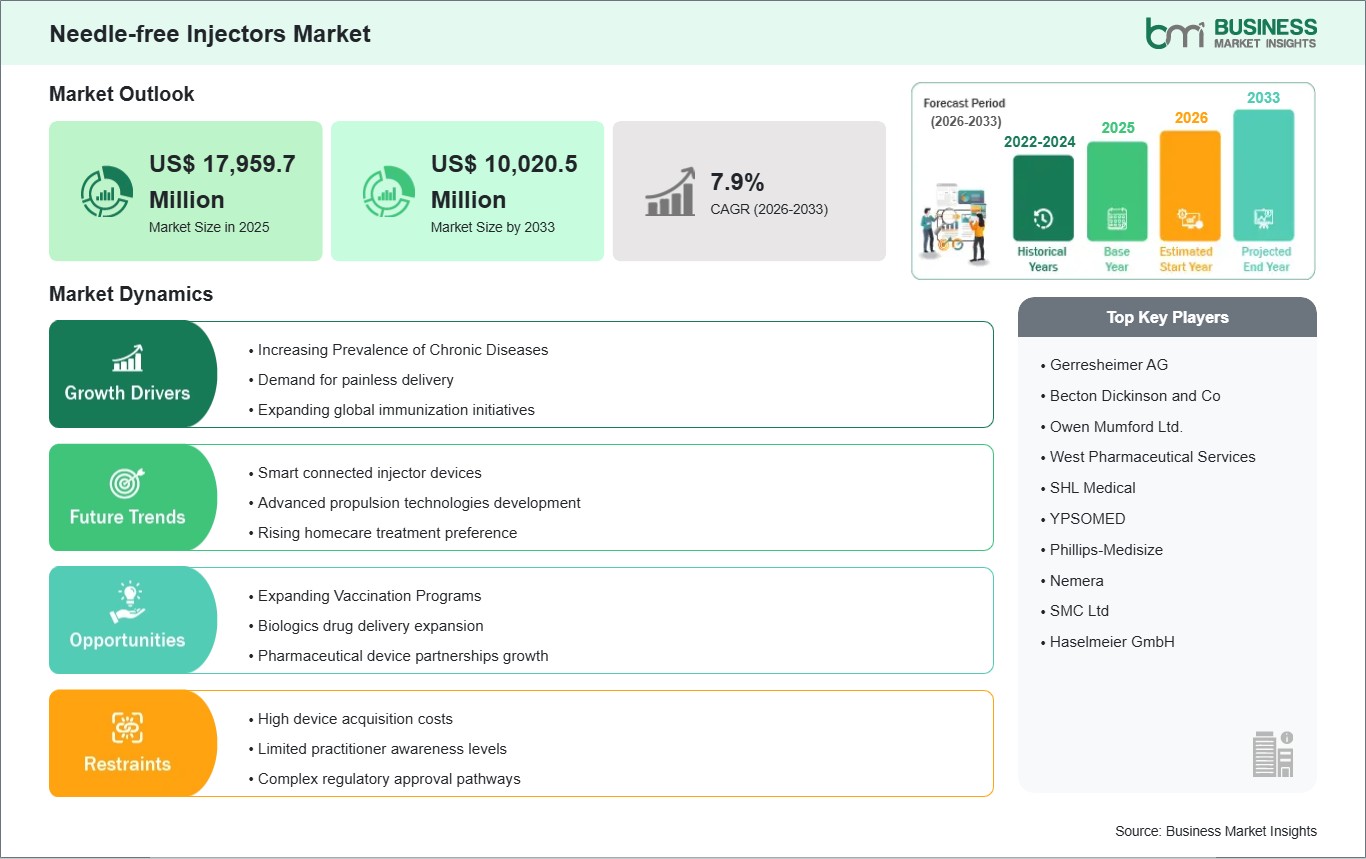
Needle phobia, high rates of needlestick injuries, and challenges in patient adherence have accelerated the adoption of needle-free systems across hospitals, outpatient clinics, and home care settings. Current product developments emphasize jet injectors, spring‑powered devices, and compact auto-injectors capable of precise dosing, which enhance treatment reliability while reducing procedural risk. Digital integration is emerging as a differentiating factor. Devices capable of recording dose history, linking with mobile apps, and sending adherence alerts are gaining traction among chronic disease patients, particularly in diabetes and immunization management. The competitive landscape is dynamic, with established medical device manufacturers leveraging global distribution networks, while startups focus on specialized therapeutics and niche delivery mechanisms. Strategic partnerships with pharmaceutical companies for drug-device combinations are becoming a key route to commercialization, particularly for biologics and vaccines. Regulatory frameworks in North America, Europe, and select APAC countries have evolved to accommodate innovative injection systems, reducing approval timelines and supporting faster market entry. Payers and healthcare providers are evaluating devices on clinical performance as well as on cost-efficiency, risk reduction, and patient engagement metrics. This combination of technological differentiation, regulatory support, and patient-focused functionality is driving adoption across multiple clinical applications, positioning needle-free injectors as a core component of modern drug delivery strategies.
Segment Analysis
Needle-free Injectors Market Segmentation
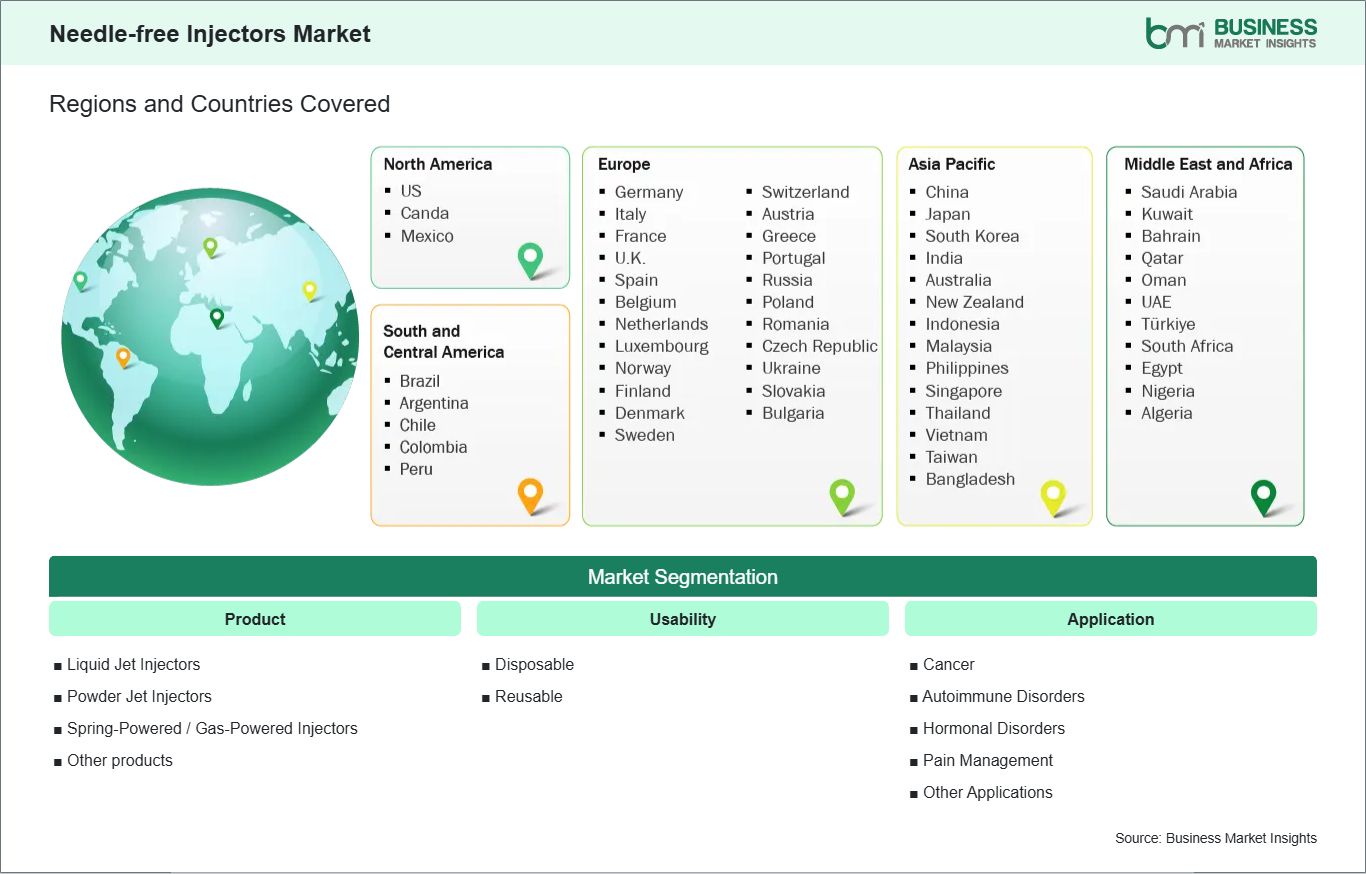
Key segments that contributed to the derivation of the needle-free injectors market analysis are product, usability, and application.
- By product, the needle-free injectors market is segmented into liquid jet injectors, powder jet injectors, spring-powered / gas-powered injectors, and other products. The liquid jet injectors segment dominated the market in 2025.
- Based on usability, the needle-free injectors market is categorized into disposable and reusable. The disposable segment dominated the market in 2025.
- In terms of application, the market is classified into cancer, autoimmune disorders, hormonal disorders, pain management, and other applications. The autoimmune disorders segment dominated the market in 2025.
Market Forces
Needle-free Injectors Market Drivers and Opportunities
Increasing Prevalence of Chronic Diseases
Conditions such as diabetes, rheumatoid arthritis, multiple sclerosis, cardiovascular disorders, and hormonal deficiencies often require frequent or lifelong injectable therapies. Global health estimates indicate that hundreds of millions of people live with diabetes alone, many of whom require daily insulin administration. The repetitive nature of these treatments has intensified the need for painless, convenient, and patient-friendly drug delivery systems. Needle-free injectors address these concerns by minimizing discomfort, reducing anxiety associated with needles, and enhancing patient experience, which supports better treatment adherence and improved clinical outcomes. Biologic therapies require routine subcutaneous self-administration, making ease of use and patient compliance essential for therapeutic success. Needle-free systems provide accurate dosing, decrease the risk of needlestick injuries, and reduce cross-contamination risks, making them suitable for healthcare facilities and homecare environments. As healthcare systems focus on improving outcomes while controlling long-term costs, enhanced adherence enabled by painless delivery technologies is becoming economically beneficial, encouraging wider integration into chronic disease management strategies. The expansion of home healthcare and self-administration trends is reinforcing adoption. Patients increasingly prefer managing long-term conditions outside hospital settings, supported by portable and user-friendly devices. Technological advancements in spring-powered, gas-powered, and electronic needle-free injectors have improved drug dispersion accuracy and reliability, overcoming earlier limitations. With aging populations and continued growth in chronic disease cases worldwide, demand for efficient, safe, and needle-free therapeutic delivery solutions is expected to remain a significant growth driver for the market.
Expanding Vaccination Programs
Governments and international health organizations continue to prioritize widespread immunization coverage to prevent infectious diseases and strengthen public health resilience. Large-scale vaccination initiatives require delivery systems that are efficient, safe, and capable of supporting high patient volumes. Needle-free injectors enable rapid administration, eliminate sharps waste disposal challenges, and reduce the risk of accidental needlestick injuries among healthcare professionals. These operational benefits make them valuable in mass immunization campaigns and emergency response situations. Vaccine hesitancy related to needle fear remains a recognized challenge across multiple age groups. A considerable percentage of children and adults experience anxiety toward traditional injections, which can delay or discourage immunization. Needle-free technologies offer a less intimidating alternative, improving patient acceptance and vaccination experience. This advantage is important in school-based immunization programs, workplace vaccination drives, and community outreach initiatives where smooth workflow and positive patient perception contribute to higher participation rates. Advancements in vaccine research increasingly align with needle-free delivery capabilities. Intradermal and subcutaneous administration using jet injectors allows precise dose control and, in some cases, supports dose-sparing strategies without compromising immune response. Such efficiency becomes important during global vaccine supply constraints or pandemic preparedness efforts. As immunization programs continue expanding and modernizing infrastructure, integration of innovative delivery technologies is expected to increase. Consequently, vaccination initiatives remain a central factor driving sustained demand for needle-free injector systems.
Size and Share Analysis
Needle-free Injectors Market Size and Share Analysis
The Needle-free Injectors Market demonstrates steady growth, with size and share analysis highlighting evolving trends and competitive dynamics among key players. The report examines subsegments categorized within product, usability, and application, offering insights into their contribution to overall market performance.
By product, the liquid jet injectors subsegment dominated the market in 2025, driven by their ability to deliver high-pressure drug administration with improved absorption and reduced patient discomfort.
Based on usability, the disposable subsegment dominated the market in 2025, driven by growing demand for infection control, single-use safety, and elimination of sterilization procedures in clinical and homecare settings.
In terms of application, the autoimmune disorders subsegment dominated the market in 2025, driven by the increasing adoption of self-injectable biologic therapies requiring frequent and long-term subcutaneous drug delivery.
Report Coverage
Needle-free Injectors Market Report Coverage and Deliverables
The "Needle-free Injectors Market Size and Forecast (2022–2033)" report provides a detailed analysis of the market covering below areas:
- Needle-free Injectors market size and forecast at global, regional, and country levels for all the key market segments covered under the scope
- Needle-free Injectors Market trends, as well as drivers, restraints, and opportunities
- Needle-free Injectors Market analysis covering key trends, global and regional framework, major players, regulations, and recent developments
- Industry landscape and competition analysis covering market concentration, heat map analysis, prominent players, and recent developments for the Needle-free Injectors Market
- Detailed company profiles, including SWOT analysis
Geographic Insights
Needle-free Injectors Market Geographic Insights
The geographical scope of the Needle-free Injectors Market report is divided into North America, Asia Pacific, Europe, Middle East & Africa, and South & Central America. North America held the largest share in 2025.
North America remains a pivotal nucleus for adoption due to advanced clinical ecosystems, robust reimbursement structures, and a deep pipeline of research and development investment in drug delivery modalities, particularly in chronic disease management, where needle-free injectors support compliance and convenience in conditions such as diabetes and rheumatoid disorders. Strong patient safety mandates, regulatory harmonization within the EU, systematic adoption in institutional settings, government-led immunization efforts, and outpatient care protocols shape Europe's market evolution. Conversely, APAC is witnessing rapid uptake anchored in large population bases, expanding healthcare access, and cost-competitive device sourcing. Countries such as China, India, and Japan are focal points for unit deployments in clinical and community health settings, often supported by government vaccination campaigns and telehealth integration strategies. Emerging markets in Latin America and the Middle East & Africa, though currently smaller in relative scale, demonstrate growth potential driven by targeted healthcare modernization initiatives, increasing clinic infrastructure, and donor-supported programmes aimed at reducing injection-related risks. Country-level adoption narratives differ by scale and strategic focus—where high-income markets emphasize integrated chronic care support, developing regions leverage needle-free injectors to expand preventive care reach and bolster public health outcomes.
Industry Activity
Recent Developments
The Needle-free Injectors Market is evaluated by gathering qualitative and quantitative data post primary and secondary research, which includes important corporate publications, association data, and databases. A few of the key developments in the needle-free injectors market are:
- In December 2025, Intas Pharmaceuticals signed an exclusive partnership with IntegriMedical to deploy needle‑free injection systems specifically for IVF and gynaecology therapies in India, planning a nationwide rollout across clinics by early 2026 to improve patient comfort and reduce injection‑related anxiety.
- In January 2025, Daicel Medical Ltd (Japan) received regulatory approval from Japan's PMDA for its gas‑powered needle‑free injector, the Daicel Injector P1 SC, designed for subcutaneous delivery of vaccines and drugs without traditional needles; marketing plans and launch details were set to follow pending further announcements by the company.
Trust & Transparency
Research Methodology
The market analysis combines proprietary research with secondary data from government agencies, company disclosures, regulatory filings, industry databases and expert interviews. Market estimates are validated through data triangulation, cross-market benchmarking and analyst
review.
View Full Research Methodology
Key Sources Referred:
World Health Organization (WHO) Organisation for Economic Cooperation and Development (OECD) The World Bank Group Worldometer The Lancet International Bar Association International Trade Administration