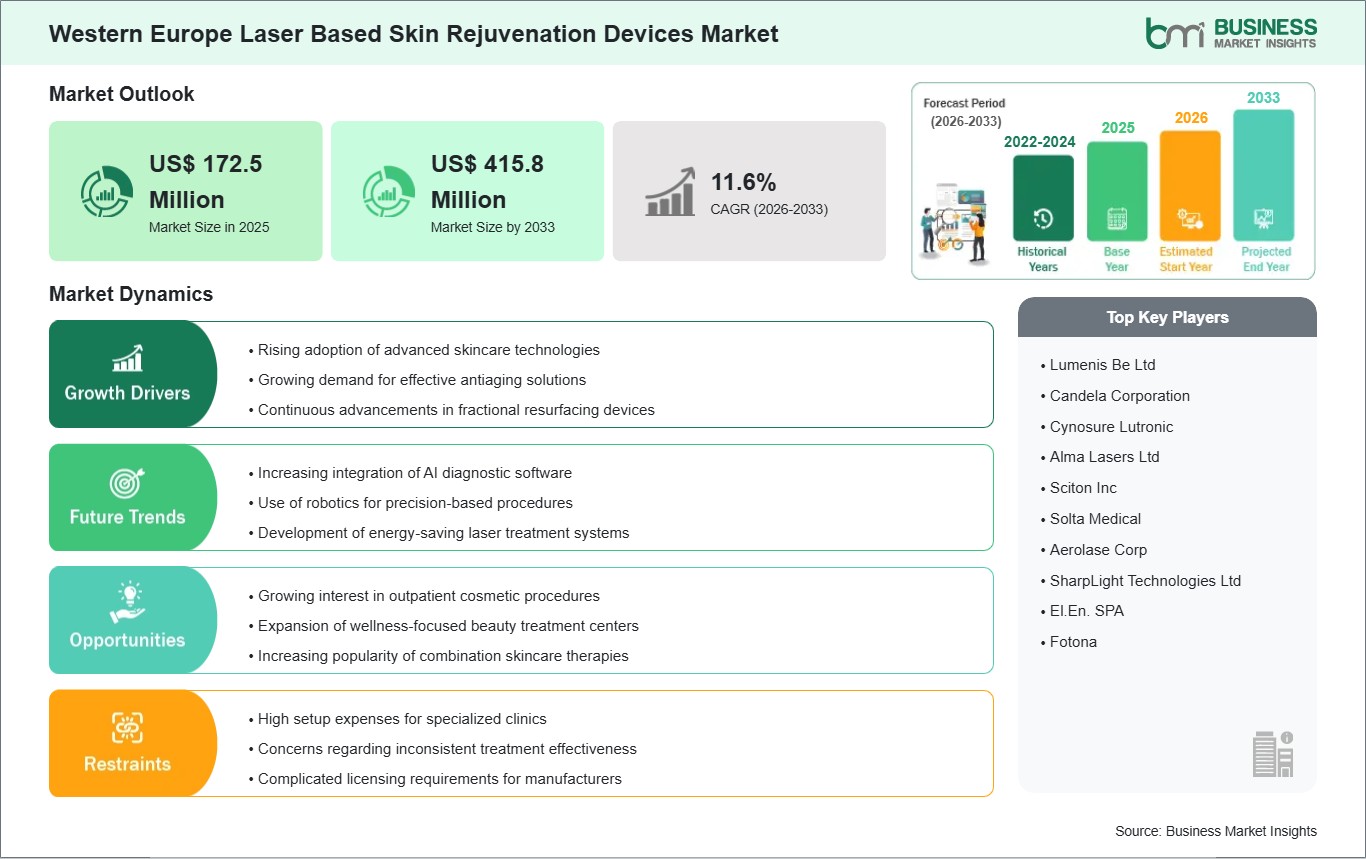
The Western Europe laser based skin rejuvenation devices market size is expected to reach US$ 415.8 million by 2033 from US$ 172.5 million in 2025. The market is estimated to record a CAGR of 11.6% from 2026 to 2033.
The Western Europe laser-based skin rejuvenation devices market is evolving within a distinctly regulated, quality-driven healthcare framework, where clinical validation, physician expertise, and long-term device reliability take precedence over purely price-based purchasing decisions. Demand patterns are increasingly shifting toward skin health maintenance rather than purely aesthetic correction. This shift is driving the adoption of sophisticated wavelength-selective devices that use selective photothermolysis to target vessels, pigments, and surface texture abnormalities with improved tissue selectivity. Another notable trend is the growing role of laser therapy in treating various chronic skin disorders, including erythematous lesions in rosacea, post-inflammatory hyperpigmentation, and sun damage—applications that have now surpassed their traditional cosmetic role.
The competitive market environment is heavily influenced by procurement practices in hospital-based dermatology clinics and academic skin centers, where device selection is strongly guided by scientific research findings and long-term performance data. As a result, clinical trials and endorsements from dermatological societies have become key areas of focus for manufacturers. A significant shift in the operational landscape is the emergence of centralized aesthetic procedure facilities in urban areas, which utilize high-throughput laser systems to improve efficiency and reduce per-procedure costs. Sustainability has become an increasingly important consideration, with clinics favoring energy-efficient equipment and devices with long-lasting components. Although the field is technologically mature, it continues to evolve through innovations such as real-time skin imaging, adaptive pulsed laser operation, and AI-assisted selection of optimal treatment parameters.

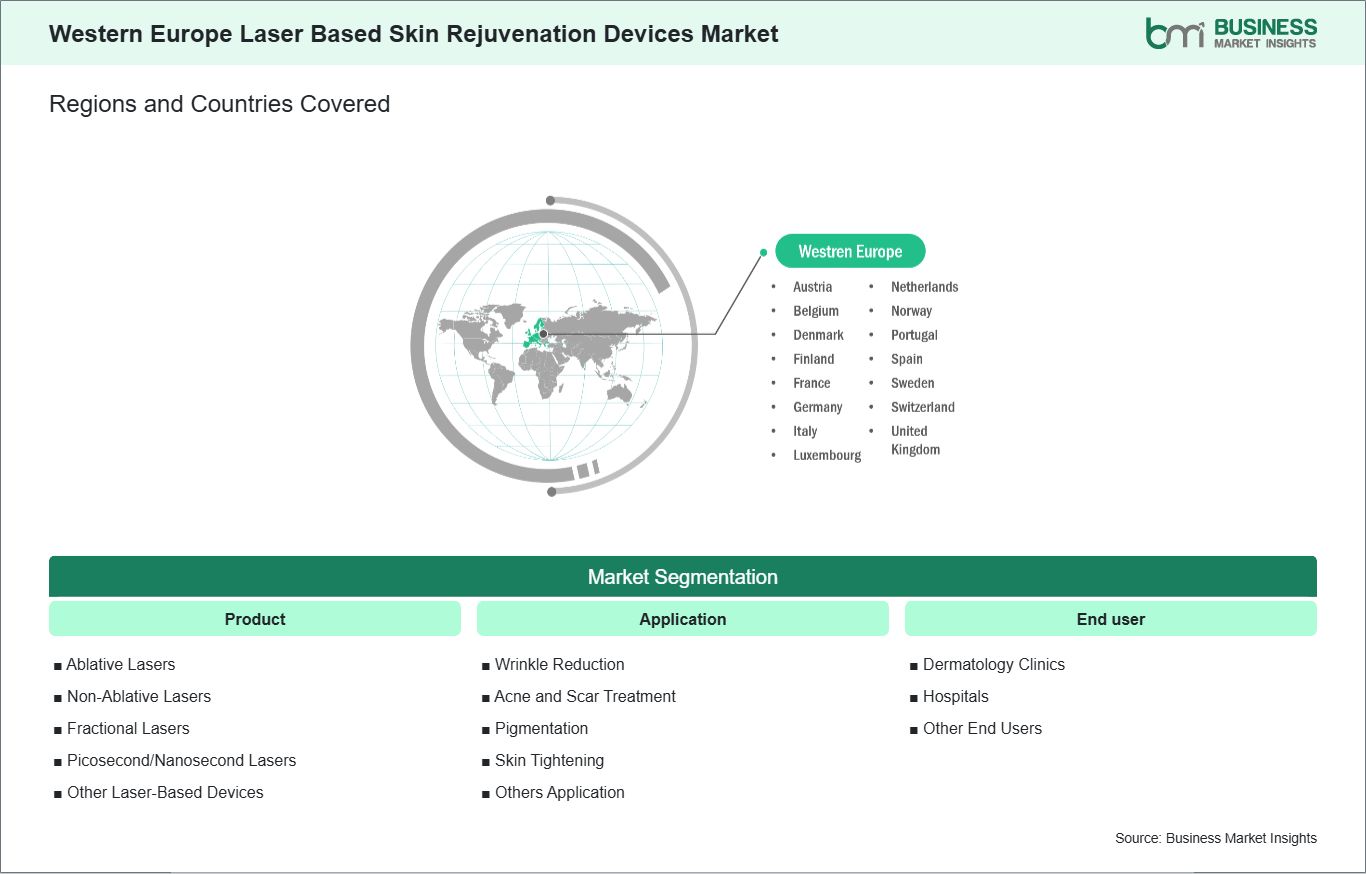
Key segments that contributed to the derivation of the Western Europe laser based skin rejuvenation devices market analysis are product, application, and end user.
The laser-based skin rejuvenation devices market in Western Europe is strongly shaped by continuous technological refinement, especially across Germany, the UK, France, Italy, and Spain. Aesthetic clinics are increasingly migrating toward highly efficient fractional lasers, picosecond technologies, and combined platforms utilizing different wavelengths in order to boost their efficiency and minimize the time necessary for recovery. German clinics represent an example of the rapid transition to such technologies due to a well-developed system of dermatology and considerable per capita expenditure in the sector of aesthetic treatment.
Innovation in the UK and France is centered on growing demand for less invasive procedures, including skin resurfacing, pigmentation correction, and skin smoothing. Integrated systems have been introduced in aesthetic medicine practices in London, where laser treatments are combined with other technologies such as ultrasound and radio frequency to enable multilevel skin rejuvenation within a single session. In France, advanced dermatology devices have gained greater acceptance in major cities such as Paris and Lyon, as patient preferences increasingly favor no-downtime procedures with rapid results. In this context, innovation focuses on enhancing comfort, reducing recovery time, and ensuring the suitability of procedures across different skin types.
In Western Europe, another important development is the growing popularity of multifunctional laser platforms with high energy efficiency. Clinics in Italy and Spain are increasingly adopting laser systems capable of performing a range of procedures, including acne scar treatment, removal of vascular lesions, and skin tightening, all within a single platform. This improves equipment utilization efficiency and helps reduce overall treatment costs. Additionally, the introduction of digital user interfaces, artificial intelligence–based calibration, and real-time feedback from the skin surface enhances treatment accuracy.
In Western Europe, investments in cosmetic dermatology research are driven by both private aesthetic companies and publicly funded healthcare innovation programs, with strong contributions from key regional markets.
Germany and France are at the forefront of research into laser-based technologies for tissue regeneration and pigmentation correction. Germany's thriving medical devices sector is characterized by close collaboration among universities, dermatological hospitals, and laser technology companies, which supports the development of next-generation skin-rejuvenating systems. In France, alongside its research initiatives, there is a strong clinical focus on advancing laser applications for skin health and improving treatment outcomes across diverse patient groups.
In the UK, research funding in cosmetic dermatology has been significantly influenced by the rapid growth of medical aesthetics in urban centers such as London and Manchester. This has led to an increasing number of clinical studies on laser skin resurfacing combined with complementary rejuvenation approaches, including skin boosters and collagen-stimulating treatments. This trend reflects a broader shift toward regenerative aesthetics, where the emphasis extends beyond surface-level improvement to long-term enhancement of skin quality.
In France, Italy, and Spain, rising demand for anti-aging and pigmentation correction therapies is driving increased investment in dermatology research. Laboratories in these countries are focusing on improving laser safety across different skin types, minimizing post-treatment complications, and enhancing overall therapeutic effectiveness for age-related skin conditions. Additionally, cosmetic manufacturers are actively collaborating with hospitals to develop more personalized and customized treatment protocols.

The Western Europe laser based skin rejuvenation devices market demonstrates steady growth, with size and share analysis highlighting evolving trends and competitive dynamics among key players. The report examines subsegments categorized within product, application, and end user, offering insights into their contribution to overall market performance.
By product, the non-ablative lasers segment dominated the market in 2025, driven by a strong preference for minimally invasive procedures with reduced downtime, improved safety, and effective collagen stimulation for skin rejuvenation.
Based on application, the wrinkle reduction segment dominated the market in 2025, driven by an aging population, rising demand for anti-aging aesthetic procedures, and increasing adoption of noninvasive laser-based treatments to improve skin texture and elasticity.
In terms of end user, the dermatology clinics segment dominated the market in 2025, driven by the rapid expansion of private aesthetic dermatology centers and high patient preference for specialized, physician-led laser treatments in outpatient clinical settings.
| Report Attribute | Details |
|---|---|
| Market size in 2025 | US$ 172.5 Million |
| Market Size by 2033 | US$ 415.8 Million |
| CAGR (2026 - 2033) | 11.6% |
| Historical Data | 2022-2024 |
| Forecast period | 2026-2033 |
| Segments Covered | By Product
|
|
Regions and Countries Covered
| |
| Western Europe | Belgium, the Netherlands, Luxembourg, Germany, France, Italy, Spain, Switzerland, Sweden, Austria, the United Kingdom, Denmark, Portugal, Norway, Finland |
| Market leaders and key company profiles |
|
The "Western Europe Laser Based Skin Rejuvenation Devices Market Size and Forecast (2022–2033)" report provides a detailed analysis of the market covering below areas:
The geographical scope of the Western Europe laser based skin rejuvenation devices market report is divided into Belgium, the Netherlands, Luxembourg, Germany, France, Italy, Spain, Switzerland, Sweden, Austria, the UK, Denmark, Portugal, Norway, and Finland. Germany held the largest share in 2025.
The market in Germany is distinguished by its engineering-oriented healthcare culture, where laser devices are evaluated heavily on precision control, safety engineering, and reproducibility of outcomes. Dermatology institutions in the country often integrate laser platforms into structured treatment algorithms for medically indicated dermatologic conditions, making clinical interoperability and documentation compatibility key purchasing criteria. There is also a strong emphasis on operator certification, leading to slower but highly standardized technology adoption cycles. France demonstrates a strong aesthetic dermatology culture influenced by a preference for understated enhancement and preservation of natural facial expression.
Clinics are increasingly investing in low-ablation and collagen-induction laser technologies that focus on gradual tissue regeneration rather than aggressive resurfacing. The regulatory environment encourages conservative treatment approaches, which have shaped demand toward devices offering fine parameter control and reduced complication profiles. The UK exhibits a highly commercialized private aesthetics sector, where competitive differentiation among clinics drives rapid turnover of advanced laser platforms. Practices frequently adopt combination treatment models, pairing laser resurfacing with energy-based skin tightening and injectable procedures to enhance patient retention. Market demand is also influenced by strong consumer awareness and high expectations for visible yet subtle results.
Italy shows a growing concentration of boutique dermatology clinics specializing in pigmentation correction and photoaging management, particularly in metropolitan and coastal regions with high sun exposure. Meanwhile, Spain is experiencing increasing procedural uptake driven by lifestyle-oriented aesthetic care and expansion of outpatient cosmetic services, with clinics emphasizing quick-recovery laser treatments suited to high patient throughput models. Across Western Europe, the market is increasingly defined by clinical sophistication, procedural diversification, and a strong alignment between dermatological science and aesthetic outcomes.

The Western Europe laser based skin rejuvenation devices market is evaluated by gathering qualitative and quantitative data post primary and secondary research, which includes important corporate publications, association data, and databases. A few of the key developments in the Western Europe laser based skin rejuvenation devices market are:
The Western Europe Laser Based Skin Rejuvenation Devices Market is valued at US$ 172.5 Million in 2025, it is projected to reach US$ 415.8 Million by 2033.
As per our report Western Europe Laser Based Skin Rejuvenation Devices Market, the market size is valued at US$ 172.5 Million in 2025, projecting it to reach US$ 415.8 Million by 2033. This translates to a CAGR of approximately 11.6% during the forecast period.
The Western Europe Laser Based Skin Rejuvenation Devices Market report typically cover these key segments-
The historic period, base year, and forecast period can vary slightly depending on the specific market research report. However, for the Western Europe Laser Based Skin Rejuvenation Devices Market report:
The Western Europe Laser Based Skin Rejuvenation Devices Market is populated by several key players, each contributing to its growth and innovation. Some of the major players include:
The Western Europe Laser Based Skin Rejuvenation Devices Market report is valuable for diverse stakeholders, including:
Essentially, anyone involved in or considering involvement in the Western Europe Laser Based Skin Rejuvenation Devices Market value chain can benefit from the information contained in a comprehensive market report.
Please tell us your area of interest
(Market Segments/ Regions and Countries/ Companies)