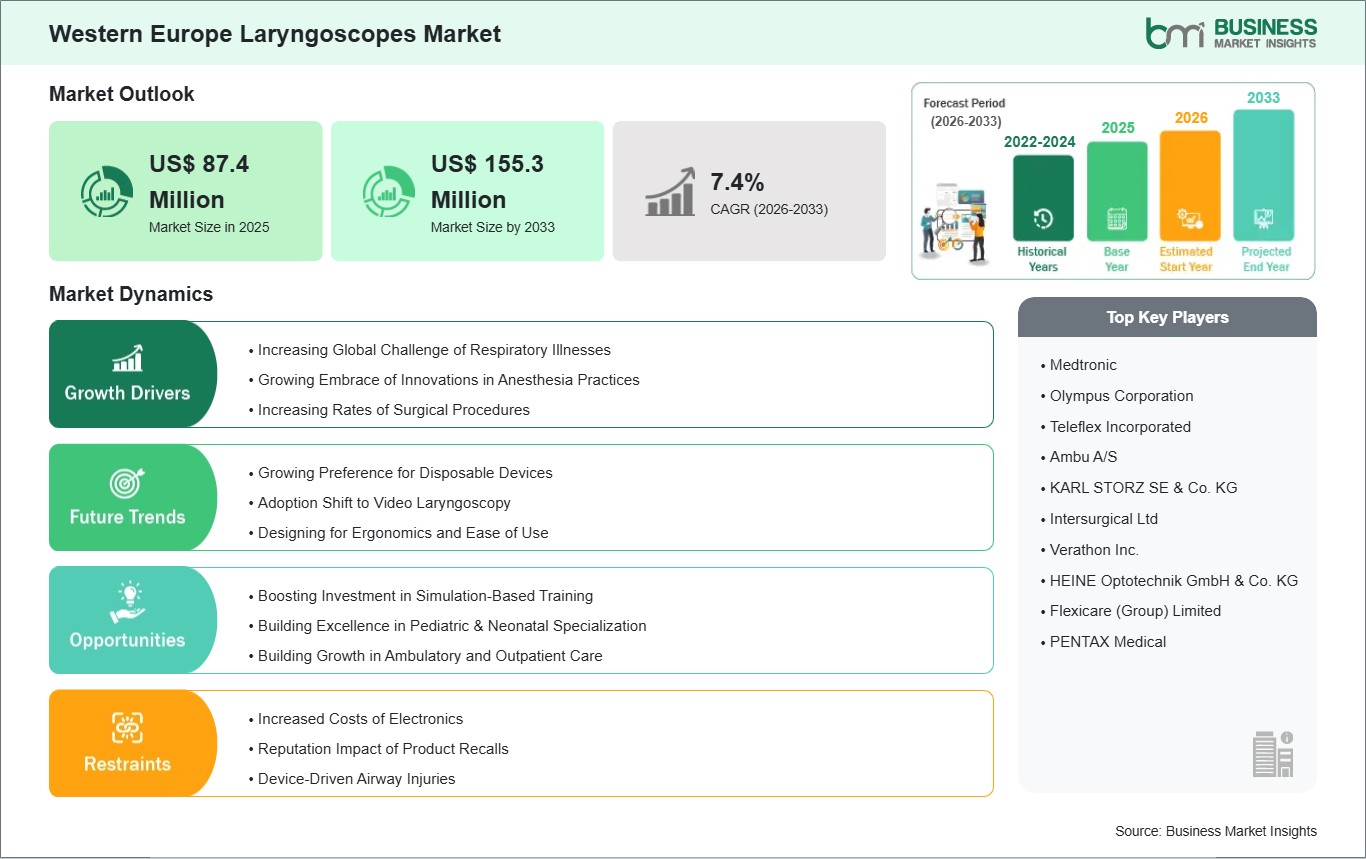
The Western Europe laryngoscopes market size is expected to reach US$ 155.3 million by 2033 from US$ 87.4 million in 2025. The market is estimated to record a CAGR of 7.4% from 2026 to 2033.
The Western Europe laryngoscope market consists of a relatively mature and innovative healthcare sector wherein the main drivers behind laryngoscope demand stem from the high level of technological advancement and rigorous patient safety standards. High uptake levels of novel airway management technologies, specifically video and fiber-optic laryngoscopes, have been reported for the region due to the growing complexity of surgical procedures and the necessity to optimize intubation procedures at hospitals.
High levels of technological advancement and development of the healthcare infrastructure in the region ensure fast and efficient introduction of new products and technologies used in hospitals, ambulatory surgical centers, and emergency medical services. Increasing incidences of respiratory diseases and the growing share of the elderly population also contribute to a stable demand for airway management products, such as laryngoscopes.
However, the high cost involved in acquiring and maintaining advanced laryngoscopes is likely to pose challenges to their broader adoption, especially within publicly funded healthcare institutions. The continuous need for clinical education in the use of advanced video-assisted devices will further complicate the matter, especially within small-scale health institutions. The Western Europe market is experiencing a steady growth trend, backed by robust regulations, high clinical awareness, and consistent healthcare reforms.

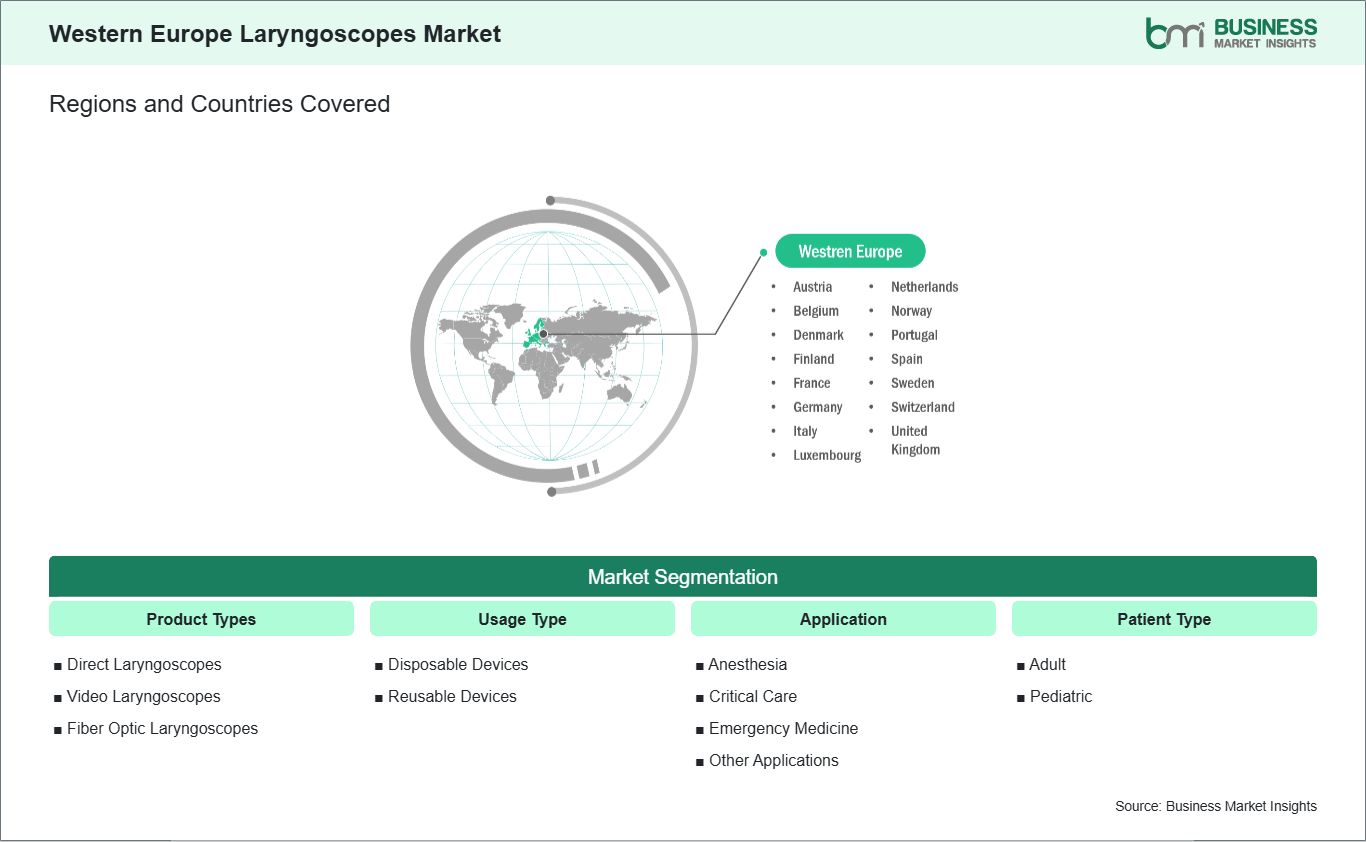
Key segments that contributed to the derivation of the Western Europe laryngoscopes market analysis are product type, usage type, application, patient type, and end user.
Western Europe's laryngoscopes market is influenced by the rising prevalence of respiratory diseases, which are associated with an aging population, environmental exposure, and lifestyles. There are increasing cases of chronic respiratory diseases such as asthma, COPD, and breathing problems associated with sleep, which put continuous strain on the surgical operations and emergency departments. Moreover, seasonal respiratory infections and complications resulting from viral infections will keep adding up to the number of airway emergencies necessitating rapid responses and intubation services.
There are increasing numbers of surgical operations and critical admissions in healthcare facilities in Western Europe, which mostly involve patients with compromised respiratory capabilities. Therefore, the need for laryngoscopes has become increasingly common in operating theaters, ICUs, and emergency departments. There are also rising incidences of difficult airway cases that are attributed to other medical conditions, such as obesity and heart conditions.
Another key factor is the growing emphasis on early and safe airway management in pre-hospital and emergency transport settings. With increasing demand for rapid response care, clinicians are prioritizing devices that improve first-pass intubation success rates. This has led to a gradual shift toward more advanced laryngoscopy solutions that offer better visualization and reduced procedural risk, strengthening overall market demand in the region.
Western Europe is witnessing a steady expansion in simulation-based medical training, particularly in high-risk clinical procedures such as airway management. Medical institutions are increasingly integrating simulation into anesthesia, emergency medicine, and critical care education to ensure clinicians are better prepared for real-life intubation challenges. This approach is helping standardize skill development and reduce variability in procedural outcomes.
The emphasis on patient safety and minimizing any avoidable mistakes in medical care is another primary factor behind this trend. Training programs in simulations allow practicing challenging airway procedures without any harm to the patient, which helps learners develop their decision-making skills. In complicated cases, when the slightest mistake may influence the outcome, this approach is particularly useful.
Moreover, there has been a considerable investment in sophisticated simulation devices, such as realistic mannequins, virtual reality training, and integrated digital simulation systems. These devices help to recreate the most accurate conditions of surgery and emergencies for practitioners. As professionals become acquainted with new equipment in simulations, they begin to use advanced airway scopes in their practices, contributing to further market expansion.

The Western Europe Laryngoscopes market demonstrates steady growth, with size and share analysis highlighting evolving trends and competitive dynamics among key players. The report evaluates important subsegments categorized within product type, usage type, application, patient type, and end user, highlighting their respective contributions to overall market performance.
By product type, the video laryngoscopes subsegment dominated the laryngoscopes market in 2025. This is driven by the increasing demand for enhanced airway visualization, improved first-pass intubation success rates, and reduced complications in difficult airway management, making them a key revenue driver for manufacturers and supporting strong adoption in clinical practice.
In terms of usage type, the disposable devices subsegment led the market in 2025. The dominance of disposable devices is attributed to the growing emphasis on infection control, prevention of cross-contamination, and the operational convenience of eliminating reprocessing and sterilization requirements in high-volume healthcare settings.
Based on application, the anesthesia subsegment held the largest share in 2025. Hospitals and surgical centers widely rely on laryngoscopes during anesthesia procedures for airway management and intubation, supported by the rising number of surgeries and the increasing use of advanced airway management techniques.
In terms of patient type, the adult subsegment dominated the market in 2025. This is driven by the higher prevalence of surgical procedures, critical care admissions, and chronic respiratory conditions among adults, resulting in greater demand for airway management devices in this population group.
By end user, the hospitals subsegment held the largest share in 2025. Hospitals maintain leadership due to their advanced infrastructure, availability of skilled healthcare professionals, high patient inflow, and strong capability to perform complex surgical and emergency procedures requiring laryngoscopy.
| Report Attribute | Details |
|---|---|
| Market size in 2025 | US$ 87.4 Million |
| Market Size by 2033 | US$ 155.3 Million |
| CAGR (2026 - 2033) | 7.4% |
| Historical Data | 2022-2024 |
| Forecast period | 2026-2033 |
| Segments Covered | By Product Types
|
|
Regions and Countries Covered
| |
| Western Europe | Belgium, Netherlands, Luxembourg, Germany, France, Italy, Spain, Switzerland, Sweden, Austria, United Kingdom, Denmark, Portugal, Norway, Finland |
| Market leaders and key company profiles |
|
The "Western Europe Laryngoscopes Market Size and Forecast (2022-2033)" report provides a detailed analysis of the market covering below areas:
The geographical scope of the Western Europe Laryngoscopes market report is divided into: Belgium, the Netherlands, Luxembourg, Germany, France, Italy, Spain, Switzerland, Sweden, Austria, the UK, Denmark, Portugal, Norway, and Finland. Germany held the largest share in 2025.
Germany is the dominant force in the Western Europe laryngoscopes market due to the well-developed healthcare system and technological advances in medical equipment in the country. Germany features a sophisticated network of hospitals with state-of-the-art surgical and intensive care facilities, which contributes to the use of standard and technologically advanced laryngoscopes in the country.
The German market of laryngoscopes is supported by the fact that there is a considerable number of surgeries performed in Germany, along with an increasing rate of chronic and respiratory conditions, for which it will be necessary to provide airway treatment. Moreover, there are healthcare facilities that focus on accurate diagnosis and treatment of patients, ensuring that video laryngoscopes are quickly adopted in practice. There are numerous factors facilitating the adoption of laryngoscopes in Germany, such as the advanced regulatory framework, well-developed reimbursement practices, and constant investments in the modernization of hospitals and training of anesthesiologists and emergency physicians. Nonetheless, cost considerations are still present at some of the publicly financed hospitals, which affects purchasing decisions in favor of reusable products. Germany continues to play an important role as an innovation and adoption center in the Western European region.

The Western Europe Laryngoscopes market is evaluated by gathering qualitative and quantitative data post primary and secondary research, which includes important corporate publications, association data, and databases. A few of the key developments in the Western Europe laryngoscopes market are:
The Western Europe Laryngoscopes Market is valued at US$ 87.4 Million in 2025, it is projected to reach US$ 155.3 Million by 2033.
As per our report Western Europe Laryngoscopes Market, the market size is valued at US$ 87.4 Million in 2025, projecting it to reach US$ 155.3 Million by 2033. This translates to a CAGR of approximately 7.4% during the forecast period.
The Western Europe Laryngoscopes Market report typically cover these key segments-
The historic period, base year, and forecast period can vary slightly depending on the specific market research report. However, for the Western Europe Laryngoscopes Market report:
The Western Europe Laryngoscopes Market is populated by several key players, each contributing to its growth and innovation. Some of the major players include:
The Western Europe Laryngoscopes Market report is valuable for diverse stakeholders, including:
Essentially, anyone involved in or considering involvement in the Western Europe Laryngoscopes Market value chain can benefit from the information contained in a comprehensive market report.
Please tell us your area of interest
(Market Segments/ Regions and Countries/ Companies)