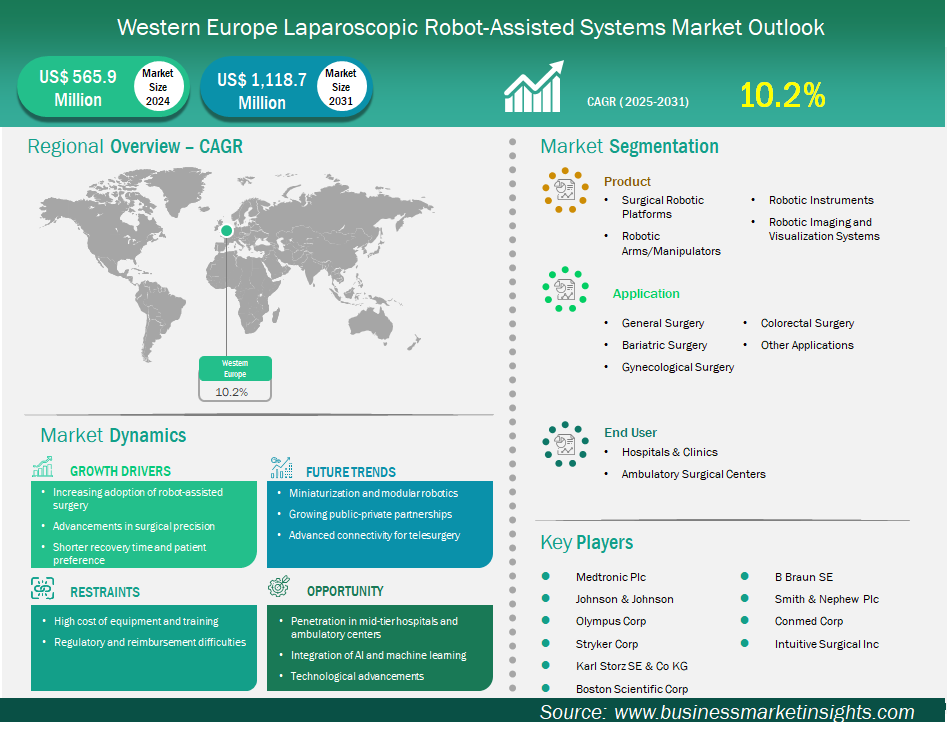
The Western Europe laparoscopic robot-assisted systems market size is expected to reach US$ 1,118.7 million by 2031 from US$ 565.9 million in 2024. The market is estimated to record a CAGR of 10.2% from 2025 to 2031.
Executive Summary and Western Europe Laparoscopic Robot-Assisted Systems Market Analysis:
The laparoscopic robot-assisted systems market in Western Europe is experiencing significant growth driven by increasing adoption of robot-assisted surgery, advancements in surgical precision, and shorter recovery times and patient preference. The laparoscopic robot-assisted systems market in Western Europe is gradually expanding owing to the progressive medical technology, healthcare investments, and the demand for minimally invasive surgeries. Germany, France, and the United Kingdom are majorly responsible for the trend in the use of robot-assisted systems that find application in almost all the surgical specialties, like general surgery, urology, and gynecology. These countries are heavily investing in healthcare facilities and education with the main emphasis on surgical simulation training as a method to train healthcare professionals and patient safety assurance. The market is represented by a diverse range of products. Of these, surgical robotic platforms constitute the most significant segment and are the core technology that brings about a multitude of precision robot-assisted surgical procedures in different specialties. As the largest volume of minimally invasive surgeries is carried out, clinical protocols are well established, and surgeons are proficient in the region, general surgery has become the leading application segment. On the other hand, hospitals and clinics are the major end-user groups as they have a complex healthcare infrastructure network, centralized surgery centers, and the capability to make expensive investments in advanced robotic technologies. While the market is on an upward trajectory, there is still a challenge of a high initial capital requirement, the need for skilled maintenance on a regular basis, and specialized training programs. Also, reimbursement schemes, although advantageous, differ from one Western European country to another, and they have a significant impact on procurement decisions. Nevertheless, it is this firm commitment of the region to health innovation and technology integration that positions it as a leader in the deployment of laparoscopic robot-assisted systems.
Western Europe Laparoscopic Robot Assisted Systems Market Segmentation Analysis:
Key segments that contributed to the derivation of the laparoscopic robot-assisted systems market analysis are product, application, and end user.
- By product, the laparoscopic robot-assisted systems market is segmented into surgical robotic platforms, robotic arms/manipulators, robotic instruments, and robotic imaging and visualization systems. The surgical robotic platforms segment dominated the market in 2024. This is the largest segment due to its role as the core infrastructure, integrating robotic arms, instruments, and imaging technologies, which enables a wide range of precision robot-assisted surgical procedures across various specialties.
- In terms of application, the market is segmented into general surgery, bariatric surgery, gynecological surgery, colorectal surgery, and other applications. The general surgery segment held the largest market share in 2024. This is the largest segment due to the broad range of common procedures performed with robotic assistance, such as cholecystectomy, hernia repair, and colorectal surgeries, which benefit from improved visualization, precision, and reduced invasiveness.
- By end user, the market is segmented into hospitals and clinics, and ambulatory surgical centers. The hospitals and clinics segment held the largest market share in 2024. This is the largest segment due to their comprehensive surgical services and capacity to invest in advanced technologies, enhancing surgical outcomes and patient care.
Western Europe Laparoscopic Robot-Assisted Systems Market Outlook
The rise in the incidence of chronic diseases such as colorectal cancer, obesity, and gynecological conditions will lead to the need for minimally invasive treatments, thus the increased use of robotic assistance will be propelled. One of the primary reasons healthcare practitioners are increasingly adopting robotic surgery systems is that these innovations can significantly enhance the precision and overall quality of surgical procedures. The incorporation of AI, advanced imaging technologies, and augmented reality are key areas contributing to these improvements. Such technologies not only enable better surgical planning but also provide real-time decision support, which leads to improved patient care.
In addition, the introduction of value-based healthcare systems is one of the factors that increases the usage of technology that demonstrates measurable benefits in patient outcomes and cost-effectiveness. Hybrid financing models such as leasing, pay-per-use, and outcome-based payment arrangements are in place to address the issue of the high initial investment gradually and to allow mid-sized hospitals to be on the same level of access. The issue of skill shortages is addressed by enhancing surgeon training through simulation centers, virtual reality components, and collaborative networks, which leads to broader adoption. Nevertheless, obstacles in the form of economic uncertainty, import duties, and differences between urban and rural healthcare delivery still remain. With the removal of these obstacles, the market will transition from early adopter countries to a wider mix of geographical and clinical areas, supported by technological, financial, and educational resources. The creation of strategic partnerships between governments, private sector players, and institutions will, therefore, be instrumental in facilitating adoption and sustainable growth in this region.
Western Europe Laparoscopic Robot-Assisted Systems Market Country Insights
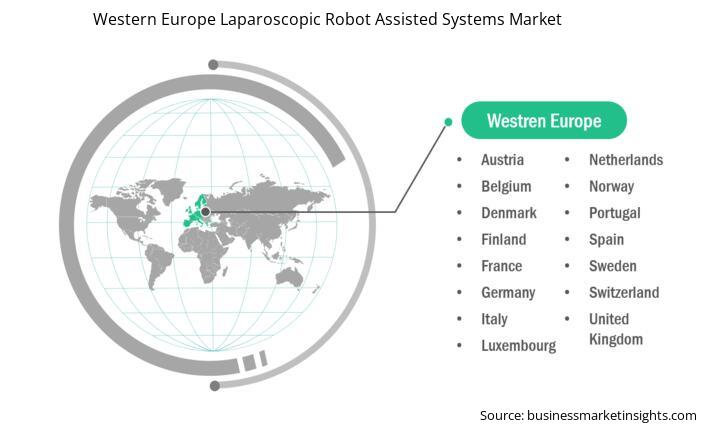
Based on country, the Western Europe laparoscopic robot-assisted systems market is segmented into Belgium, the Netherlands, Luxembourg, Germany, France, Italy, Spain, Switzerland, Sweden, Austria, the United Kingdom, Denmark, Portugal, Norway, and Finland. Germany held the largest share in 2024.
Across Western Europe, the dynamics at the country level provide a diverse setting for the adoption and use of laparoscopic robot-assisted systems. Germany is at the forefront of the adoption of robotic surgery, mainly because of its relatively well-developed regulatory environment, a strong private healthcare market, and a large number of tertiary hospitals equipped with robots. In general, the country has made high investments to demonstrate its commitment to the adoption of sophisticated medical technologies. France's market is driven by robust private hospital networks, emerging medical tourism, and forward-looking regulatory authorities. However, reimbursement policies are still at the stage of evolution, as are the differences in adoption rates between urban and rural areas. The United Kingdom is likewise witnessing a sharp rise in demand for bariatric operations, with forecasts pointing to a considerable increase in the near future. Throughout the region, the prices and availability are affected by foreign exchange volatilities and import tariffs, and suppliers have to come up with tailored business models to tackle the economic conditions in each country. To support clinical adoption and training surgeons, it is equally important to have local distribution partnerships and collaboration with academic institutions. The culture around robot-assisted surgical procedures is gradually changing, where more patients are becoming aware of and demanding minimally invasive treatments. Each country shows an increased level of interest in localizing parts of the supply chain and service operations to enhance their efficiency and better meet their needs.
Western Europe Laparoscopic Robot Assisted Systems Market Company Profiles
Medtronic Plc; Johnson & Johnson; Olympus Corp; Stryker Corp; Karl Storz SE & Co KG, Boston Scientific Corp, B Braun SE, Smith & Nephew Plc, Conmed Corp, and Intuitive Surgical Inc., are among the key players operating in the market. These players adopt strategies such as expansion, product innovation, and mergers and acquisitions to stay competitive in the market and offer innovative products to their consumers.
Western Europe Laparoscopic Robot-Assisted Systems Market Research Methodology:
The following methodology has been followed for the collection and analysis of data presented in this report:
Secondary Research
The research process begins with comprehensive secondary research, utilizing both internal and external sources to gather qualitative and quantitative data for each market. Commonly referenced secondary research sources include, but are not limited to:
- Company websites, annual reports, financial statements, broker analyses, and investor presentations
- Industry trade journals and other relevant publications
- Government documents, statistical databases, and market reports
- News articles, press releases, and webcasts specific to companies operating in the market
Note: All financial data included in the Company Profiles section has been standardized to US$. For companies reporting in other currencies, figures have been converted to US$ using the relevant exchange rates for the corresponding year.
Primary Research
Business Market Insights conducts a significant number of primary interviews each year with industry stakeholders and experts to validate and analyze the data and gain valuable insights. These research interviews are designed to:
- Refine findings from secondary research
- Enhance the expertise and market understanding of the analysis team
- Gain insights into market size, trends, growth patterns, competitive dynamics, and future prospects
Primary research is conducted via email interactions and telephone interviews with industry experts across various markets, categories, segments, and sub-segments in different regions. Participants typically include:
- Industry stakeholders: Vice Presidents, business development managers, market intelligence managers, and national sales managers
- External experts: Valuation specialists, research analysts, and key opinion leaders with industry-specific expertise
Key Sources Referred:
- World Health Organization (WHO)
- The World Bank Group
- Worldometer
- The Lancet
- BMC Medical Education
- Eurostat
Western Europe Laparoscopic Robot Assisted Systems Market Strategic Insights
Western Europe Laparoscopic Robot Assisted SystemsMarket Report Highlights
| Report Attribute | Details |
| Market size in 2024 | US$ 565.9 Million |
| Market Size by 2031 | US$ 1,118.7 Million |
| CAGR (2025 - 2031) | 10.2% |
| Historical Data | 2021-2023 |
| Forecast period | 2025-2031 |
| Segments Covered |
By Product
|
|
Regions and Countries Covered
|
|
| Western Europe | Belgium, Netherlands, Luxembourg, Germany, France, Italy, Spain, Switzerland, Sweden, Austria, United Kingdom, Denmark, Portugal, Norway, Finland |
| Market leaders and key company profiles |
|
Western Europe Laparoscopic Robot Assisted Systems Market Country and Regional Insights