The Western Europe high intensity focused ultrasound market size is expected to reach US$ 583.1 million by 2033 from US$ 264.4 million in 2025. The market is estimated to register a CAGR of 10.4% from 2026 to 2033.
The Western Europe high intensity focused ultrasound market is characterized by strong technological adoption, well-established healthcare infrastructure, and a high degree of clinical specialization. HIFU is utilized as a minimally invasive treatment option across oncology, urology, and gynecology, offering the benefits of precise targeting, reduced complications, and shorter recovery periods compared to conventional surgical procedures. Market growth is driven by the region’s focus on innovation and patient-centered care, where hospitals and specialized medical centers integrate advanced imaging and therapy devices to optimize treatment outcomes. Collaborative research initiatives and clinical trials across European institutions support evidence-based adoption and the development of standardized treatment protocols. However, widespread adoption is moderated by high capital investment requirements, the need for specialized operator training, and stringent regulatory approval processes that can extend the time between device introduction and routine clinical use. Varying reimbursement policies across Western European countries can affect access to HIFU treatments in smaller hospitals. The region remains an innovation hub for minimally invasive therapies, and increasing awareness among clinicians and patients positions HIFU as a key growth segment in Western Europe’s advanced healthcare landscape.

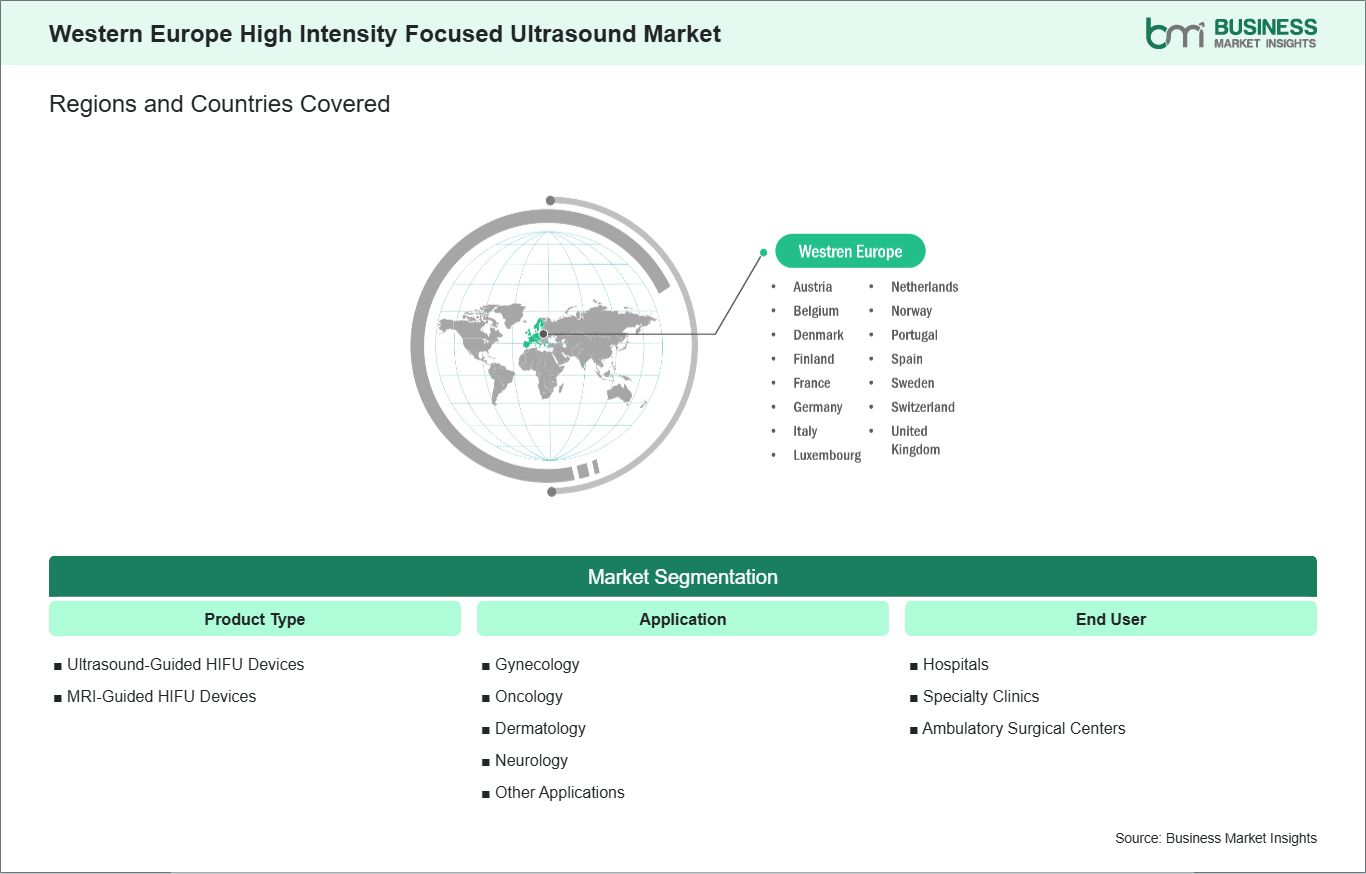
Key segments that contributed to the derivation of the Western Europe high intensity focused ultrasound market analysis are product type, application, and end user.
Healthcare systems across Western Europe are showing increasing interest in non‑invasive ablation options such as high intensity focused ultrasound as clinicians seek alternatives to traditional surgery. In major treatment centers, physicians are turning to HIFU for conditions such as uterine fibroids, localized tumors, and select soft‑tissue abnormalities where surgical intervention can mean longer hospital stays and higher complication risks. By delivering energy focus without incisions, HIFU allows patients to recover more quickly and return to their routines sooner, that often highlighted in patient care strategies throughout the region.
Clinicians in Western Europe have also been integrating focused ultrasound into multi‑disciplinary therapeutic protocols that combine imaging and intervention. Radiologists and surgeons leverage real‑time visualization during ablation treatments, improving procedural precision and confidence. This collaborative approach has encouraged broader acceptance of HIFU in clinical settings that emphasize evidence‑based therapy and procedural safety, especially in centers of excellence that serve both local and regional patient populations.
Ongoing professional training and cross‑institution knowledge sharing are reinforcing HIFU’s role in minimally invasive care. Hospitals are organizing hands‑on workshops and case review sessions where physicians can exchange insights on patient selection, workflow optimization, and post‑procedure management. As familiarity with focused ultrasound technologies increases, so does clinician confidence helping noninvasive ablation options become a more common component of therapeutic offerings across Western Europe.
Outside of therapeutic uses, HIFU is gaining strong momentum in the aesthetic and cosmetic sector across Western Europe. Clinics specializing in dermatology and cosmetic medicine are incorporating focused ultrasound to deliver non‑surgical skin tightening, facial contouring, and body rejuvenation treatments. These solutions appeal to patients who want visible cosmetic benefits without the downtime, scarring, or risk associated with traditional surgical procedures, fitting well with the region’s broader consumer preference for minimally invasive beauty treatments.
Practitioners in the region are also blending HIFU with complementary non‑invasive technologies such as radiofrequency energy, microneedling‑based systems, and advanced light therapies, to design comprehensive rejuvenation regimens. This multi‑modality strategy allows clinicians to customize treatment plans for a range of skin concerns including laxity, fine lines, and texture irregularities. Many clinics highlight HIFU’s collagen‑stimulating effects as part of personalized anti‑aging packages that underscore natural‑looking improvements.
Consumer awareness and savvy choice are shaping the aesthetic uptake of HIFU, with patients often researching options online and sharing treatment experiences on social media and beauty forums. Clinics are responding by enhancing educational outreach, offering consultations, before‑and‑after galleries, and informational content that help set realistic expectations. As familiarity with focused ultrasound grows among beauty‑focused audiences, HIFU is steadily establishing itself as a trusted and mainstream choice within Western Europe’s expanding aesthetic landscape.

The Western Europe high intensity focused ultrasound market demonstrates consistent growth, with market size and share analysis reflecting evolving treatment preferences and competitive dynamics among leading players. The report evaluates important subsegments categorized within product type, application, and end user, highlighting their respective contributions to overall market performance.
By product type, the ultrasound-guided HIFU devices subsegment dominated the market in 2025. This is driven by the recurring need for precise and reliable imaging during HIFU procedures, which ensures accurate targeting and effective ablation of tissues, making these devices a key revenue driver for manufacturers and sustaining consistent demand in clinical settings.
In terms of application, the gynecology subsegment led the market in 2025. The dominance of gynecology applications is attributed to the rising prevalence of uterine fibroids and adenomyosis, growing adoption of noninvasive treatment methods, and increasing awareness among healthcare providers of HIFU’s effectiveness in providing safe, minimally invasive therapeutic options for women’s health conditions.
Based on end user, the hospitals subsegment held the largest share in 2025. Hospitals maintain leadership due to their well-established gynecology and surgical departments, access to advanced HIFU equipment, trained medical staff, and the capability to perform complex procedures while providing comprehensive patient care.
| Report Attribute | Details |
|---|---|
| Market size in 2025 | US$ 204.7 Million |
| Market Size by 2033 | US$ 465.8 Million |
| CAGR (2026 - 2033) | 10.8% |
| Historical Data | 2022-2024 |
| Forecast period | 2026-2033 |
| Segments Covered | By Product Type
|
|
Regions and Countries Covered
| |
| Western Europe | Belgium, Netherlands, Luxembourg, Germany, France, Italy, Spain, Switzerland, Sweden, Austria, United Kingdom, Denmark, Portugal, Norway, Finland |
| Market leaders and key company profiles |
|
The "Western Europe High Intensity Focused Ultrasound Market Size and Forecast (2022–2033)" report provides a detailed analysis of the market covering below areas:
The geographical scope of the Western Europe high intensity focused ultrasound market report is divided into: Belgium, the Netherlands, Luxembourg, Germany, France, Italy, Spain, Switzerland, Sweden, Austria, the UK, Denmark, Portugal, Norway, and Finland. Germany held the largest share in 2025.
Germany dominates the Western Europe HIFU market, reflecting its reputation as a leader in advanced medical technologies and clinical research. German hospitals, particularly in metropolitan areas such as Berlin, Munich, and Hamburg, have integrated HIFU systems into treatment protocols for localized cancers, prostate disorders, and uterine fibroids, with an emphasis on noninvasive, patient-friendly therapies. The country’s healthcare system, known for its high standards of clinical practice, encourages adoption of evidence-based innovations and supports long-term studies to evaluate HIFU efficacy. Germany also benefits from strong collaborations between hospitals, universities, and medical device manufacturers, fostering continuous development of device technology and treatment techniques. Patient demand for minimally invasive procedures with lower risk profiles and faster recovery times fuels adoption, especially in private and specialized clinics. Key challenges include ensuring uniform access to HIFU across urban and rural regions and addressing high equipment costs within hospital budgets. Nonetheless, Germany’s combination of infrastructure sophistication, clinical expertise, and research-driven adoption solidifies its position as the regional leader, influencing HIFU deployment and treatment standards throughout Western Europe.

The Western Europe high intensity focused ultrasound market is evaluated by gathering qualitative and quantitative data post primary and secondary research, which includes important corporate publications, association data, and databases. A few of the key developments in the Western Europe High Intensity Focused Ultrasound market are:
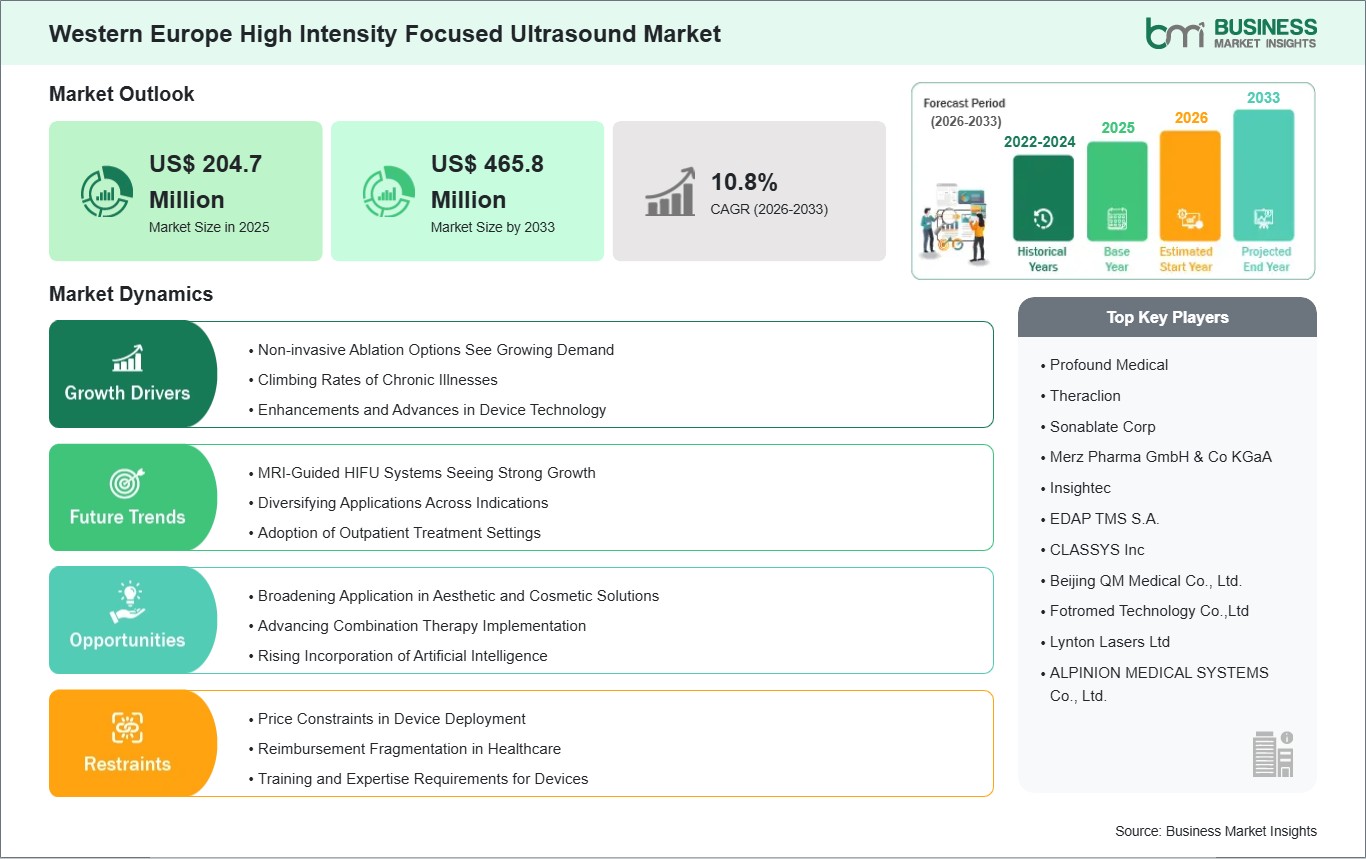
The Western Europe High Intensity Focused Ultrasound Market is valued at US$ 204.7 Million in 2025, it is projected to reach US$ 465.8 Million by 2033.
As per our report Western Europe High Intensity Focused Ultrasound Market, the market size is valued at US$ 204.7 Million in 2025, projecting it to reach US$ 465.8 Million by 2033. This translates to a CAGR of approximately 10.8% during the forecast period.
The Western Europe High Intensity Focused Ultrasound Market report typically cover these key segments-
The historic period, base year, and forecast period can vary slightly depending on the specific market research report. However, for the Western Europe High Intensity Focused Ultrasound Market report:
The Western Europe High Intensity Focused Ultrasound Market is populated by several key players, each contributing to its growth and innovation. Some of the major players include:
The Western Europe High Intensity Focused Ultrasound Market report is valuable for diverse stakeholders, including:
Essentially, anyone involved in or considering involvement in the Western Europe High Intensity Focused Ultrasound Market value chain can benefit from the information contained in a comprehensive market report.
Please tell us your area of interest
(Market Segments/ Regions and Countries/ Companies)