Market Summary
Executive Summary and Global Market Analysis
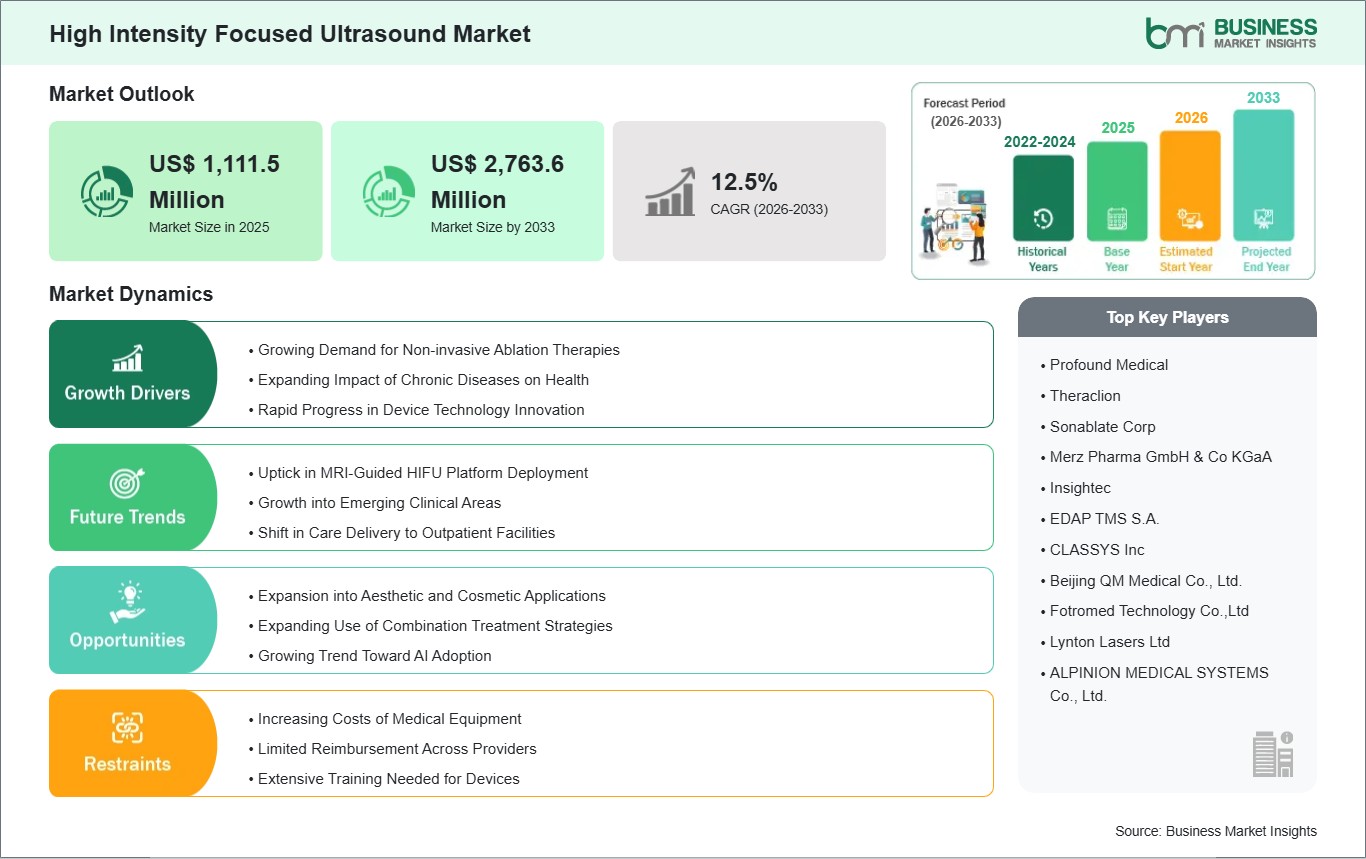
The high intensity focused ultrasound (HIFU) market is witnessing steady expansion as healthcare providers adopt noninvasive therapeutic technologies. HIFU uses focused ultrasound energy to ablate targeted tissue without the need for surgical incisions, making it an attractive option across oncology, urology, gynecology, and aesthetic medicine. Growing demand for minimally invasive treatment alternatives is supporting market expansion. Patients and clinicians are favoring treatments that reduce hospitalization time, lower complication risks, and accelerate recovery, which has positioned HIFU as a promising alternative to conventional surgical and radiation-based procedures. In oncology applications, the technology is gaining attention for tumor ablation in prostate, liver, pancreatic, and uterine conditions, while in aesthetics, it is widely used for skin tightening and body contouring.
Technological advancements are strengthening the market landscape. Integration of real-time imaging guidance, particularly ultrasound and MRI-guided systems, has improved treatment precision and safety. Healthcare providers in developed economies are incorporating HIFU platforms into specialized treatment centers and ambulatory care settings. However, the market faces certain restraints. High capital investment requirements for advanced HIFU equipment can limit adoption among smaller hospitals and clinics, particularly in developing healthcare systems. Regulatory complexities and varying clinical acceptance across therapeutic indications can slow the pace of commercialization. Despite these barriers, expanding clinical research and broader therapeutic indications are expected to sustain the long-term growth trajectory of the HIFU market.
Segment Analysis
High Intensity Focused Ultrasound Market Segmentation
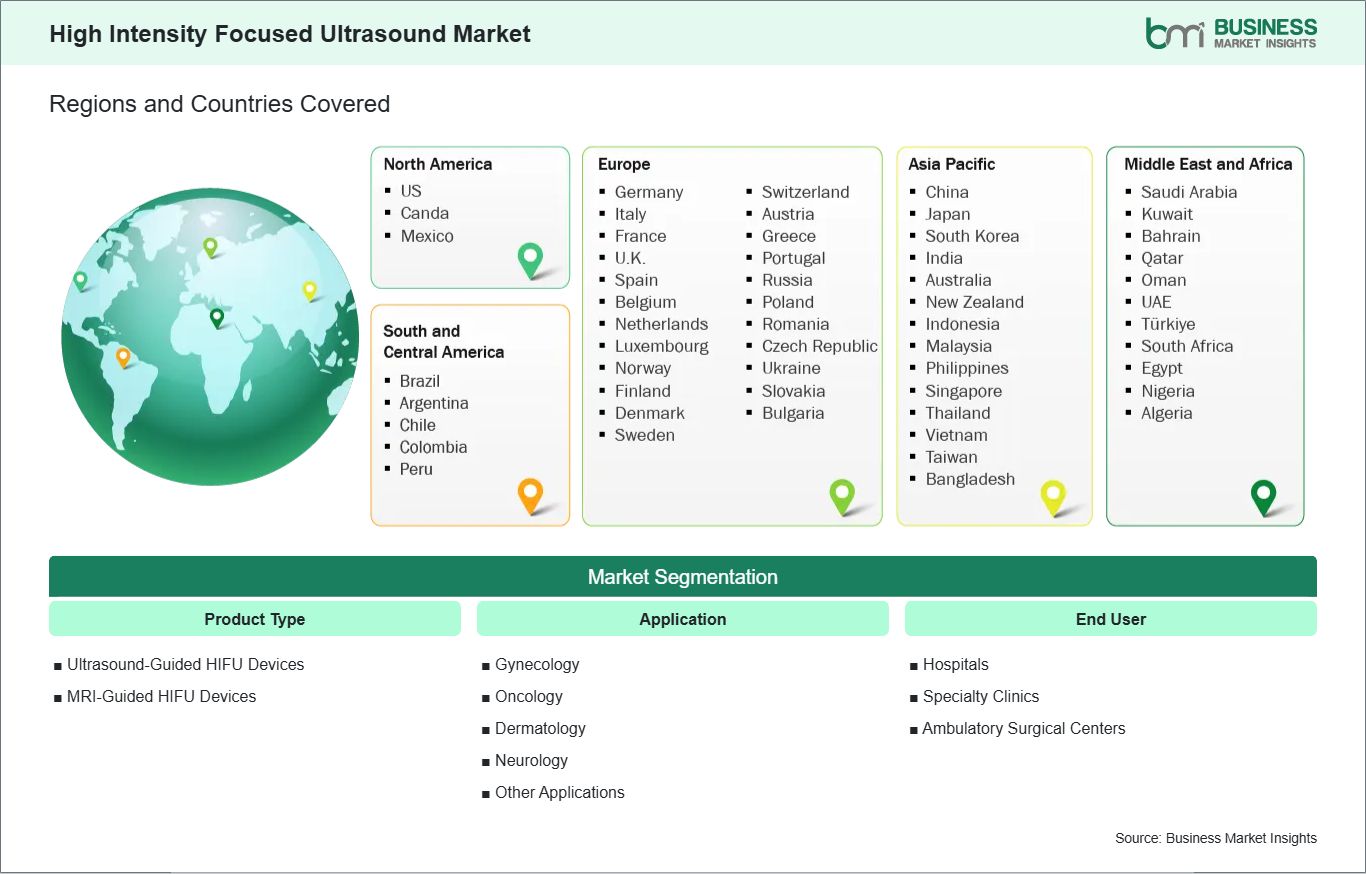
Key segments that contributed to the derivation of the high intensity focused ultrasound market analysis are product type, application, and end user.
- By product type, the high intensity focused ultrasound market is segmented into ultrasound-guided HIFU devices and MRI-guided HIFU devices. The ultrasound-guided HIFU devices segment dominated the market in 2025.
- Based on application, the high intensity focused ultrasound market is classified into gynecology, oncology, dermatology, neurology, and other applications. The gynecology segment dominated the market in 2025.
- In terms of end user, the high intensity focused ultrasound market is categorized into hospitals, specialty clinics, and ambulatory surgical centers. The hospitals segment dominated the market in 2025.
Market Forces
High Intensity Focused Ultrasound Market Drivers and Opportunities
Rising Prevalence of Chronic Diseases
The increasing prevalence of chronic diseases is contributing to the growth of the High Intensity Focused Ultrasound (HIFU) market. Chronic conditions such as cancer, neurological disorders, and gynecological diseases continue to place a significant burden on healthcare systems worldwide. As healthcare providers seek treatment options that minimize surgical risks and recovery times, noninvasive technologies such as HIFU are gaining greater acceptance in clinical practice. The ability of HIFU to precisely target diseased tissue without damaging surrounding structures makes it an attractive option for both physicians and patients.
In oncology care, HIFU is recognized as an alternative or complementary treatment method for localized tumors. Hospitals and specialized treatment centers are adopting ultrasound-based ablation technologies to address growing patient demand for minimally invasive procedures. The technology is particularly valuable in cases where conventional surgery may not be suitable due to patient age, health conditions, or tumor location. As healthcare systems emphasize patient-centered care and improved treatment outcomes, HIFU is becoming an important component of modern therapeutic strategies for chronic disease management.
The rising incidence of gynecological and neurological conditions is also expanding the clinical applications of HIFU technology. Noninvasive treatment options for uterine fibroids and movement disorders are gaining attention among healthcare professionals who aim to reduce hospital stays and surgical complications. With increasing awareness of noninvasive therapeutic solutions and the continuous advancement of ultrasound-guided treatment technologies, the HIFU market is expected to benefit from the growing demand for effective and less invasive chronic disease treatments.
Expansion into Aesthetic and Cosmetic Applications
The growing use of high-intensity focused ultrasound in aesthetic and cosmetic procedures is emerging as an important driver of market expansion. Dermatology clinics and medical aesthetic centers are increasingly incorporating HIFU technology into their treatment offerings due to its ability to deliver skin tightening and lifting effects without surgical intervention. The technology works by stimulating collagen production within deeper layers of the skin, allowing practitioners to address concerns such as skin laxity and wrinkles through noninvasive procedures.
Consumer preferences are shifting toward cosmetic treatments that require minimal downtime and involve lower procedural risks. As a result, nonsurgical facial rejuvenation and body contouring procedures have gained popularity in the global aesthetic industry. HIFU devices provide a convenient option for individuals seeking visible cosmetic improvements without undergoing invasive surgery. This trend is encouraging aesthetic clinics to invest in advanced ultrasound-based treatment systems to meet the rising demand for noninvasive cosmetic services.
The expansion of medical aesthetics markets across multiple regions is also contributing to the adoption of HIFU technology. Increasing awareness of aesthetic treatments, growing interest in preventive skincare, and the influence of social media have all contributed to higher demand for innovative cosmetic procedures. In response, manufacturers are developing specialized HIFU devices designed specifically for dermatology and aesthetic applications. As the beauty and wellness industry continues to evolve, the integration of HIFU technology into cosmetic practice is expected to remain a significant growth opportunity for the market.
Size and Share Analysis
High Intensity Focused Ultrasound Market Size and Share Analysis
The high intensity focused ultrasound market is experiencing steady growth, with market size and share analysis reflecting evolving treatment preferences and competitive dynamics among key players. The report evaluates important subsegments categorized within product type, application, and end user, highlighting their respective contributions to overall market performance.
By product type, the ultrasound-guided HIFU devices subsegment dominated the market in 2025. This is driven by the growing demand for real-time imaging guidance during high-intensity focused ultrasound procedures, which enables physicians to target and monitor tissues during treatment precisely. The integration of ultrasound imaging improves procedural accuracy, enhances safety, and minimizes damage to surrounding healthy tissues, making these devices essential for effective therapy delivery and a key revenue driver for manufacturers.
In terms of application, the gynecology subsegment dominated the market in 2025. The leadership of gynecology applications is attributed to the increasing prevalence of uterine fibroids and adenomyosis, rising preference for noninvasive treatment options, and growing awareness among healthcare providers about the clinical benefits of HIFU therapy. The technology is widely used for treating uterine fibroids and other gynecological conditions due to its ability to provide precise tissue ablation without surgical incisions.
Based on end user, the hospitals subsegment dominated the market in 2025. Hospitals maintain a stronghold due to their well-established gynecology and surgical departments, access to advanced HIFU treatment systems, trained physicians and clinical staff, and the capability to perform specialized procedures with comprehensive patient care and monitoring facilities.
Report Coverage
High Intensity Focused Ultrasound Market Report Coverage and Deliverables
The "High Intensity Focused Ultrasound Market Size and Forecast (2022–2033)" report provides a detailed analysis of the market covering below areas:
- High Intensity Focused Ultrasound market size and forecast at global, regional, and country levels for all the key market segments covered under the scope
- High Intensity Focused Ultrasound market trends, as well as drivers, restraints, and opportunities
- High Intensity Focused Ultrasound market analysis covering key trends, regional framework, major players, regulations, and recent developments
- Industry landscape and competition analysis covering market concentration, heat map analysis, prominent players, and recent developments for the High Intensity Focused Ultrasound market
- Detailed company profiles, including SWOT analysis
Geographic Insights
High Intensity Focused Ultrasound Market Geographic Insights
The geographical scope of the high intensity focused ultrasound market report is divided into five regions: North America, Asia Pacific, Europe, Middle East & Africa, and South & Central America. The high intensity focused ultrasound market in North America is expected to grow during the forecast period.
North America represents the dominant regional market for high intensity focused ultrasound, supported by advanced healthcare infrastructure, early technology adoption, and strong clinical research capabilities. The region has witnessed increasing integration of HIFU platforms within specialty hospitals, cancer treatment centers, and aesthetic clinics. Healthcare providers in the US and Canada are exploring noninvasive therapeutic alternatives to conventional surgical procedures, particularly for prostate cancer, uterine fibroids, and certain liver tumors. The presence of leading medical device manufacturers, research institutions, and regulatory pathways that support clinical innovation has contributed to the region’s leadership in the global market. Another key factor driving the North American market is the growing demand for outpatient and minimally invasive procedures. Patients are seeking treatments that minimize recovery time and hospital stays, which aligns with the clinical advantages offered by HIFU therapies. In addition, aesthetic medicine has become an application in the region, with dermatology and cosmetic clinics incorporating ultrasound-based technologies for facial lifting and skin tightening treatments. The region also benefits from strong investments in medical technology development and clinical trials evaluating new therapeutic uses for focused ultrasound. Academic medical centers are collaborating with technology developers to expand the clinical evidence base for HIFU in neurological disorders, oncology, and pain management. While reimbursement coverage varies across indications, ongoing clinical validation and increasing physician familiarity with the technology continue to strengthen the adoption of HIFU systems.
Industry Activity
Recent Developments
The high intensity focused ultrasound market is evaluated by gathering qualitative and quantitative data post primary and secondary research, which includes important corporate publications, association data, and databases. A few of the key developments in the high intensity focused ultrasound market are:
- In November 2025, EDAP TMS announced that the latest enhancements to its Focal One robotic HIFU system received FDA 510(k) clearance, improving imaging and workflow capabilities for the treatment of prostate cancer.
- In October 2023, HistoSonics announced that it received U.S. FDA De Novo clearance for its Edison Histotripsy System, a noninvasive focused ultrasound platform designed to destroy liver tumors without surgery or radiation.
Trust & Transparency
Research Methodology
The market analysis combines proprietary research with secondary data from government agencies, company disclosures, regulatory filings, industry databases and expert interviews. Market estimates are validated through data triangulation, cross-market benchmarking and analyst
review.
View Full Research Methodology
Key Sources Referred:
The World Bank World Health Organization (WHO) Center for Disease Control and Prevention (CDC) Food and Drug Administration (FDA) European Database on Medical Devices (EUDAMED) European Society of Cardiology (ESC) American College of Cardiology (ACC) American Heart Association (AHA) Company Websites Company Annual Reports Company Investor Presentations