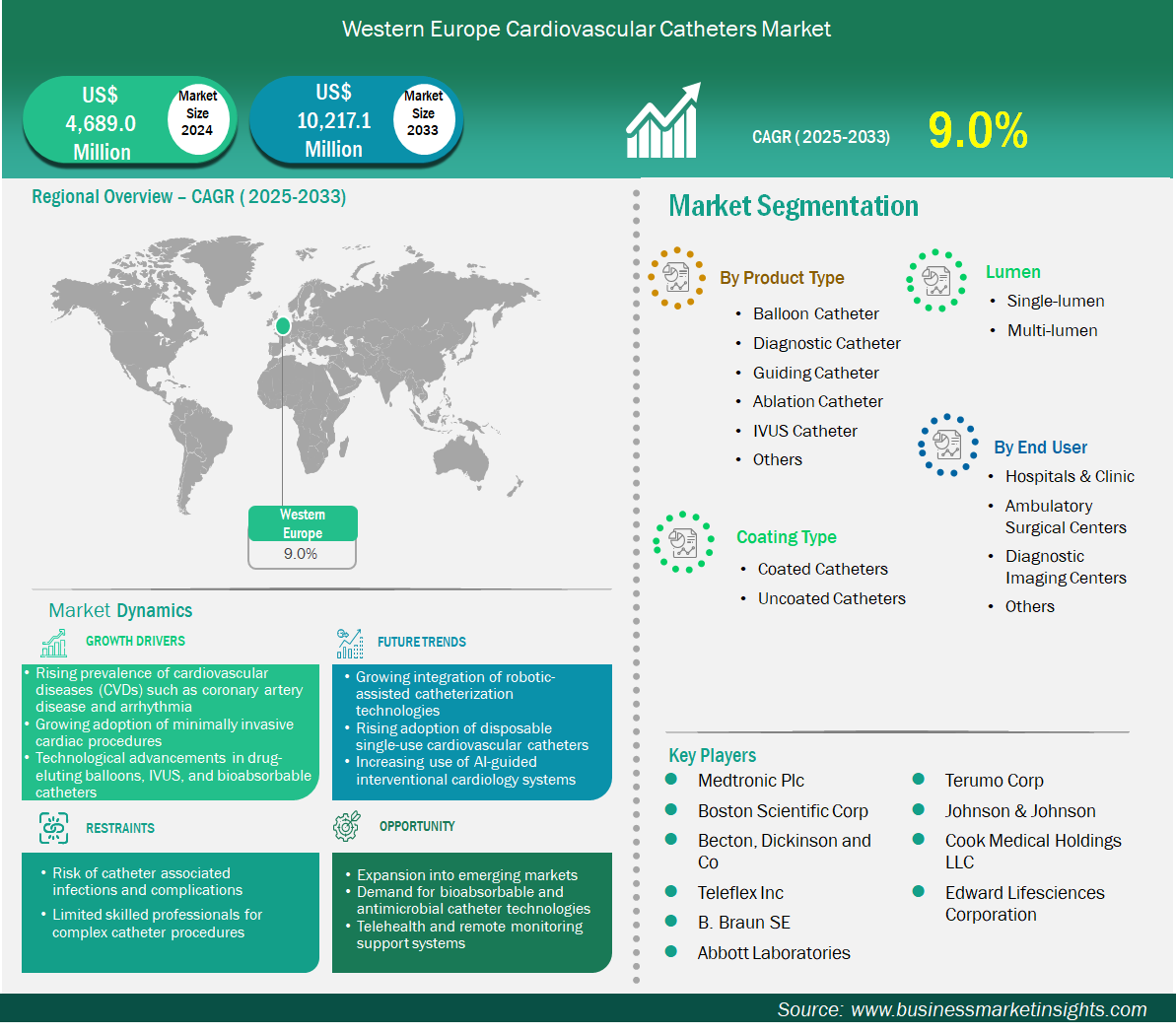
The Western Europe cardiovascular catheters market size is expected to reach US$ 10,217.1 million by 2033 from US$ 4,689.0 million in 2024. The market is estimated to record a CAGR of 9.0% from 2025 to 2033.
Executive Summary and Western Europe Cardiovascular Catheters Market Analysis:
The cardiovascular catheters market in Western Europe is experiencing significant growth driven by the rising prevalence of cardiovascular diseases (CVDs) such as coronary artery disease and arrhythmia, growing adoption of minimally invasive cardiac procedures, technological advancements in drug-eluting balloons, IVUS, and bioabsorbable catheters. The Western Europe cardiovascular catheters market is characterized by advanced healthcare infrastructure, strong regulatory oversight, and high adoption of minimally invasive procedures. Balloon catheters dominate, reflecting their central role in angioplasty, a procedure widely performed in Germany, France, and the UK. Coated catheters are gaining traction as EU MDR regulations prioritize biocompatibility and infection prevention, compelling manufacturers to innovate coatings that enhance patient safety. Multi‑lumen catheters are increasingly adopted in tertiary hospitals, particularly in Italy and Spain, where complex cardiovascular procedures are expanding. Hospitals and clinics remain the primary end‑users, supported by strong reimbursement frameworks and government initiatives to reduce cardiovascular mortality. From a competitive standpoint, European manufacturers such as B. Braun and Fresenius Kabi compete alongside global leaders like Medtronic and Abbott, creating a dynamic landscape defined by product differentiation and compliance. Market analysis highlights that Western Europe leads in premium adoption, while smaller nations such as Portugal and Austria are gradually scaling access through healthcare modernization programs. Overall, Western Europe’s market reflects a balance of innovation, regulation, and accessibility, positioning it as a critical region for global cardiovascular catheter strategies.
Western Europe Cardiovascular Catheters Market Segmentation Analysis:
Key segments that contributed to the derivation of the cardiovascular catheters market analysis are product, coating type, lumen, and end user.
- By product, the cardiovascular catheters market is segmented into balloon catheter, diagnostic catheter, guiding catheter, ablation catheter, IVUS catheter, and others. Balloon catheter dominated the market in 2024, driven by widespread use in angioplasty procedures across advanced cardiology centers in Western Europe.
- By coating type, the cardiovascular catheters market is segmented into coated catheters, uncoated catheters. Coated catheters dominated the market in 2024, driven by strict EU regulatory compliance and demand for infection‑resistant, biocompatible devices.
- By lumen, the market is segmented into single-lumen, multi-lumen. Multi-lumen dominated the market in 2024, driven by efficiency requirements in complex cardiovascular interventions at tertiary hospitals.
- By end user, the market is segmented into hospitals & clinics, ambulatory surgical centers, diagnostic imaging centers, and others. Hospitals & clinics dominated the market in 2024, driven by strong reimbursement systems and extensive network of specialized cardiac institutes.
Western Europe Cardiovascular Catheters Market Outlook
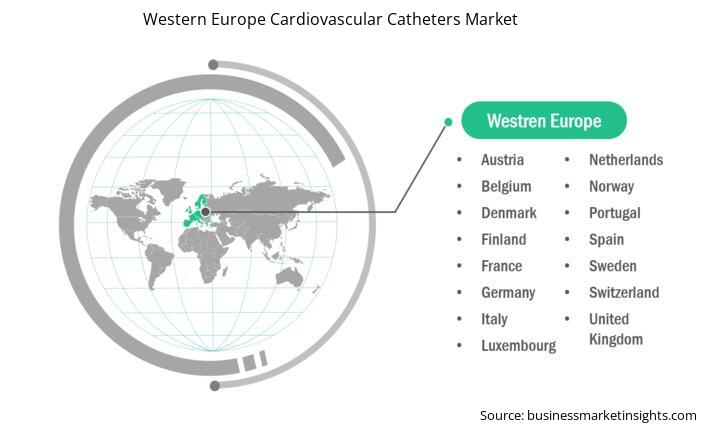
The Western Europe cardiovascular catheters market is segmented into Belgium, the Netherlands, Luxembourg, Germany, France, Italy, Spain, Switzerland, Sweden, Austria, the United Kingdom, Denmark, Portugal, Norway, and Finland. The outlook for Western Europe’s cardiovascular catheters market is shaped by demographic trends, regulatory evolution, and healthcare investment. Aging populations across Germany, France, and Italy will continue to drive demand for balloon and diagnostic catheters, while lifestyle‑related risk factors such as obesity and diabetes increase cardiovascular disease prevalence. Coated catheters are expected to see accelerated adoption, as infection control remains a priority under EU MDR compliance. Multi‑lumen catheters will gain traction in tertiary hospitals, where complex interventions require efficiency and precision. Strategic opportunities lie in expanding catheter use in outpatient centers, supported by reimbursement reforms and the shift toward value‑based care. Medical tourism in Spain and France will further boost demand for premium catheter products. From a business perspective, companies must balance innovation with affordability, tailoring portfolios to meet diverse needs across Western European markets. The long‑term outlook positions Western Europe as a growth engine, where regulatory compliance, product innovation, and strategic partnerships will define competitive advantage.
Western Europe Cardiovascular Catheters Market Country Insights
Based on region, the Western Europe cardiovascular catheters market is further segmented into Belgium, the Netherlands, Luxembourg, Germany, France, Italy, Spain, Switzerland, Sweden, Austria, the United Kingdom, Denmark, Portugal, Norway, and Finland. Germany held the largest share in 2024.
Country‑level dynamics in Western Europe reveal significant variation in adoption patterns. Germany leads the region, supported by advanced healthcare infrastructure, strong reimbursement frameworks, and continuous innovation from domestic manufacturers. Hospitals in Berlin and Munich are early adopters of coated and multi‑lumen catheters, reflecting demand for complex cardiovascular interventions. France emphasizes accessibility, with government programs ensuring broad availability of catheter‑based procedures, particularly balloon and diagnostic catheters. United Kingdom benefits from NHS initiatives that expand catheterization labs and tele‑cardiology services, making connected devices more accessible in rural areas. Italy is emerging as a dynamic market, where public‑private partnerships are expanding access to advanced catheter technologies, especially in urban centers. Spain follows a similar trajectory, with regional health authorities investing in catheter‑based programs to address rising rates of cardiovascular disease. Smaller countries such as Portugal, Austria, and Switzerland are scaling adoption through strong healthcare systems and mobile connectivity, integrating catheters into broader digital health strategies. Collectively, Western Europe’s country‑level dynamics highlight a composite of opportunities where localized approaches and strong distribution networks are essential for sustained success.
Western Europe Cardiovascular Catheters Market Company Profiles
Medtronic Plc, Boston Scientific Corp, Becton, Dickinson and Co, Teleflex Inc, B. Braun SE, Abbott Laboratories, Terumo Corp, Johnson & Johnson, Cook Medical Holdings LLC, Edward Lifesciences Corporation, are among the key players operating in the market. These players adopt strategies such as expansion, product innovation, and mergers and acquisitions to stay competitive in the market and offer innovative products to their consumers.
Western Europe Cardiovascular Catheters Market Research Methodology:
The following methodology has been followed for the collection and analysis of data presented in this report:
-
Secondary Research
The research process begins with comprehensive secondary research, utilizing both internal and external sources to gather qualitative and quantitative data for each market. Commonly referenced secondary research sources include, but are not limited to:
- Company websites, annual reports, financial statements, broker analyses, and investor presentations
- Industry trade journals and other relevant publications
- Government documents, statistical databases, and market reports
- News articles, press releases, and webcasts specific to companies operating in the market
Note: All financial data included in the Company Profiles section has been standardized to US$. For companies reporting in other currencies, figures have been converted to US$ using the relevant exchange rates for the corresponding year.
-
Primary Research
Business Market Insights conducts a significant number of primary interviews each year with industry stakeholders and experts to validate and analyze the data and gain valuable insights. These research interviews are designed to:
- Refine findings from secondary research
- Enhance the expertise and market understanding of the analysis team
- Gain insights into market size, trends, growth patterns, competitive dynamics, and future prospects
Primary research is conducted via email interactions and telephone interviews with industry experts across various markets, categories, segments, and sub-segments in different regions. Participants typically include:
- Industry stakeholders: Vice Presidents, business development managers, market intelligence managers, and national sales managers
- External experts: Valuation specialists, research analysts, and key opinion leaders with industry-specific expertise
Key Sources Referred:
- World Health Organization (WHO)
- World Heart Federation (WHF)
- Organisation for Economic Cooperation and Development (OECD)
- The World Bank Group
- Worldometer
- The Lancet
- International Bar Association
- International Trade Administration
- Eurostat
Western Europe Cardiovascular Catheters Market Strategic Insights
Western Europe Cardiovascular CathetersMarket Report Highlights
| Report Attribute | Details |
| Market size in 2024 | US$ 4,689.0 Million |
| Market Size by 2033 | US$ 10,217.1 Million |
| CAGR (2025 - 2033) | 9.0% |
| Historical Data | 2022-2023 |
| Forecast period | 2025-2033 |
| Segments Covered |
By Product
|
|
Regions and Countries Covered
|
|
| Western Europe | Belgium, Netherlands, Luxembourg, Germany, France, Italy, Spain, Switzerland, Sweden, Austria, United Kingdom, Denmark, Portugal, Norway, Finland |
| Market leaders and key company profiles |
|
Western Europe Cardiovascular Catheters Market Country and Regional Insights