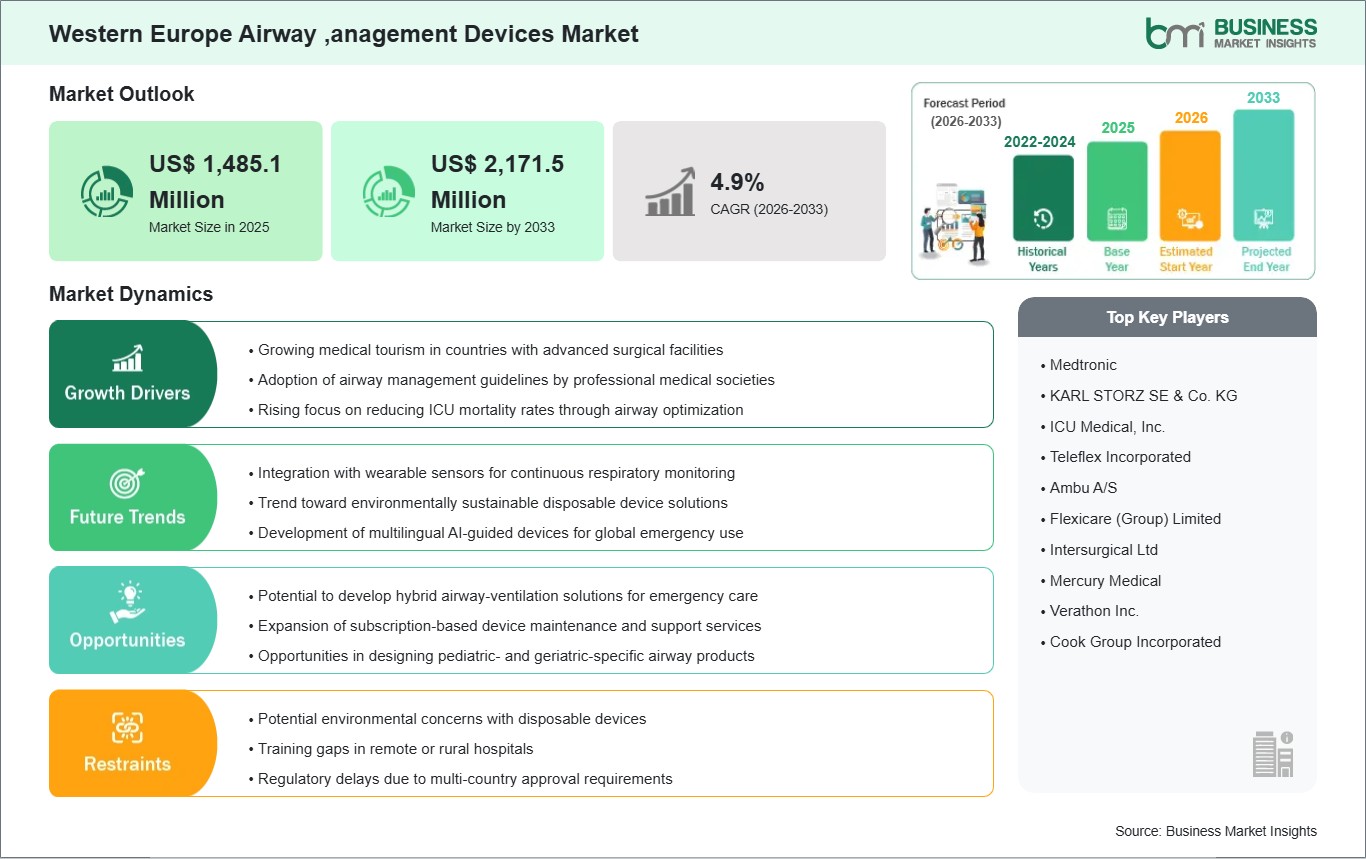
The Western Europe airway management devices market size is expected to reach US$ 2,171.5 million by 2033 from US$ 1,485.1 million in 2025. The market is estimated to record a CAGR of 4.9% from 2026 to 2033.
The Western Europe airway management devices market is characterized by highly advanced healthcare systems, strong regulatory frameworks, and widespread adoption of innovative technologies. Key countries in this region include Germany, France, the UK, Italy, and Spain, with Germany leading the market due to its sophisticated hospital infrastructure, high standards of clinical care, and early adoption of medical innovations. Market expansion is fueled by aging demographics, an increase in the number of surgeries being performed, and a focus on patient safety within the hospital setting and emergencies. Advanced airway management products such as video laryngoscopes, supraglottic airway devices, and one-use intubation kits are being used more frequently within German hospitals and those located in neighboring countries to improve procedure accuracy while reducing complications. In addition to hospitals, EMS units within the more populous areas are provided with airway management kits. However, the market faces several restraints, including high product costs, stringent regulatory approval processes, and the need for continuous professional training. These challenges particularly affect small and rural hospitals, which often face limited access to advanced airway management products. Despite these constraints, Western Europe remains a mature and highly innovative market, supported by strong medical infrastructure and significant investment in healthcare technology.

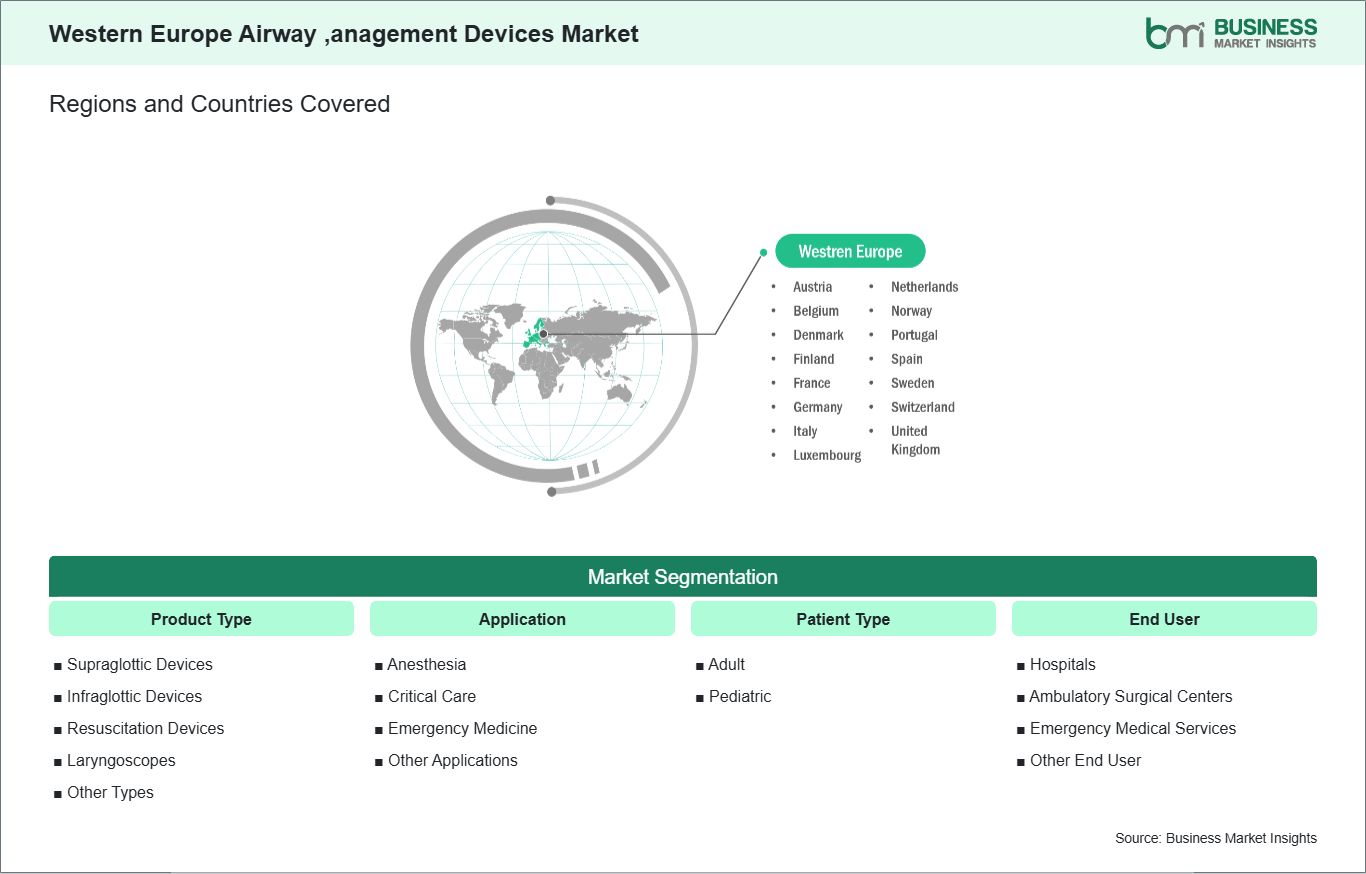
Key segments that contributed to the derivation of the Western Europe airway management devices market analysis are product type, application, patient type, and end user.
The airway management devices market in Western Europe has been experiencing favorable conditions due to the region's global reputation for high-quality surgical services. Patients from other countries frequently travel to Germany, France, and Switzerland for complex procedures such as cardiac bypass and bariatric surgeries. This influx increases demand for advanced airway management tools, including video laryngoscopes and advanced supraglottic airway devices. As a result, hospitals are compelled to invest in modern airway technologies to accommodate the growing number of international patients.
There have been reports of a significant increase in foreign patients at specialist centers in London and Manchester requiring thoracic and neurosurgical procedures. This influx of patients has increased demand for high-performance airway management devices, as these centers place strong emphasis on turnaround time and low complication rates. As a result, there is a growing preference for tools that enable first-pass intubation and minimize intraoperative complications.
Smaller hospitals in Western Europe are also contributing to competition by investing in advanced airway devices and surgical tools to attract foreign patients. Countries such as Spain and Italy have expanded medical tourism services, particularly in cosmetic and orthopedic surgeries. The adoption of modular airway device kits in these hospitals enables surgeons to manage a wide range of cases using a single system.
The airway management devices market in Western Europe is advancing through the development of ventilation devices designed for emergency use. EMS centers, as well as trauma centers from countries such as France and the Netherlands, are concentrating on airway management products that combine airway protection along with dynamic ventilation assistance. Hybrid approaches are expected to fill the gap existing between airway adjuncts and mechanical ventilators, helping paramedics as well as clinicians to provide proper respiratory assistance in emergencies.
The current development of healthcare practices in Germany and Belgium involves testing of portable hybrid devices that integrate supraglottic airway interfaces with adaptable ventilation protocols. The ability of EMS to stabilize a patient through securing the airway and adjusting ventilatory settings in response to physiological signals increases the chances of stabilizing respiratory and cardiopulmonary disorders before reaching a definitive medical facility. Ambulance's arrival times can differ in crowded cities such as Paris or Amsterdam. In such cases, an integrated approach to treatment improves chances of survival.
Furthermore, scientific efforts in Scandinavia focus on wearable hybrid devices that enable extended pre-hospital care while allowing patients to move without restriction. This is especially important in the case of rescue operations in Norway's fjords and the Swiss mountains, when access to the definitive healthcare facilities cannot be guaranteed promptly. Another promising innovation is the integration of telemetric monitoring into wearable hybrid devices, allowing EMS teams to transmit patient condition data to the receiving institution before arrival. Thus, wearable and portable hybrid airway-ventilation devices are expected to be a future trend in Western European medical practice.
The Western Europe airway management devices market is experiencing steady growth, with market size and share analysis reflecting evolving treatment preferences and competitive dynamics among key players. The report evaluates important subsegments categorized within product type, application, patient type, and end user, highlighting their respective contributions to overall market performance.
By product type, the infraglottic devices subsegment dominated the market in 2025. In anesthesia practice, the use of infraglottic devices ensures protection against aspiration and precise airway management, which drives higher adoption in operating rooms and critical care settings compared to supraglottic devices.
On the basis of application, the anesthesia subsegment dominated the market in 2025 due to its role in providing definitive airway control across a wide range of surgical procedures, from routine elective surgeries to complex interventions. Infraglottic devices are essential for intubation during anesthesia, leading to consistent, high-volume usage and making this the largest segment compared to emergency or general critical care.
In terms of patient type, the adult subsegment dominated the market in 2025 due to the higher incidence of conditions requiring intubation. Additionally, most procedural training, device designs, and usage guidelines are optimized for adult anatomy and clinical scenarios, reinforcing its higher market share.
Based on end user, the hospitals subsegment dominated the market in 2025. Hospitals are central hubs for airway management, handling scheduled surgeries, emergency admissions, ICU care, and trauma cases. Their larger budgets, need for extensive airway inventories, and availability of multidisciplinary professionals make them the largest purchasers of airway management devices compared to outpatient centers or EMS, where volume and purchasing power are lower.
| Report Attribute | Details |
|---|---|
| Market size in 2025 | US$ 1,485.1 Million |
| Market Size by 2033 | US$ 2,171.5 Million |
| CAGR (2026 - 2033) | 4.9% |
| Historical Data | 2022-2024 |
| Forecast period | 2026-2033 |
| Segments Covered | By Product Type
|
|
Regions and Countries Covered
| |
| Western Europe | Belgium, Netherlands, Luxembourg, Germany, France, Italy, Spain, Switzerland, Sweden, Austria, United Kingdom, Denmark, Portugal, Norway, Finland |
| Market leaders and key company profiles |
|
The "Western Europe Airway Management Devices Market Size and Forecast (2022–2033)" report provides a detailed analysis of the market covering below areas:
The geographical scope of the Western Europe Airway management devices market report is divided into: Belgium, the Netherlands, Luxembourg, Germany, France, Italy, Spain, Switzerland, Sweden, Austria, the UK, Denmark, Portugal, Norway, and Finland. Germany held the largest share in 2025.
Germany leads the Western Europe airway management devices industry because of its well-developed, innovative healthcare system and abundance of hospitals. Large hospitals located in major German cities such as Berlin, Munich, and Hamburg are among the pioneers in incorporating the latest advances in the field, which include video-assisted laryngoscopy, second-generation supraglottic airway devices, and disposable intubation equipment. Germany primarily leads because of a focus on professional training and technology implementation. Anesthesiologists, emergency personnel, and ICU specialists receive regular simulation training to ensure efficient use of airway devices, improving outcomes in both hospital and pre-hospital settings. Ambulance services are well organized, with urban units equipped with portable airway devices for rapid emergency response. Airway devices are also produced domestically at scale, supported by international cooperation for reliable supply. Standardized usage protocols and government initiatives to upgrade hospital equipment further strengthen Germany's position as the leading market in Western Europe.

The Western Europe airway management devices market is evaluated by gathering qualitative and quantitative data post primary and secondary research, which includes important corporate publications, association data, and databases. The following are among the key developments in the Western Europe airway management devices market:
The Western Europe Airway ,anagement Devices Market is valued at US$ 1,485.1 Million in 2025, it is projected to reach US$ 2,171.5 Million by 2033.
As per our report Western Europe Airway ,anagement Devices Market, the market size is valued at US$ 1,485.1 Million in 2025, projecting it to reach US$ 2,171.5 Million by 2033. This translates to a CAGR of approximately 4.9% during the forecast period.
The Western Europe Airway ,anagement Devices Market report typically cover these key segments-
The historic period, base year, and forecast period can vary slightly depending on the specific market research report. However, for the Western Europe Airway ,anagement Devices Market report:
The Western Europe Airway ,anagement Devices Market is populated by several key players, each contributing to its growth and innovation. Some of the major players include:
The Western Europe Airway ,anagement Devices Market report is valuable for diverse stakeholders, including:
Essentially, anyone involved in or considering involvement in the Western Europe Airway ,anagement Devices Market value chain can benefit from the information contained in a comprehensive market report.
Please tell us your area of interest
(Market Segments/ Regions and Countries/ Companies)