Market Summary
Executive Summary and Global Market Analysis
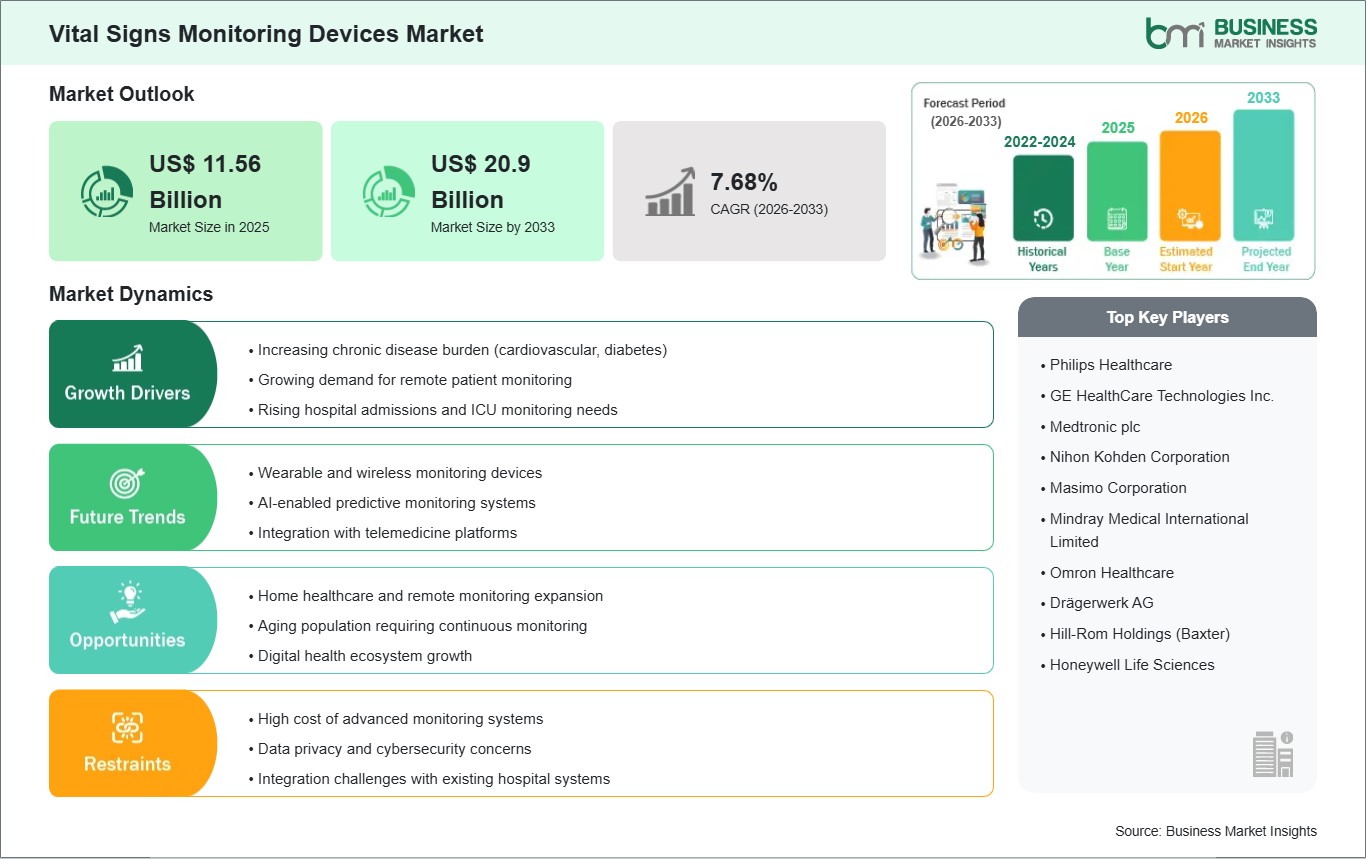
Vital signs monitoring devices refer to a specialized category of clinical and consumer instruments used to measure the fundamental physiological parameters that indicate the status of an individual`s essential body functions. These systems primarily track body temperature, pulse rate, respiration rate, and blood pressure, often extending to include oxygen saturation and cardiac electrical activity. Market expansion is fundamentally driven by the rising global prevalence of chronic and lifestyle-related diseases, such as hypertension, diabetes, and cardiovascular disorders, which necessitate regular monitoring to prevent acute complications.
Furthermore, the shift toward telehealth and remote patient monitoring (RPM) is accelerating the adoption of wireless, connected devices that allow for real-time data transmission between patients and providers. The global aging population, which frequently requires long-term monitoring for age-related physiological changes, continues to serve as a primary catalyst for sustained demand.
However, several factors can restrain market growth. The high cost of multi-parameter monitoring systems and the associated infrastructure for data integration can be a significant barrier for healthcare facilities in developing regions. Stringent regulatory requirements for medical-grade accuracy and data security necessitate extensive testing and certification, which can delay the commercialization of innovative products. Additionally, the industry faces challenges related to data privacy and cybersecurity, as the proliferation of connected devices increases the risk of sensitive patient information being compromised.
Despite these hurdles, the market holds significant opportunities in the integration of artificial intelligence (AI) for predictive analytics, capable of alerting clinicians to potential health crises before they occur. The rise of cuffless blood pressure monitoring and the expansion of integrated wearable sensors that track multiple vitals in a single, non-obtrusive form factor are expected to support long-term development within the sector.
Segment Analysis
Vital Signs Monitoring Devices Market Segmentation
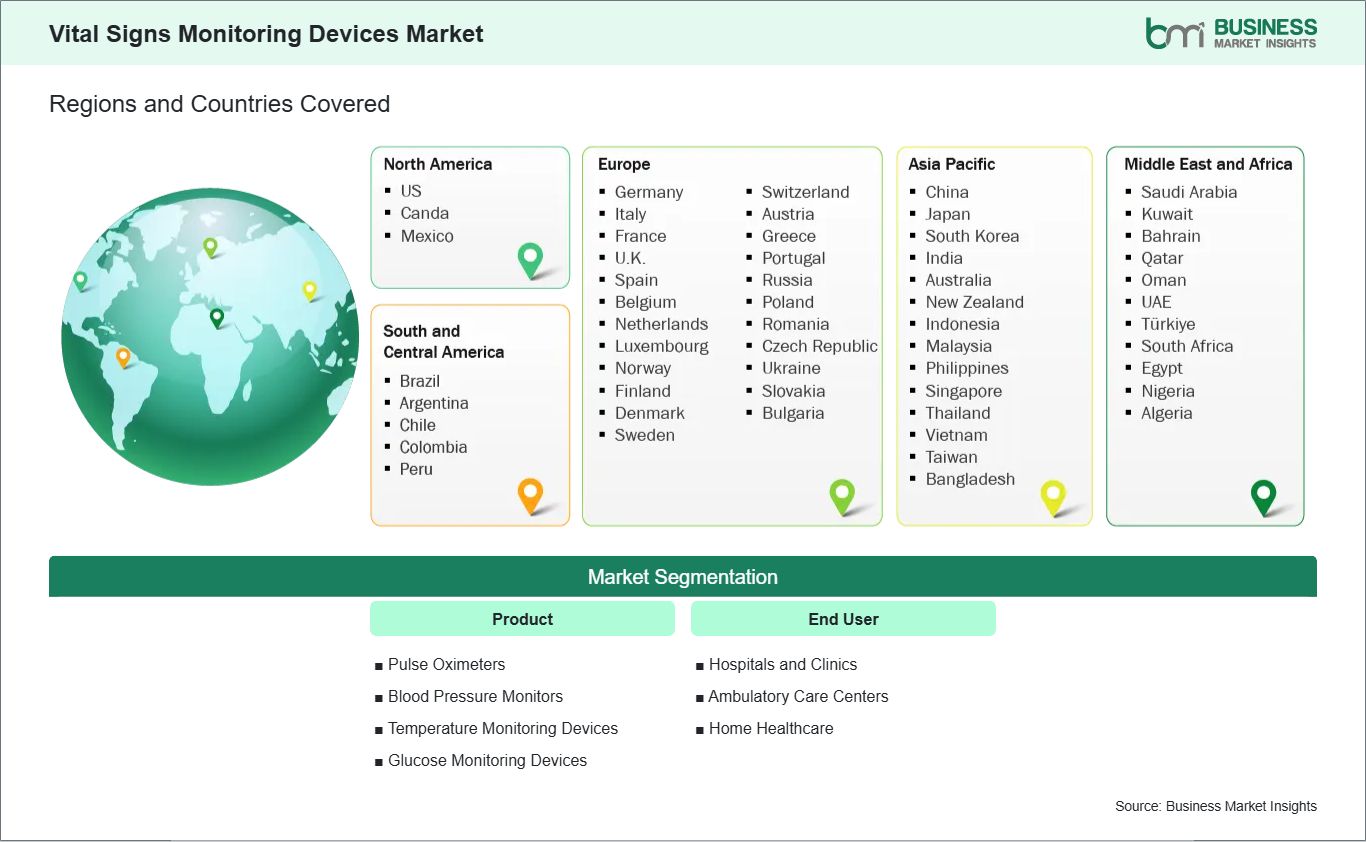
Key segments that contributed to the derivation of the Vital Signs Monitoring Devices market analysis are product and end user.
- By Product, the market is segmented into Pulse Oximeters, Blood Pressure Monitors, Temperature Monitoring Devices, and Glucose Monitoring Devices.
- By End User, the market is categorized into Hospitals and Clinics, Ambulatory Care Centers, and Home Healthcare.
Market Forces
Vital Signs Monitoring Devices Market Drivers and Opportunities
Escalating Chronic Disease Burden and the Industrialization of Remote Care
The primary driver for the Vital Signs Monitoring Devices Market is the accelerating global prevalence of non-communicable diseases (NCDs) and the systemic shift toward decentralized healthcare. The Rising Incidence of Cardiovascular Disorders, Hypertension, and Chronic Respiratory Ailments acts as a foundational catalyst, as billions of individuals require long-term, routine monitoring to prevent acute exacerbations. This momentum is further propelled by the Strategic Expansion of Remote Patient Monitoring (RPM) and Home Healthcare Ecosystems; as reimbursement frameworks increasingly reward outcome-based care, providers are adopting connected devices to manage patients outside of traditional acute settings. In the technological sphere, the Mainstreaming of AI-Powered Predictive Analytics and Early Warning Systems (EWS) serves as a major driver, with algorithms now capable of identifying sepsis or cardiac risk hours before clinical symptoms manifest.
Furthermore, the Migration of Surgical Procedures to Ambulatory Surgery Centers (ASCs) is creating a robust demand for mid-acuity portable monitors that provide hospital-level accuracy in a compact, cost-effective form factor. Together, these factors, demographic vulnerability, digital infrastructure growth, and clinical automation, ensure a robust and essential growth path for the Vital Signs Monitoring Devices Market.
Contactless Sensing and the Convergence of Medical-Grade Wearables
A significant high-value opportunity lies in the convergence of Vital Signs Monitoring with Contactless and Optical Sensing Technologies. Next-generation ambient monitors are being developed to utilize infrared sensors and AI-powered cameras to track heart and respiratory rates without physical contact, offering a breakthrough for neonatal care and infectious disease wards. There is also a major growth frontier in the Integration of Medical-Grade Sensors into Consumer Wearables; as technology firms secure regulatory clearances for features like atrial fibrillation detection and sleep apnea screening, the boundary between professional diagnostics and personal health management is disappearing.
Furthermore, the expansion of Interoperable, Cloud-Native Data Platforms presents a lucrative opportunity, where hospital-to-home monitoring partnerships allow for seamless data transitions and longitudinal health tracking across the entire continuum of care. Beyond hardware, the rise of Generative AI for Clinical Documentation and Triage offers a unique frontier, where monitoring systems automatically summarize vital-sign trends and gaps in patient charts, significantly reducing the administrative burden on nursing staff. Manufacturers who focus on Multi-Modal Bio-Sensors (PPG, Bioimpedance, and ECG) and those pioneering Sustainable, Bioresorbable Monitoring Components are positioned to lead the global Vital Signs Monitoring Devices Market
Size and Share Analysis
Vital Signs Monitoring Devices Market Size and Share Analysis
The Vital Signs Monitoring Devices market demonstrates steady growth, with size and share analysis revealing evolving trends and competitive positioning among key players. The report examines subsegments categorized within product and end user, offering insights into their contribution to overall market performance.
Based on the product, the Blood Pressure Monitors and Glucose Monitoring Devices subsegment holds the primary market presence, acting as the essential infrastructure for managing the world`s most prevalent chronic metabolic and cardiovascular conditions. Blood Pressure Monitors maintain a significant position due to the persistent global requirement for hypertension management, while Glucose Monitoring Devices hold a leading influence driven by the escalating demand for continuous glucose monitoring (CGM) systems that eliminate the need for traditional fingerstick testing. A notable trend is the surge in the Pulse Oximeters subsegment, which is registering the highest pace of adoption. These devices are becoming essential for Respiratory and Cardiovascular Vigilance, as the move toward wearable and fingertip formats allows for frequent oxygen saturation checks in both clinical and residential environments. Furthermore, Temperature Monitoring Devices continue to maintain a critical presence, with advanced infrared and digital sensors being strategically utilized for rapid, non-invasive screening in high-traffic healthcare settings.
Report Coverage
Vital Signs Monitoring Devices Market Report Coverage and Deliverables
The "Vital Signs Monitoring Devices Market Size and Forecast (2022–2033)" report provides a detailed analysis of the market covering below areas:
- Vital Signs Monitoring Devices market size and forecast at global, regional, and country levels for all market segments covered under the scope
- Vital Signs Monitoring Devices market trends, as well as drivers, restraints, and opportunities
- Vital Signs Monitoring Devices market analysis covering key trends, global and regional framework, major players, regulations, and recent developments
- Industry landscape and competition analysis covering market concentration, heat map analysis, prominent players, and recent developments for the Vital Signs Monitoring Devices market
- Detailed company profiles, including SWOT analysis
Geographic Insights
Vital Signs Monitoring Devices Market Geographic Insights
The geographical scope of the Vital Signs Monitoring Devices market report is divided into five regions: North America, Asia Pacific, Europe, Middle East & Africa, and South & Central America.
North America maintains a commanding market presence, supported by a sophisticated healthcare infrastructure, rapid adoption of digital health technologies, and favorable reimbursement frameworks for remote patient monitoring.
Europe represents a mature and technologically advanced market where growth is sustained by rising investment in digital health, a high prevalence of chronic conditions, and a strong institutional focus on integrating monitoring data into national health registries.
Asia Pacific is identified as the most rapidly advancing region, propelled by accelerating healthcare modernization, exceptionally high population volumes in emerging economies, and substantial public investments in specialized diagnostic and monitoring networks.
The Asia-Pacific Vital Signs Monitoring Devices Market is segmented into China, Japan, South Korea, India, Australia, and the Rest of Asia Pacific. China serves as a central engine for regional expansion, driven by large-scale government programs to enhance primary healthcare and the increasing adoption of multi-parameter bedside monitors in specialized provincial hospitals. India is witnessing a notable transition as private healthcare providers and diagnostic chains expand their monitoring portfolios to address a rising awareness of hypertension and respiratory disorders. Japan continues to lead in the integration of high-specification home monitoring technologies, focusing on the use of advanced AI-enabled devices to ensure independent living for its substantial geriatric population.
Industry Activity
Recent Developments
The Vital Signs Monitoring Device market is evaluated by gathering qualitative and quantitative data post primary and secondary research, which includes important corporate publications, association data, and databases. A few of the key developments in the Vital Signs Monitoring Device market are:
- In September 2025, Baxter introduced the Welch Allyn Connex 360 Vital Signs Monitor, offering advanced connectivity, customizable workflows, and secure EMR integration. The device captures key vital signs in under a minute, supporting early detection of patient deterioration and enhanced clinical decision-making
- In October 2024, Evondos completed the acquisition of Vitacam, a camera-based vital signs monitoring system, to strengthen home care workflows. The integration enables remote measurement of key physiological parameters, supporting independent living and more efficient care delivery.
Trust & Transparency
Research Methodology
The market analysis combines proprietary research with secondary data from government agencies, company disclosures, regulatory filings, industry databases and expert interviews. Market estimates are validated through data triangulation, cross-market benchmarking and analyst
review.
View Full Research Methodology
Key Sources Referred:
World Bank – Global Trade Indicators World Trade Organization (WTO) (International Monetary Fund )IMF International Trade Administration (ITA) Company website Company annual reports Company investor presentations