Market Summary
Executive Summary and Global Market Analysis
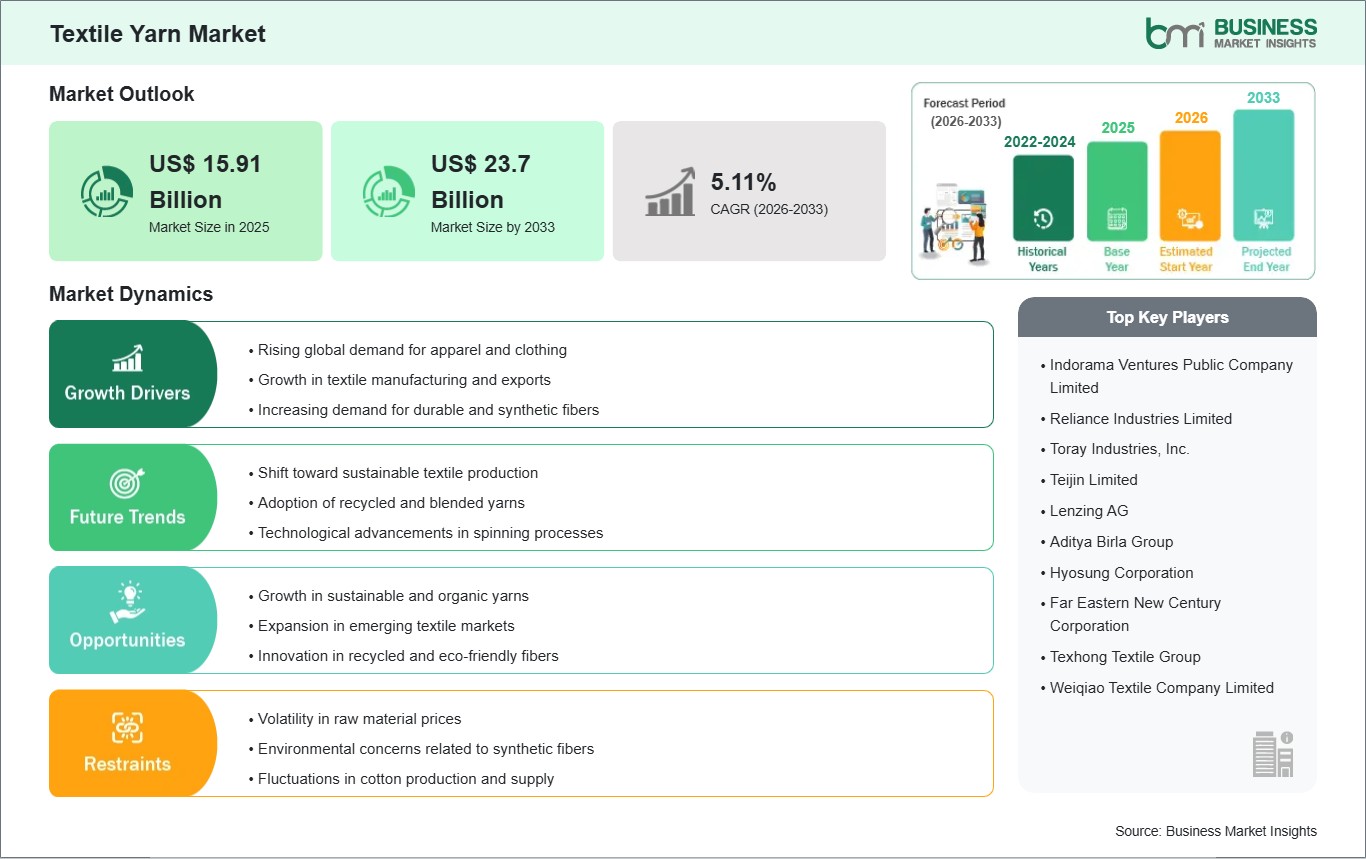
The textile yarn market is witnessing steady growth driven by increasing demand from the apparel and textile industries worldwide. Yarn serves as a fundamental component in fabric production, making it essential across various applications including clothing, home textiles, and industrial uses. Chemical-based yarns dominate the source segment due to their durability and cost-effectiveness, while artificial yarns lead the type segment owing to their versatility and performance advantages in diverse textile applications.
The apparel sector remains the largest application segment, supported by rising global clothing demand and expanding fashion industries. Despite challenges such as raw material price fluctuations and environmental concerns, the market continues to grow due to increasing textile production and technological advancements. Opportunities in sustainable yarns and eco-friendly production processes are gaining traction, encouraging innovation among manufacturers. Additionally, the expansion of textile industries in emerging economies is further supporting market growth. Overall, the textile yarn market is expected to expand steadily, driven by strong demand and evolving industry trends.
Segment Analysis
Textile Yarn Market Segmentation
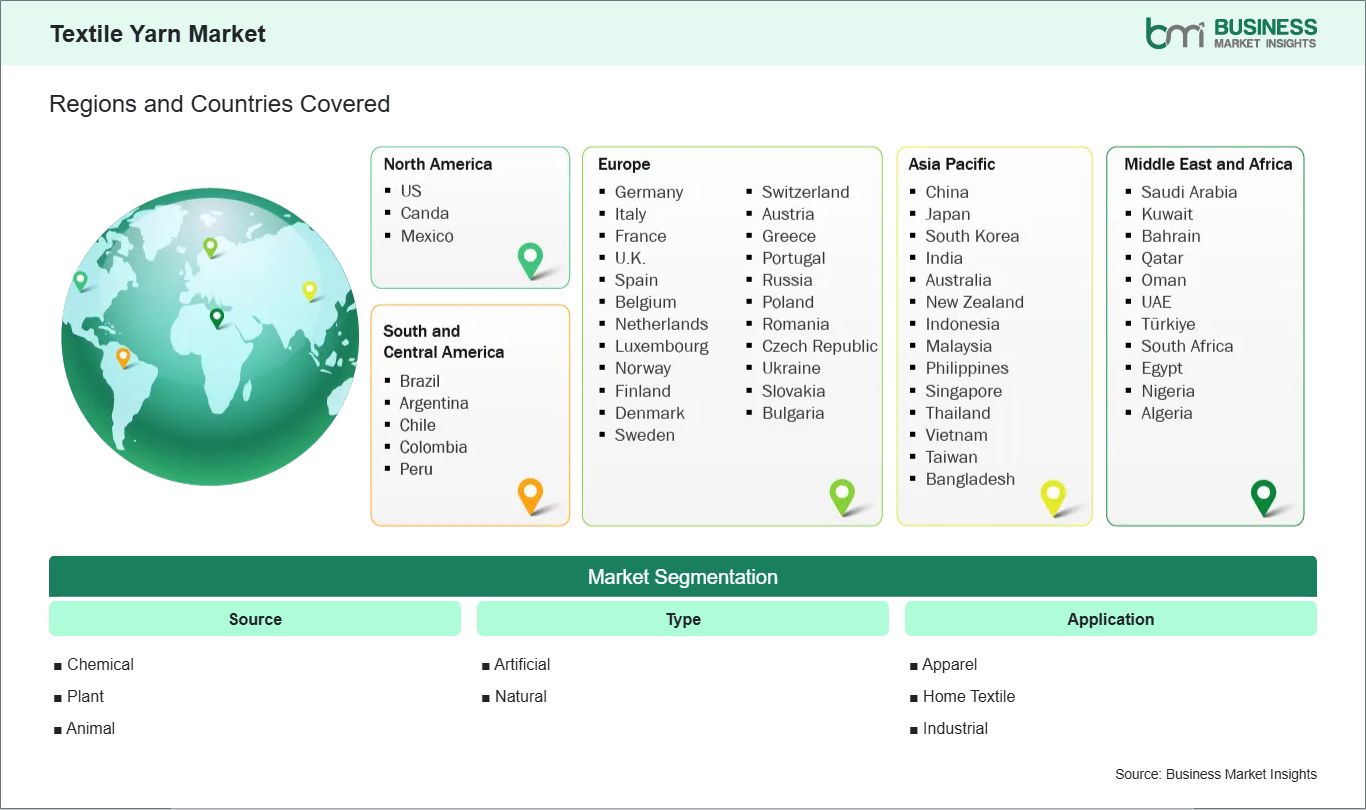
Key segments that contributed to the derivation of the Textile Yarn market analysis are source, type, and application.
- By source, the textile yarn market is segmented into Chemical, Plant, and Animal. The Chemical segment dominated the market in 2025.
- By type, the textile yarn market is segmented into Artificial and Natural. The Artificial segment dominated the market in 2025.
- By application, the textile yarn market is segmented into Apparel, Home Textile, and Industrial. The Apparel segment dominated the market in 2025.
Market Forces
Textile Yarn Market Drivers and Opportunities
Rising global demand for apparel and clothing
The increase in demand for apparel and clothing products across the globe is one of the key factors contributing to the growth of the textile yarn market. This growth in demand can be attributed to factors such as an increase in population, urbanization, and an increase in disposable income. There has been an increase in the consumption of clothing products as people are buying more clothes owing to the changing fashion trends. This has increased the need for yarn, which is a primary raw material used in the production of textiles. There has been an increase in the production capacity of apparel manufacturers.
In addition, the growth of e-commerce platforms and global retail chains has improved product accessibility, further boosting apparel sales. Emerging economies are witnessing increased consumer spending on clothing, while developed regions continue to demand high-quality and premium textile products. Manufacturers are also focusing on product diversification and innovation to meet changing consumer preferences. This sustained growth in apparel demand ensures continuous utilization of yarn across various textile applications, strengthening the overall market and supporting long-term expansion.
Growth in sustainable and organic yarns
The rise of sustainable and organic yarns is a great opportunity for the textile yarn market, considering the environmental factors that continue to shape consumer and industry behavior. The awareness of the environmental implications of synthetic and traditional textile yarns is leading to the increased consumption of sustainable alternatives. Organic cotton and recycled polyester yarns are becoming popular due to their environmental benefits and sustainable characteristics.
Manufacturers are investing in sustainable production processes and materials to ensure regulatory compliance and to cater to consumer demand for sustainable products. Brands are also using sustainable yarns to increase brand value and to target consumers who are looking for sustainable products. In addition, developments in recycling technology and yarn materials are helping to create sustainable yarns with high performance capabilities. As sustainability initiatives become more widespread globally, and regulations become more stringent, the demand for sustainable yarns is likely to increase manifold, providing new business opportunities to market players.
Size and Share Analysis
Textile Yarn Market Size and Share Analysis
The global Textile Yarn market is experiencing steady growth, with market size and share analysis reflecting evolving treatment preferences and competitive dynamics among key players. The report evaluates important subsegments categorized within source, type, and application highlighting their respective contributions to overall market performance.
By source, the Chemical subsegment dominated the market in 2025 due to its cost efficiency, high durability, and consistent quality, making it widely preferred in large-scale textile manufacturing where performance, uniformity, and scalability are essential for meeting global demand.
By type, the Artificial subsegment dominated the market in 2025 due to its versatility, strength, and resistance to wear and environmental factors, enabling its extensive use across apparel and industrial applications requiring reliable and long-lasting textile materials.
By application, the Apparel subsegment dominated the market in 2025 due to increasing global demand for clothing, rapid growth of fast fashion, and rising consumer spending on garments, driving large-scale yarn consumption across textile manufacturing industries worldwide.
Report Coverage
Textile Yarn Market Report Coverage and Deliverables
The "Textile Yarn Market Size and Forecast (2022 - 2033)" report provides a detailed analysis of the market covering below areas:
- Textile Yarn market size and forecast at the regional and country levels for segments covered under the scope
- Textile Yarn market trends, as well as drivers, restraints, and opportunities
- Textile Yarn market analysis covering key trends, regional framework, major players, regulations, and recent developments
- Industry landscape and competition analysis covering market concentration, heat map analysis, prominent players, and recent developments for the Textile Yarn market
- Detailed company profiles, including SWOT analysis
Geographic Insights
Textile Yarn Market Geographic Insights
The geographical scope of the Textile Yarn market report is divided into: North America, Asia Pacific, Europe, Middle East & Africa, and South & Central America. North America held the largest share in 2025.
North America dominates the textile yarn market due to strong demand from apparel, home textile, and industrial sectors. The region benefits from advanced textile manufacturing capabilities and well-established supply chains that support efficient yarn production and distribution. Increasing consumer preference for high-quality and sustainable textile products is also contributing to market growth across the region.
Additionally, the presence of major apparel brands and growing adoption of eco-friendly yarns are driving demand. Regulatory standards promoting sustainable production practices are encouraging manufacturers to invest in innovative materials and processes. The rise of e-commerce and fashion retail is further boosting yarn consumption by increasing apparel sales. Continuous advancements in textile technologies and growing focus on sustainability are strengthening the market position. Overall, North America maintains its dominance due to strong industrial base, consumer demand, and increasing adoption of advanced yarn solutions.
Industry Activity
Recent Developments
The Textile Yarn market is evaluated by gathering qualitative and quantitative data post primary and secondary research, which includes important corporate publications, association data, and databases. A few of the key developments in the Textile Yarn market are:
- In May 2025, Champion Thread Company, announced that it acquired Carolina Sales Thread, strengthening its position in industrial yarn and thread distribution in the U.S.
- In August 2025, Oerlikon Barmag, announced that it would showcase advanced sustainable yarn production technologies and recycling-focused solutions at ITMA Asia + CITME, highlighting innovation in man-made fiber yarn manufacturing.
- In March 2024, several U.S.-based textile manufacturers, announced investments in new yarn manufacturing facilities and equipment upgrades to expand spinning capacity and improve efficiency in yarn production.
Trust & Transparency
Research Methodology
The market analysis combines proprietary research with secondary data from government agencies, company disclosures, regulatory filings, industry databases and expert interviews. Market estimates are validated through data triangulation, cross-market benchmarking and analyst
review.
View Full Research Methodology
Key Sources Referred:
International Textile Manufacturers Federation (ITMF)American Textile Manufacturers Institute (ATMI)European Textile Network (ETN)Confederation of Indian Textile Industry (CITI)China National Textile and Apparel Council (CNTAC)Japan Textile Federation (JTF)Korean Textile Trade Association (KTTA)Brazilian Textile Industry Association (ABIT)Company WebsitesCompany Annual ReportsCompany Investor Presentations