Market Summary
Executive Summary and Global Market Analysis
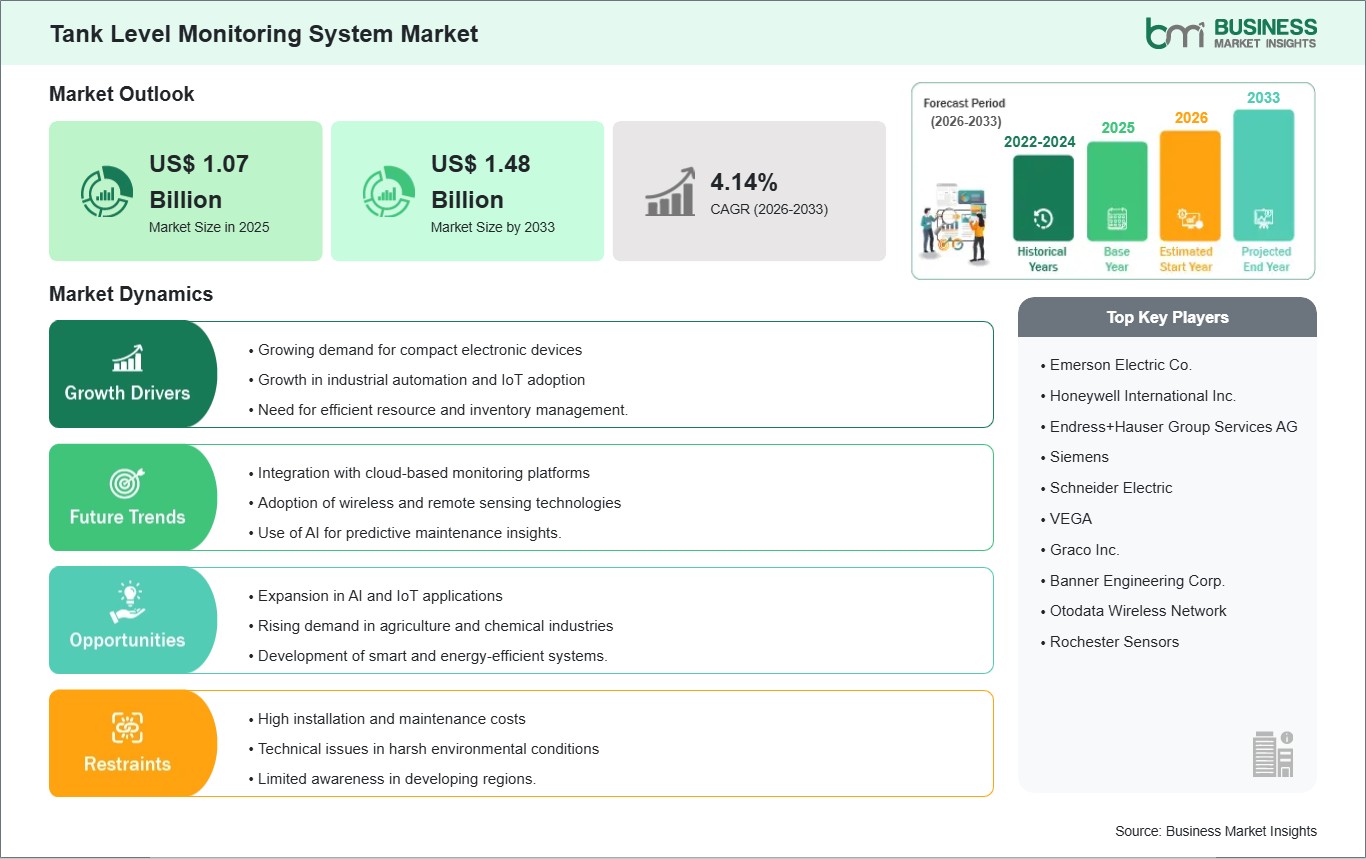
The global tank level monitoring system market is witnessing high-speed evolution as sectors boost their digital transformation and operational upgrade schemes. Increasing industrial automation in the oil & gas, water & wastewater, chemical, food & beverage, and other sectors has led to a higher demand for real-time monitoring technologies to improve safety, loss prevention, and predictive maintenance. Transition from manual gauge readings to remote automatic monitoring is being facilitated by improvements in sensor technologies that include ultrasonic, radar, and IoT‑smart sensors. Integration with cloud platforms and analytics allows stakeholders to see inventory levels, detect anomalies, and forecast usage patterns, which are more critical for supply chain resilience and regulatory compliance.
Edge computing and low‑power wide‑area network (LPWAN) connectivity are further improving scalability and decreasing total cost of ownership for dispersed assets in dangerous or inaccessible locations. Widespread adoption of advanced monitoring systems needs to address cybersecurity vulnerabilities, interoperability challenges with legacy infrastructure, and digital skills gaps for field operation teams. There are also emergence of strategic partnerships between technology providers and industrial OEMs geared towards delivering tailored solution bundles while subscription‑based service models are also becoming popular as enterprises look for predictable operational expenditures. Overall, the focus on efficiency, safety, and data-driven decision-making remains critical to innovations and deployment strategies concerning tank level monitoring system market.
Segment Analysis
Tank Level Monitoring System Market Segmentation
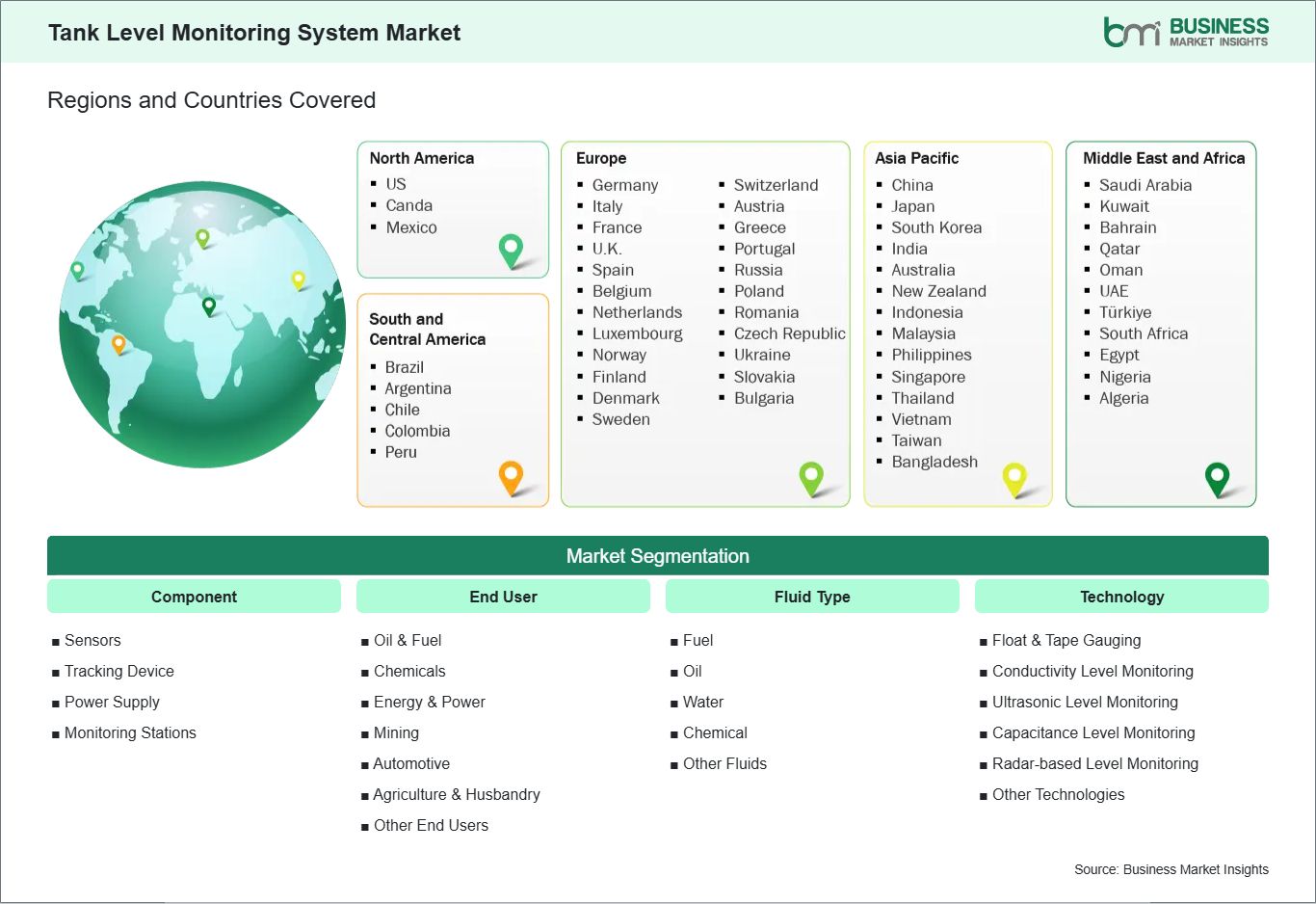
Key segments that contributed to the derivation of the tank level monitoring system market analysis are component, end user, fluid type, technology, and product.
- Component, the tank level monitoring system market is segmented into sensors, tracking device, power supply, and monitoring stations. The sensors segment dominated the market in 2025.
- End User, the tank level monitoring system market is categorized into oil & fuel, chemicals, energy & power, mining, automotive, agriculture & husbandry, and other end users. The oil & fuel segment dominated the market in 2025.
- Fluid Type, the tank level monitoring system market is classified into fuel, oil, water, chemical, and other fluids. The fuel segment dominated the market in 2025.
- Technology, the tank level monitoring system market is segmented into float & tape gauging, conductivity level monitoring, ultrasonic level monitoring, capacitance level monitoring, radar‑based level monitoring, and other technologies. The ultrasonic level monitoring segment dominated the market in 2025.
- Product, the tank level monitoring system market is classified into Invasive type and non‑invasive type. The non‑invasive type segment dominated the market in 2025.
Market Forces
Tank Level Monitoring System Market Drivers and Opportunities
Growing demand for compact electronic devices
The global tank level monitoring system market is being driven by the rising need for accurate liquid level measurement across industries. The oil and gas industry, together with the chemical industry and water utility sector and food and beverage sector, needs accurate monitoring systems to prevent their operations from experiencing both overflow incidents and leakage problems and inventory management mistakes. The industry now uses advanced radar, ultrasonic and capacitive sensor technologies to create real-time measurement systems that deliver better operational performance and safety results. The demand for systems that provide continuous monitoring together with data reporting increased because industrial automation and digital transformation programs grew in popularity. The solutions achieve two objectives by reducing manual inspections and delivering greater process reliability while enabling organizations to practice predictive maintenance, which leads to decreased downtime and operational expenses.
The growing industry trend toward miniaturization and enhanced sensitivity, together with the development of measurement systems that integrate with IoT and cloud platforms, enables the creation of highly accurate and responsive measurement systems. The global market for tank level monitoring systems will experience continued growth because organizations adopt precise tank level monitoring systems to meet operational safety requirements, efficiency standards and compliance regulations.
Expansion in AI and IoT applications
The market for tank level monitoring systems is growing because more and more industries and water management facilities need solutions that give them data right away. For this reason, industries are adopting advanced systems to optimize storage, improve process efficiency, and ensure regulatory compliance. They help in operational continuity by issuing alerts in cases of overflow, leakages, and critical changes in levels. In water management, continuous monitoring helps optimize distribution, reduce wastage, and support resource sustainability. Integration with smart automation platforms allows the operator to track and control storage tanks remotely with enhanced responsiveness and higher operational efficiency. Also, industrial applications such as chemicals, oil storage, and manufacturing stimulate the adoption of connected monitoring systems. Predictive analytics and IoT-enabled capabilities allow better resource allocation, maintenance plans, and safety management. Overall, the demand for optimized operations and smart infrastructure is driving global growth in tank level monitoring systems across industries.
Size and Share Analysis
Tank Level Monitoring System Market Size and Share Analysis
The Tank Level Monitoring System Market demonstrates steady growth, with size and share analysis highlighting evolving trends and competitive dynamics among key players. The report examines subsegments categorized within component, end user, fluid type, technology, and product, offering insights into their contribution to overall market performance.
By Component, the sensors subsegment dominated the market in 2025, driven by the need for precise real‑time measurement and reliability across diverse applications.
Based on End User, the Oil & Fuel subsegment dominated the market in 2025, owing to the critical importance of monitoring fuel storage in transportation, logistics, and energy infrastructure.
On the Basis of Fluid Type, the fuel subsegment dominated the market in 2025, propelled by increasing consumption in industrial and transportation sectors.
In terms of Technology, the ultrasonic level monitoring subsegment dominated the market in 2025, driven by its non‑contact measurement capability, high accuracy, and adaptability for various tank sizes.
By Product, the non‑invasive type subsegment dominated the market in 2025, driven by its ease of installation, safety, and suitability for hazardous or sensitive liquids.
Report Coverage
Tank Level Monitoring System Market Report Coverage and Deliverables
The "Tank Level Monitoring System Market Size and Forecast (2022 - 2033)" report provides a detailed analysis of the market covering below areas:
- Tank Level Monitoring System Market size and forecast at global, regional, and country levels for all the key market segments covered under the scope
- Tank Level Monitoring System Market trends, as well as drivers, restraints, and opportunities
- Tank Level Monitoring System Market analysis covering key trends, global and regional framework, major players, regulations, and recent developments
- Industry landscape and competition analysis covering market concentration, heat map analysis, prominent players, and recent developments for the Tank Level Monitoring System Market
- Detailed company profiles, including SWOT analysis
Geographic Insights
Tank Level Monitoring System Market Geographic Insights
The geographical scope of the Tank Level Monitoring System Market report is divided into North America, Asia Pacific, Europe, Middle East & Africa, and South & Central America. North America held the largest share in 2025.
Regional deployment patterns for tank level monitoring systems reflect varied maturity levels in industrial automation, regulatory regimes, and infrastructure modernization efforts. North America is characterized by strong adoption of connected sensing platforms integrated with enterprise analytics, driven by stringent safety standards and demand for predictive maintenance in energy and manufacturing sectors.
Asia Pacific shows rapid uptake across utilities, agriculture, and chemicals, supported by national initiatives promoting smart infrastructure and digitized resource management; rising investments in industrial IoT ecosystems are accelerating localized innovation. Europe emphasizes solutions that align with environmental regulations and sustainability targets, particularly in water treatment and storage applications, where integration with energy management systems enhances operational governance.
Middle East & Africa is witnessing growing interest in remote monitoring to support oil storage terminals and water distribution networks, where geographic dispersion and harsh environmental conditions make automated sensing essential for reliability and cost control.
South & Central America is gradually expanding adoption, typically starting from high‑impact verticals such as fuel retail and mining, with increasing implementation of cloud‑based dashboards for centralized visibility over scattered assets.
Across regions, variability in digital infrastructure, investment capacity, and industry priorities shapes how tank level monitoring technologies are adopted and customized, underscoring the importance of flexible deployment models and scalable technology architectures.
Industry Activity
Recent Developments
The Tank Level Monitoring System Market is evaluated by gathering qualitative and quantitative data post primary and secondary research, which includes important corporate publications, association data, and databases. A few of the key developments in the spatial light Modulator market are:
- In April 2024, Anova announced the launch of its Universal Tank Monitor with Radar Level Sensor, designed to improve monitoring of intermediate bulk containers (IBCs) and liquid storage assets by enabling more accurate remote level tracking and reducing container waste.
- In November 2025, Emerson Electric Co. announced the launch of the Rosemount 2405 Tank Monitoring Hub, a device designed to centralize data from multiple level, pressure, and temperature transmitters to automate storage tank inventory monitoring and simplify tank monitoring system architecture.
Trust & Transparency
Research Methodology
The market analysis combines proprietary research with secondary data from government agencies, company disclosures, regulatory filings, industry databases and expert interviews. Market estimates are validated through data triangulation, cross-market benchmarking and analyst
review.
View Full Research Methodology
Key Sources Referred:
International Electrotechnical Commission Institute of Electrical and Electronics Engineers International Organization for Standardization Bureau of Indian Standards Central Electricity Authority Ministry of Power Indian Electrical and Electronics Manufacturers' Association European Committee for Electrotechnical Standardization VDE Association for Electrical Electronic & Information Technologies Company Websites Company Annual Reports Company Investor Presentation