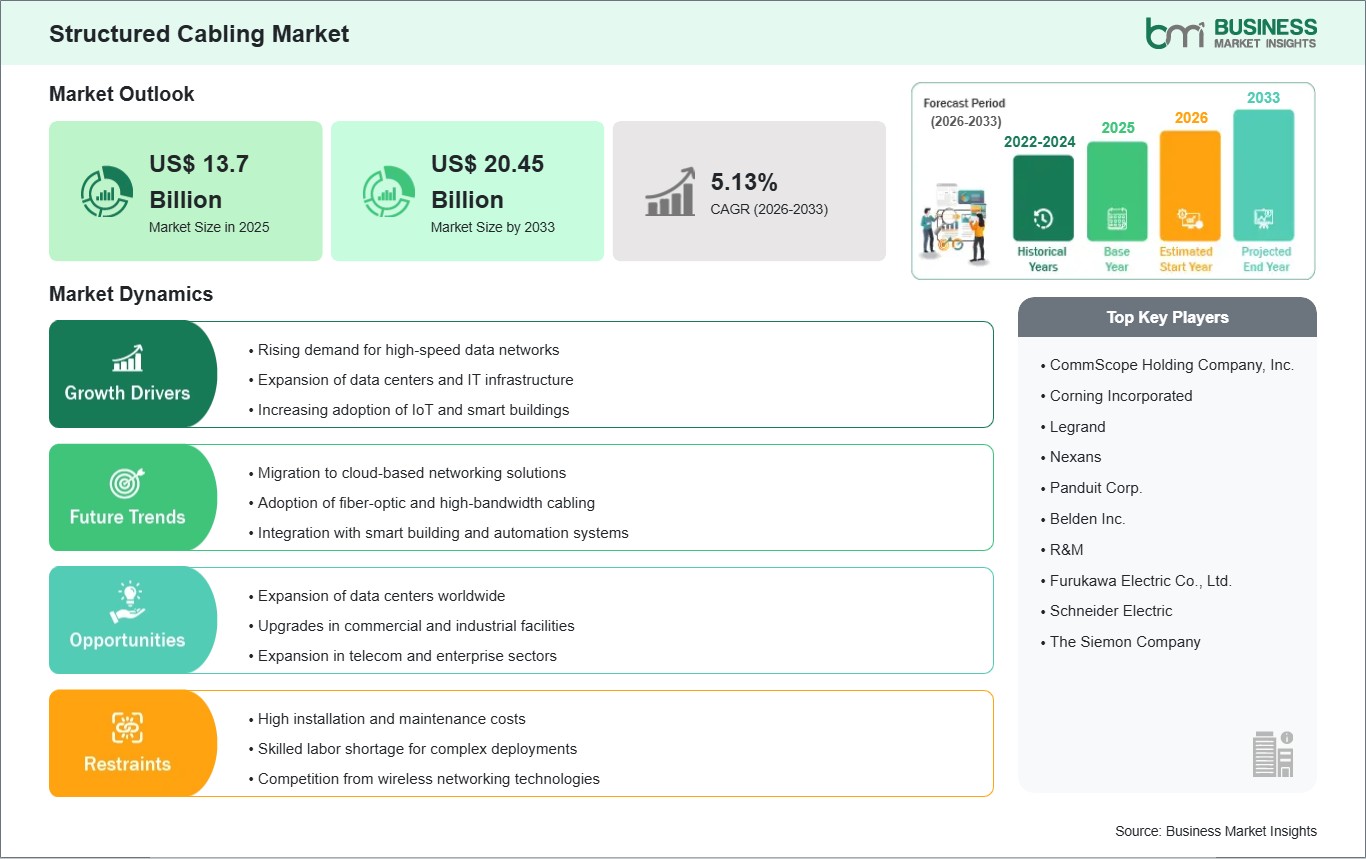
The Structured Cabling Market size is expected to reach US$ 20.45 billion by 2033 from US$ 13.7 billion in 2025. The market is estimated to record a CAGR of 5.13% from 2026 to 2033.
The global structured cabling market is witnessing significant growth as enterprises, data centers, and telecom providers seek reliable, high-speed, and scalable network infrastructure. Structured cabling systems provide standardized pathways and components for data, voice, and video communications, enabling streamlined installation, easier maintenance, and enhanced network performance. Increasing demand for high-bandwidth applications, cloud computing, IoT connectivity, and 5G deployment is driving the adoption of structured cabling across commercial, industrial, and institutional sectors. Technological advancements are shaping market trends, with innovations in high-speed fiber optic cabling, Category 6A/7 twisted pair solutions, and modular connectivity enabling improved data transfer rates, reduced latency, and future-proof infrastructure. The adoption of intelligent cabling management systems and integrated monitoring tools ensures optimized network performance, simplified troubleshooting, and reduced operational downtime.
Additionally, hybrid copper-fiber systems are gaining traction to balance cost efficiency with performance requirements. The market is further supported by global digital transformation initiatives, smart building development, and expansion of enterprise networks. Growing demand for robust and flexible cabling solutions in data-intensive applications, including cloud computing, AI, and multimedia streaming, is driving continuous innovation. Overall, the structured cabling market is evolving toward high-performance, scalable, and sustainable infrastructure solutions that support modern communication and digital business operations.

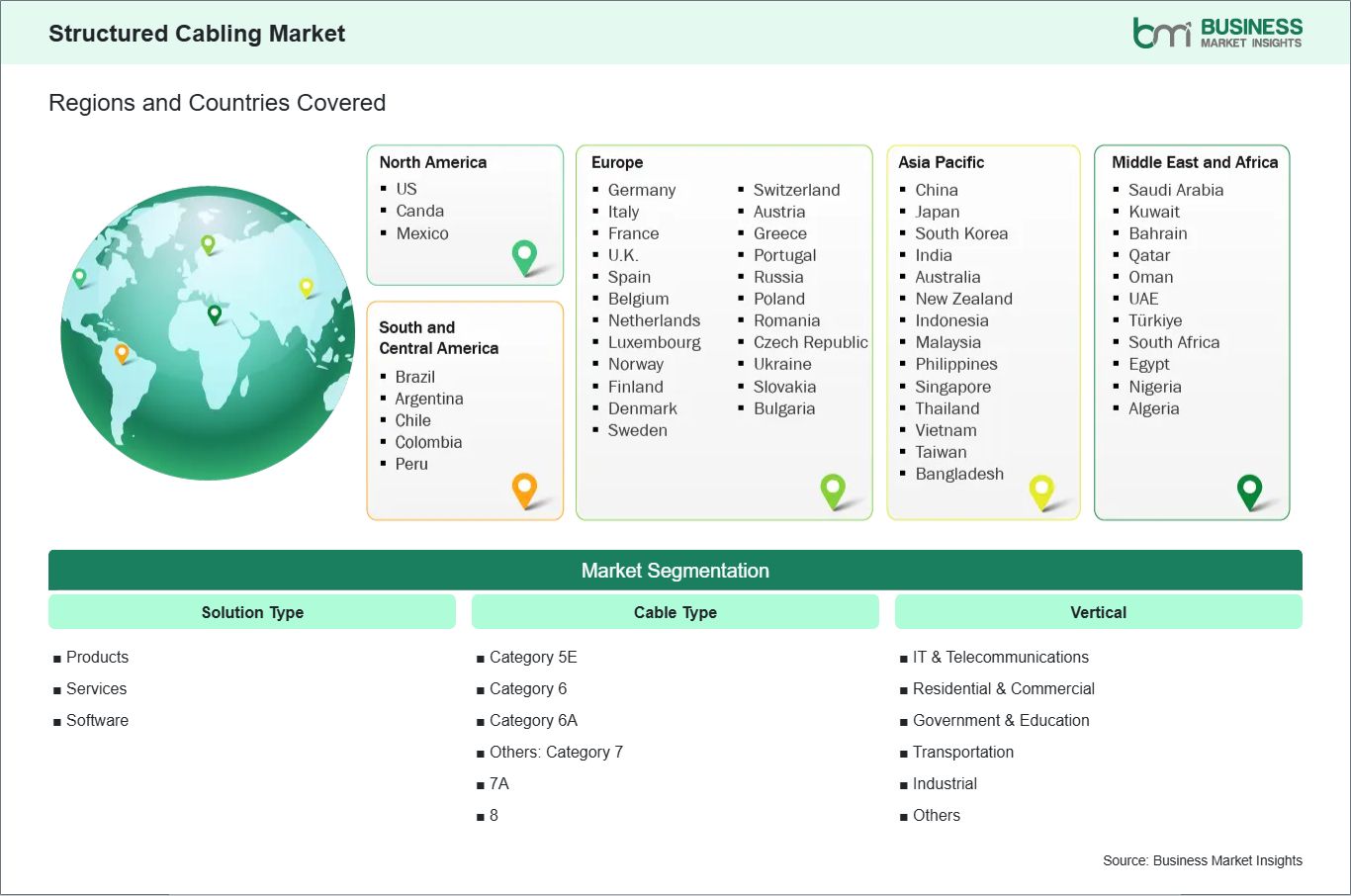
Key segments that contributed to the derivation of the structured cabling market analysis are solution type, cable type, and vertical.
The global structured cabling market is driven by the escalating demand for high‑speed data networks across commercial, industrial, and enterprise environments. As digital transformation accelerates, organizations require cabling infrastructures capable of supporting higher bandwidths for applications such as cloud computing, unified communications, and real‑time data transfer. High‑performance cabling systems like Category 6A, Category 8, and fiber optics are increasingly replacing legacy copper cabling to deliver superior throughput, reduced latency, and enhanced network reliability. This transition is fundamental to supporting modern networking standards. In addition, the proliferation of bandwidth‑intensive applications such as video conferencing, virtualized desktops, and big data analytics has intensified the need for structured cabling systems that can scale effectively. End users are prioritizing cabling solutions that future‑proof network architectures, allowing seamless integration of emerging technologies like Wi‑Fi 6/6E and beyond. This has prompted structured cabling manufacturers to innovate modular and flexible designs that accommodate rapid upgrades without major overhauls. Furthermore, the rise of connected devices from IoT sensors to high‑definition surveillance systems places additional pressure on network infrastructure. Structured cabling serves as the backbone for these expanding networks, ensuring consistent performance as device density grows. With enterprises and service providers alike upgrading network backbones, the market for advanced cabling systems continues to expand on a global scale.
The expansion of data centers worldwide is a key catalyst for structured cabling market growth. As demand for cloud services, edge computing, and hyperscale data processing rises, new facilities are being deployed with extensive cabling infrastructures to support high‑density interconnections. Structured cabling systems play a pivotal role in data center architecture by facilitating efficient connectivity between servers, storage arrays, and networking equipment. High‑capacity fiber cabling solutions are particularly vital to enable rapid data throughput and low latency within these environments. Beyond new builds, existing data centers are undergoing significant upgrades to accommodate increased compute loads and evolving network topologies. Modern workloads related to artificial intelligence, machine learning, and large‑scale virtualization require cabling solutions that can handle substantial traffic spikes while maintaining signal integrity. Structured cabling systems, with their standardized layouts and scalable designs, are integral to achieving these performance benchmarks and ensuring operational resilience. In addition, the trend toward modular and prefabricated data center designs underscores the importance of structured cabling. These approaches demand cabling solutions that are both flexible and easy to deploy, allowing rapid scaling of capacity without disrupting ongoing operations. As digital services proliferate and network demands intensify, structured cabling remains central to supporting the global data center ecosystem’s expansion and long‑term growth.
The Structured Cabling Market demonstrates steady growth, with size and share analysis highlighting evolving trends and competitive dynamics among key players. The report examines subsegments categorized within solution type, cable type, and vertical, offering insights into their contribution to overall market performance.
Solution Type, the products subsegment dominated the market in 2025, driven by increasing installations of cables, patch panels, communication outlets, and racks across enterprise and commercial networks.
Based on Cable Type, the category 6 subsegment dominated the market in 2025, driven by its optimal combination of bandwidth support, reliability, and cost-effectiveness for modern IT and telecom networks.
In terms of Vertical, the IT & telecommunications subsegment dominated the market in 2025, driven by rapid growth in data centers, cloud adoption, and enterprise networking requirements worldwide.
| Report Attribute | Details |
|---|---|
| Market size in 2025 | US$ 13.7 Billion |
| Market Size by 2033 | US$ 20.45 Billion |
| Global CAGR (2026 - 2033) | 5.13% |
| Historical Data | 2022-2024 |
| Forecast period | 2026-2033 |
| Segments Covered | By Solution Type
|
|
Regions and Countries Covered
| |
| North America | US, Canada, Mexico |
| Europe | Belgium, Austria, Finland, Denmark, Greece, Poland, Romania, Russia, Ukraine, Czech Republic, Slovakia, Bulgaria, Italy, Luxembourg, Germany, Switzerland, France, Netherlands, Norway, Portugal, Spain, Sweden, United Kingdom |
| Asia-Pacific | Australia, China, India, Japan, South Korea, Indonesia, Malaysia, Philippines, Singapore, Thailand, Vietnam, Bangladesh, New Zealand, Taiwan |
| South and Central America | Brazil, Argentina, Peru, Chile, Colombia |
| Middle East and Africa | Bahrain, Kuwait, Oman, Qatar, Saudi Arabia, United Arab Emirates, Turkiye, South Africa, Egypt, Algeria, Nigeria |
| Market leaders and key company profiles |
|
The "Structured Cabling Market Size and Forecast (2022 - 2033)" report provides a detailed analysis of the market covering below areas:
The geographical scope of the Structured Cabling Market report is divided into North America, Asia Pacific, Europe, Middle East & Africa, and South & Central America. North America held the largest share in 2025.
Regional adoption of structured cabling systems is driven by enterprise network expansion, digital infrastructure development, and technology investments. North America dominates the market due to extensive data center infrastructure, high cloud adoption, and demand for high-speed enterprise networks. The United States and Canada lead in deploying advanced fiber optic cabling, modular patch panels, and intelligent cable management solutions to support enterprise, government, and telecom applications. Asia Pacific is a high-growth region, fueled by rapid urbanization, industrial digitalization, and increasing adoption of smart city projects.
Countries such as China, India, Japan, and South Korea are implementing structured cabling in corporate offices, data centers, and 5G network expansions to enable high-speed, reliable connectivity. Europe emphasizes compliance with standardized network protocols, energy efficiency, and high-performance infrastructure.
Germany, France, and the United Kingdom are integrating fiber optic and hybrid cabling systems for enterprise and industrial networks, supporting digital transformation and IoT deployment.
Middle East & Africa is gradually adopting structured cabling in commercial, industrial, and educational sectors, particularly in the UAE, Saudi Arabia, and South Africa, to strengthen digital infrastructure.
South & Central America is expanding structured cabling deployment in corporate, telecom, and government networks, with Brazil, Mexico, and Chile driving adoption to enhance connectivity, network reliability, and scalability across emerging markets.

The Structured Cabling Market is evaluated by gathering qualitative and quantitative data post primary and secondary research, which includes important corporate publications, association data, and databases. A few of the key developments in the spatial light Modulator market are:
The Structured Cabling Market is valued at US$ 13.7 Billion in 2025, it is projected to reach US$ 20.45 Billion by 2033.
As per our report Structured Cabling Market, the market size is valued at US$ 13.7 Billion in 2025, projecting it to reach US$ 20.45 Billion by 2033. This translates to a CAGR of approximately 5.13% during the forecast period.
The Structured Cabling Market report typically cover these key segments-
The historic period, base year, and forecast period can vary slightly depending on the specific market research report. However, for the Structured Cabling Market report:
The Structured Cabling Market is populated by several key players, each contributing to its growth and innovation. Some of the major players include:
The Structured Cabling Market report is valuable for diverse stakeholders, including:
Essentially, anyone involved in or considering involvement in the Structured Cabling Market value chain can benefit from the information contained in a comprehensive market report.
Please tell us your area of interest
(Market Segments/ Regions and Countries/ Companies)