
Sports Footwear Market Outlook: Size, Share, Trends, Growth Analysis, Competitive Landscape & Forecast, 2026-2033

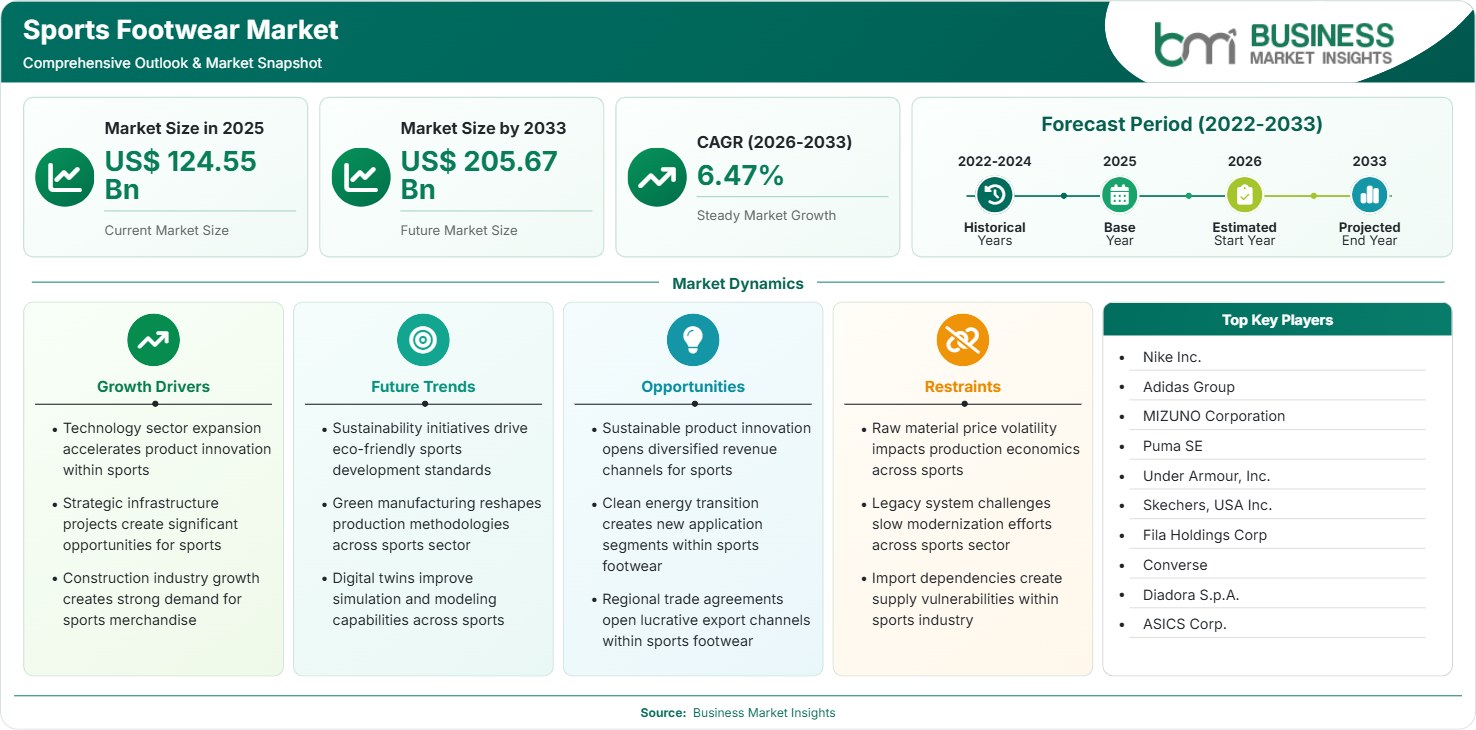
The Sports Footwear Market size was valued at US$ 124.55 Billion in 2025 and is projected to reach US$ 205.67 Billion by 2033, growing at a CAGR of 6.47% during 2026–2033, driven by running participation, athleisure adoption, product innovation, digital commerce, and premium performance demand.

Report Coverage
  • Gender: Men, Women, Kids
  • End-User: Professional Users, Recreational Users
  • Distribution Channel: Online, Offline
US$ 124.55 Bn Market size in 2025
US$ 205.67 Bn Market Size by 2033
6.47% CAGR, 2026 - 2033
2026-2033 Forecast Period

01 AI Overview

Sports Footwear Market Summary

  • North America Region: North America holds a 28%–31% share in 2025, growing at a 5.8%–6.4% CAGR, supported by running participation, athleisure, premium footwear replacement, organized sports, direct-to-consumer retail, and performance innovation. The U.S. represents most regional demand, expanding at a 5.9%–6.5% CAGR through 2033, supported by running, basketball, fitness, and online purchasing.
  • Fastest Growing Region: Asia Pacific holds a 27%–30% share in 2025, growing at a 7.4%–8.2% CAGR, driven by rising sports participation, urbanization, expanding middle-class consumers, e-commerce penetration, local brand development, and growing interest in running and fitness.
  • Leading Segment: Men hold a 48%–52% share in 2025, growing at a 6.0%–6.5% CAGR, supported by running, football, basketball, gym participation, outdoor activities, replacement purchases, and continued demand for performance-oriented footwear.
  • High Growth Segment: Online distribution holds a 26%–30% share in 2025, growing at a 9.0%–10.0% CAGR, supported by mobile commerce, broader assortment, digital product discovery, personalization, promotional flexibility, and improving omnichannel fulfillment.
  • Key Market Opportunity: Premium running shoes, women-focused performance products, direct-to-consumer commerce, sustainable materials, connected retail, and emerging Asian consumer markets offer attractive opportunities for differentiated brands.
  • Major Market Players: NIKE, Inc.; adidas AG; Mizuno Corporation; PUMA SE; Under Armour, Inc.; Skechers U.S.A., Inc.; FILA Holdings Corp.; Converse Inc.; Diadora S.p.A.; ASICS Corporation.
02 Strategic Insights

Sports Footwear Market: Strategic Insights

Sports Footwear Market Strategic Framework
FREE PDF
Request your free sample
Request free sample
03 Stakeholder View

Key Takeaways

  • The industry is moving from a conventional design-manufacture-retail model toward integrated ecosystems linking athlete testing, material science, digital product development, contract manufacturing, owned retail, marketplaces, and consumer data. Control over these interfaces can improve product velocity and strengthen pricing power.
  • Running remains one of the most commercially attractive performance categories because consumers increasingly differentiate between daily trainers, super trainers, racing shoes, trail footwear, and recovery products. adidas reported more than 30% running growth in 2025, reinforcing the opportunity created by technical segmentation.
  • Midsole chemistry, plate geometry, lightweight textiles, stability structures, and computational product design are becoming central competitive variables. Brands increasingly use athlete testing and biomechanical feedback to validate products before commercialization.
  • Asia Pacific offers a compelling investment case because footwear adoption can increase alongside rising disposable income, urban fitness culture, e-commerce penetration, and local sports participation. India and Southeast Asia are particularly attractive for localized pricing and digital-first distribution.
  • Brand portfolios are increasingly balancing performance credibility with lifestyle relevance. Strategic collaborations, athlete endorsements, direct-to-consumer platforms, and selective retail partnerships are being used to create product scarcity, brand visibility, and stronger consumer engagement.
  • Digital channels are becoming more influential in discovery, comparison, personalization, and replenishment, but physical stores retain an important role because consumers value fit testing, product trial, and expert recommendations for technical footwear.
04 Geographic Outlook

Sports Footwear Market Regional Highlights

North America Sports Footwear Market

North America held a 28%–31% of the Sports Footwear Market share in 2025 and is projected to expand at a 5.8%–6.4% CAGR through 2033. The United States represents the principal regional demand center, while Canada contributes through running, hockey-related training, fitness, outdoor recreation, and lifestyle consumption. Strong brand awareness, premium product penetration, organized sports, established specialty retailers, and high digital-commerce adoption support sustained category demand. Replacement purchases remain important because consumers increasingly own footwear for distinct activities.

  • Running culture supports demand for specialized daily trainers, racing footwear, trail models, stability shoes, and recovery-oriented products, allowing brands to expand consumer wardrobes beyond one general-purpose athletic shoe.
  • Premiumization is strengthening average selling prices as consumers increasingly evaluate cushioning systems, weight, durability, fit, and performance credentials rather than relying solely on brand recognition.
  • Direct-to-consumer channels allow manufacturers to control product presentation, collect first-party consumer data, personalize recommendations, and launch limited products without depending entirely on wholesale partners.
  • Sustainability claims are becoming more relevant to product development, particularly through recycled materials, lower-impact manufacturing processes, packaging reduction, and longer product-use cycles.

US Sports Footwear Market

The United States accounted for 22%–25% of North American Sports Footwear Market demand in 2025 and is projected to grow at a 5.9%–6.5% CAGR through 2033. Running, basketball, training, football, outdoor recreation, and athleisure provide multiple demand pools. Consumers are also becoming more knowledgeable about performance technologies, increasing differentiation among footwear categories. The market benefits from sophisticated retail infrastructure, strong brand ecosystems, professional sports visibility, and extensive digital commerce.

  • Performance running is gaining strategic importance as consumers seek differentiated footwear for training, racing, recovery, and everyday activity rather than using identical products across occasions.
  • Basketball and team sports maintain strong brand visibility through professional athletes, leagues, collegiate competition, grassroots participation, and seasonal product launches.
  • Online shopping is expanding product accessibility while allowing brands to test assortment, pricing, memberships, personalized recommendations, and limited-release strategies.

Europe Sports Footwear Market

Europe represented a 20%–23%Sports Footwear Market share in 2025 and is projected to expand at a 5.5%–6.2% CAGR through 2033. Germany, the United Kingdom, France, Italy, and Spain are leading markets, while Poland, the Netherlands, and selected Nordic economies provide attractive growth opportunities. Running, football, cycling-related training, fitness, hiking, and athleisure support diversified demand. Sustainability expectations are also influencing materials, packaging, product durability, and corporate sourcing strategies.

  • Germany remains a leading market because of strong sports participation, purchasing power, established specialty retail, football culture, and consumer acceptance of technical performance products.
  • The United Kingdom combines mature running participation with strong e-commerce adoption, football culture, fitness trends, and extensive brand competition across performance and lifestyle categories.
  • France and Italy provide opportunities through running, football, fashion-led athletic footwear, tourism-related outdoor activities, and premium consumer segments.
  • Poland and the Netherlands offer growth potential as organized fitness, running communities, digital commerce, and sports retail infrastructure continue developing.

Asia Pacific Sports Footwear Market

Asia Pacific held a 27%–30% Sports Footwear Market share in 2025 and is projected to grow at a 7.4%–8.2% CAGR through 2033. China, Japan, South Korea, India, and Australia are leading markets, while India, Indonesia, Vietnam, and Thailand provide stronger incremental growth opportunities. Urbanization, expanding fitness participation, social-commerce influence, local sports communities, and rising digital purchasing are broadening consumer access to technical and lifestyle footwear.

  • China combines large consumer scale with growing running communities, basketball participation, premium sneaker demand, and increasingly sophisticated domestic sports brands.
  • Japan remains a technically mature market where running, walking, outdoor activities, and comfort-focused footwear support demand for specialized products.
  • India offers substantial upside from expanding fitness participation, growing running events, increasing disposable income, and rapid adoption of mobile commerce.
  • Southeast Asian markets are benefiting from younger populations, urban lifestyles, social commerce, sports participation, and expanding organized retail networks.

Rest of World Sports Footwear Market

South and Central America represented approximately 8%–10% of global Sports Footwear Market demand in 2025 and are projected to expand at a 6.3%–7.1% CAGR. Brazil and Mexico are leading markets, supported by football, running, fitness, youth participation, and expanding digital retail. Premium products remain concentrated among higher-income consumers, while accessible performance products provide wider-volume opportunities.

The Middle East and Africa represented approximately 5%–7% share in 2025 and are projected to grow at a 6.6%–7.5% CAGR. Saudi Arabia, the UAE, South Africa, and selected Gulf economies offer opportunities through fitness initiatives, tourism, outdoor activities, football, and expanding sports infrastructure.

  • Brazil provides a strong football-led footwear ecosystem while running, gym participation, and athleisure are widening demand beyond traditional team sports.
  • Mexico benefits from manufacturing proximity, football culture, youth participation, expanding shopping infrastructure, and increasing online access to international brands.
  • Gulf countries are investing in sports participation and large-scale events, creating demand for running, training, football, basketball, and outdoor footwear.
  • South Africa provides opportunities through running, football, fitness, hiking, and established specialty retail, although affordability remains important for broader adoption.
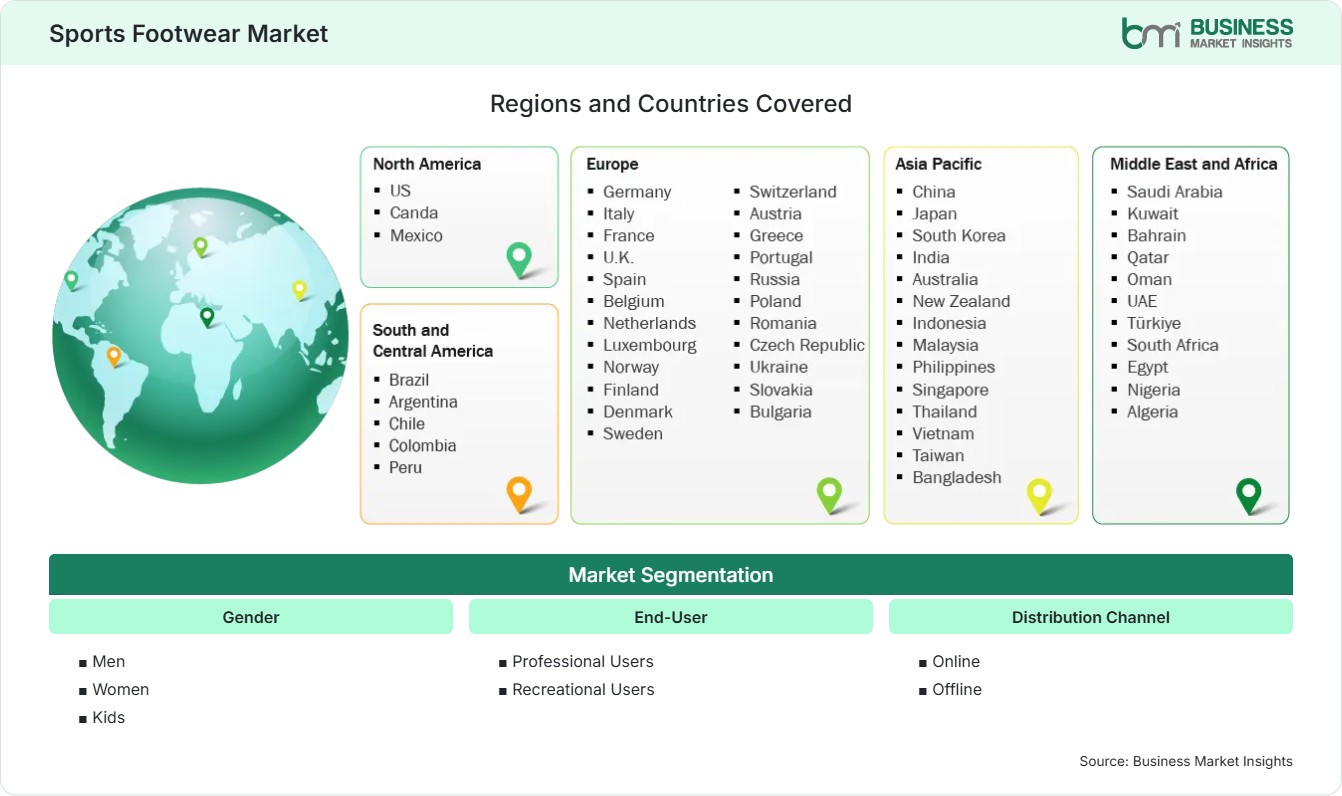
Global Market Geography
FREE PDF
Request your free sample
Request free sample
05 Segment Analysis

Sports Footwear Market Segmentation

Gender

Gender segmentation remains commercially important because fit, biomechanics, sizing, aesthetics, color preferences, and sport participation differ across consumer groups. Men represented a 48%–52% share of the Sports Footwear Market in 2025 and are projected to grow at a 6.0%–6.5% CAGR through 2034. Women and kids provide additional upside through specialized designs, participation growth, and family-oriented purchasing.

  • Men: Men's demand remains broad across running, football, basketball, training, outdoor activities, and athleisure, supported by frequent replacement cycles and growing interest in specialized performance footwear.
  • Women: Women's footwear is benefiting from increased participation in running, fitness, walking, training, and recreational sport, encouraging brands to improve fit, cushioning, styling, and women-specific product development.
  • Kids: Kids' footwear benefits from school sports, organized youth programs, family purchases, and rapid size replacement, while durable construction and accessible pricing remain key purchasing considerations.

End-User

End-user segmentation separates high-performance professional demand from broader recreational consumption. Professional Users represented approximately 18%–22% of 2025 demand and are projected to grow at a 6.2%–6.8% CAGR through 2034. Recreational Users remain substantially larger, supported by fitness, wellness, walking, running, and athleisure adoption across developed and emerging markets.

  • Professional Users: Professional athletes prioritize tested cushioning, energy return, stability, weight reduction, traction, durability, and sport-specific construction, making technical innovation and athlete validation critical purchasing factors.
  • Recreational Users: Recreational consumers increasingly purchase footwear for multiple activities, including walking, gym training, casual running, travel, and everyday wear, expanding opportunities for versatile hybrid designs.

Distribution Channel

Distribution is being reshaped by mobile commerce, brand websites, marketplaces, specialty stores, department stores, and omnichannel fulfillment. Online channels held a 26%–30% share of the Sports Footwear Market in 2025 and are projected to expand at a 9.0%–10.0% CAGR through 2034. Offline channels remain essential for fit, trial, premium presentation, and technical consultation.

  • Online: Online purchasing benefits from broader assortment, price comparison, product reviews, personalized recommendations, membership programs, mobile commerce, and direct brand access across geographically dispersed consumers.
  • Offline: Offline retail remains important for technical footwear because consumers often need physical fitting, gait-related guidance, product comparison, and immediate assessment of comfort, support, and sizing.
06 Market Forces

Sports Footwear Market Dynamics

Key Market Drivers

Running participation is increasing demand for specialized footwear

Running has become a major innovation engine because consumers increasingly differentiate between daily training, racing, trail running, recovery, stability, and high-mileage footwear. In 2025, adidas reported an increase of over 30% in its running performance due to the Adizero range. This illustrates the importance of technical segmentation as a way of creating more value for the category rather than merely switching customers to other brands. Similar strategies are visible across leading manufacturers as foam chemistry, plate geometry, weight reduction, rocker structures, and upper engineering become more sophisticated. The Sports Footwear Market growth outlook therefore benefits from consumers purchasing multiple shoes for distinct training purposes. Current Sports Footwear Market trends also indicate that athlete validation, measurable performance characteristics, and product storytelling are becoming more influential in premium purchasing decisions.

Active lifestyles are expanding footwear usage beyond organized sports

The distinction between sports participation and everyday apparel continues to narrow as consumers use athletic footwear for commuting, travel, casual wear, walking, and social activities. The PUMA annual report 2025 noted the importance of active living and athleisure wear as structural influences on the industry, and major sporting events in 2026 have further increased visibility of sports participation. This provides a larger consumer base as compared to competitive sports alone. A brand can ensure higher purchase frequencies by designing products that incorporate performance technology with styling. Young consumers, in particular, are good targets for such products because young consumers tend to switch between exercise, leisure, and social settings without having to change their footwear.

Product engineering is becoming a stronger competitive differentiator

Footwear companies are investing in proprietary foams, carbon plates, stability systems, lightweight meshes, engineered lasts, and digitally assisted design. The Mizuno NEO VISTA 3, launched in 2026, incorporates an innovative dual-layer midsole and a 3D plate that increases the efficiency of energy return and stability of the foot, while ASICS released its SUPERBLAST 3 with FF LEAP foam technology, which aims to increase energy return properties. The Japanese brand also opened its own technical lab in Kobe where custom footwear for top athletes will be created, rapid prototyping will take place, and the link between research and production will speed up.

Key Market Opportunities

Women-specific product development can unlock incremental demand

Women constitute a huge potential opportunity as participation in running, training, walking, fitness, and recreational sports increases significantly among many different markets. Brands can capture incremental demand through anatomically considered lasts, differentiated cushioning, improved heel fit, wider size availability, and product lines designed around women rather than simply adapting men's footwear. This marketing can also be made more relevant as brands link up product engineering with particular participation requirements, such as distance running, gym workouts, walking, and recuperation. This is relevant to retail merchandising because women consumers now come into contact with sports shoes in specialized shops, on websites and e-commerce platforms, and at lifestyle retailers. Women-specific research will help enhance credibility as well as consumer loyalty.

Digital commerce can expand premium footwear reach

Online distribution provides a scalable route to consumers in cities and regions where specialized sports retailers remain limited. Better sizing options, demonstration of products online, consumer reviews, personalized recommendations, loyalty schemes, and flexible return policies will help in overcoming the limitations associated with the purchase of performance footwear in the absence of trial of the product physically. Brands can also make use of online media for introducing limited edition collections and gauging market response before large-scale production. The Sports Footwear Market Forecasts increasingly depend on the ability of brands to integrate online acquisition with offline fitting is well recognized. A hybrid approach may help maintain the benefits of specialty retail while utilizing digital tools to increase geographical reach, extend assortments, and drive repeat transactions.

Emerging Asian consumers create localization opportunities

Asia Pacific provides opportunities for brands willing to adapt products, pricing, marketing, and distribution to local consumer behavior. Younger people make up sizable numbers in India, Indonesia, Vietnam, China, South Korea, and Thailand, becoming increasingly aware of international sports culture through social media, professional sporting events, running organizations, and online markets. However, to expand into these markets, simply introducing well-known Western products is not enough. This is possible by using sizing, suitable material according to the climate, affordable prices, regional athletes, running competitions, and cooperation with local digital marketing channels. In addition, manufacturing and sourcing locally will help reduce replenishment time. The companies having both international technological expertise and a suitable product-market fit locally can create a better competitive advantage as the numbers increase.

Market Restraints and Challenges

High product costs can limit adoption of premium performance footwear

Factor: Rapid product refresh cycles can also encourage retailers to discount previous models when new technologies arrive.

Impact: Discounting may reduce the exclusivity of a brand and reduce profit margins despite innovation that enhances the performance of the products. This is why brands require a balanced portfolio of entry-level, mid-range, luxury, and high-performance products. Cost-efficient engineering, local manufacturing, raw materials procurement, and product development through platforms may assist in innovation and affordability of some models.

Complex supply chains increase exposure to production and inventory risks

Factor: Global footwear production relies on geographically distributed material suppliers, contract manufacturers, shipping networks, and regional distribution centers.

Impact: Surplus stock may cause markdowns and shortages of in-demand products may cause shifts in sales to competitors. Diversified supply chain management is one of the approaches that have been adopted to address this issue by brands. This continues to be especially challenging for those dealing with large seasonal assortments and unpredictable fashion trends.

07 Company Analysis

Competitive Landscape

The Sports Footwear Market analysis shows competition increasingly centered on technical credibility, brand equity, athlete partnerships, product launch velocity, retail control, digital engagement, and geographic localization. Leading companies are expanding performance categories while simultaneously using lifestyle collections and collaborations to increase consumer frequency.

Company Name

Overview

Products and Services relevant to this market

NIKE, Inc.

U.S.-based sportswear leader with extensive global brand equity across running, basketball, football, training, lifestyle, and performance categories.

Running shoes, basketball footwear, football boots, training shoes, lifestyle sneakers, performance technologies, digital commerce, athlete services, and direct retail.

adidas AG

Germany-based sportswear company with strong positions in running, football, training, basketball, outdoor, and sports-inspired lifestyle footwear.

Running shoes, football boots, basketball footwear, training shoes, outdoor footwear, lifestyle sneakers, performance technologies, and digital retail.

Mizuno Corporation

Japan-based sporting-goods company recognized for technical footwear across running, football, volleyball, golf, and other performance categories.

Running shoes, football footwear, performance midsoles, racing shoes, training footwear, sport-specific designs, and athlete-tested technologies.

PUMA SE

Germany-based sports brand combining performance footwear with sportstyle products across football, running, training, basketball, and lifestyle categories.

Running shoes, football boots, basketball footwear, training shoes, sportstyle sneakers, performance technologies, and athlete collaborations.

Under Armour, Inc.

U.S. performance brand focused strongly on training, running, basketball, and athletic apparel and footwear.

Running shoes, training footwear, basketball shoes, performance cushioning, athletic products, connected commerce, and athlete-focused footwear platforms.

Skechers U.S.A., Inc.

U.S.-based footwear company with broad athletic, walking, running, comfort, and lifestyle exposure across international consumer markets.

Running shoes, walking footwear, training products, performance collections, comfort technologies, lifestyle sneakers, and direct retail.

FILA Holdings Corp.

South Korean sportswear group with heritage across tennis, running, training, lifestyle, and fashion-oriented athletic footwear.

Athletic shoes, tennis footwear, running products, training shoes, lifestyle sneakers, apparel, and branded sports collections.

Converse Inc.

U.S.-based footwear brand known for iconic sneakers and growing connections between basketball heritage, lifestyle, and youth culture.

Basketball heritage footwear, lifestyle sneakers, canvas shoes, collaborations, casual athletic products, and direct-to-consumer retail.

Diadora S.p.A.

Italy-based sports and lifestyle footwear company combining performance heritage with football, running, tennis, and premium lifestyle positioning.

Running shoes, football boots, tennis footwear, training products, lifestyle sneakers, heritage designs, and sport-specific collections.

ASICS Corporation

Japan-based performance specialist focused on running, tennis, indoor sports, and scientifically informed footwear technologies.

Running shoes, trail footwear, stability shoes, racing products, performance foams, technical laboratories, athlete testing, and sport-specific footwear.

10 Trust & Transparency

Research Methodology

The market analysis combines proprietary research with secondary data from government agencies, company disclosures, regulatory filings, industry databases and expert interviews. Market estimates are validated through data triangulation, cross-market benchmarking and analyst review.

View Full Research Methodology

11 Questions Answered

Frequently Asked Questions

What is the role of direct-to-consumer retail?

The Sports Footwear Market Report indicates that Direct-to-consumer retail gives brands greater control over assortment, pricing, product launches, consumer data, and brand presentation. It also supports membership programs and personalized recommendations. However, physical specialty stores remain important for fit assessment and technical guidance, making an integrated omnichannel model more effective than a purely digital strategy.

How is sustainability influencing footwear design?

Sustainability is influencing recycled-material use, packaging reduction, material efficiency, product durability, manufacturing processes, and supply-chain transparency. Mizuno, for example, has incorporated recycled textile content into selected 2026 running products. The direction is toward reducing environmental impact without compromising cushioning, durability, fit, or performance requirements.

Can smaller brands compete with global footwear companies?

Smaller brands can compete by specializing in particular sports, biomechanics, materials, sustainability, geographic markets, or consumer communities. Strong technical positioning and direct digital relationships can reduce dependence on large physical retail networks. Community-led marketing and athlete credibility can also accelerate awareness among focused consumer groups.

How important is running to future category development?

Running is a central innovation platform because it supports frequent product launches, specialist categories, athlete testing, and premium technologies. The commercial model increasingly includes daily trainers, stability shoes, super trainers, carbon-plated racers, trail footwear, and recovery products, creating opportunities for higher purchase frequency.

What is driving the Sports Footwear Market Growth?

Premium demand is increasingly linked to measurable performance characteristics rather than branding alone. Consumers are paying closer attention to cushioning response, weight, stability, fit, durability, and sport-specific design. The resulting segmentation allows brands to sell multiple footwear types to the same customer, particularly across daily training, racing, trail running, gym activity, and recovery.

Access the Full Sports Footwear Market Report

Get segment-level forecasts, regional estimates, competitive benchmarking, company profiles and downloadable Excel datasets.

Access the full Sports Footwear Market Report
350 pages PDF & Excel | 2026-08-17