Market Summary
Executive Summary and Market Analysis
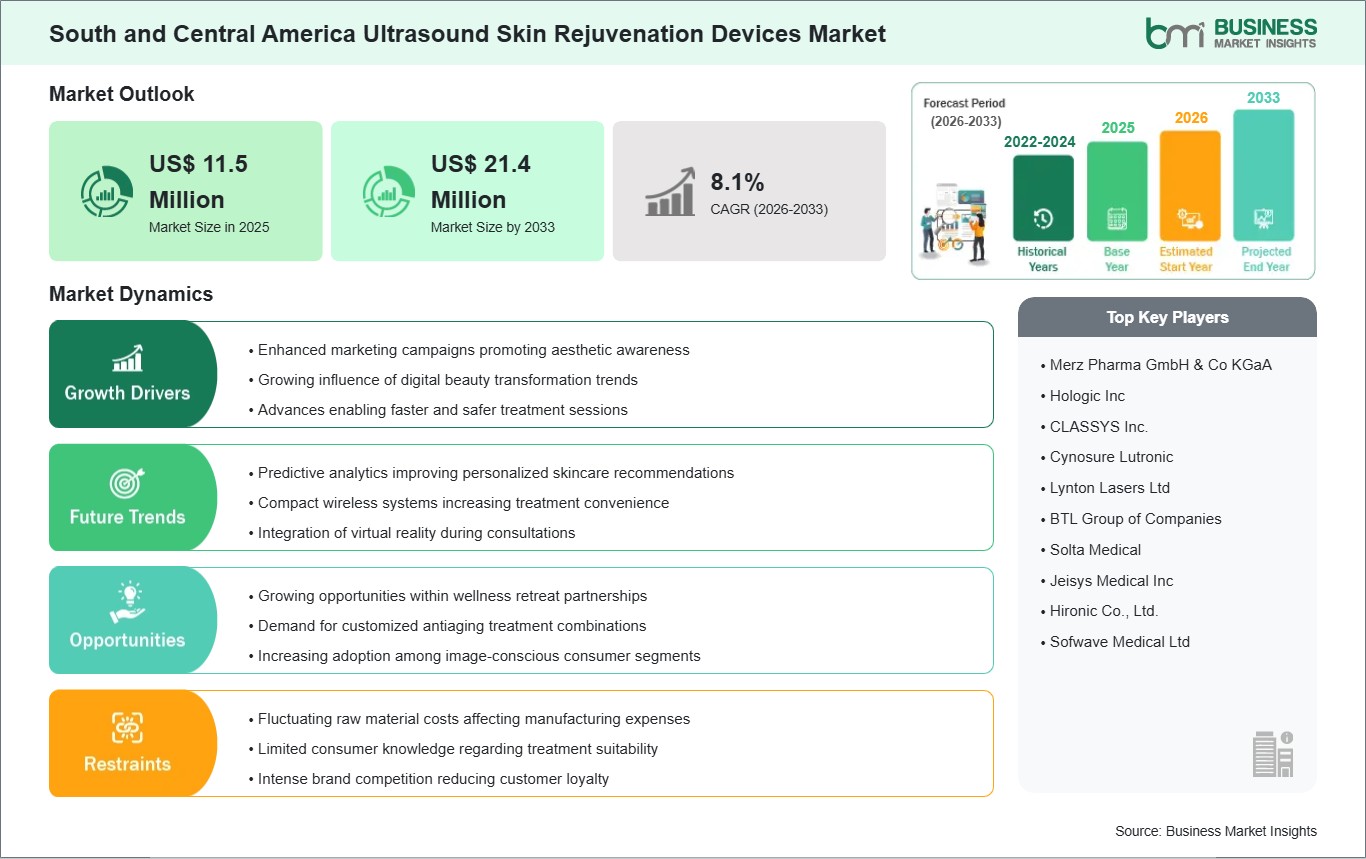
The South and Central America ultrasound skin rejuvenation devices market is evolving as a dynamic segment within the broader aesthetic technology industry. Driven by rising consumer awareness of non-invasive cosmetic procedures, the region is witnessing a shift from traditional surgical interventions to advanced ultrasound-based solutions. Clinics and dermatology centers are increasingly adopting these devices to cater to a growing middle-class population that values affordability, safety, and minimal downtime. Strategic partnerships between global manufacturers and local distributors are accelerating device penetration, while regulatory frameworks are gradually aligning with international standards to ensure product quality and patient safety. Moreover, the influence of medical tourism, particularly in countries like Brazil and Mexico, is fostering demand for cutting-edge rejuvenation technologies. The competitive landscape is characterized by innovation in portable and multifunctional devices, enabling practitioners to expand service offerings. As consumer preferences lean toward personalized treatments, ultrasound technology is positioned as a cornerstone of modern aesthetic care in the region, supported by rising disposable incomes and cultural emphasis on appearance.
Segment Analysis
South and Central America Ultrasound Skin Rejuvenation Devices Market Segmentation
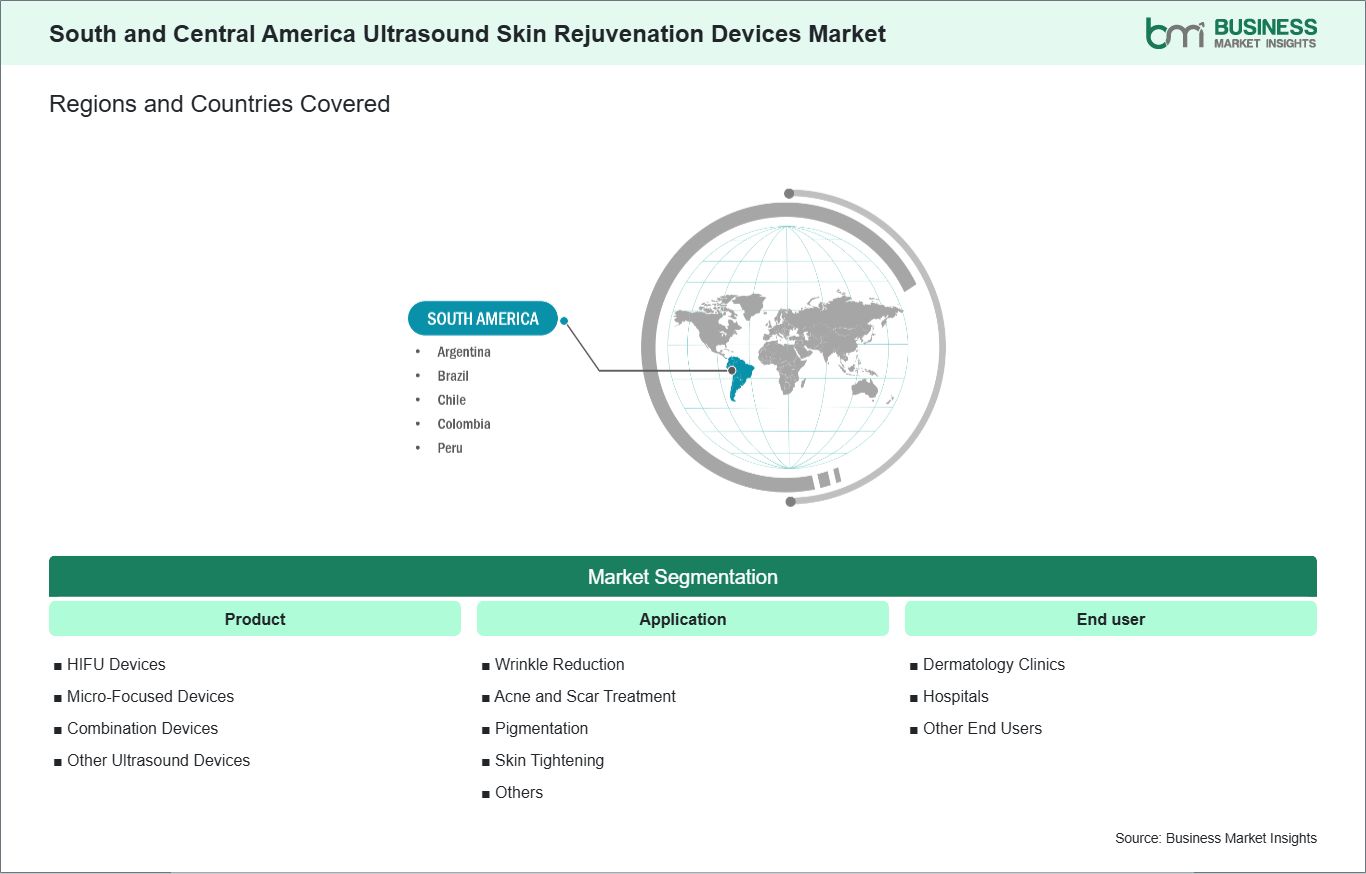
Key segments that contributed to the derivation of the South and Central America ultrasound skin rejuvenation devices market analysis are product, application, and end user.
- By product, the ultrasound skin rejuvenation devices market is segmented HIFU devices, micro-focused devices, combination devices, other ultrasound devices. The HIFU devices segment dominated the market in 2025.
- Based on application, the ultrasound skin rejuvenation devices market is categorized into wrinkle reduction, acne and scar treatment, pigmentation, skin tightening, others application. The wrinkle reduction segment dominated the market in 2025.
- In terms of end user, the ultrasound skin rejuvenation devices market is categorized into dermatology clinics, hospitals, other end users. The dermatology clinics segment dominated the market in 2025.
Market Forces
South and Central America Ultrasound Skin Rejuvenation Devices Market Drivers and Opportunities
Rising prevalence of age-related skin conditions
The South and Central American market for ultrasound skin rejuvenation devices is expanding rapidly due to the rising prevalence of age-related skin conditions across diverse populations. In nations like Brazil, Mexico, and Argentina, it is evident that there is an increasing trend amongst the population aged between 35-60 looking for non-surgical means to get rid of their wrinkles and skin sags and other pigmentation problems. In Brazil, one of the world’s top five nations for cosmetic surgeries, ultrasound gadgets have become popular as safe alternatives to surgical facelifts. In Mexico, there has been an increasing trend amongst city professionals who experience aging more rapidly due to stressful lifestyles and environmental factors.
Due to the popularity of their medical tourism industry, Costa Rica and Colombia are using their advantage to market their services to overseas clients looking for affordable options in the field of anti-aging treatments. Ultrasound devices have become increasingly popular among cosmetic clinics in San José and Bogotá, which aim to position themselves as regional pioneers in providing modern medical services. It is clear that the popularity of these countries as centers of excellence for medical tourism has had a direct impact on the use of such devices.
Environmental elements have been identified to be another factor that contributes significantly to the rising demand for ultrasound machines. Premature aging due to high exposure to UV rays in regions such as Chile and Panama can be countered by the use of ultrasound devices, while smoking and poor eating habits in Argentina and Guatemala can contribute to poor skin health, and again the consumer can opt for preventive action using ultrasonic machines.
Increasing collaborations with cosmetic care providers
Collaborations between device manufacturers and cosmetic care providers are becoming a cornerstone of market expansion in South and Central America. Brazilian and Mexican markets witness alliances between international ultrasound equipment makers and dermatologists and aesthetics centers offering training programs for practitioners to ensure they get the most out of using their equipment. At the same time, the manufacturers have an opportunity to use an existing distribution network. The joint advertising campaign stresses the effectiveness of ultrasound treatment on skin aging.
Noteworthy mention should be made of Costa Rica and Colombia where ultrasound devices have been incorporated into their medical tourism package deals. The cosmetic care specialists in Costa Rica and Colombia are collaborating with manufacturers to come up with comprehensive anti-aging packages aimed at attracting foreigners seeking cosmetic care services. Ultrasound treatment together with other treatments like chemical peel and laser treatment increases the competitiveness of providers by incorporating the use of ultrasound devices.
For developing countries like Panama, Guatemala, and Chile, collaboration is centered around educating practitioners and making technology sharing agreements. The manufacturers are putting their money into training programs to create local expertise, thereby helping the providers offer quality care. This is boosting the trust of the patients and helping in adopting technology faster, especially in secondary cities where advanced technologies for cosmetic care are just starting to be adopted. Through collaboration with cosmetic care providers, the ultrasound technology companies are positioning themselves within the healthcare landscape of the region for future growth.
Size and Share Analysis
South and Central America Ultrasound Skin Rejuvenation Devices Market Size and Share Analysis
The South and Central America ultrasound skin rejuvenation devices market demonstrates steady growth, with size and share analysis highlighting evolving trends and competitive dynamics among key players. The report examines subsegments categorized within product, application, and end user, offering insights into their contribution to overall market performance.
By product, the HIFU devices segment dominated the market in 2025, driven by rising adoption of affordable non-invasive skin rejuvenation technologies with minimal downtime in South and Central America.
Based on application, the wrinkle reduction segment dominated the market in 2025, driven by growing demand for accessible anti-aging treatments among expanding urban middle-class populations.
In terms of end user, the dermatology clinics segment dominated the market in 2025, driven by increasing establishment of private aesthetic clinics and preference for professional supervised procedures.
Report Coverage
South and Central America Ultrasound Skin Rejuvenation Devices Market Report Coverage and Deliverables
The "South and Central America Ultrasound Skin Rejuvenation Devices Market Size and Forecast (2022-2033)" report provides a detailed analysis of the market covering below areas:
- Market size and forecast at global, regional, and country levels for all the key market segments covered under the scope
- Market trends, as well as drivers, restraints, and opportunities
- Market analysis covering key trends, global and regional framework, major players, regulations, and recent developments
- Market concentration, heat map analysis, prominent players, and recent developments for the Market
- Detailed company profiles, including SWOT analysis
Geographic Insights
South and Central America Ultrasound Skin Rejuvenation Devices Market Geographic Insights
The geographical scope of the South and Central America ultrasound skin rejuvenation devices market report is divided into Brazil, Argentina, Peru, Chile, Colombia. Brazil held the largest share in 2025.
Country-level dynamics reveal distinct opportunities and challenges across South and Central America. Brazil stands out as a hub for aesthetic medicine, with a strong domestic market supported by advanced dermatology practices and a culture deeply invested in beauty enhancement. Mexico, on the other hand, benefits from proximity to North America, attracting cross-border patients seeking cost-effective yet high-quality treatments. Argentina demonstrates growing adoption in urban centers, where private clinics are investing in ultrasound technologies to differentiate themselves in a competitive healthcare environment. Smaller Central American nations, such as Costa Rica and Panama, leverage their reputation in medical tourism to integrate ultrasound rejuvenation into wellness packages aimed at international clients. Regulatory diversity across countries creates varying entry barriers, requiring manufacturers to tailor compliance strategies. Additionally, local economic conditions influence purchasing power, with premium devices concentrated in metropolitan areas while mid-range solutions gain traction in secondary markets. Collectively, these country-specific insights highlight a fragmented yet promising landscape, where localized strategies and cultural alignment are essential for sustained growth.
Industry Activity
Recent Developments
The South and Central America ultrasound skin rejuvenation devices market is evaluated by gathering qualitative and quantitative data post primary and secondary research, which includes important corporate publications, association data, and databases. A few of the key developments in the South and Central America ultrasound skin rejuvenation devices market are:
- In November 2022, Sofwave Medical announced that Brazil’s regulatory authority ANVISA granted pre-market approval to market its SUPERB non-invasive ultrasound skin tightening technology, enabling commercial launch of the device in Brazil and strengthening access to ultrasound-based skin rejuvenation systems in Latin America’s largest aesthetic market.
- In March 2023, Sofwave Medical received additional FDA clearance for its Precise SUPERB applicator, expanding the use of its synchronous ultrasound parallel beam technology for treating fine lines and hard-to-reach facial areas such as around the eyes and mouth.
Trust & Transparency
Research Methodology
The market analysis combines proprietary research with secondary data from government agencies, company disclosures, regulatory filings, industry databases and expert interviews. Market estimates are validated through data triangulation, cross-market benchmarking and analyst
review.
View Full Research Methodology
Key Sources Referred:
American Society for Laser Medicine and Surgery (ASLMS)European Academy of Dermatology and Venereology (EADV)Bharat Society of Laser Medicine & Surgery (BSLMS)S. Food and Drug Administration (FDA)European Medicines Agency (EMA)International Electrotechnical Commission (IEC)International Organization for Standardization (ISO)Beauty Device Association (BDA)Indian Laser Association (ILA)Association of Industrial Laser Users (AILU)