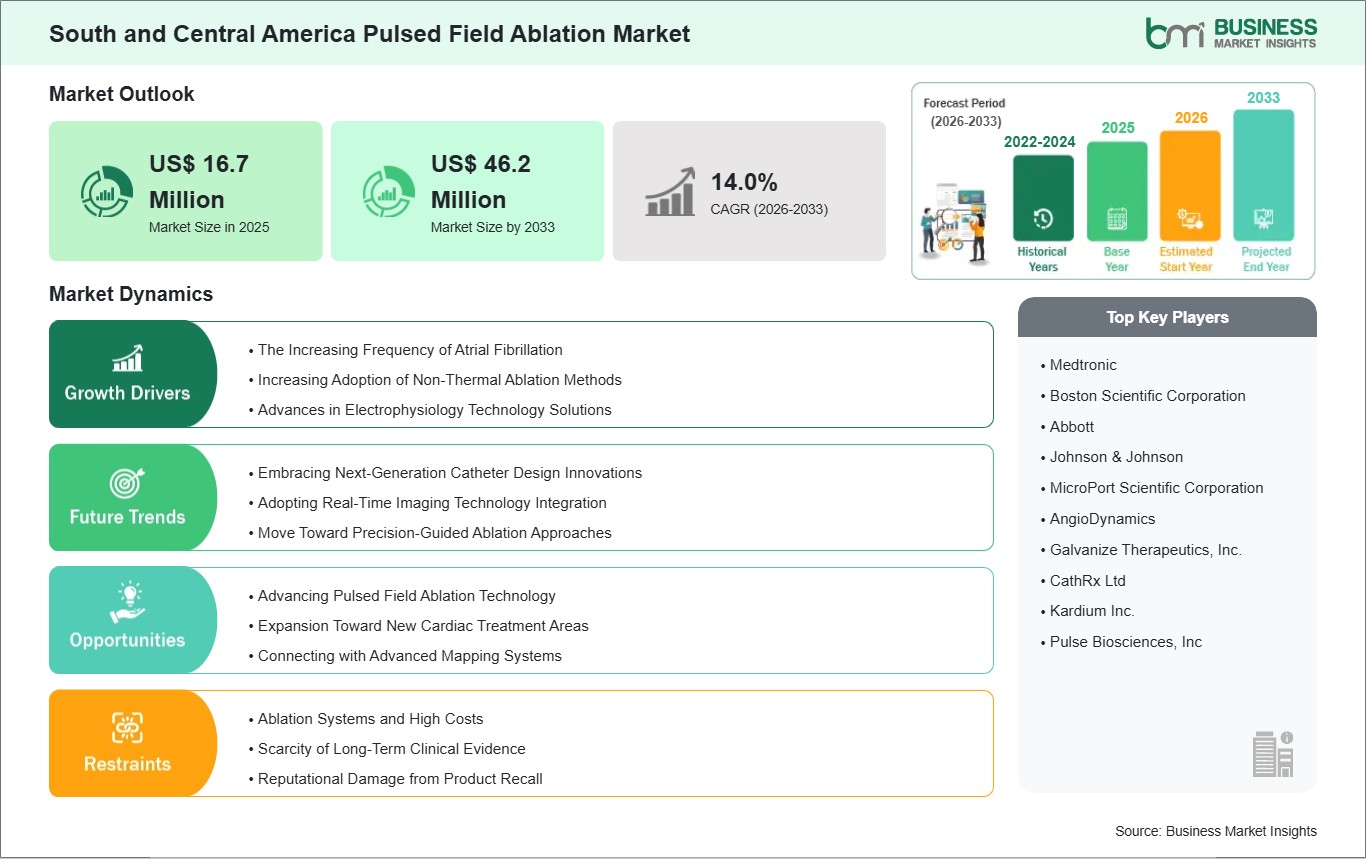
The South and Central America pulsed field ablation market size is expected to reach US$ 46.2 million by 2033 from US$ 16.7 million in 2025. The market is estimated to register a CAGR of 14.0% from 2026 to 2033.
The market for South and Central America pulsed field ablation technology is slowly gathering momentum since most healthcare facilities within the region are increasingly looking for minimally invasive solutions that can address cardiac arrhythmias. Increased incidences of atrial fibrillation, coupled with the need to overcome some of the shortcomings associated with conventional thermal ablation technologies, have fueled the uptake of PFA treatments, which rely on non-thermal and selective tissue ablation.
Adoption of the new technology is mainly taking place in premier healthcare facilities that are equipped with state-of-the-art electrophysiology laboratories and cardiac mapping equipment. Knowledge dissemination through training sessions and pilot trials has gone a long way in ensuring that cardiologists gain sufficient technical know-how to conduct PFA treatments. Strategic collaborations with major medical device vendors have been instrumental in sharing knowledge and standardizing the procedure. Despite growing interest, adoption is restrained by high equipment and procedural costs, which limit accessibility in smaller or regional healthcare facilities. In addition, the limited number of trained electrophysiologists slows broader clinical integration. Nonetheless, increasing investment in healthcare infrastructure, focus on minimally invasive therapies, and a rising emphasis on patient-centered care indicate a promising path for the gradual expansion of the PFA market across South and Central America.

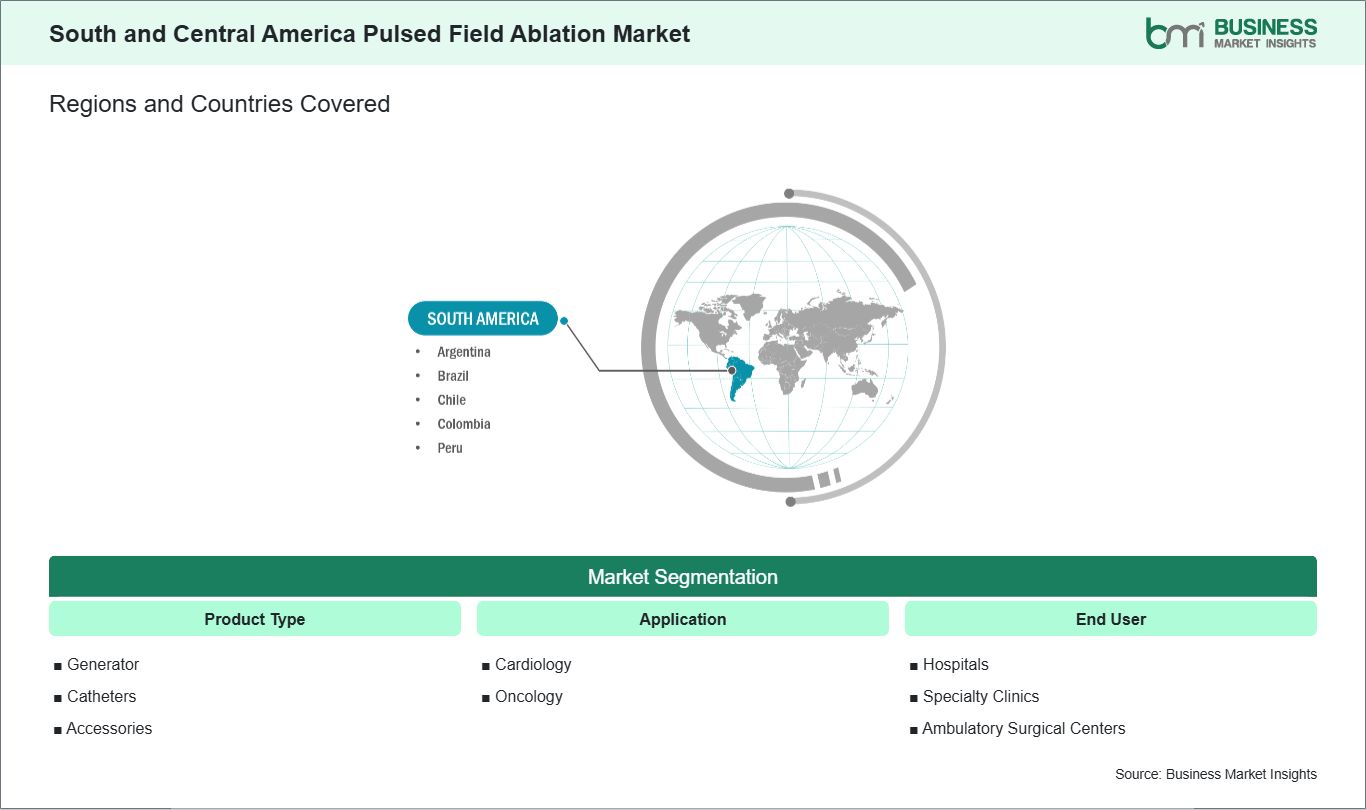
Key segments that contributed to the derivation of the South and Central America pulsed field ablation market analysis are product type, application, and end user.
Across South and Central America, atrial fibrillation (AFib) is emerging as a more commonly encountered cardiac condition, reflecting broader changes in lifestyle and healthcare access. Urbanization has brought shifts in diet and physical activity patterns that correlate with a rise in cardiovascular risk factors. Physicians in large metropolitan centers are seeing more patients with palpitations and irregular heart rhythms during routine check‑ups, which has elevated AFib awareness among both patients and primary care providers.
Public health initiatives and expanding cardiology services have also contributed to higher detection rates. In cities such as Sao Paulo, Buenos Aires, and Bogota, advances in non‑invasive monitoring and greater use of ambulatory ECG technologies have helped clinicians identify AFib earlier in its course. This shift has led to more referrals to specialist electrophysiology centers, where treatment planning includes rhythm‑control strategies beyond traditional drug therapy. Patients are becoming better informed about the risks associated with untreated AFib, such as stroke, leading to more proactive discussions with cardiologists.
As AFib is increasingly recognized as a significant contributor to morbidity, the focus on effective interventional options has grown. Electrophysiologists in the region are exploring alternatives to long‑standing thermal ablation techniques, particularly for patients who are younger or who have experienced limited success with medication. Pulsed field ablation (PFA), with its non‑thermal mechanism and potential for reduced collateral tissue injury, is drawing interest in centers looking to optimize rhythm control outcomes. While adoption is still in earlier stages compared with some other regions, growing clinical experience and patient demand are shaping a clearer role for PFA in addressing the rising frequency of AFib across South and Central America.
Pulsed field ablation (PFA) technology is advancing steadily in South and Central America as electrophysiology teams look for safer and more efficient ways to treat atrial fibrillation. Early clinical experiences in major cardiac centers are demonstrating non‑thermal electrical pulses can be used to isolate arrhythmogenic tissue with precision. These innovations align well with regional priorities, where clinicians aim to improve procedural safety and reduce hospitalization times in complex healthcare environments.
Recent refinements in PFA systems focus on enhanced catheter maneuverability and real‑time guidance features that help clinicians navigate diverse cardiac anatomies. This has been particularly useful in patients with persistent or atypical AFib presentations, where accurate lesion placement makes a significant difference. Electrophysiologists in the region appreciate the ability to integrate advanced mapping technologies with PFA workflows, enabling better visualization of pulmonary veins and adjacent structures during procedures.
Training and knowledge exchange are also contributing to how PFA is evolving locally. Regional cardiology and electrophysiology societies are incorporating PFA into educational forums, case reviews, and hands‑on workshops. These professional development efforts help local specialists understand not only the technical nuances of PFA devices but also best practices for patient selection and procedural planning. As these technologies mature and clinicians gain experience, pulsed field ablation is increasingly seen as a promising component of modern AFib care in South and Central America one that balances innovation with the practical demands of diverse healthcare settings.

The South and Central America pulsed field ablation market demonstrates steady growth, with size and share analysis highlighting evolving trends and competitive dynamics among key players. The report evaluates important subsegments categorized within product type, application, and end user, highlighting their respective contributions to overall market performance.
By product type, the catheters subsegment dominated the market in 2025. Catheter devices offer improved procedural efficiency, reduced risk of complications, and real-time control for electrophysiologists, making them a crucial component for effective PFA therapy and a key revenue driver for manufacturers.
In terms of application, the cardiology subsegment dominated the market in 2025. The leadership of cardiology applications is attributed to the rising prevalence of atrial fibrillation and other cardiac arrhythmias, growing preference for non-thermal and tissue-selective ablation techniques, and increasing awareness among healthcare providers about the clinical benefits of PFA.
Based on end user, the hospitals subsegment dominated the market in 2025. Hospitals maintain a stronghold due to their established cardiology and electrophysiology departments, access to advanced PFA systems, trained physicians and clinical staff, and the capability to perform specialized cardiac procedures with comprehensive patient monitoring and post-procedure care.
| Report Attribute | Details |
|---|---|
| Market size in 2025 | US$ 16.7 Million |
| Market Size by 2033 | US$ 46.2 Million |
| CAGR (2026 - 2033) | 14.0% |
| Historical Data | 2022-2024 |
| Forecast period | 2026-2033 |
| Segments Covered | By Product Type
|
|
Regions and Countries Covered
| |
| South and Central America | Brazil, Argentina, Chile, Colombia, Peru |
| Market leaders and key company profiles |
|
The "South and Central America Pulsed Field Ablation Market Size and Forecast (2022–2033)" report provides a detailed analysis of the market covering below areas:
The geographical scope of the South and Central America pulsed field ablation market report is divided into: Brazil, Argentina, Chile, Colombia, Peru, and the Rest of South and Central America. Brazil held the largest share in 2025.
The Brazilian country has been taking up a dominant position in the South and Central America pulsed field ablation market due to the relatively more developed healthcare system, presence of an enormous number of patients suffering from cardiac arrhythmias, and usage of progressive medical technologies. PFA is superior to conventional thermal ablation because it destroys only the diseased cells without affecting any other organs and tissues, which is important for Brazil, where new cardiac treatment centers have started developing.
Some Brazilian medical institutions, including cardiology centers and hospitals, are creating conditions that will allow performing PFA operations. Cardiologists will be getting training to perform this complex procedure and using progressive devices for cardiac imaging and mapping. Nevertheless, with the consideration of the expensive nature of the equipment and the lack of electrophysiologists who have been trained on how to use the technique away from big cities, the wider application of the method has become difficult. Considering Brazil's dedication towards the development of healthcare facilities, and the inclusion of minimally invasive techniques in its healthcare systems, together with its emphasis on the improvement of the outcome, it has become the epicenter of PFA in South and Central America.

The South and Central America pulsed field ablation market is evaluated by gathering qualitative and quantitative data post primary and secondary research, which includes important corporate publications, association data, and databases. A few of the key developments in the South and Central America pulsed field ablation market are:
The South and Central America Pulsed Field Ablation Market is valued at US$ 16.7 Million in 2025, it is projected to reach US$ 46.2 Million by 2033.
As per our report South and Central America Pulsed Field Ablation Market, the market size is valued at US$ 16.7 Million in 2025, projecting it to reach US$ 46.2 Million by 2033. This translates to a CAGR of approximately 14.0% during the forecast period.
The South and Central America Pulsed Field Ablation Market report typically cover these key segments-
The historic period, base year, and forecast period can vary slightly depending on the specific market research report. However, for the South and Central America Pulsed Field Ablation Market report:
The South and Central America Pulsed Field Ablation Market is populated by several key players, each contributing to its growth and innovation. Some of the major players include:
The South and Central America Pulsed Field Ablation Market report is valuable for diverse stakeholders, including:
Essentially, anyone involved in or considering involvement in the South and Central America Pulsed Field Ablation Market value chain can benefit from the information contained in a comprehensive market report.
Please tell us your area of interest
(Market Segments/ Regions and Countries/ Companies)