Market Summary
Executive Summary and Market Analysis
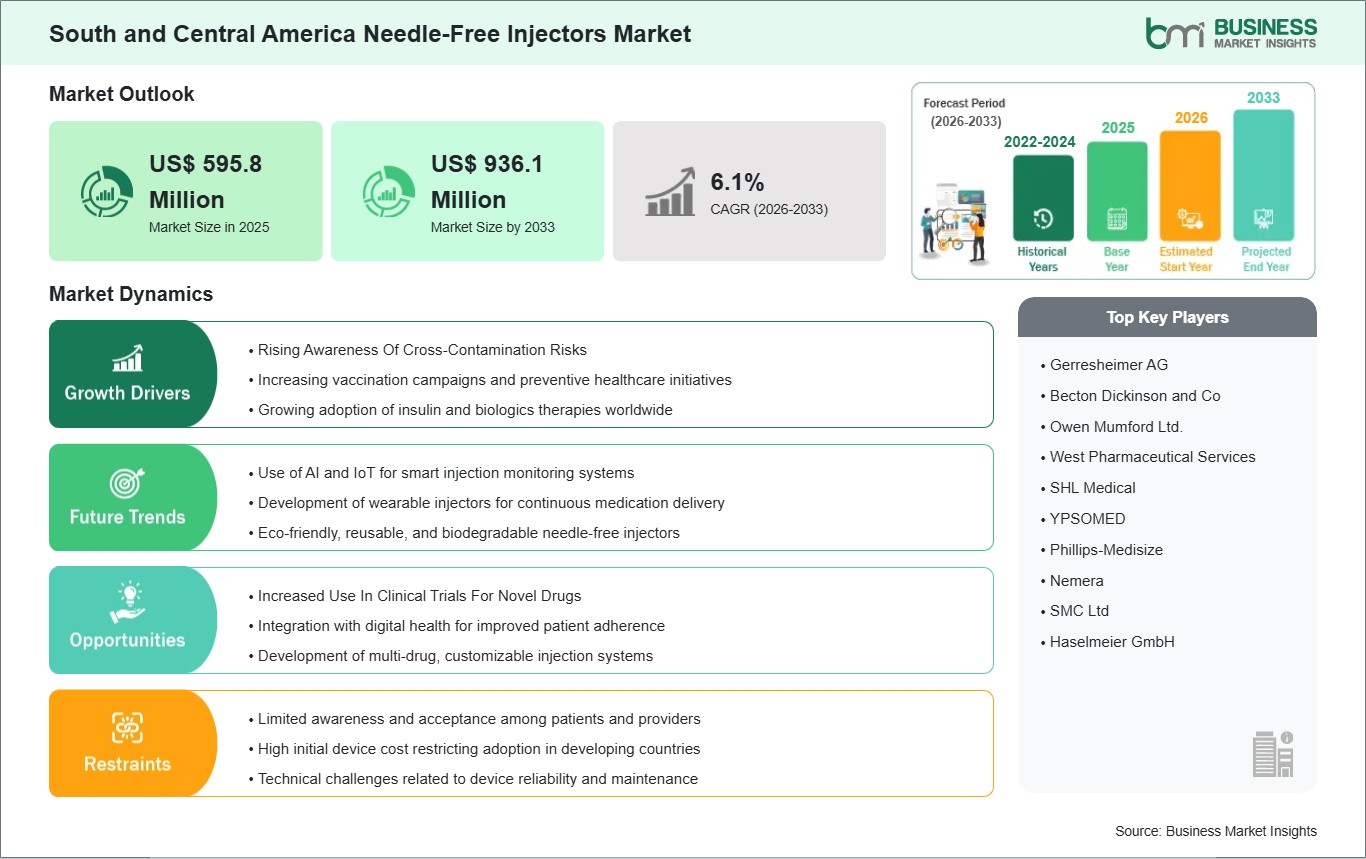
Countries such as Brazil, Mexico, Argentina, Chile, and Colombia are exploring needle-free drug delivery solutions to reduce the risk of needle-stick injuries, improve patient adherence, and optimize operational efficiency in vaccination programs and chronic therapy administration. Multinational medical device manufacturers and local distributors emphasize affordability, regulatory compliance, and regional market adaptability. Adoption is driven by clinical evidence demonstrating enhanced safety, reduced infection risk, and better patient experience, particularly in high-volume immunization and outpatient care settings. Regulatory frameworks vary across the region, with Brazil and Mexico enforcing strict approval processes requiring clinical validation, whereas other countries implement more flexible guidelines to encourage pilot adoption. Healthcare providers evaluate devices based on total cost of ownership, including consumables, training, and long-term operational efficiency. Innovation trends emphasize disposable and reusable systems, ergonomic designs, multi-drug compatibility, and integration with digital adherence tracking solutions. Pilot programs and hospital-led demonstration projects play a critical role in validating clinical efficacy and operational workflows. The market represents a transitional and promising landscape where regulatory alignment, operational efficiency, and patient-centered innovation define competitive advantage and growth potential.
Segment Analysis
South and Central America Needle-Free Injectors Market Segmentation
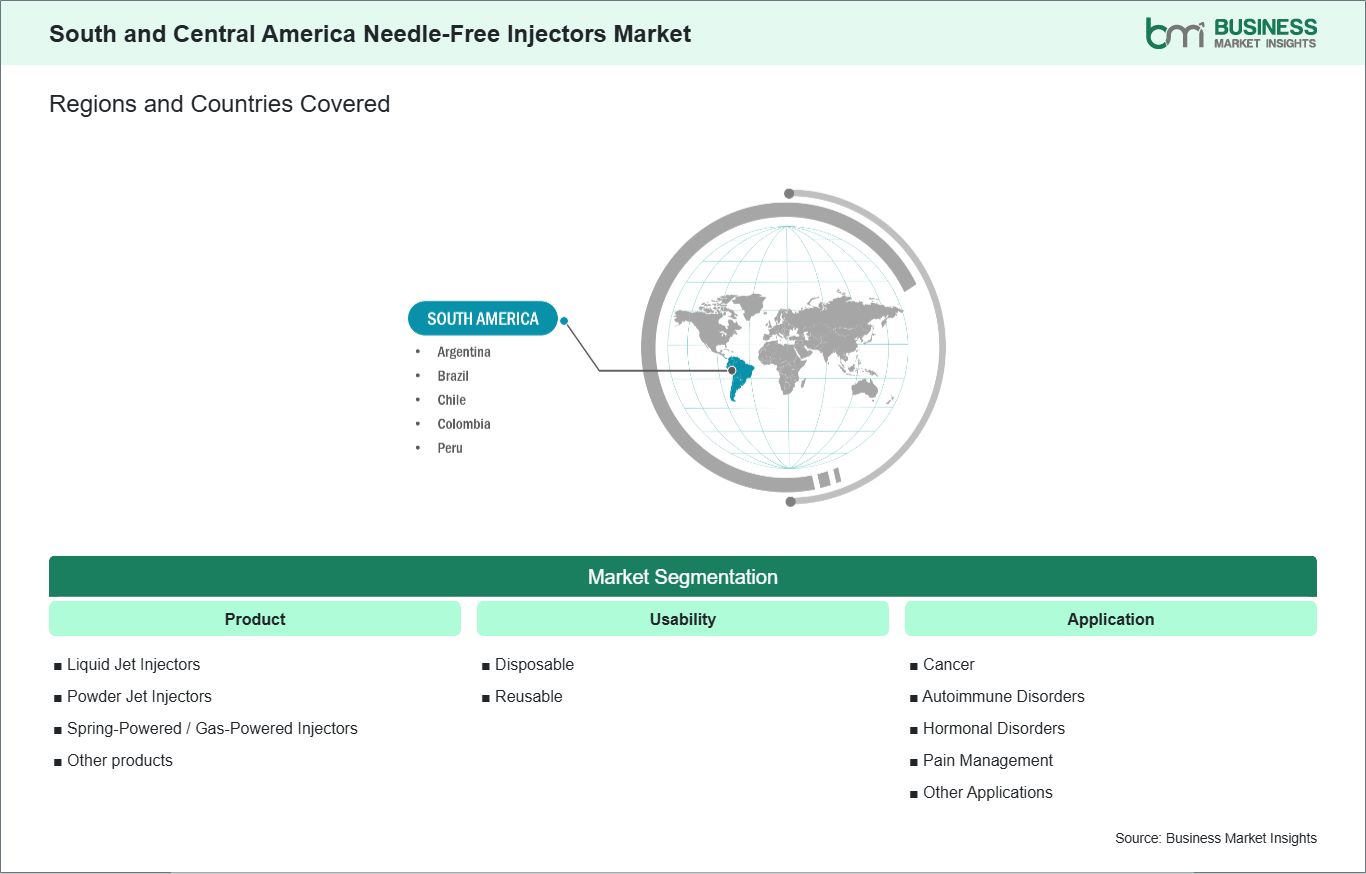
Key segments that contributed to the derivation of the South and Central needle-free injectors market analysis are product, usability, and application.
- By product, the needle-free injectors market is segmented into liquid jet injectors, powder jet injectors, spring-powered / gas-powered injectors, and other products. The liquid jet injectors segment dominated the market in 2025.
- Based on usability, the needle-free injectors market is categorized into disposable and reusable. The disposable segment dominated the market in 2025.
- In terms of application, the market is classified into cancer, autoimmune disorders, hormonal disorders, pain management, and other applications. The autoimmune disorders segment dominated the market in 2025.
Market Forces
South and Central America Needle-Free Injectors Market Drivers and Opportunities
Rising Awareness Of Cross-Contamination Risks
Needle-stick injuries and the reuse of syringes in high-volume clinics have historically posed risks of infection transmission. Needle-free injectors are gaining adoption as a safer alternative, eliminating direct needle contact and reducing the risk of pathogen spread in hospitals, vaccination programs, and outpatient care facilities. Countries such as Brazil, Argentina, and Mexico are witnessing growing public and professional awareness of infection control practices. Hospitals and vaccination centers are implementing needle-free systems to safeguard healthcare workers and patients alike. The devices’ ability to provide precise, single-use dosing makes them suitable for immunization campaigns and chronic disease management programs, aligning with regional initiatives to strengthen patient safety standards. Healthcare policymakers and hospital administrators are recognizing the operational benefits of needle-free injectors beyond safety. Reduced needle-stick injuries lower occupational health costs, enhance staff confidence, and improves workflow efficiency. As awareness of cross-contamination risks continues to rise, the adoption of needle-free injectors is expected to accelerate, becoming an integral component of safer, modern healthcare delivery.
Increased Use In Clinical Trials For Novel Drugs
Clinical research activity is expanding across South and Central America, with Brazil, Chile, and Argentina emerging as hubs for drug development and testing. Needle-free injectors are utilized in clinical trials for novel therapeutics, particularly biologics, vaccines, and hormone therapies. Their precise dosing and reduced risk of contamination make them ideal for investigational drugs where safety, accuracy, and patient compliance are critical. The use of needle-free devices in trials ensures consistent administration across study participants and minimizes variability that may arise from conventional injection methods. This consistency is important in multicenter trials spanning urban and rural locations, where healthcare personnel may have varying levels of injection expertise. By providing pain-free delivery, needle-free injectors enhance participant adherence and retention, critical factors for successful clinical study outcomes. Regulatory bodies and research institutions are encouraging the adoption of innovative delivery technologies in clinical research. Needle-free injectors support these initiatives by enabling safe, reproducible, and efficient administration of novel therapeutics. As South and Central America continue to grow as key destinations for pharmaceutical development and testing, the integration of needle-free injectors in clinical trials is expected to expand, promoting safer and more effective drug evaluation.
Size and Share Analysis
South and Central America Needle-Free Injectors Market Size and Share Analysis
The South and Central Needle-free Injectors Market demonstrates steady growth, with size and share analysis highlighting evolving trends and competitive dynamics among key players. The report examines subsegments categorized within product, usability, and application, offering insights into their contribution to overall market performance.
By product, the liquid jet injectors subsegment dominated the market in 2025, driven by their ability to provide precise, rapid, and pain-free dosing, making them suitable for clinical, home-care, and vaccination programs.
Based on usability, the disposable subsegment dominated the market in 2025, driven by the emphasis on hygiene, infection control, and ease of use in hospitals, outpatient clinics, and home-based care settings.
In terms of application, the autoimmune disorders subsegment dominated the market in 2025, driven by the high demand for frequent, long-term injectable biologic therapies where patient comfort, adherence, and safety are critical for disease management.
Report Coverage
South and Central America Needle-Free Injectors Market Report Coverage and Deliverables
The "South and Central Needle-free Injectors Market Size and Forecast (2022–2033)" report provides a detailed analysis of the market covering below areas:
- South and Central Needle-free Injectors Market size and forecast at regional and country levels for all market segments covered under the scope
- South and Central Needle-free Injectors Market trends, as well as drivers, restraints, and opportunities
- South and Central Needle-free Injectors Market analysis covering key trends, regional framework, major players, regulations, and recent developments
- Industry landscape and competition analysis covering market concentration, heat map analysis, prominent players, and recent developments for the South and Central Needle-free Injectors Market
- Detailed company profiles, including SWOT analysis
Geographic Insights
South and Central America Needle-Free Injectors Market Geographic Insights
The geographical scope of the South and Central Needle-free Injectors Market report is divided into Brazil, Argentina, Peru, Chile, and Colombia. Brazil held the largest share in 2025.
Brazil dominates the market due to large-scale public vaccination programs, widespread hospital modernization, and increasing deployment of outpatient and home-based therapies. Mexico follows closely, with strong adoption in public hospitals and private healthcare networks, emphasizing operational efficiency, clinical validation, and patient-centered design. Argentina demonstrates growing uptake, particularly in urban hospitals where multi-hospital procurement and pilot programs influence wider adoption. Chile and Colombia are emerging markets, with demand concentrated in government-led vaccination initiatives, chronic disease management programs, and NGO-supported community health efforts. Across the region, adoption depends on reliable distributor networks, localized clinician training, and after-sales support to ensure device integration and workflow efficiency. Urban healthcare facilities act as reference centers, influencing secondary hospitals and regional clinics. Regulatory variations, procurement practices, and healthcare infrastructure differences require manufacturers to implement country-specific commercialization strategies. Brazil and Mexico drive the scale of adoption, and other South and Central American countries provide growth opportunities through pilot projects, public health initiatives, and targeted operational deployment.
Industry Activity
Recent Developments
The South and Central Needle-free Injectors Market is evaluated by gathering qualitative and quantitative data post primary and secondary research, which includes important corporate publications, association data, and databases. A few of the key developments in the South and Central needle-free injectors market are:
- In April 2025, a technology called BoldJet (jet‑based needle‑free delivery) was highlighted for its ability to inject medications and vaccines without needles using micro‑jet streams, a development that could influence Latin American clinical approaches toward needle‑free vaccination and drug delivery if adopted in clinical or commercial programs across countries such as Brazil and Argentina.
- In January 2024, NuGen Medical Devices expanded distribution of its InsuJet needle‑free injection device into Argentina, Chile, Costa Rica, and Peru through an agreement with regional partner Science‑Link Trading SAPI de CV, marking a regional product expansion and strengthening access to needle‑free diabetes care across South and Central America. The partnership plans to sell around 5,000 units in 2024 and includes a clinic and pharmacy rollout, increasing the reach of the InsuJet platform in both clinical and retail channels. Science‑Link also collaborates with a major medical network to expand sales into specialty clinics across Mexico and Latin America, reinforcing multi‑country commercial coverage.
Trust & Transparency
Research Methodology
The market analysis combines proprietary research with secondary data from government agencies, company disclosures, regulatory filings, industry databases and expert interviews. Market estimates are validated through data triangulation, cross-market benchmarking and analyst
review.
View Full Research Methodology
Key Sources Referred:
World Health Organization (WHO) Organisation for Economic Cooperation and Development (OECD) The World Bank Group Worldometer The Lancet International Bar Association International Trade Administration