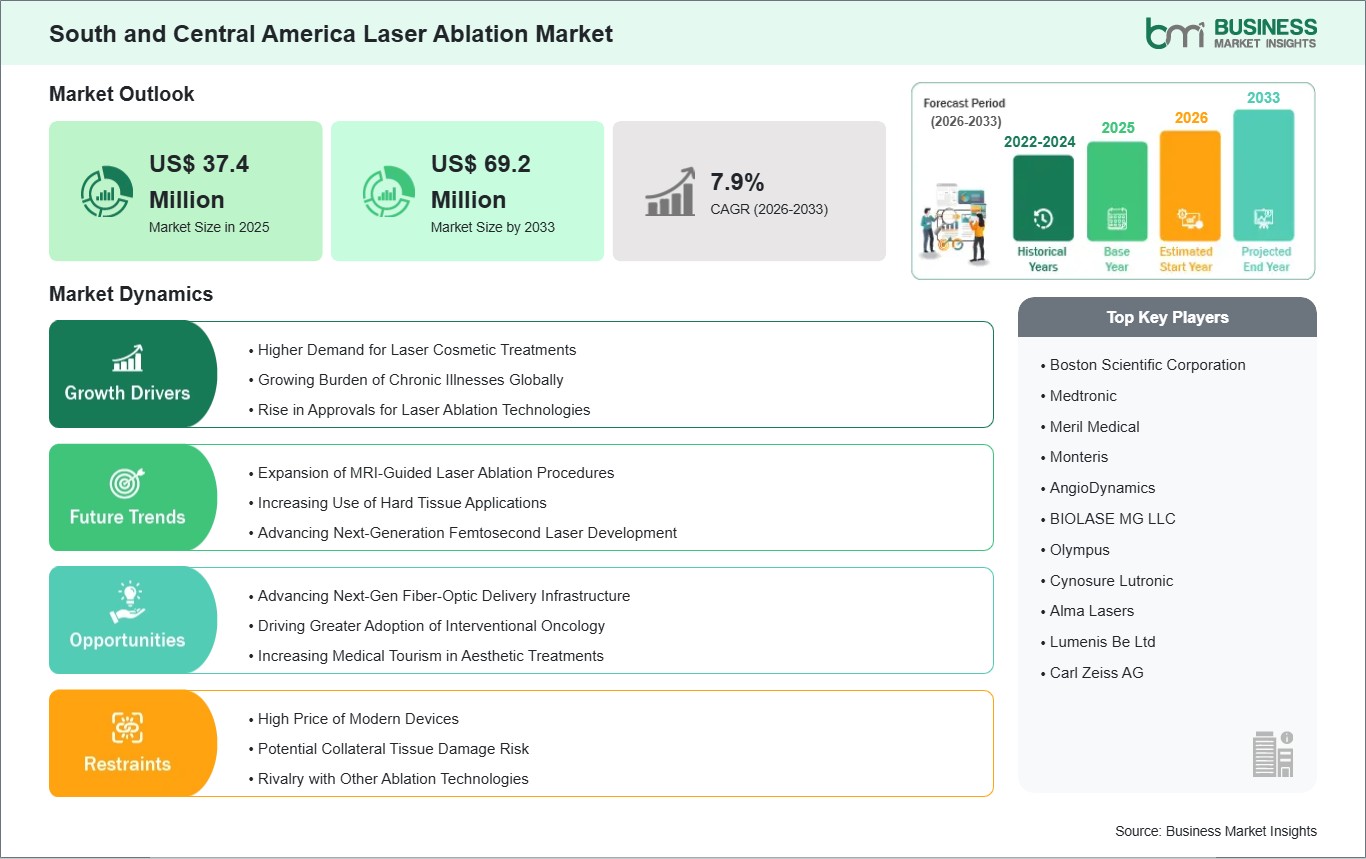
The South and Central America laser ablation market size is expected to reach US$ 69.2 million by 2033 from US$ 37.4 million in 2025. The market is estimated to record a CAGR of 7.9% from 2026 to 2033.
The South and Central America laser ablation market is witnessing gradual expansion, driven by growing awareness of minimally invasive procedures, rising patient demand for precision therapies, and investments in healthcare infrastructure. Countries are progressively adopting laser ablation technologies across cardiology, oncology, dermatology, and urology. Urban hospitals and specialty clinics are the primary adoption hubs, offering advanced treatments in metropolitan areas with well-developed healthcare networks. The increasing availability of private healthcare facilities is also boosting accessibility to high-quality laser ablation procedures.
A key growth driver in the region is the focus on improving patient outcomes and reducing hospital stay durations. Clinics and hospitals are increasingly implementing laser technologies to enhance treatment efficiency and reduce procedural complications, particularly for elective and cosmetic procedures. Furthermore, the expansion of medical tourism, especially in countries like Brazil and Mexico, encourages hospitals to adopt innovative laser solutions to attract international patients seeking advanced care.
The high equipment and maintenance costs restrict widespread adoption, particularly in smaller clinics and rural hospitals. Limited availability of trained specialists further hinders uniform deployment, creating a gap between urban and peripheral regions. Regulatory heterogeneity across countries also poses delays in introducing new laser technologies. As a result, market growth is concentrated in large cities while regional penetration remains uneven.

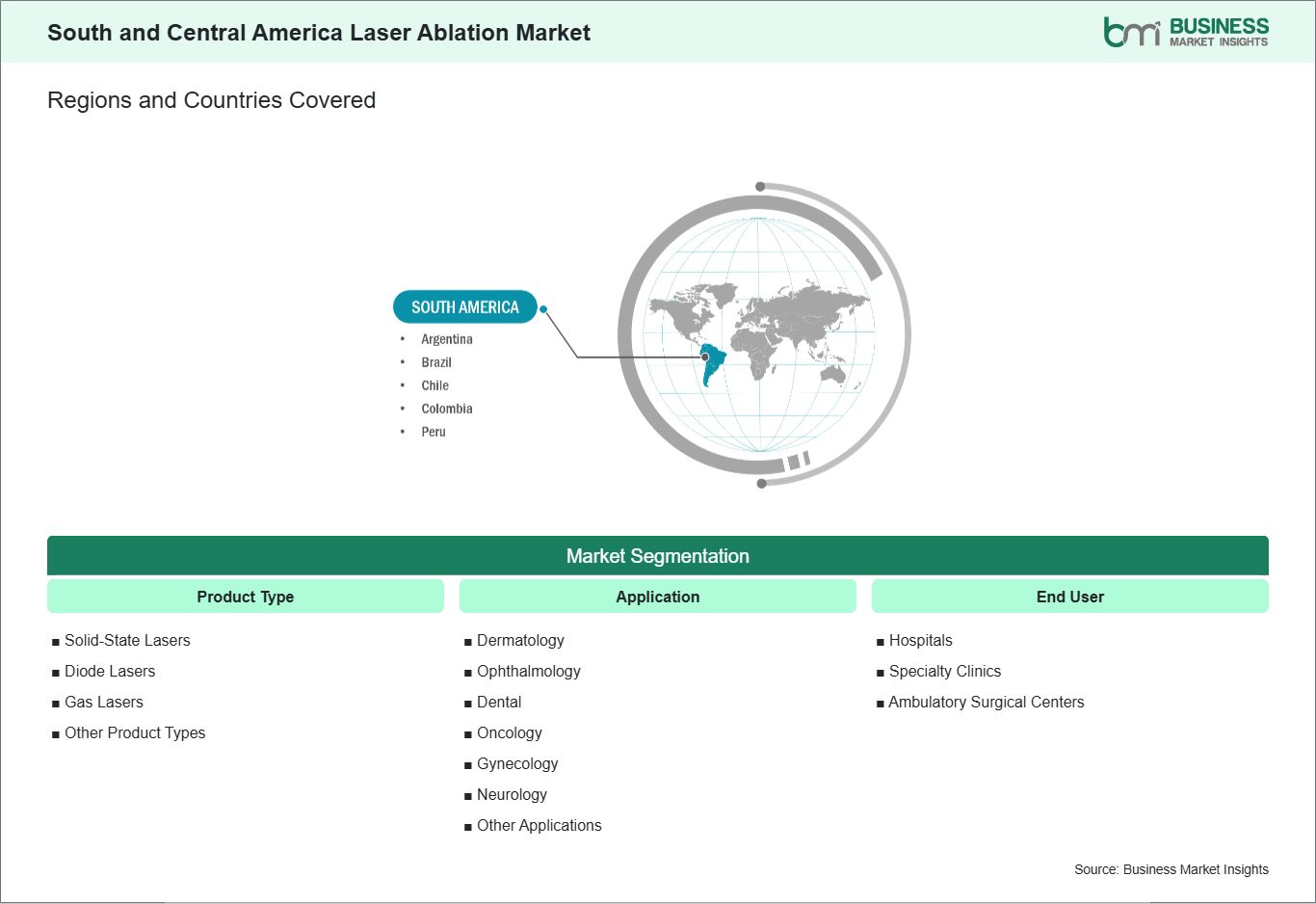
Key segments that contributed to the derivation of the South and Central America Laser Ablation market analysis are product type, application, and end user.
South and Central America is experiencing higher demand for laser cosmetic treatments driven by a combination of cultural emphasis on beauty, urbanization, and growing disposable incomes. Cities have become key hubs for dermatology clinics and medspas offering procedures such as laser hair removal, fractional resurfacing, pigmentation correction, scar revision, and tattoo removal. Patients in the region increasingly prefer minimally invasive procedures due to shorter recovery times, lower risk of complications, and predictable results compared to traditional surgery.
Environmental and lifestyle factors also shape treatment demand. High sun exposure in tropical and subtropical areas contributes to pigmentation issues, photoaging, and uneven skin tone, creating a need for laser solutions that restore skin uniformity. Clinics emphasize customized treatment protocols and combination therapies that integrate laser procedures with topical skincare solutions to address specific regional skin concerns.
The rise of aesthetic awareness is also fueled by social and media influences, where image-conscious populations seek modern, professional cosmetic interventions. Regulatory standards in urban centers ensure quality and safety, while the proliferation of trained specialists strengthens patient confidence. The convergence of cultural priorities, urban concentration of high-quality clinics, and environmental factors has driven the sustained growth of laser cosmetic treatments across South and Central America, establishing them as a mainstream component of personal care and aesthetic healthcare in the region.
Next-generation fiber-optic delivery systems are becoming a cornerstone of the laser ablation market in South and Central America, enabling more precise, safe, and versatile procedures. Leading clinics are deploying these systems for aesthetic procedures such as scar revision, pigmentation correction, fractional resurfacing, and hair removal. Fiber-optic technology allows practitioners to deliver laser energy with high accuracy, reducing damage to surrounding tissue and improving treatment consistency a critical feature for the region’s diverse skin phototypes.
Beyond aesthetic use, fiber-optic systems are being applied in dermatologic treatments and minimally invasive procedures, providing multifunctional capabilities that optimize device utilization. Clinics benefit from real-time feedback, adjustable energy settings, and modular designs that allow a single system to address multiple treatment needs. This is particularly advantageous for mid-sized clinics seeking to maximize return on investment while delivering a wide range of procedures.
Infrastructure development trends focus on portability, compact design, and ease of integration, enabling smaller clinics and urban centers to adopt advanced technologies. Advanced software and treatment customization allow practitioners to address regional skin concerns, such as pigmentation irregularities from sun exposure or post-acne scarring. By combining precision, flexibility, and accessibility, next-generation fiber-optic delivery systems are driving growth in South and Central America’s laser ablation market, supporting both aesthetic and therapeutic applications while expanding patient access to high-quality care.

The South and Central America Laser Ablation market demonstrates steady growth, with size and share analysis highlighting evolving trends and competitive dynamics among key players. The report evaluates important subsegments categorized within product type, application, and end user, highlighting their respective contributions to overall market performance.
By product type, the solid-state lasers subsegment dominated the market in 2025, driven by the superior performance and versatility of solid-state lasers in clinical applications. These devices offer high precision, consistent energy delivery, and compatibility with a wide range of tissues, making them the preferred choice for laser ablation procedures.
In terms of application, the dermatology subsegment dominated the market in 2025, propelled by the increasing prevalence of skin disorders such as acne scars, pigmentation issues, and vascular lesions, coupled with a growing demand for minimally invasive cosmetic procedures.
Based on end user, the hospitals subsegment dominated the market in 2025 due to their well-established dermatology and surgical departments, access to advanced laser ablation systems, and availability of trained physicians and clinical staff.
| Report Attribute | Details |
|---|---|
| Market size in 2025 | US$ 37.4 Million |
| Market Size by 2033 | US$ 69.2 Million |
| CAGR (2026 - 2033) | 7.9% |
| Historical Data | 2022-2024 |
| Forecast period | 2026-2033 |
| Segments Covered | By Product Type
|
|
Regions and Countries Covered
| |
| South and Central America | Brazil, Argentina, Chile, Colombia, Peru |
| Market leaders and key company profiles |
|
The "South and Central America Laser Ablation Market Size and Forecast (2022–2033)" report provides a detailed analysis of the market covering below areas:
The geographical scope of the South and Central America Laser Ablation market report is divided into: Brazil, Argentina, Chile, Colombia, Peru, and the Rest of South and Central America. Brazil held the largest share in 2025.
Brazil dominates the South and Central America laser ablation market due to its advanced healthcare infrastructure, large population, and concentration of modern medical facilities in urban centers. Cities such as São Paulo, Rio de Janeiro, and Brasília host hospitals and specialty clinics equipped with state-of-the-art laser ablation systems, catering to applications in cardiology, oncology, dermatology, and urology. Urban hospitals, private clinics, and specialized research centers are the primary adopters, reflecting Brazil’s focus on precision medicine and minimally invasive procedures.
A major factor driving Brazil’s leadership is its investment in healthcare innovation and training. Hospitals collaborate with international technology providers to implement cutting-edge laser equipment, refine procedural protocols, and train medical professionals in advanced techniques. High patient awareness and growing demand for minimally invasive treatments, including elective and cosmetic procedures, have further accelerated adoption, particularly in urban centers.
Challenges remain in extending access to smaller towns and rural areas, where healthcare infrastructure and trained personnel are limited. High costs for acquiring and maintaining laser ablation systems restrict adoption outside metropolitan hospitals. Nevertheless, Brazil’s focus on advanced healthcare, skilled workforce development, and patient demand ensures it remains the regional hub for laser ablation in South and Central America.

The South and Central America Laser Ablation market is evaluated by gathering qualitative and quantitative data post primary and secondary research, which includes important corporate publications, association data, and databases. A few of the key developments in the South and Central America Laser Ablation market are:
The South and Central America Laser Ablation Market is valued at US$ 37.4 Million in 2025, it is projected to reach US$ 69.2 Million by 2033.
As per our report South and Central America Laser Ablation Market, the market size is valued at US$ 37.4 Million in 2025, projecting it to reach US$ 69.2 Million by 2033. This translates to a CAGR of approximately 7.9% during the forecast period.
The South and Central America Laser Ablation Market report typically cover these key segments-
The historic period, base year, and forecast period can vary slightly depending on the specific market research report. However, for the South and Central America Laser Ablation Market report:
The South and Central America Laser Ablation Market is populated by several key players, each contributing to its growth and innovation. Some of the major players include:
The South and Central America Laser Ablation Market report is valuable for diverse stakeholders, including:
Essentially, anyone involved in or considering involvement in the South and Central America Laser Ablation Market value chain can benefit from the information contained in a comprehensive market report.
Please tell us your area of interest
(Market Segments/ Regions and Countries/ Companies)