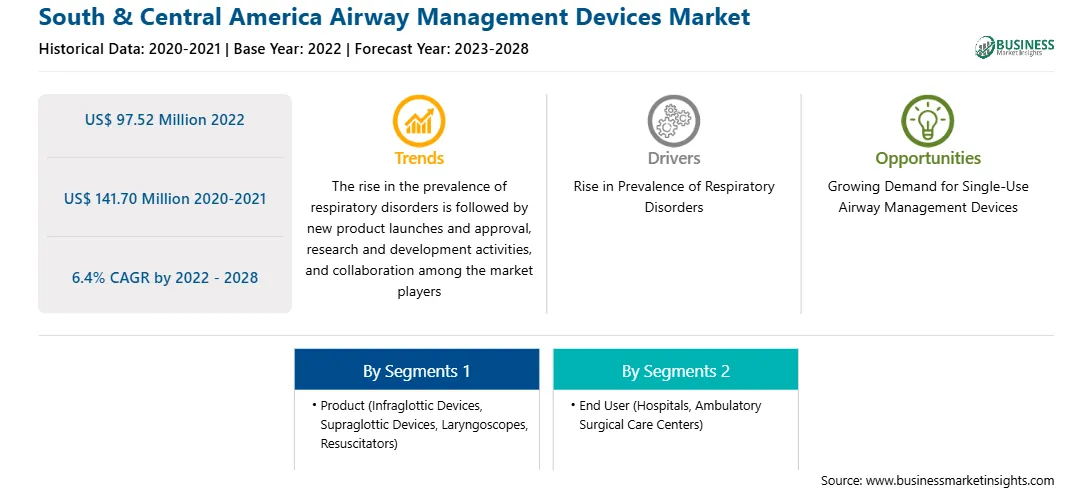
The South and Central America airway management devices market size is expected to reach US$ 381.6 million by 2033 from US$ 273.4 million in 2025. The market is estimated to record a CAGR of 4.3% from 2026 to 2033.
The South and Central America airway management devices market in can be described by moderate growth due to better accessibility to healthcare and higher understanding about respiratory care among both urban and semi-urban demographics. Increasing incidences of respiratory diseases, surgeries performed and growing demand for emergency and critical care are driving the demand for airway management devices. Modernizing public healthcare facilities in the region results in purchasing necessary equipment and supplies used in airway management, including endotracheal tubes, laryngeal mask airways and resuscitation airway devices. Simultaneously, private hospitals and clinics invest in technologically sophisticated products, including video laryngoscope. One of the trends observed in the market is the focus on affordability and disposability of airway devices, especially taking into consideration infection control and resource management concerns. Furthermore, collaboration with foreign companies and training initiatives for clinicians contribute to improving their skills in airway management. Nevertheless, there are several limitations to the market such as inadequate healthcare facilities in various countries, along with low availability of sophisticated equipment in rural regions. Moreover, economic instability in conjunction with budgetary constraints in the public healthcare sector may hamper the widespread deployment of expensive technology. Nonetheless, continuous healthcare reform initiatives along with the growing emphasis on disaster preparedness are anticipated to drive market growth in the coming years.

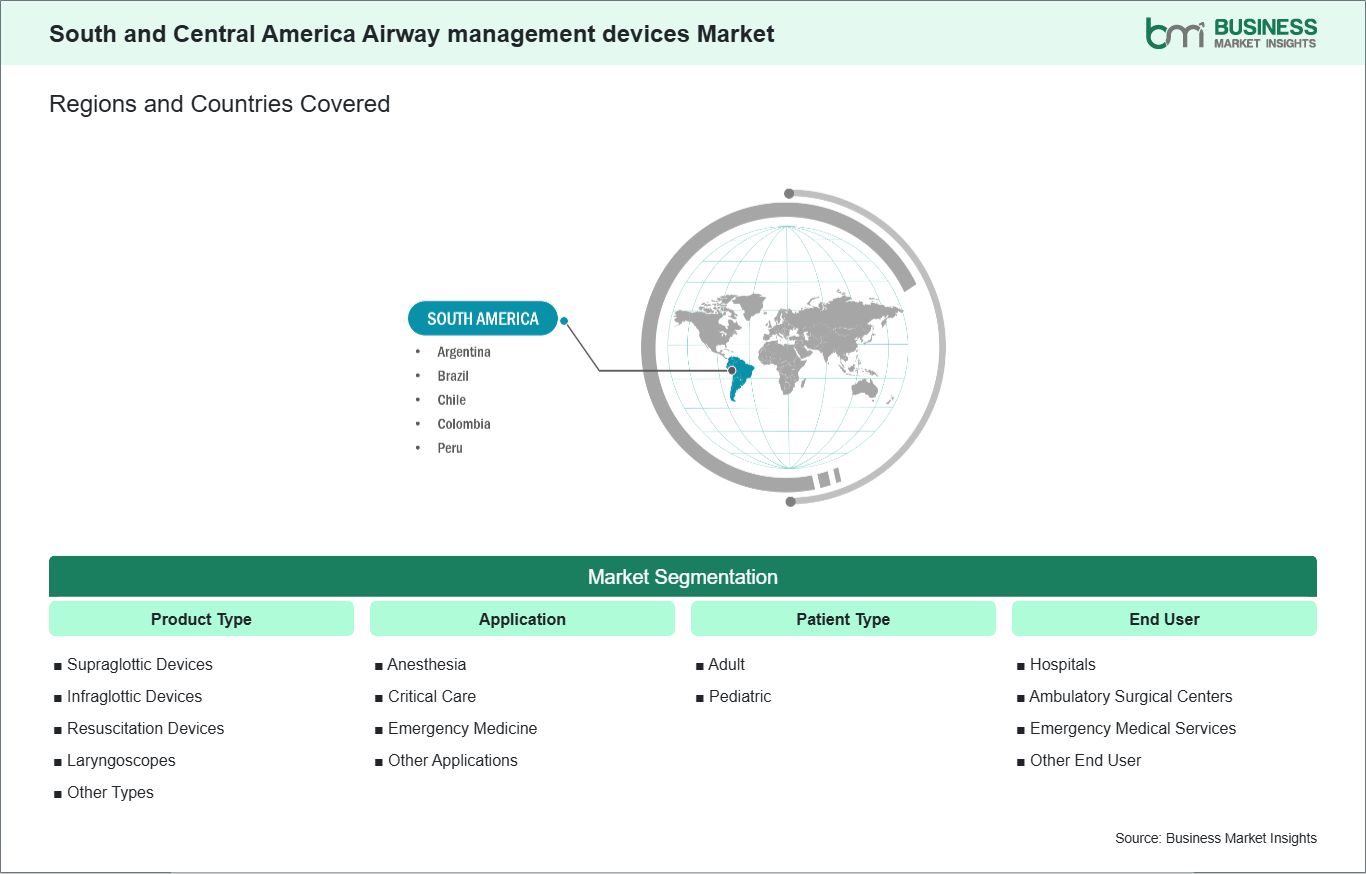
Key segments that contributed to the derivation of the airway management devices market analysis are product type, application, patient type, and end user.
Healthcare facilities in South and Central America are being upgraded steadily as a result of both government initiatives as well as increased investment from the private sector. Countries like Brazil, Mexico, and Argentina have focused on the upgrade of hospital facilities, building of more intensive care units, and improvement of their emergency response teams. These factors have been responsible for an increase in the use of airway management devices in these areas as a result of their growing prevalence of critical medical interventions.
Moreover, governments in these countries are undertaking various efforts towards making healthcare facilities available to the citizens through renovation of older hospitals and equipping them with modern medical equipment. This has made there be a rising demand for airway management devices such as laryngoscopes, resuscitators, and tracheal tubes among other products used in critical care medicine in the public hospitals. There is also increased collaboration between the producers of medical devices in the region and their suppliers.
Private players in the healthcare sector have also contributed equally to the development of infrastructure, especially in metro areas, due to the increasing need for quality healthcare services. This segment tends to be innovative in terms of adopting new airway technology products, thereby acting as the yardstick by which the performance of other institutions in the area is judged. Disparities also occur between cities and semi-urban areas with regards to the spread of airway devices.
There is an unexploited potential market for airway management devices in rural and remote locations in South and Central America. Much of the population resides in places far from major metropolitan centers, and access to modern medical institutions is still relatively difficult to come by in such regions. As a result, there is an acute need for cost-effective airway management tools in areas where hospitals and clinics have little more than rudimentary equipment.
The health care industry has been focusing more and more on providing its services to those who have previously had inadequate access. Mobile health clinics, community-based health services, and other innovations aimed at providing treatment in less developed areas are becoming increasingly popular. This trend opens up opportunities for innovative, portable airway management devices that are simple to use and maintain.
Moreover, the shift towards home care services is also affecting the market dynamics in rural areas. People with chronic respiratory disorders tend to seek medical assistance at home because of budgetary and transport restrictions. It has facilitated the use of portable respiratory equipment that can be operated outside of hospitals. Although there are various economic and operational hurdles, the expansion of health care facilities, along with raising awareness, is anticipated to eventually capitalize on the untapped market potential in rural and remote areas of the region.
The South and Central America airway management devices market is experiencing steady growth, with market size and share analysis reflecting evolving treatment preferences and competitive dynamics among key players. The report evaluates important subsegments categorized within product type, application, patient type, and end user, highlighting their respective contributions to overall market performance.
By product type, the infraglottic devices subsegment dominated the market in 2025. In anesthesia practice, infraglottic devices provide protection against aspiration and enable precise airway management, driving higher adoption in operating rooms and critical care settings compared to supraglottic devices.
Based on application, the anesthesia subsegment dominated the market in 2025 due to the need for definitive airway control across a wide range of surgical procedures, from routine elective surgeries to complex interventions. Because infraglottic devices are essential for intubation during anesthesia, this segment experiences consistent, high-volume usage, making it the largest segment compared to emergency or general critical care.
In terms of patient type, the adult subsegment dominated the market in 2025. Most procedural training, device designs, and usage guidelines are optimized for adult anatomy and usage scenarios, reinforcing higher market volume.
Based on end user, the hospital subsegment dominated the market in 2025, as hospitals remain the central hub for airway management, handling scheduled surgeries, emergency admissions, ICU care, and trauma cases. Their larger budgets, need for extensive airway inventories, and availability of multidisciplinary professionals make them the largest purchasers compared to outpatient centers or EMS, where volume and purchasing power are comparatively lower.
| Report Attribute | Details |
|---|---|
| Market size in 2025 | US$ 273.4 Million |
| Market Size by 2033 | US$ 381.6 Million |
| CAGR (2026 - 2033) | 4.3% |
| Historical Data | 2022-2024 |
| Forecast period | 2026-2033 |
| Segments Covered | By Product Type
|
|
Regions and Countries Covered
| |
| South and Central America | Brazil, Argentina, Chile, Colombia, Peru |
| Market leaders and key company profiles |
|
The "South and Central America Airway Management Devices Market Size and Forecast (2022–2033)" report provides a detailed analysis of the market covering below areas:
The geographical scope of the South and Central America airway management devices market report is divided into: Brazil, Argentina, Chile, Colombia, Peru, and the Rest of South and Central America. Brazil held the largest share in 2025.
Brazil emerges as the leading player in the airway management devices market in South and Central Americas owing to its advanced health care sector along with the presence of public as well as private health care facilities in the country. Significant uptake of airway management devices can be observed in the tertiary hospitals, emergency facilities, and surgical facilities as a result of high procedure rate in addition to the importance being given to critical care treatments. São Paulo and Rio de Janeiro have emerged as important cities in Brazil where modern airway management device technology is being introduced in hospitals. The private health care segment is leading in terms of introducing novel devices whereas public hospitals are focusing on making sure that all the patients get access to these critical devices. The country is also witnessing improvements in clinical training, with medical institutions incorporating simulation-based learning for airway management, enhancing practitioner confidence and skill levels. However, disparities between urban and rural healthcare facilities remain a challenge, with limited access to advanced devices outside major cities. Currency fluctuations and procurement constraints can further impact device availability. Nonetheless, Brazil continues to anchor regional growth, driven by healthcare expansion, clinical advancements, and increasing prioritization of respiratory and critical care management.

The South and Central America Airway management devices market is evaluated by gathering qualitative and quantitative data post primary and secondary research, which includes important corporate publications, association data, and databases. A few of the key developments in the South and Central America airway management devices market are:
The South and Central America Airway management devices Market is valued at US$ 273.4 Million in 2025, it is projected to reach US$ 381.6 Million by 2033.
As per our report South and Central America Airway management devices Market, the market size is valued at US$ 273.4 Million in 2025, projecting it to reach US$ 381.6 Million by 2033. This translates to a CAGR of approximately 4.3% during the forecast period.
The South and Central America Airway management devices Market report typically cover these key segments-
The historic period, base year, and forecast period can vary slightly depending on the specific market research report. However, for the South and Central America Airway management devices Market report:
The South and Central America Airway management devices Market is populated by several key players, each contributing to its growth and innovation. Some of the major players include:
The South and Central America Airway management devices Market report is valuable for diverse stakeholders, including:
Essentially, anyone involved in or considering involvement in the South and Central America Airway management devices Market value chain can benefit from the information contained in a comprehensive market report.
Please tell us your area of interest
(Market Segments/ Regions and Countries/ Companies)