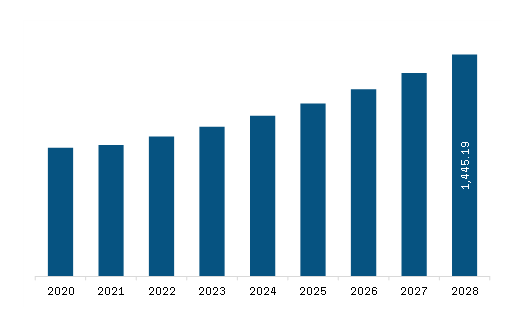
The South America advanced composites market is expected to grow from US$ 911.83 million in 2022 to US$ 1,445.19 million by 2028. It is estimated to grow at a CAGR of 8.0% from 2022 to 2028.
Increasing Demand for Nanocomposites is Fuelling South America Advanced Composites Market
Nanocomposites are materials that incorporate nanosized particles into a matrix of standard material. To overcome the limitation of different engineering materials, nanocomposites act as a beneficial alternative. Nanocomposites can be classified based on their dispersed matrix and dispersed phase materials. Polymeric nanocomposites are materials incorporating nanosized inclusions into the polymer matrices. They exhibit excellent mechanical properties, flame retardancy, enhanced modulus & dimensional stability, improved scratch resistance, superior thermal and processing properties, reduced warpage of components, and enhanced impact resistance, making them suitable to replace metals in various industrial applications. These nanocomposites are widely used in medical, electronics, automotive, food packaging, and sport equipment applications. They are also used in aeronautics and spaceflight due to their ability to withstand tension and extreme temperatures. Furthermore, growing research and development efforts are also increasing the applications of nanocomposites. Hence, the rising demand for nanocomposites and associated research & development activities is expected to offer lucrative opportunities for the South America advanced composites market growth during the forecast period.
South America Advanced Composites Market Overview
In South America, the construction industry is expanding, and various countries such as Brazil are investing their capital expenditure on many projects in infrastructure. The ongoing infrastructure projects such as “Jubarte Offshore Oil Field Development” and “Pre-Salt Submarine Fiber Optic Cable Network” are expected to grow the demand for carbon-reinforced composites and glass-reinforced composites during the tenure of these infrastructure projects. Further, governments of various countries in South America are focusing on developing more infrastructure projects owing to surging urbanization. Moreover, advanced composites make lighter, safer, and more fuel-efficient vehicles, hence, the automotive companies in Brazil and Argentina are using these reinforced composited, which propels the sales of advanced composites in the region. For instance, according to the report by the Brazilian Association of Automotive Vehicle Manufacturers, the production of automobiles in Brazil grew by 11.4%, and the sales were boosted by 10.9% from February to March 2022. Moreover, a few major market players operating in the automotive sector have strategized the development and expansion of their operational capacities in South America to fuel the growth of the automotive market. For instance, in 2022, Audi AG invested US$ 19.2 million to restart production at its plant in Parana, Brazil, registering a capacity of 4,000 vehicles per year. Thus, increased production capacity of major automobile players would eventually increase the demand for raw materials such as advanced composites for its production.
South America Advanced Composites Market Revenue and Forecast to 2028 (US$ Million)
South America Advanced Composites Market Segmentation
The South America advanced composites market is segmented based on fiber type, matrix type, end-use industry, and country.
Based on fiber type, the South America advanced composites market is segmented into carbon fiber composites, aramid fiber composites, glass fiber composites, and others. The carbon fiber composites segment held the largest share of the South America advanced composites market in 2022.
Based on matrix type, the South America advanced composites market is segmented into epoxy resin, phenolics, polyester resin, polyurethane resin, polyphenylene sulfide (PPS), polyetherimide (PEI), and others. The epoxy resin segment held the largest share of the South America advanced composites market in 2022.
Based on end-use industry, the South America advanced composites market is segmented into aerospace & defense, automotive, wind energy, building & construction, electrical & electronics, and others. The aerospace & defense segment held the largest share of the South America advanced composites market in 2022.
Based on country, the South America advanced composites market has been categorized into Brazil, Argentina, and the Rest of South America. Our regional analysis states that Brazil dominated the South America advanced composites market in 2022.
Avient Corp, Ensinger GmbH, Johns Manville Corp, Mitsubishi Chemical Corp, Owens Corning, SGL Carbon SE, Solvay SA, Teijin Ltd, and Toray Industries Inc are the leading companies operating in the South America advanced composites market.
South America Advanced Composites Market Strategic Insights
Get more information on this report
South America Advanced Composites Market Segmentation Analysis
South America Advanced Composites Market Report Highlights
South America Advanced Composites Report Scope
Report Attribute
Details
Market size in 2022
US$ 911.83 Million
Market Size by 2028
US$ 1,445.19 Million
CAGR (2022 - 2028)
8.0%
Historical Data
2020-2021
Forecast period
2023-2028
Segments Covered
By Fiber Type
Carbon Fiber Composites
Aramid Fiber Composites
Glass Fiber Composites
By Matrix Type
Epoxy Resin
Phenolics
Polyester Resin
Polyurethane Resin
Polyphenylene Sulfide
Polyetherimide
By End-Use Industry
Aerospace & Defense
Automotive
Wind Energy
Building & Construction
Electrical & Electronics
Regions and Countries Covered
South and Central America
Brazil, Argentina, Rest of South and Central America
Market leaders and key company profiles
Avient Corp
Ensinger GmbH
Johns Manville Corp
Mitsubishi Chemical Corp
Owens Corning
SGL Carbon SE
Solvay SA
Teijin Ltd
Toray Industries Inc
Get more information on this report
South America Advanced Composites Market Country and Regional Insights
Get more information on this report
Identical Market Reports with other Region/Countries
The List of Companies - South America Advanced Composites Market
Avient CorpEnsinger GmbHJohns Manville CorpMitsubishi Chemical CorpOwens CorningSGL Carbon SE Solvay SA Teijin Ltd Toray Industries Inc
Frequently Asked Questions
How big is the South America Advanced Composites Market?
The South America Advanced Composites Market is valued at US$ 911.83 Million in 2022, it is projected to reach US$ 1,445.19 Million by 2028.
What is the CAGR for South America Advanced Composites Market by (2022 - 2028)?
As per our report South America Advanced Composites Market, the market size is valued at US$ 911.83 Million in 2022, projecting it to reach US$ 1,445.19 Million by 2028. This translates to a CAGR of approximately 8.0% during the forecast period.
What segments are covered in this report?
The South America Advanced Composites Market report typically cover these key segments-
End-Use Industry (Aerospace & Defense, Automotive, Wind Energy, Building & Construction, Electrical & Electronics)
What is the historic period, base year, and forecast period taken for South America Advanced Composites Market?
The historic period, base year, and forecast period can vary slightly depending on the specific market research report. However, for the South America Advanced Composites Market report:
Historic Period : 2020-2021
Base Year : 2022
Forecast Period : 2023-2028
Who are the major players in South America Advanced Composites Market?
The South America Advanced Composites Market is populated by several key players, each contributing to its growth and innovation. Some of the major players include:
Avient Corp
Ensinger GmbH
Johns Manville Corp
Mitsubishi Chemical Corp
Owens Corning
SGL Carbon SE
Solvay SA
Teijin Ltd
Toray Industries Inc
Who should buy this report?
The South America Advanced Composites Market report is valuable for diverse stakeholders, including:
Investors: Provides insights for investment decisions pertaining to market growth, companies, or industry insights. Helps assess market attractiveness and potential returns.
Industry Players: Offers competitive intelligence, market sizing, and trend analysis to inform strategic planning, product development, and sales strategies.
Suppliers and Manufacturers: Helps understand market demand for components, materials, and services related to concerned industry.
Researchers and Consultants: Provides data and analysis for academic research, consulting projects, and market studies.
Financial Institutions: Helps assess risks and opportunities associated with financing or investing in the concerned market.
Essentially, anyone involved in or considering involvement in the South America Advanced Composites Market value chain can benefit from the information contained in a comprehensive market report.





 Get Free Sample For South America Advanced Composites Market