Market Summary
Executive Summary and Global Market Analysis
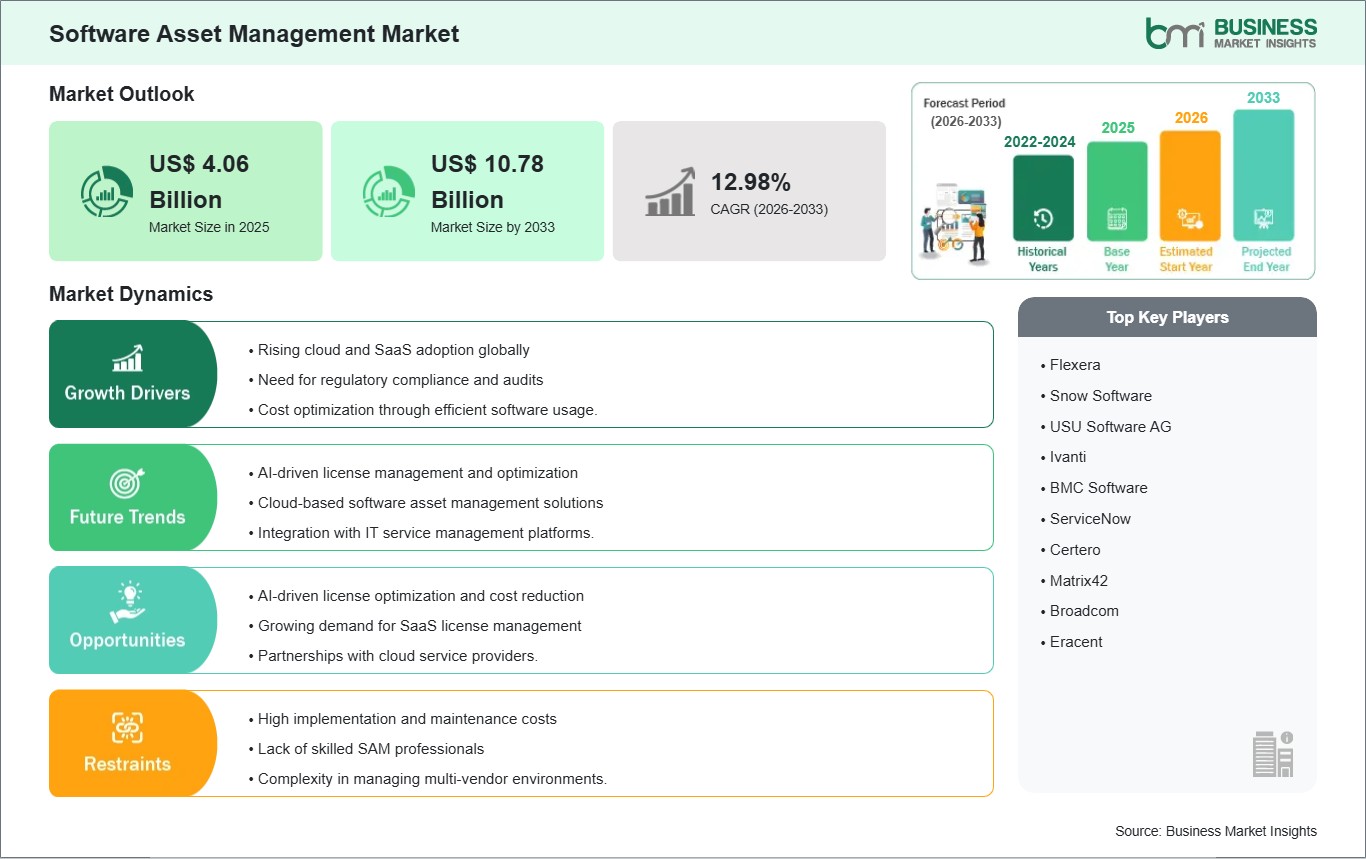
The software asset management (SAM) market is growing as organizations see the importance of using software effectively, lowering compliance risks, and managing IT spending. SAM solutions help businesses track software licenses, handle renewals, and enforce policy compliance in complex IT setups that include on-premises, cloud, and hybrid systems. The increase in cloud computing, SaaS adoption, and digital transformation projects has created a need for centralized platforms that offer real-time visibility into software inventories, usage patterns, and related costs.
Companies are starting to use artificial intelligence and machine learning to automate license reconciliation, identify underused assets, and forecast future software needs. This improves efficiency and helps with decision-making. With rising regulatory oversight and audits from software vendors, compliance-focused SAM is becoming essential for reducing risks, especially in highly regulated fields like finance, healthcare, and government. Organizations are also using SAM insights to negotiate vendor contracts, improve subscription models, and plan IT investments more strategically. New trends include integration with IT service management (ITSM), cloud cost management, and cybersecurity frameworks, showing the link between efficiency, cost control, and security in enterprise software. Competitors mainly focus on their automation skills, scalability, and compatibility with multiple platforms.
Segment Analysis
Software Asset Management Market Segmentation
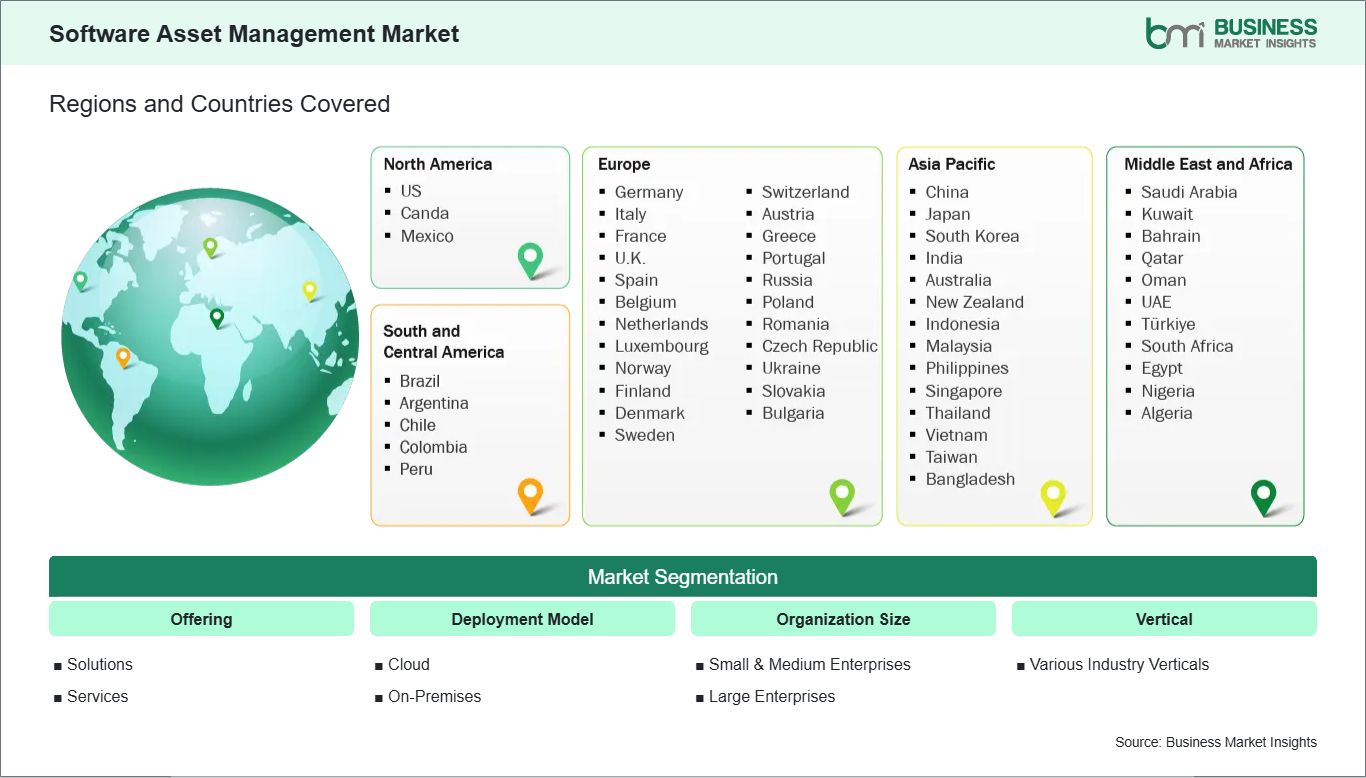
Key segments that contributed to the derivation of the software asset management market analysis are offering, deployment model, organization size, and vertical.
- Offering, the software asset management market is segmented into solutions and services. The solutions segment dominated the market in 2025.
- Deployment Model, the software asset management market is categorized into cloud and on-premises. The cloud segment dominated the market in 2025.
- Organization Size, the software asset management market is classified into small & medium enterprises and large enterprises. The large enterprises segment dominated the market in 2025.
- Vertical, the software asset management market is segmented into various industry verticals. The IT & telecommunications vertical dominated the market in 2025.
Market Forces
Software Asset Management Market Drivers and Opportunities
Rising cloud and SaaS adoption globally
The global Software Asset Management market is driven by the fast growth of cloud platforms and SaaS applications. Companies around the world are increasingly using subscription-based software for collaboration, productivity, and enterprise resource planning. This creates complex software environments that need centralized visibility and management. SAM solutions help organizations track software usage, monitor subscriptions, and ensure compliance. They reduce the risk of overspending or noncompliance across various software portfolios. As businesses move workloads to cloud-based settings, the need for real-time license tracking and governance increases. SAM platforms now connect with cloud and SaaS systems for automated discovery, inventory management, and usage analytics. This helps organizations optimize their subscriptions, enforce software policies, and avoid unnecessary duplication of licenses. It also improves cost control and operational efficiency. New improvements in SAM tools, like AI-driven insights and automated reporting, drive further adoption. Organizations gain end-to-end management of their software assets, covering procurement, deployment, usage, and retirement. This allows companies to comply with licensing agreements, lower audit risks, and get a better return on their software investments. SAM is becoming a vital part of global digital transformation plans.
AI-driven license optimization and cost reduction
The global SAM market is increasingly using AI-driven solutions to optimize software licensing and cut costs. Artificial intelligence and machine learning examine software usage patterns, find underused licenses, and suggest reallocation or subscription changes. By automating these processes, organizations can save money, improve forecasting accuracy, and reduce unnecessary software purchases in complex IT environments. AI-powered SAM platforms also improve compliance management by regularly monitoring software deployments against licensing agreements. Predictive analytics help organizations expect future license needs, spot irregularities, and simplify renewals, lowering financial risks and enhancing operational planning. Automated insights assist IT teams in negotiating better contracts and improving software use on a larger scale. Additionally, AI integration enables SAM systems to manage ever-changing and hybrid software environments, like multi-cloud and SaaS setups. Real-time analytics, usage monitoring, and automated reporting aid decision-making and support strategic IT governance. The combination of cost savings, compliance assurance, and practical insights makes AI-enabled SAM a key element for organizations looking to manage software effectively worldwide.
Size and Share Analysis
Software Asset Management Market Size and Share Analysis
The software asset management market demonstrates steady growth, with size and share analysis highlighting evolving trends and competitive dynamics among key players. The report examines subsegments categorized within offering, deployment model, organization size, and vertical, offering insights into their contribution to overall market performance.
By Offering, the solutions subsegment dominated the market in 2025, driven by growing adoption of software lifecycle management tools for compliance and cost optimization.
Based on Deployment Model, the cloud subsegment dominated the market in 2025, owing to scalability, ease of access, and real-time monitoring capabilities.
On the Basis of Organization Size, the large enterprises subsegment dominated the market in 2025, propelled by high software portfolio complexity and the need for centralized asset management.
By Vertical, the IT & telecommunications vertical dominated the market in 2025, due to extensive software usage and regulatory compliance requirements.
Report Coverage
Software Asset Management Market Report Coverage and Deliverables
The "Software Asset Management Market Size and Forecast (2022 - 2033)" report provides a detailed analysis of the market covering below areas:
- Software Asset Management Market size and forecast at global, regional, and country levels for all the key market segments covered under the scope
- Software Asset Management Market trends, as well as drivers, restraints, and opportunities
- Software Asset Management Market analysis covering key trends, global and regional framework, major players, regulations, and recent developments
- Industry landscape and competition analysis covering market concentration, heat map analysis, prominent players, and recent developments for the Software Asset Management Market
- Detailed company profiles, including SWOT analysis
Geographic Insights
Software Asset Management Market Geographic Insights
The geographical scope of the Software Asset Management Market report is divided into North America, Asia Pacific, Europe, Middle East & Africa, and South & Central America. North America held the largest share in 2025.
North America leads the software asset management market. This growth comes from the widespread use of IT systems, the digitalization of businesses, and strict software compliance regulations. The United States is at the forefront, implementing advanced SAM solutions that work with cloud and hybrid systems to ensure licensing compliance, reduce costs, and enhance cybersecurity. Large companies and tech firms use AI-powered analytics to predict software needs and improve licensing models. The Asia Pacific region is growing rapidly, with countries like China, India, Japan, and South Korea taking the lead. The rise in IT services, government digital projects, and cloud adoption is boosting the demand for SAM solutions that manage software across international operations and various platforms. Local companies are increasingly focusing on compliance frameworks to meet global standards. In Europe, there is a strong emphasis on following regulations, optimizing costs, and ensuring transparency. Germany, the UK, and France are leading in SAM adoption. In Europe, SAM often works alongside IT governance and risk management efforts, especially in sectors like finance, healthcare, and manufacturing. The Middle East and Africa are developing markets. Here, companies and government bodies are starting to use SAM to track software use, manage IT spending, and lessen audit risks. In South and Central America, countries like Brazil, Mexico, and Argentina are slowly adopting SAM solutions to improve IT asset visibility, ensure licensing compliance, and support digital change in multinational and large-scale companies.
Industry Activity
Recent Developments
The Software Asset Management Market is evaluated by gathering qualitative and quantitative data post primary and secondary research, which includes important corporate publications, association data, and databases. A few of the key developments in the spatial light Modulator market are:
- In October 2025, SoftwareOne announced that it was recognized along with Crayon as Leaders in the 2025 Gartner® Magic Quadrant for Software Asset Management (SAM) Managed Services, underscoring their combined global SAM managed services expertise following their strategic integration.
- In October 2025, Flexera and SHI International Corp. announced that they forged a strategic alliance to deliver unified IT asset management (ITAM) and FinOps services to more than 17,000 customers worldwide, bolstering SAM, cloud, SaaS, and FinOps integration across global enterprise deployments.
Trust & Transparency
Research Methodology
The market analysis combines proprietary research with secondary data from government agencies, company disclosures, regulatory filings, industry databases and expert interviews. Market estimates are validated through data triangulation, cross-market benchmarking and analyst
review.
View Full Research Methodology
Key Sources Referred:
International Electrotechnical Commission Institute of Electrical and Electronics Engineers International Organization for Standardization Bureau of Indian Standards Central Electricity Authority Ministry of Power Indian Electrical and Electronics Manufacturers' Association European Committee for Electrotechnical Standardization VDE Association for Electrical Electronic & Information Technologies Company Websites Company Annual Reports Company Investor Presentation