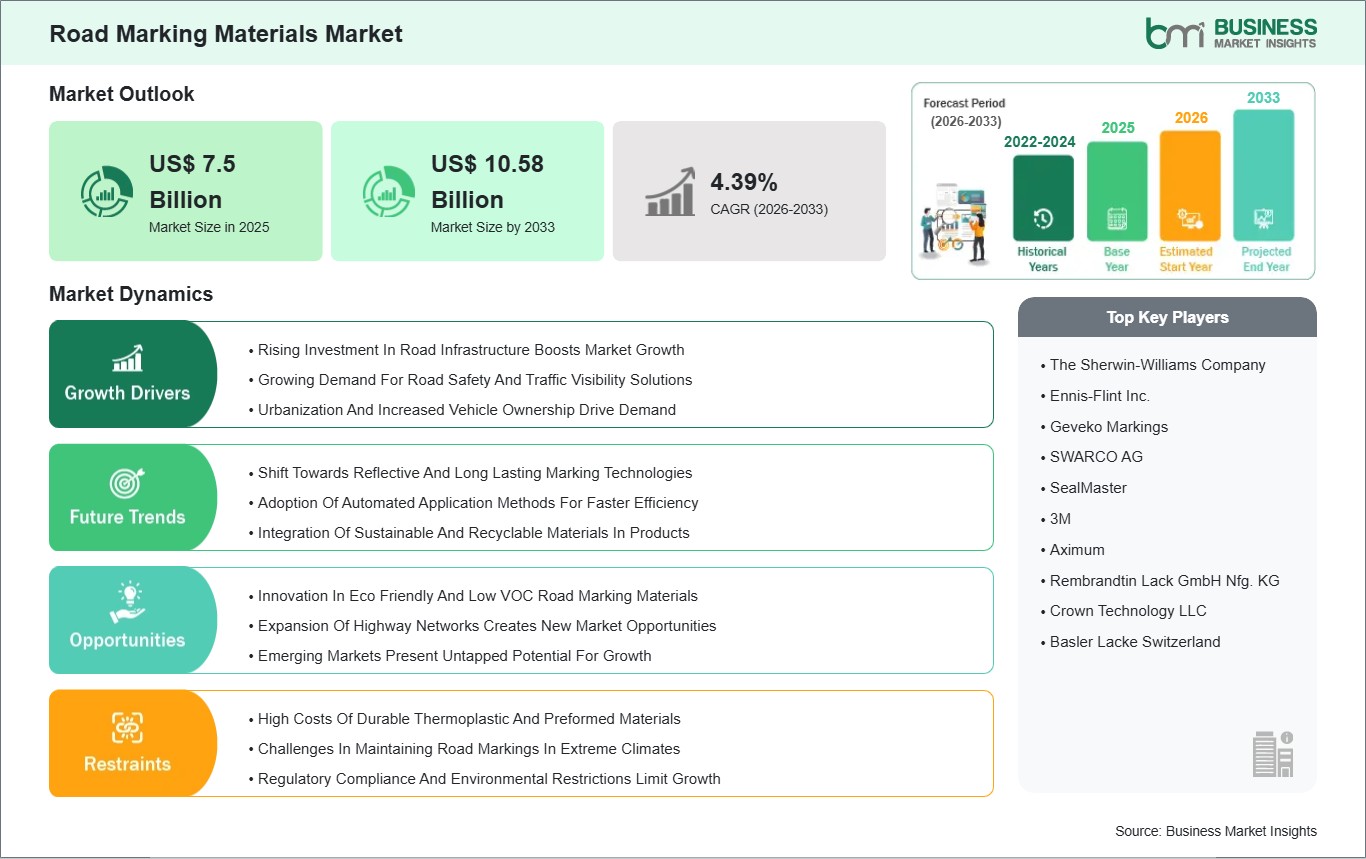
The Road Marking Materials Market size is expected to reach US$ 10.58 billion by 2033 from US$ 7.5 billion in 2025. The market is estimated to record a CAGR of 4.39% from 2026 to 2033.
The global market for road marking materials plays a vital role in the development and maintenance of transportation infrastructure and is mainly fueled by factors such as the need for better road safety, increased number of vehicles on the road, and large investments in highway and road infrastructure development across various parts of the world. Materials used for road marking include paints, thermoplastics, tapes, and preformed materials used for marking lanes, pedestrian crossings, direction indicators, and other types of on-road indicators.
As governments and private entities are looking to improve safety and efficiency in terms of traffic movement, these materials are increasingly used across various parts of the world, including both developed and emerging nations. Some of the significant factors responsible for driving the global market for road marking materials include the focus on reducing accidents and fatalities on roads. As part of road safety initiatives in regions such as Europe, North America, and Asia Pacific, the quality of road marking materials is under increased scrutiny, and this has prompted the use of better materials that offer better service lives and are more reflective during night and bad weather conditions.
Moreover, the need for retroreflective and eco-friendly road marking products has been created through the phenomenon of urbanization and expansion of urban transportation corridors. However, the global market is also facing some restraints. The high cost of advanced road marking products such as thermoplastic compositions and preformed tapes containing glass beads is considered to be a major restraint for cash-strapped governments and small players in the market of developing nations. The environmental hazards of volatile organic compounds (VOCs) in conventional coatings and paints have prompted governments to adopt low-VOC or water-based coatings. The high cost of materials and complexity of application of such coatings can act as another restraint to the growth of the global market. Nevertheless, the global focus on traffic safety and infrastructure development is providing stable growth opportunities to the global road marking materials market.

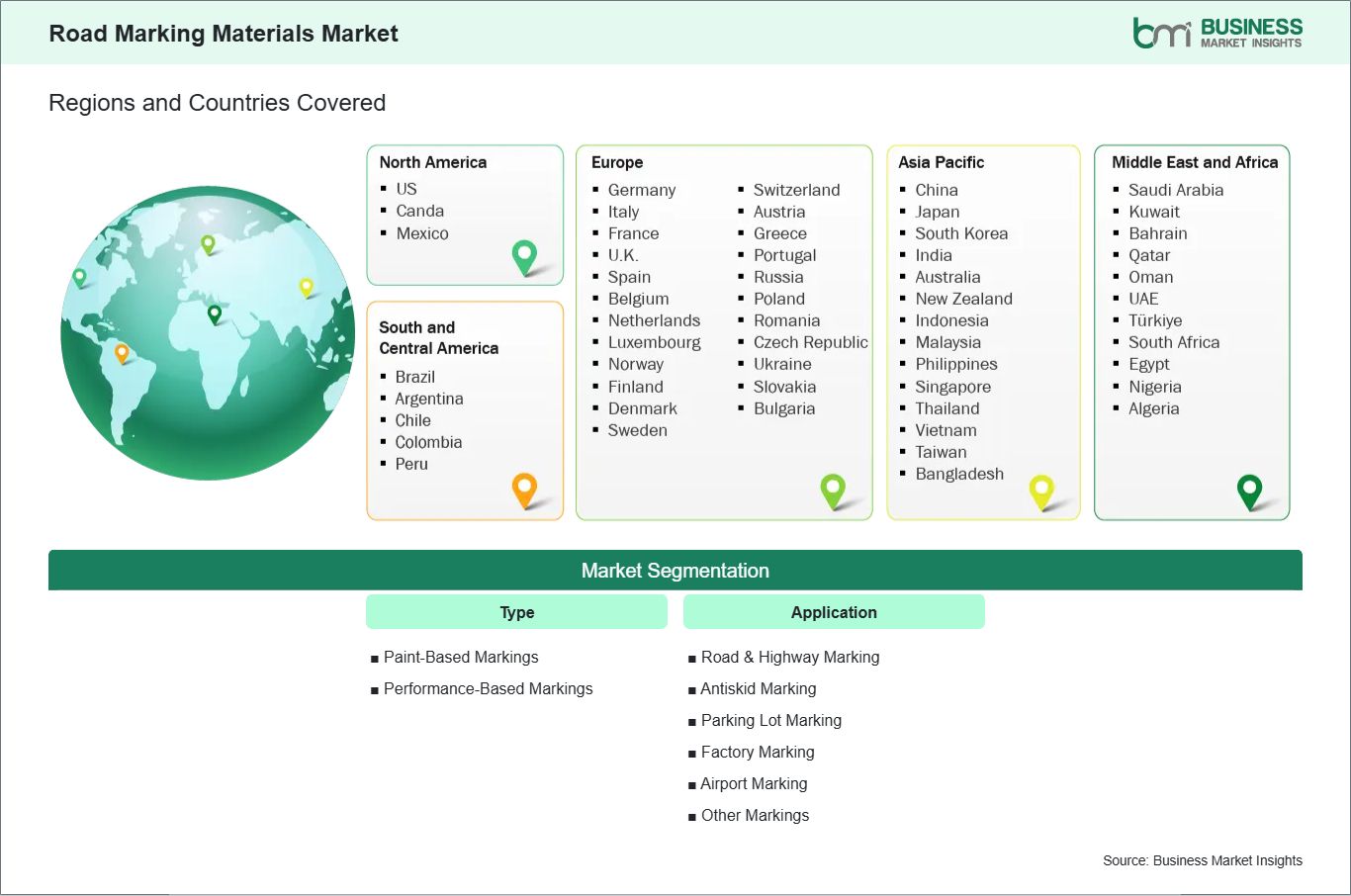
Key segments that contributed to the derivation of the road marking materials market analysis are type and application.
Global investment in road infrastructure has become a cornerstone for economic growth, and this is significantly elevating demand for road marking materials. Governments across North America, Europe, and Asia Pacific are prioritizing the expansion and modernization of highways, expressways, and urban road networks to support rising traffic volumes and seamless connectivity between urban centers and logistics hubs. This sustained focus on infrastructure translates into steady demand for durable paints, thermoplastics, and preformed tapes required to enhance lane visibility, traffic guidance, and pedestrian safety.
In developing regions, initiatives to improve rural accessibility and intercity travel corridors have encouraged the adoption of advanced marking solutions that can withstand varied climatic conditions. For example, in countries with heavy monsoons or extreme heat, the preference for high‑performance thermoplastic markings has grown in line with infrastructure upgrades. Similarly, urban metropolitan areas investing in metro extensions and new road grids are allocating budget for visible, long‑lasting road symbols and crosswalk demarcations.
Environmental sustainability is reshaping the global road marking materials landscape, with manufacturers and governments pushing for low‑impact solutions. Traditional solvent‑based paints emit volatile organic compounds (VOCs), prompting regulatory bodies in Europe and North America to encourage water‑based and low‑VOC formulations. As a result, research and development efforts are increasingly directed at materials that meet environmental norms without compromising durability or reflectivity. These innovations are expanding adoption, especially in urban centers where air quality and ecological footprints are key policy concerns.
In Asia Pacific, where rapid urban development coexists with rising environmental consciousness, cities are gradually integrating eco‑friendly alternatives into standard road maintenance practices. For example, reflective glass bead technologies incorporated into water‑based paints not only enhance nighttime visibility but also support regulatory pushes for cleaner products. Road marking suppliers are collaborating with municipal authorities to pilot these solutions on major city thoroughfares, expanding awareness of sustainable marking benefits.
The road marking materials market demonstrates steady growth, with size and share analysis highlighting evolving trends and competitive dynamics among key players. The report examines subsegments categorized within type and application, offering insights into their contribution to overall market performance.
By type, the paint‑based markings subsegment dominated the market in 2025, driven by their low cost, ease of application, and widespread adoption across road networks.
Based on application, the road & highway marking subsegment dominated the market in 2025, driven by high infrastructure demand and the need for clear, durable markings on major transportation routes.
| Report Attribute | Details |
|---|---|
| Market size in 2025 | US$ 7.5 Billion |
| Market Size by 2033 | US$ 10.58 Billion |
| Global CAGR (2026 - 2033) | 4.39% |
| Historical Data | 2022-2024 |
| Forecast period | 2026-2033 |
| Segments Covered | By Type
|
|
Regions and Countries Covered
| |
| North America | US, Canada, Mexico |
| Europe | Belgium, Austria, Finland, Denmark, Greece, Poland, Romania, Russia, Ukraine, Czech Republic, Slovakia, Bulgaria, Italy, Luxembourg, Germany, Switzerland, France, Netherlands, Norway, Portugal, Spain, Sweden, United Kingdom |
| Asia-Pacific | Australia, China, India, Japan, South Korea, Indonesia, Malaysia, Philippines, Singapore, Thailand, Vietnam, Bangladesh, New Zealand, Taiwan |
| South and Central America | Brazil, Argentina, Peru, Chile, Colombia |
| Middle East and Africa | Bahrain, Kuwait, Oman, Qatar, Saudi Arabia, United Arab Emirates, Turkiye, South Africa, Egypt, Algeria, Nigeria |
| Market leaders and key company profiles |
|
The "Road Marking Materials Market Size and Forecast (2022 - 2033)" report provides a detailed analysis of the market covering below areas:
The geographical scope of the Road Marking Materials Market report is divided into North America, Asia Pacific, Europe, Middle East & Africa, and South & Central America. North America held the largest share in 2025.
North America holds a significant position in the global market for road marking materials due to its large infrastructure, safety regulations, and maintenance activities for highways and city roads. The region has experienced significant consumption of thermoplastics, preformed tapes, and water-based paints, which are specifically formulated to perform in harsh winters, high traffic volumes, and long-term durability requirements. The regulatory bodies in the United States and Canadian markets emphasize retroreflectivity, visibility, and environmental sustainability, which has forced companies to deliver highly advanced road marking materials to meet these critical demands.
In Asia Pacific, factors such as rapid urbanization, increase in vehicle population, and expansion of expressways and city roads are boosting demand for road marking materials. China, India, Japan, and Australia are using reflective paints, thermoplastics, and tapes to provide safety in densely populated regions. In the case of Europe, the market has already matured, with sustainability of the environment being the key driver. Low VOC paints, recycled glass beads, and eco-friendly thermoplastics are the preferred choices, especially in Western European countries, as these regions have high density as well as stringent environmental regulations.
In the Middle East & Africa, the development of infrastructure, increasing road development, and investments in highways and industrial zones have created opportunities for the use of road marking materials, with a focus on heat resistance as well as abrasion resistance, owing to the arid conditions prevailing in the regions as well as the presence of heavy commercial traffic.
South & Central America is an emerging market fueled by urbanization, development in intercity highway infrastructure, and updates in road safety standards. Governments are increasingly emphasizing traffic safety schemes and long-lasting, visible markings to prevent accidents and enhance transportation efficiency. In conclusion, while North America takes the top spot because of its infrastructure and regulatory compliance, other markets are showing strong growth rates depending on factors like urbanization, weather conditions, green living, and awareness about road safety.

The Road Marking Materials Market is evaluated by gathering qualitative and quantitative data post primary and secondary research, which includes important corporate publications, association data, and databases. A few of the key developments in the road marking materials market are:
The Road Marking Materials Market is valued at US$ 7.5 Billion in 2025, it is projected to reach US$ 10.58 Billion by 2033.
As per our report Road Marking Materials Market, the market size is valued at US$ 7.5 Billion in 2025, projecting it to reach US$ 10.58 Billion by 2033. This translates to a CAGR of approximately 4.39% during the forecast period.
The Road Marking Materials Market report typically cover these key segments-
The historic period, base year, and forecast period can vary slightly depending on the specific market research report. However, for the Road Marking Materials Market report:
The Road Marking Materials Market is populated by several key players, each contributing to its growth and innovation. Some of the major players include:
The Road Marking Materials Market report is valuable for diverse stakeholders, including:
Essentially, anyone involved in or considering involvement in the Road Marking Materials Market value chain can benefit from the information contained in a comprehensive market report.
Please tell us your area of interest
(Market Segments/ Regions and Countries/ Companies)