
Pediatric Wheelchairs Market Outlook (2022-2033)
The Pediatric Wheelchairs Market size is expected to reach US$ 3.98 Billion by 2033 from US$ 2.2 Billion in 2025. The market is estimated to record a CAGR of 7.69% from 2026 to 2033.
- Product Type: Manual, Powered
- Frame Type: Rigid Foldable, and Tilt-In-Space
- End User: Hospitals, Homecare Settings, Rehabilitation Centers, and Other End Users
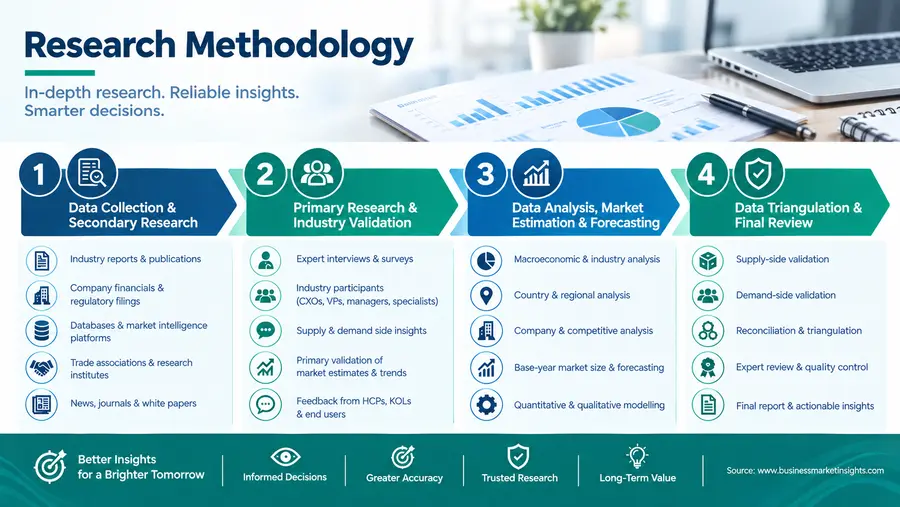
Business Market Insights follows a structured and systematic research methodology designed to deliver reliable, consistent, and decision-oriented market intelligence. Each study is developed through four major research stages:
- Data Collection & Secondary Research
- Primary Research & Industry Validation
- Data Analysis, Market Estimation & Forecasting
- Data Triangulation & Final Review
The methodology combines secondary research, primary interviews, quantitative analysis, company-level assessment, macroeconomic evaluation, market modelling, and expert validation. The depth and combination of research techniques may vary depending on the nature, maturity, geographic coverage, complexity, and availability of information for the market being analyzed.
- Data Collection and Secondary Research:
Every research study begins with an extensive review of available market information to establish an initial understanding of the industry ecosystem, historical developments, market structure, competitive environment, demand patterns, and emerging trends.
Business Market Insights collects and analyzes information from a broad range of credible secondary sources, which may include:
- Company annual reports and financial statements
- Investor presentations and earnings releases
- Regulatory and statutory filings
- Company websites and product literature
- Government databases and statistical publications
- Industry associations and trade organizations
- Research institutes, universities, and technical organizations
- Trade journals and industry publications
- Scientific and technical papers
- White papers and industry studies
- Patent and technology databases
- Import-export and trade databases
- Press releases and company announcements
- News articles and specialized industry publications
- Paid databases and business intelligence platforms, including Factiva, Hoovers, Reuters, and other relevant sources
Historical information is analyzed alongside recent developments to understand changes in demand, technology, regulation, competitive positioning, pricing, supply chains, investments, and end-user requirements.
Secondary research is also used to identify market participants, product and service categories, application areas, geographic markets, industry value chains, growth drivers, restraints, opportunities, and other variables relevant to the study.
Information collected during this stage forms the initial research framework and provides the foundation for subsequent primary research, market estimation, forecasting, and validation.
- Primary Research & Industry Validation:
Primary research is an integral part of the Business Market Insights research methodology and is undertaken to validate market estimates, assess prevailing and emerging market trends, and verify the overall direction of the market forecast.
It is also used to validate secondary research findings, address information gaps, test key assumptions, obtain first-hand industry perspectives, and strengthen the reliability of market estimates and projections.
Primary research helps ensure that market sizing, segment-level estimates, growth assumptions, and forecast projections reflect actual industry conditions rather than relying solely on published information or statistical models.
Interviews and discussions may be conducted with participants from both the supply side and demand side of the market ecosystem.
Depending on the market being studied, respondents may include:
- Chief executives and senior management
- Vice presidents and business heads
- Business development managers
- Sales and marketing managers
- Product managers
- Strategy and market intelligence professionals
- Procurement and sourcing professionals
- Operations and manufacturing executives
- Distributors, suppliers, and channel partners
- Technology and engineering specialists
- Consultants and research analysts
- Industry specialists
- Subject Matter Experts (SMEs)
- Key Opinion Leaders (KOLs)
- Customers and end users
Primary interactions may be conducted through telephone interviews, virtual discussions, structured questionnaires, email interactions, and other suitable research methods.
Primary Research Objectives:
Primary research typically supports the following objectives:
- Validate the base-year market size and overall market estimates
- Validate historical and current market trends
- Assess whether projected market growth and the overall forecast direction are consistent with industry expectations
- Validate segment- and subsegment-level estimates
- Cross-check regional and country-level market estimates
- Understand demand and supply dynamics
- Validate market segmentation and geographic trends
- Evaluate market drivers, restraints, challenges, and opportunities
- Understand pricing, adoption, purchasing, and investment patterns
- Assess competitive positioning and market shares
- Validate company-level and industry-level information
- Understand technological, regulatory, and industry developments
- Test assumptions used in market-sizing and forecasting models
- Identify potential market shifts that may affect future growth
- Validate conclusions derived through secondary research and quantitative analysis
Primary respondents are also asked to provide perspectives on the expected direction of the market, including factors that could accelerate or restrict future growth.
These inputs are compared with historical trends, macroeconomic indicators, company-level developments, secondary research findings, and internal market models to determine whether forecast assumptions are reasonable and supported by prevailing industry conditions.
The number and profile of respondents vary according to the complexity, size, geographic coverage, maturity, and availability of information for the respective market.
Insights obtained through primary research are compared with secondary information, company-level analysis, internal research databases, and market models before being incorporated into the final estimates and forecasts.
Primary research therefore serves three critical validation functions within the methodology: validating market estimates, validating market trends, and validating the overall forecast direction.
- Data Analysis, Market Estimation & Forecasting:
Following secondary and primary research, the collected information is analyzed using a combination of quantitative and qualitative research techniques.
Market estimates are developed by evaluating market-specific indicators, company information, industry statistics, demand-side indicators, supply-side information, and macroeconomic variables.
Where applicable, both top-down and bottom-up approaches are used to estimate and validate the market size.
- 3.1 Macroeconomic and Industry Factor Analysis:
Relevant macroeconomic, demographic, technological, regulatory, and industry-specific factors are assessed to understand their potential impact on market demand and growth.
Depending on the market, these factors may include:
- Gross Domestic Product (GDP)
- Industrial production
- Consumer expenditure
- Population and demographic trends
- Urbanization
- Infrastructure expenditure
- Manufacturing activity
- Healthcare expenditure
- Energy consumption
- Technology adoption
- Capital expenditure
- Commodity prices
- Import and export activity
- Government policies and regulations
- Environmental and sustainability requirements
- Industry-specific production or consumption indicators
Relevant political, economic, social, technological, environmental, and regulatory factors may also be considered where they materially influence the market.
These variables are analyzed to establish market benchmarks, assess underlying demand conditions, and understand differences in market development across countries and regions.
- 3.2 Country- and Regional-Level Analysis:
Market estimates at the regional and country levels are developed by assessing variables relevant to the respective industry.
Depending on the market, these may include:
- Presence of manufacturers and service providers
- Production and consumption levels
- Installed capacity
- Import and export activity
- Customer and end-user concentration
- Industry infrastructure
- Distribution and supply networks
- Regulatory environment
- Technology adoption
- Investment levels
- Economic conditions
- Pricing trends
- Application penetration
- Competitive intensity
Country-level growth drivers, restraints, opportunities, and market trends are subsequently evaluated to determine the relative market potential and expected growth trajectory.
- 3.3 Company & Competitive Analysis:
Companies operating across the market ecosystem are identified and analyzed to understand the competitive landscape.
The assessment may include leading companies, emerging participants, regional companies, technology providers, manufacturers, suppliers, distributors, service providers, and other relevant organizations.
Standard syndicated reports typically provide detailed profiles of selected key market participants. However, the competitive assessment is not limited to the companies formally profiled in the report. A broader group of companies may be analyzed to develop a comprehensive understanding of market activity and competitive trends.
Depending on information availability, company profiles may include:
- Key company facts
- Business description
- Products and services
- Geographic presence
- Financial information
- Strategic initiatives
- Recent developments
- Product launches
- Partnerships and collaborations
- Mergers and acquisitions
- Capacity expansions
- SWOT analysis
Financial information for publicly listed companies is generally obtained from annual reports, investor presentations, regulatory filings, and other official disclosures.
For privately held companies, estimates may be developed using publicly available information, industry benchmarks, primary interviews, employee strength, operational footprint, product portfolio, and other relevant indicators.
Company-level analysis also supports market sizing, competitive assessment, market-share estimation, and forecasting.
- 3.4 Developing the Base-Year Market Size:
The base-year market size is developed by combining multiple market indicators rather than relying on a single data source.
Depending on the industry, the calculation may incorporate:
- Company revenues
- Product- or service-specific revenues
- Production volumes
- Shipment data
- Consumption levels
- Installed base
- Capacity utilization
- Pricing information
- Import-export statistics
- Customer or end-user demand
- Industry benchmarks
- Macro- and microeconomic indicators
- Primary research findings
Data gaps identified during the estimation process are addressed through additional secondary research, primary interviews, internal databases, industry benchmarks, and analytical assumptions.
Where appropriate, market estimates are developed using both bottom-up and top-down approaches.
Under the bottom-up approach, company-, product-, application-, customer-, or country-level information is aggregated to develop the overall market estimate.
Under the top-down approach, broader industry or economic indicators are assessed and allocated to relevant market segments based on penetration rates, adoption levels, industry benchmarks, and other applicable factors.
The results obtained from different approaches are subsequently compared and reconciled.
- 3.5 Market Forecasting:
Once the base-year market size is established, forecasts are developed by analyzing historical market performance and expected changes in relevant demand and supply variables.
Forecast assumptions may consider:
- Historical growth patterns
- Macroeconomic outlook
- Industry growth
- Technology adoption
- Regulatory developments
- Investment activity
- Capacity expansion
- End-user demand
- Pricing trends
- Competitive developments
- Product substitution
- Supply-chain changes
- Emerging applications
- Market penetration
- Primary research feedback
Different growth assumptions may be applied across countries, applications, products, technologies, and other market segments to reflect variations in market maturity, adoption, competitive conditions, and future potential.
Primary research findings are incorporated during the forecasting process to validate whether projected growth rates and the overall market direction are consistent with expectations of industry participants and subject matter experts.
- Data Triangulation & Final Review:
Data triangulation is a critical stage of the Business Market Insights research process.
Market estimates, assumptions, trends, and research findings are validated by comparing information obtained through multiple independent research approaches.
The triangulation process generally combines:
Secondary Research + Primary Research + Market Models + Company Analysis + Internal Databases + Expert Validation
- Supply-Side Validation:
Supply-side analysis may include:
- Revenue generated by key market participants
- Product- or service-specific revenue
- Production and shipment information
- Installed capacity
- Company market presence
- Geographic footprint
- Distribution networks
- Product portfolios
- Employee strength
- Industry benchmarks
- Primary interviews with suppliers and market participants
Where company-level market revenue is not publicly available, estimates may be developed using relevant operational and industry indicators.
Only the portion of company revenue attributable to the specific market under study is considered to minimize the risk of overestimating market size.
- Demand-Side Validation:
Demand-side analysis may include:
- Consumption patterns
- Number of customers or end users
- Installed base
- Adoption and penetration rates
- Application demand
- Procurement trends
- Replacement cycles
- Average selling prices
- Industry production levels
- Capital expenditure
- Macroeconomic and demographic indicators
Relevant demand indicators are selected according to the characteristics of the market being studied.
- Reconciliation & Triangulation:
Results derived from supply-side and demand-side approaches are compared with estimates generated through secondary research, primary interviews, company analysis, and internal market models.
Where significant variations are identified, assumptions and calculations are reviewed and the relevant research stages are repeated until a reasonable level of convergence is achieved.
This iterative process reduces reliance on any individual data source and improves the consistency and reliability of the final market estimates.
- Expert Review & Quality Control:
Before publication, research findings undergo an internal review and quality-control process.
Where required, findings and assumptions are reviewed with Subject Matter Experts, industry specialists, and Key Opinion Leaders to validate interpretations and identify potential inconsistencies.
Key checkpoints include:
- Validation of market definitions and scope
- Verification of market segmentation
- Review of market-size calculations
- Cross-checking supply- and demand-side estimates
- Validation of primary research findings
- Verification of company information
- Review of historical trends
- Assessment of forecast assumptions
- Validation of the overall forecast direction
- Identification of data inconsistencies and outliers
- Validation of qualitative market findings
- Final analytical and editorial review
Only findings that meet the required research, validation, and quality standards are incorporated into the final report.
Through this multi-stage methodology, Business Market Insights combines secondary intelligence, first-hand industry insights, quantitative analysis, market modelling, supply- and demand-side validation, data triangulation, and expert review to deliver consistent, reliable, and actionable market research across industries, technologies, products, services, applications, and geographies.
Access the Full Pediatric Wheelchairs Market Report
Get segment-level forecasts, regional estimates, competitive benchmarking, company profiles and downloadable Excel datasets.