Market Summary
Executive Summary and Global Market Analysis
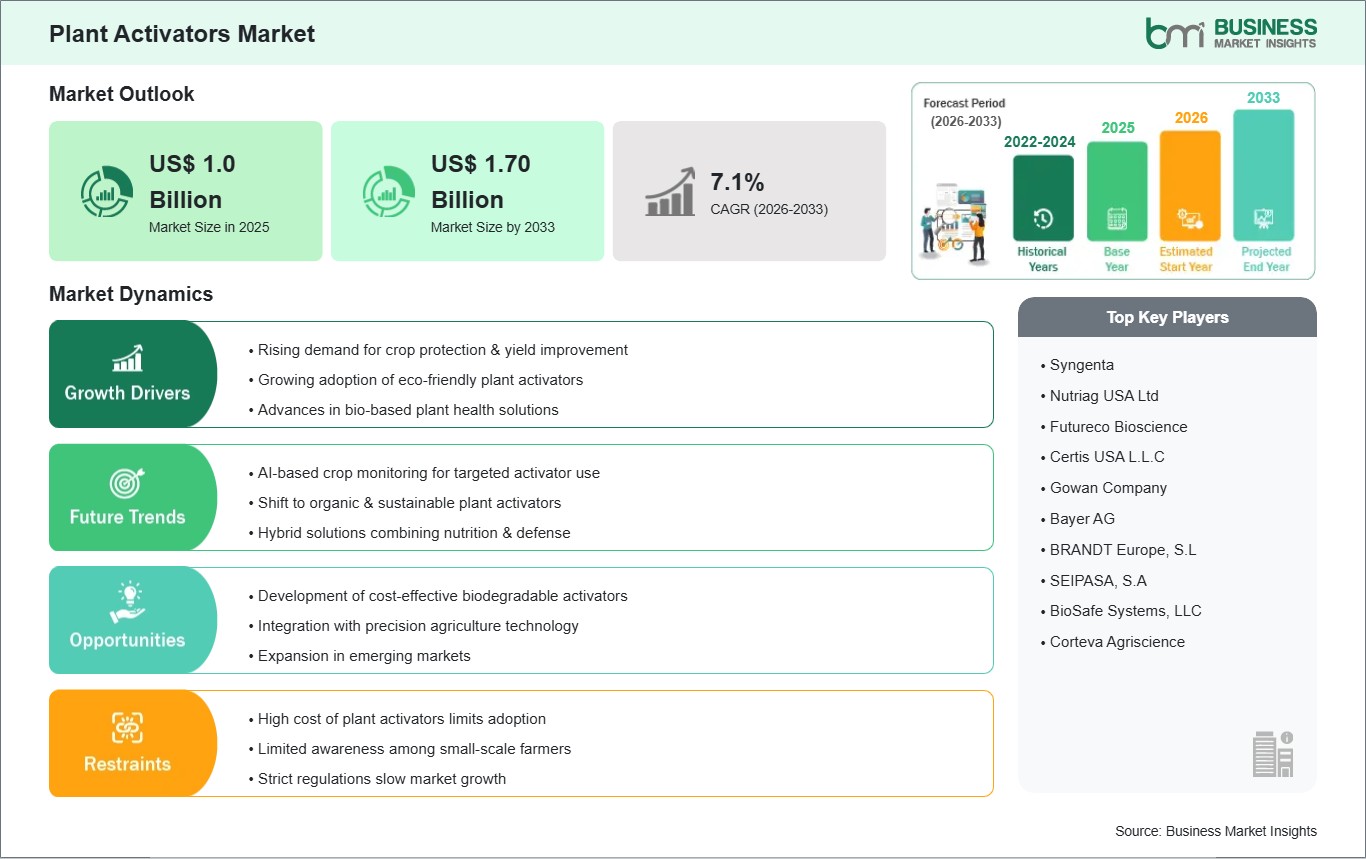
Plant activators are natural or man-made substances that boost a plant’s own defense systems instead of attacking pathogens directly. They help plants protect themselves by activating pathways such as Systemic Acquired Resistance (SAR) and Induced Systemic Resistance (ISR). This process prepares plants to handle a wide range of stresses, such as fungal infections, bacterial diseases, and harsh weather. The plant activators market plays an important role in modern Integrated Pest Management (IPM) and includes biological agents like microbials and botanical extracts, as well as synthetic products such as salicylic acid derivatives. These products stand out as they provide lasting, broad protection without causing pathogen resistance or leaving behind harmful chemical residues. The market is growing mainly due to the global move toward sustainable farming, stricter rules on traditional fungicides, and higher demand for produce that is free from residues, especially in export markets. Additionally, the integration of plant activators with precision agriculture tools, such as drone-based foliar spraying, is fundamentally optimizing application efficiency and crop health outcomes.
However, several challenges can restrain market growth: variable efficacy compared to traditional "knock-down" pesticides, often dependent on environmental conditions and the timing of application, remains a barrier for broader adoption. High R&D costs and the complex regulatory pathways for registering novel biological elicitors pose constant financial hurdles for manufacturers. Furthermore, the industry is constrained by a technical knowledge gap among growers regarding the preventive rather than curative nature of these products, often leading to sub-optimal field results. Despite these hurdles, the market holds immense opportunities due to the universal mandate for food security and the accelerating deployment of seed treatment formulations to protect crops from the earliest stages of development. The expansion into indoor and vertical farming, where chemical use is highly restricted, and the development of next-generation RNAi-based signaling molecules are expected to create significant opportunities for market growth.
Segment Analysis
Plant Activators Market Segmentation
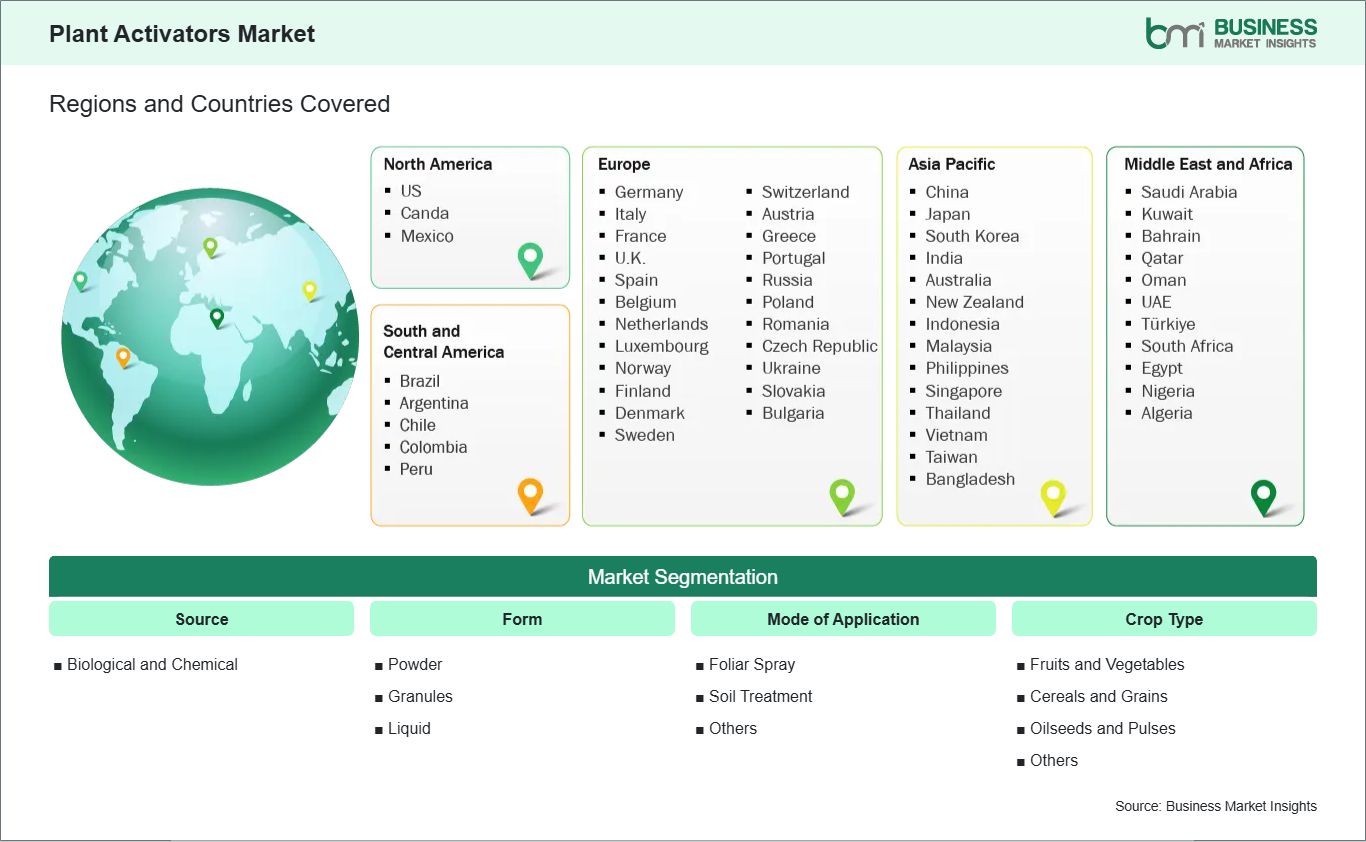
Key segments that contributed to the derivation of the Plant Activators market analysis are source, form, mode of application, and crop type.
- By Source, the market is segmented into Biological and Chemical.
- By Form, the market is segmented into Powder, Granules, and Liquid.
- By Mode of Application, the market is segmented into Foliar Spray, Soil Treatment, and Others.
- By Crop Type, the market is segmented into Fruits and Vegetables, Cereals and Grains, Oilseeds and Pulses, and Others.
Market Forces
Plant Activators Market Drivers and Opportunities
Sustainable Agriculture and Pathogen Resistance Management
Plant activators strengthen a plant’s inherent defense mechanisms by stimulating pathways such as Systemic Acquired Resistance (SAR) and Induced Systemic Resistance (ISR), rather than acting directly on pathogens. By priming the plant to recognize and respond more effectively to biotic stress, these products offer broad-spectrum protection with a significantly reduced risk of resistance development—an increasingly valuable attribute in modern Integrated Pest Management (IPM) programs. Growing consumer demand for clean, “residue-free” food has further accelerated their relevance, pushing farmers to reduce reliance on conventional synthetic pesticides. Many plant activators, being biologically derived or designed to mimic natural signaling compounds like salicylic acid and jasmonates, commonly feature zero-day pre-harvest intervals and minimal environmental toxicity. This makes them compatible with organic farming systems and compliant with stringent global food safety regulations. As a result, their adoption has expanded rapidly across high-value horticultural crops, vegetables, fruits, and even major cereals, where maintaining strong plant immunity, yield stability, and marketable quality is essential amid increasing climatic and disease pressures.
Size and Share Analysis
Plant Activators Market Size and Share Analysis
AI-powered sensing technologies are transforming crop protection by enabling early, highly precise detection of stress or infection in plants. By identifying subtle physiological changes—often before visible symptoms emerge—these systems allow growers to apply plant activators at the optimal moment, safeguarding crops during their most vulnerable growth stages. Increasing research and commercial interest is also focused on creating “dual-action” activators that address both biotic pressures, such as fungal or bacterial diseases, and abiotic stresses like drought, heat, and high soil salinity. These next-generation products aim not only to enhance disease resistance but also to improve plant resilience and survival under extreme or erratic environmental conditions. Such traits are especially valuable for large-scale crops like soybeans and maize grown in regions with unpredictable weather patterns. Companies investing in innovative delivery platforms—such as seed treatment formulations that protect seedlings from the moment they emerge, or RNA-based immunity enhancers that trigger highly targeted defense pathways—are well positioned to lead the market. These advancements make plant activators a practical, affordable cornerstone of climate-smart, resilient agriculture.
Report Coverage
Plant Activators Market Report Coverage and Deliverables
The Plant Activators market demonstrates steady growth, with size and share analysis revealing evolving trends and competitive positioning among key players. The report further examines subsegments categorized within source, form, mode of application, and crop type, offering insights into their contribution to overall market performance.
For instance, the Biological subsegment is experiencing rapid growth as farmers shift away from synthetic inputs in favor of natural defense stimulants. These activators, often derived from microbial components or botanical extracts, are essential for fruits and vegetables, where consumer demand for residue-free produce is at an all-time high. This trend is particularly strong in Europe and North America, where stringent regulations on chemical pesticides have made biological activators a prerequisite for meeting organic certification standards and retailer "zero-residue" policies.
Geographic Insights
Plant Activators Market Geographic Insights
The geographical scope of the Plant Activators market report is divided into five regions: North America, Asia Pacific, Europe, Middle East & Africa, and South & Central America.
The Asia-Pacific Plant Activators Market is segmented into China, Japan, South Korea, India, Australia, New Zealand, Indonesia, Malaysia, the Philippines, Singapore, Thailand, Vietnam, Taiwan, Bangladesh, and the Rest of Asia. The market is primarily driven by the region's massive agricultural footprint and the urgent need to mitigate abiotic stress caused by unpredictable climate patterns. Growth is further bolstered by the rising adoption of Integrated Pest Management (IPM) strategies, where plant activators are used to trigger the plant's natural defense mechanisms against both biotic and abiotic stresses. The increasing demand for residue-free produce for export markets, particularly in the fruits and vegetables sector, and the expansion of modern farming techniques like foliar spray application solidify Asia-Pacific as a critical hub for innovation and adoption in the plant activator industry.
Industry Activity
Recent Developments
The Plant Activators market is evaluated by gathering qualitative and quantitative data post primary and secondary research, which includes important corporate publications, association data, and databases. A few of the key developments in the Plant Activators market are:
- In January 2025, Syngenta Crop Protection entered into a strategic collaboration with AI specialist TraitSeq to accelerate the development of next-generation biostimulants. The partnership leverages artificial intelligence to identify plant biomarkers that improve the predictability and performance of biological inputs, supporting the growing demand for sustainable and data-driven plant activator solutions.
- In May 2024, Rizobacter BioSoluções launched RizoPower, a new bioactivator for foliar application in Brazil. The product features the company’s proprietary UBP molecule, designed to stimulate plant metabolism, mitigate abiotic and biotic stress, and improve crop productivity, supporting the growing demand for sustainable plant activators in commercial agriculture.
Trust & Transparency
Research Methodology
The market analysis combines proprietary research with secondary data from government agencies, company disclosures, regulatory filings, industry databases and expert interviews. Market estimates are validated through data triangulation, cross-market benchmarking and analyst
review.
View Full Research Methodology
Key Sources Referred:
World Bank – Global Trade Indicators
World Trade Organization (WTO)
International Monetary Fund (IMF)
International Trade Administration (ITA)
Company Websites
Company Annual Reports
Company Investor Presentations