
Optical Coherence Tomography Market Outlook: Size, Share, Trends, Growth Analysis, Competitive Landscape & Forecast, 2026-2033

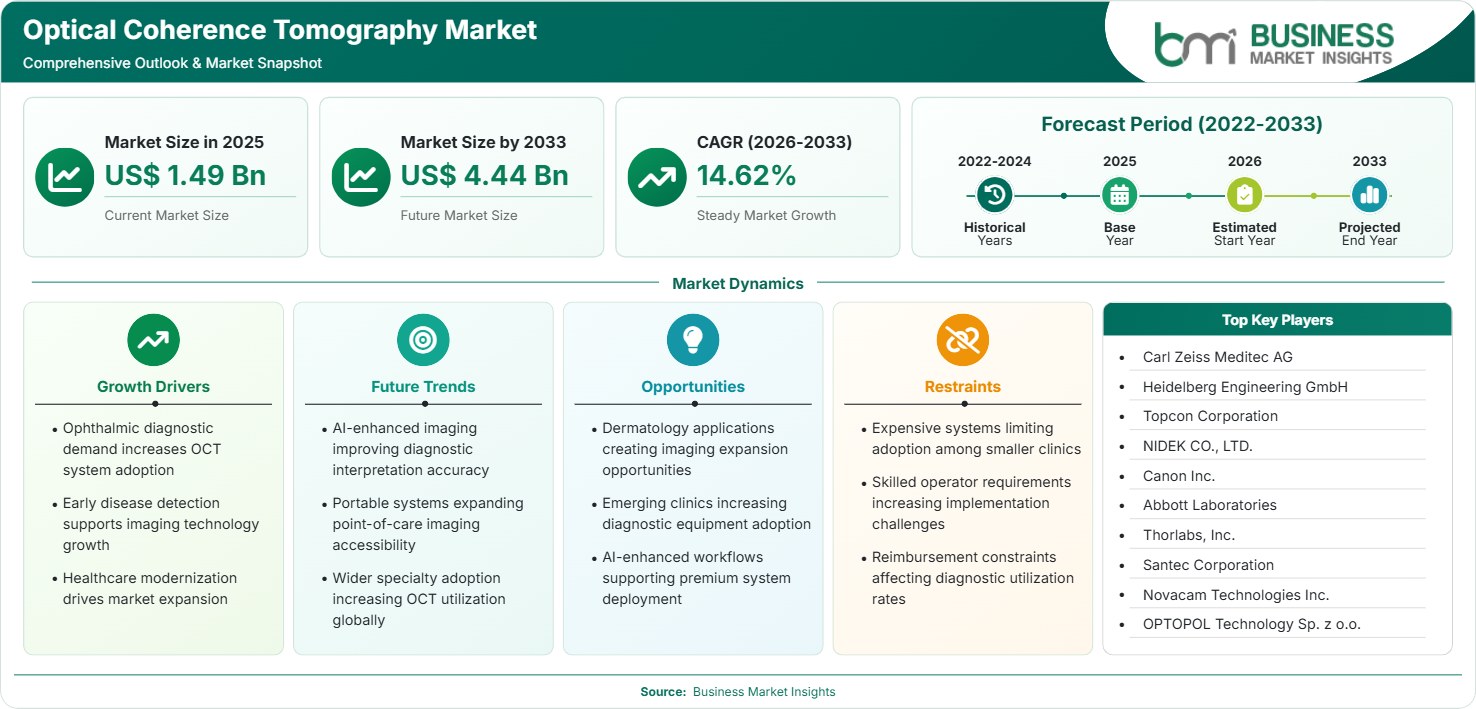
The Optical Coherence Tomography Market size was valued at US$ 1.49 Billion in 2025 and is projected to reach US$ 4.44 Billion by 2033, growing at a CAGR of 14.62% during 2026–2033, driven by advanced retinal imaging, AI integration, expanding clinical applications, and portable diagnostics.

Report Coverage
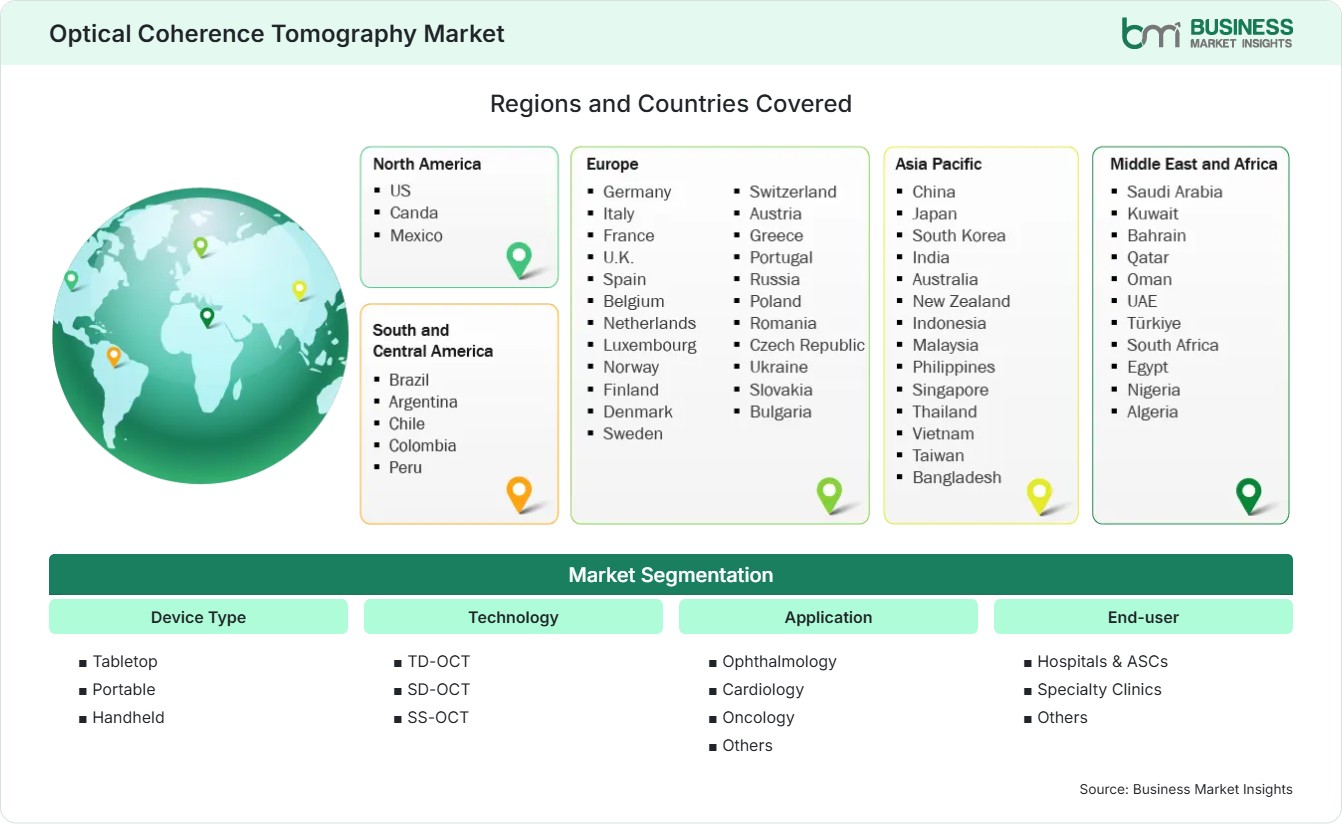
  • Device Type: Tabletop, Portable, Handheld
  • Technology: TD-OCT, SD-OCT, SS-OCT
  • Application: Ophthalmology, Cardiology, Oncology, Others
  • End-user: Hospitals & ASCs, Specialty Clinics, Others
US$ 1.49 Bn Market size in 2025
US$ 4.44 Bn Market Size by 2033
14.62% CAGR, 2026 - 2033
2026-2033 Forecast Period

AI Overview

Optical Coherence Tomography Market Summary

  • North America Region: North America holds a 36%–39% share in 2025, growing at a 13.8%–14.7% CAGR during 2026–2033, supported by advanced ophthalmic infrastructure, reimbursement, AI-enabled imaging, and clinical research investment. The US market remains dominant, supported by sophisticated retina services, reimbursement coverage, academic research, and rapid adoption of AI-assisted OCT workflows, with CAGR estimated at 13.9%–14.8% during 2026–2033.
  • Fastest Growing Region: Asia Pacific holds a 25%–28% Optical Coherence Tomography Market share in 2025, with a 16.0%–17.2% CAGR through 2033, supported by expanding ophthalmology capacity, aging populations, increasing diabetes burden, medical technology investment, and improving access to advanced imaging.
  • Leading Segment: Tabletop devices hold a 65%–69% share in 2025, expanding at a 13.6%–14.5% CAGR through 2033, supported by superior image quality, multimodal integration, established ophthalmology workflows, and demand for high-throughput diagnostic imaging.
  • High Growth Segment: Swept Source OCT holds a 19%–23% share in 2025 and advances at a 16.5%–17.5% CAGR through 2033, driven by deeper penetration, faster scanning, choroidal visualization, anterior-segment imaging, and broader clinical utility.
  • Key Market Opportunity: AI-assisted interpretation, portable systems, swept-source imaging, and non-ophthalmic applications create attractive opportunities for manufacturers developing interoperable platforms, automated analytics, decentralized diagnostics, and specialized clinical workflows.
  • Major Market Players: Carl Zeiss Meditec AG, Heidelberg Engineering GmbH, Topcon Corporation, NIDEK CO., LTD., Canon Inc., Abbott Laboratories, Thorlabs, Inc., Santec Corporation, Novacam Technologies Inc., and OPTOPOL Technology Sp. z o.o.
Strategic Insights

Optical Coherence Tomography Market: Strategic Insights

Optical Coherence Tomography Market Strategic Framework
FREE PDF
Request your free sample
Request free sample
Stakeholder View

Key Takeaways

  • The value chain is moving from optical hardware to integrated platforms which incorporate the imaging engine, the probe, the software, the AI, the data storage, the service contracts and the clinical decision support.
  • Swept source systems and the portable/handheld formats have much greater potential for expansion as deeper imaging, mobility, more decentralized diagnostics, and wider clinical applications all lead to greater equipment utilization.
  • Product development is moving in the direction of higher scan speeds, better depth, automated segmentation, OCT angiography, multimodal imaging and AI-assisted interpretation, which can reduce the amount of clinician review required.
  • Asia Pacific is an attractive investment case as the region is seeing the expansion of specialty healthcare networks, an aging population, increasing prevalence of diabetes and greater availability of advanced diagnostic equipment, all of which will underpin continued technology adoption.
  • Competitive activity is increasingly focused on integrated ophthalmology portfolios, digital health ecosystems, specialist imaging and strategic partnerships that bring the hardware, software and clinical data together.

Long-term differentiation will be driven by clinical workflow integration, interoperability, service responsiveness, and evidence that the advanced OCT capabilities actually lead to improved diagnostic efficiency and patient management.

Geographic Outlook

Optical Coherence Tomography Market Regional Highlights

North America Optical Coherence Tomography Market

North America held a 36%–39% Optical Coherence Tomography Market share in 2025 and is projected to expand at a 13.8%–14.7% CAGR through 2033. The region benefits from established ophthalmology networks, sophisticated hospitals, research funding, reimbursement infrastructure, and early adoption of AI-enabled imaging. The US represents the largest national contributor, while Canada provides additional opportunity through specialized ophthalmic centers.

  • High-resolution retinal imaging is still the key to adoption, with providers focused on early detection and longitudinal monitoring of retinal disease within their specialist networks and in the ambulatory environment.
  • AI-assisted segmentation and biomarker analysis are increasingly being incorporated into the workflow, which in turn is creating a demand for platforms that can provide standardized measurements and efficient assessment of disease progression over time.
  • Academic medical centers continue to underpin the development of technology via clinical research, providing opportunities for manufacturers of investigational imaging capabilities and software platforms.
  • Reimbursement and the existence of established specialist infrastructure will go a long way to reducing the barriers to adoption. The purchase decision is increasingly going to be driven by workflow productivity, interoperability, the service contract, and the total cost of ownership.

US Optical Coherence Tomography Market

The US accounted for approximately 30%–33% of global Optical Coherence Tomography Market demand within the regional structure in 2025 and is projected to grow at a 13.9%–14.8% CAGR during 2026–2033. High procedure volumes, specialist density, established reimbursement mechanisms, and sophisticated clinical research sustain adoption.

  • Large ophthalmology networks are moving towards the standardization of imaging platforms to improve consistency, technician training, data portability, and the ability to monitor patients longitudinally across multiple sites.
  • AI-enabled workflows can help to overcome the constraints of productivity by prioritizing the abnormalities, automating the measurements, and assisting the clinician as the volume of imaging increases without a corresponding increase in examination time.
  • Research institutions provide an innovation route for more advanced OCT applications (high-resolution imaging, multimodal diagnostics, surgical visualization, experimental disease biomarkers).

Europe Optical Coherence Tomography Market

Europe represented a 27%–30% Optical Coherence Tomography Market share in 2025 and is expected to expand at a 13.4%–14.3% CAGR through 2033. Germany, the UK, France, Italy, and Spain form the principal demand centers, supported by established ophthalmology services and strong medical technology capabilities.

  • Germany has a very strong base in ophthalmic research and a very well-established medical device manufacturing base, which in turn supports the demand for high-end imaging systems, research platforms, and software-enabled diagnostics.
  • The UK market has specialist retinal services, and there's growing interest in digital workflows. Procurement is still very much driven by clinical evidence, interoperability and the economics of the healthcare system.
  • France and Italy offer attractive opportunities for replacement and modernization as hospitals and specialist clinics upgrade their imaging capabilities and move towards greater integration of automated diagnostic functions.
  • Spain and a number of the Central European markets can deliver higher growth as private healthcare investment increases access to both advanced diagnostic equipment and specialist ophthalmic services.

Asia Pacific Optical Coherence Tomography Market

Asia Pacific held a 25%–28% Optical Coherence Tomography Market share in 2025 and is projected to record a 16.0%–17.2% CAGR through 2033, making it the fastest-growing regional market. Japan and China provide substantial installed-base opportunities, while India, South Korea, and Australia contribute strong growth prospects.

  • China has both a huge patient population and a growing number of specialist hospitals, which provides the perfect environment for high-volume systems, AI-assisted screening, and locally supported diagnostics.
  • Japan is a very mature technology market, and demand is increasingly being driven by replacement cycles, advanced retinal imaging, compact systems, and the integration of diagnostic data into the clinical workflow.
  • India has huge potential for expansion as the number of private hospitals and specialist clinics increases and they look for affordable systems which can support very high patient volumes.
  • South Korea and Australia are technology-driven markets with a strong infrastructure in place for imaging, clinical research, and digital health, which in turn supports the uptake of more sophisticated OCT platforms.

Rest of World Optical Coherence Tomography Market

South and Central America accounted for approximately 7%–9% of global Optical Coherence Tomography Market demand in 2025 and is expected to grow at a 14.0%–15.0% CAGR through 2033. Brazil and Mexico lead regional demand as private hospitals, specialist clinics, and diagnostic networks expand.

  • Brazil has the benefit of a huge healthcare ecosystem and a growing network of private specialty practices, which in turn creates demand for reliable imaging systems, service support, and financing models.
  • Mexico provides growth opportunities through private hospitals and specialist centers seeking modern diagnostic capabilities, particularly in major urban healthcare clusters.
  • Saudi Arabia and the UAE are investing in advanced healthcare infrastructure, supporting demand for premium ophthalmic imaging and integrated digital diagnostic platforms.
  • South Africa is still the regional diagnostic hub. Wider adoption across Africa will depend on cost, technical support, availability of specialists, and sustainable equipment maintenance models.
Global Market Geography
FREE PDF
Request your free sample
Request free sample
Segment Analysis

Optical Coherence Tomography Market Segmentation

Device Type

Tabletop devices represented a 65%–69% share in 2025 and are projected to grow at a 13.6%–14.5% CAGR during 2026–2034, supported by clinical accuracy, workflow integration, and established specialist demand.  The Optical Coherence Tomography Market scope is therefore expanding from fixed specialty laboratories toward flexible care environments.

  • Tabletop: Tabletop platforms remain preferred for specialist ophthalmology because they deliver high-resolution imaging, stable positioning, multimodal integration, automated analysis, and efficient repeat examinations.
  • Portable and Handheld: Portable and handheld systems improve access in outreach programs, pediatric care, intensive settings, and decentralized clinics where conventional tabletop equipment is difficult to deploy.

Technology

Spectral-domain systems remain widely adopted because of established clinical validation and strong image quality, while swept-source technology is gaining faster momentum through deeper penetration and high-speed acquisition. Optical Coherence Tomography Market trends increasingly favor platforms that combine acquisition performance with software intelligence.

  • Time Domain OCT (TD-OCT): TD-OCT retains relevance in specialized and installed-base applications, particularly where established workflows, lower complexity, and compatibility with existing systems influence purchasing decisions.
  • Spectral Domain OCT (SD-OCT): SD-OCT provides strong resolution and mature clinical workflows, supporting widespread retinal imaging, glaucoma assessment, OCT angiography, and longitudinal disease monitoring.
  • Swept Source OCT (SS-OCT): SS-OCT enables deeper imaging and high-speed acquisition, strengthening applications involving choroidal structures, anterior segments, wide fields, and complex retinal assessment.

Application

Ophthalmology remains the dominant Optical Coherence Tomography Market application, reflecting established clinical adoption in retinal and glaucoma diagnosis. Cardiology and oncology provide expansion pathways as imaging advances improve visualization of tissue structures and vascular characteristics.

  • Ophthalmology: Ophthalmology remains the core application because OCT provides rapid, non-invasive structural visualization supporting retinal disease, glaucoma, macular assessment, and longitudinal treatment monitoring.
  • Cardiology: Cardiology applications benefit from intravascular OCT capabilities that provide high-resolution vascular imaging, supporting lesion characterization, stent assessment, and procedure planning.
  • Oncology: Oncology research uses OCT for high-resolution tissue assessment and potential intraoperative or near-real-time visualization, supporting development of non-invasive and minimally invasive diagnostic approaches.

End-user

Hospitals and ambulatory surgical centers represented a 49%–53% share in 2025 and are projected to expand at a 14.1%–15.0% CAGR during 2026–2034. Specialty clinics remain important buyers because ophthalmology-focused practices require efficient, repeatable imaging. Other users include research institutions and specialized diagnostic facilities. Purchasing decisions increasingly consider utilization rates, interoperability, service availability, training requirements, and the ability to connect imaging data with broader clinical information systems.

  • Hospitals & ASCs: Hospitals and ASCs require integrated platforms capable of supporting high patient volumes, multidisciplinary workflows, surgical applications, advanced imaging, and centralized data management.
  • Specialty Clinics: Specialty clinics prioritize compact workflows, rapid acquisition, automated measurements, and intuitive software that enable high examination throughput with limited technical staffing.
Market Forces

Optical Coherence Tomography Market Dynamics

Key Market Drivers

Rising Demand for Earlier and Non-Invasive Diagnosis

Increasing emphasis on early diagnosis is strengthening demand for high-resolution optical imaging that can reveal structural abnormalities before symptoms become advanced. OCT enables rapid, non-invasive visualization of retinal layers and vascular structures, supporting repeated assessments without ionizing radiation. The growing burden of age-related and metabolic eye disorders reinforces utilization in specialist practices. Optical Coherence Tomography Market growth is further supported by providers seeking diagnostic methods that improve longitudinal monitoring while maintaining efficient patient throughput.

Rapid Adoption of Spectral and Swept Source Platforms

Technology progression is moving procurement toward higher-speed and deeper-imaging architectures. Spectral-domain systems have established a broad installed base, while swept-source systems are gaining momentum because longer wavelengths can improve penetration into deeper ocular structures and support wider scanning. Higher acquisition speeds also reduce motion artifacts and increase examination efficiency. Optical Coherence Tomography Market trends increasingly center on software-enhanced acquisition, automated segmentation, OCT angiography, and multimodal integration rather than improvements in optical hardware alone.

Integration of Artificial Intelligence and Automated Analytics

AI is becoming a differentiating layer across OCT platforms as clinicians are faced with ever-increasing image volumes and an ever greater demand for standardized interpretation. The ability to automate segmentation, biomarker quantification, abnormality detection and longitudinal comparison can all go some way to reducing the amount of manual review required and improving consistency. AI is of particular value when it's integrated into the acquisition and reporting workflow rather than simply being an add-on application. There's a real move in the industry now to create connected ecosystems where the imaging data can be used to support research, population screening, clinical decision support, and disease monitoring.

Key Market Opportunities

Expansion of Portable and Decentralized Diagnostic Imaging

Portable and handheld OCT systems can be used in healthcare settings where the use of a full-sized (tabletop) system is impractical for reasons of space, mobility, patient positioning, or infrastructure. The scope of their use goes well beyond traditional ophthalmology into community screening, pediatrics, intensive care, outreach, and remote clinical services. The move to smaller optical engines, smaller electronics, better software and wireless connectivity is making the mobile systems more viable. Manufacturers can go some way toward driving commercial uptake by providing simpler interfaces, automated acquisition guidance, cloud connectivity, remote support, and subscription-based analytics.

Broader Clinical Use Beyond Traditional Ophthalmology

Expansion into cardiology, oncology, surgery, dermatology and research would allow for greater equipment utilization and a more diversified revenue base. Intravascular OCT is a good example of how a specialist probe can take optical imaging and bring it into a clinical environment other than the retina. Both oncology and surgery could benefit from real-time visualization in situations where the architecture of the tissue is hard to assess with conventional techniques. The commercial opportunities will of course be predicated on clinical validation, regulatory approval, compatibility with the clinical workflow and demonstrable diagnostic or procedural value. A manufacturer with a flexible optical platform could potentially re-use their core imaging technology across a range of applications, thus avoiding the need to re-develop everything.

AI-Enabled Imaging Ecosystems and Data Monetization

OCT platforms generate structured longitudinal imaging data that can support research, clinical trials, population studies, and algorithm development when governance and consent requirements are appropriately addressed. Manufacturers can build higher-value ecosystems by combining imaging hardware with secure cloud infrastructure, analytics, clinical dashboards, and research services. Optical Coherence Tomography Market growth opportunities include automated disease progression tracking, cohort identification, biomarker discovery, and integration with pharmaceutical research workflows.

Market Restraints and Challenges

High Acquisition and Ownership Costs

Factor: Advanced OCT platforms (swept source engines, multimodal imaging, high-speed processors, specialist probes, and AI software) are obviously going to be capital intensive, particularly for the smaller clinic. Impact: The high acquisition cost will necessarily lead to longer replacement cycles, will favor the existing premium providers, and will limit uptake in the lower resource settings. The issue is not just the purchase price, as the provider will also have to factor in maintenance, calibration, software updates, training, and service contracts.

Shortage of Skilled Interpretation and Workflow Integration

Factor: More advanced OCT systems require trained operators and clinicians to interpret the complex structural, vascular and longitudinal imaging data. Impact: The lack of available specialists can lead to under-utilization of the equipment and slow uptake, particularly in non-metropolitan areas. AI-assisted interpretation can help to reduce some of the workload but won't remove the requirement for clinical oversight, quality control and appropriate patient selection. The OCT data also has to be integrated into the electronic records, the imaging archive, the referral system and the treatment workflow.

Company Analysis

Competitive Landscape

The Optical Coherence Tomography Market analysis indicates competition is concentrated around image quality, technology architecture, clinical validation, software integration, geographic reach, and service capability. Leading manufacturers are increasingly differentiating through multimodal platforms, AI-assisted analytics, high-speed scanning, specialized applications, and integrated ophthalmology ecosystems.

Company Name

Overview

Products and Services relevant to this market

Carl Zeiss Meditec AG

Global ophthalmic technology provider with extensive diagnostic imaging capabilities and strong clinical relationships across major healthcare markets.

CIRRUS OCT platforms, OCT angiography, retinal imaging, ophthalmic workflow software, analytics, and integrated diagnostic solutions.

Heidelberg Engineering GmbH

Specialist ophthalmic imaging company recognized for high-resolution diagnostic systems and sophisticated image-management capabilities.

SPECTRALIS OCT, OCTA, swept-source solutions, research imaging, image analysis, and ophthalmic data-management platforms.

Topcon Corporation

Japanese medical technology company with broad ophthalmic imaging and diagnostic equipment capabilities across global markets.

Maestro OCT systems, OCTA, swept-source imaging, retinal diagnostics, software, data services, and connected clinical workflows.

NIDEK CO., LTD.

Ophthalmic equipment manufacturer offering diagnostic and treatment technologies for eye-care providers and specialists.

RS-series OCT systems, retinal and glaucoma analytics, diagnostic imaging equipment, and integrated ophthalmic solutions.

Canon Inc.

Diversified technology company with established medical imaging expertise and optical engineering capabilities.

OCT and retinal imaging technologies, ophthalmic diagnostic equipment, image-processing capabilities, and clinical imaging solutions.

Abbott Laboratories

Healthcare company with significant cardiovascular imaging capabilities and specialized intravascular OCT applications.

Intravascular OCT imaging systems, coronary imaging technologies, procedural guidance, and cardiovascular diagnostic solutions.

Thorlabs, Inc.

Photonics technology specialist supplying optical components, imaging systems, and research-oriented OCT technologies.

OCT imaging engines, optical components, light sources, detectors, research systems, and customized photonics solutions.

Santec Corporation

Japanese photonics and medical technology company specializing in optical components and ophthalmic imaging systems.

Swept-source OCT, OCTA technologies, optical engines, ophthalmic imaging systems, and photonics components.

Novacam Technologies Inc.

Canadian optical measurement company specializing in non-contact three-dimensional imaging and OCT-related technologies.

High-resolution OCT systems, optical measurement platforms, research imaging, and specialized non-contact inspection technologies.

OPTOPOL Technology Sp. z o.o.

European ophthalmic technology manufacturer focused on diagnostic imaging and advanced retinal assessment.

Spectral-domain OCT, OCT angiography, retinal imaging systems, diagnostic software, and ophthalmic clinical solutions.

Trust & Transparency

Research Methodology

The market analysis combines proprietary research with secondary data from government agencies, company disclosures, regulatory filings, industry databases and expert interviews. Market estimates are validated through data triangulation, cross-market benchmarking and analyst review.

View Full Research Methodology

Questions Answered

Frequently Asked Questions

How important will software become in OCT systems?

The Optical Coherence Tomography Market Report highlights that Software is becoming a core competitive differentiator because automated segmentation, biomarker analysis, longitudinal comparison, AI-assisted detection, reporting, and interoperability directly influence clinical productivity.

What role can OCT play in clinical research?

OCT can generate high-resolution, repeatable structural and vascular measurements that support disease characterization, biomarker development, treatment monitoring, and clinical trials.

Why is swept-source technology gaining attention?

Swept-source OCT can provide deeper tissue penetration and high-speed acquisition, enabling improved visualization of structures that may be challenging to assess with shorter-wavelength systems.

How can portable OCT systems expand clinical access?

Portable systems can support outreach screening, pediatric examinations, community ophthalmology, bedside imaging, and decentralized specialty services.

What factors will influence OCT purchasing decisions through 2033?

Purchasers will increasingly evaluate image quality alongside scan speed, automation, interoperability, cybersecurity, AI capabilities, service coverage, and total cost of ownership.

Access the Full Optical Coherence Tomography Market Report

Get segment-level forecasts, regional estimates, competitive benchmarking, company profiles and downloadable Excel datasets.

Access the full Optical Coherence Tomography Market Report
350 pages PDF & Excel | 2026-11-10
Similar Research

Related Market Reports