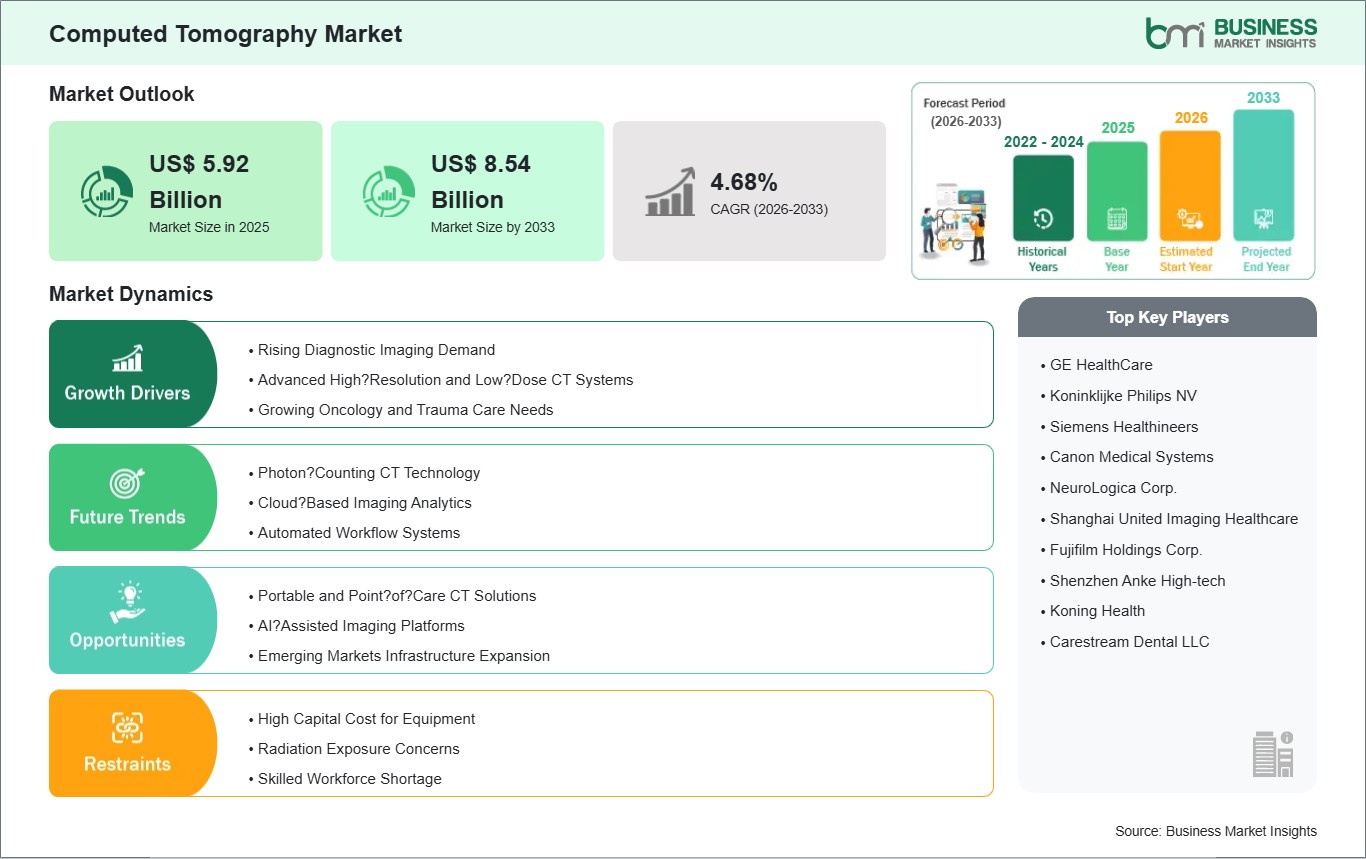
Market Summary
Executive Summary and Global Market Analysis
Computed tomography (CT) is a medical imaging method that employs X-rays and computer processing to produce highly detailed cross-sectional images of the body, thus enabling doctors to identify diseases, spot injuries, direct treatments, and keep an eye on conditions with superb precision.
The computed tomography market is a significant component of the medical imaging sector, which is primarily fueled by the increased occurrence of chronic diseases, the need for early and accurate diagnosis, and the constant upgrade of technology. CT scans are commonly utilized in tumor treatment, heart disease, brain disorders, accident and emergency care, because of their quickness, accuracy, and ability to show detailed anatomy. Apart from that, the market is benefiting from developments like low radiation imaging, AI applications, multi-slice and portable CT machines, which provide better picture quality and lesser radiation exposure at the same time. Big healthcare investment in up-and-coming countries, plus the widening of access to diagnostic imaging services, are giving a push to global demand. On the other hand, the market cannot escape high equipment prices, upkeep costs, and radiation safety worries, which might make it difficult to penetrate certain price-sensitive areas. In short, the computed tomography market is foreseen to have a steady growth rate worldwide, driven by technological advancements, the aging demographic, and the indispensable role of CT imaging in modern clinical decision-making, plus preventive healthcare interventions.
Segment Analysis
Computed Tomography Market Segmentation
Key segments that contributed to the derivation of the computed tomography market analysis are technology, application, and end user.
- By technology, the market is categorized into high-end slice CT, mid-end slice CT, low-end slice CT, cone beam CT. The high-end slice CT segment held the largest share of the market in 2025.
- By application, the market is segmented into oncology, cardiology, vascular, neurology, musculoskeletal, other applications. The oncology segment held the largest share of the market in 2025.
- By end user, the computed tomography market is segmented into hospitals, diagnostic imaging centers, other end users. The hospitals segment dominated the market in 2025.
Market Forces
Computed Tomography Market Drivers and Opportunities
Increasing Global Prevalence of Chronic Diseases
The escalating global prevalence of chronic diseases is one of the most significant factors driving the computed tomography market and making it necessary to have advanced diagnostic imaging for early detection, effective treatment planning, and ongoing monitoring. The demand for CT scans has surged worldwide, mainly due to the rising cases of cancer, cardiovascular diseases, and neurological diseases. For instance, the global volume of CT scans increased as hospitals enlarged their diagnostic facilities to manage the chronic illness prevalence, and the yearly total of millions of procedures was performed to highlight and keep track of these conditions. The trends of chronic diseases include greatly increased yearly cases of cancer and heart disease, which have made CT imaging unavoidable in clinical workflows, and thus, the doctors depend on the high-resolution, cross-sectional images to make the right decisions quickly. The aging of populations and the increase of disease burdens continue to make healthcare providers invest in CT technology for the purpose of getting the correct, timely diagnostics and improving the patients' conditions.
Rapid Integration of Artificial Intelligence (AI) and Advanced Imaging Technologies
The computed tomography market has a great chance, with the fast adoption of artificial intelligence (AI) and imaging technologies. The world widely accepts AI-powered CT platforms, which are coming in a wide variety to improve the quality of diagnosis, take charge of the lengthy process of image reconstruction, reduce scan times, and compute the optimum value for radiation doses. An estimated 31% of the new CT systems are fitted with the automatic reconstruction and segmentation tools. The change in technology not only raises the productivity of the doctors but also makes it easy for the hospitals to access cloud-based diagnostics and remote reporting, thereby increasing the use of CT in areas that do not have enough medical facilities and in rural areas. For instance, the interpretation time in complicated cases like stroke and cancer detection can be reduced, and the accuracy can be increased with the help of AI, and thus the CT scan becomes more valuable in preventive care and emergency situations. In addition, the small-scale and low-dose CT machines open up the markets in mobile setups and resource-poor areas and thus, are contributing to the overall healthcare modernization worldwide, along with the market expansion.
Size and Share Analysis
Computed Tomography Market Size and Share Analysis
By technology, the market is categorized into high-end slice CT, mid-end slice CT, low-end slice CT, cone beam CT. The high-end slice CT segment held the largest share of the market in 2025. High-end slice CT systems lead the market due to their advanced imaging capabilities, including high spatial and temporal resolution, faster scan speeds, and support for complex procedures such as cardiac, trauma, and whole-body imaging. These systems improve diagnostic accuracy, reduce motion artifacts, and enhance workflow efficiency, making them indispensable in tertiary care hospitals and advanced diagnostic centers.
By application, the market is segmented into oncology, cardiology, vascular, neurology, musculoskeletal, other applications. The oncology segment held the largest share of the market in 2025. Oncology dominates the CT application segment because CT imaging is central to cancer diagnosis, staging, treatment planning, and monitoring therapeutic response. The rising global incidence of cancer and the growing emphasis on early detection and precision medicine have significantly increased demand for reliable, high-resolution CT imaging across the cancer care pathway.
By end user, the computed tomography market is segmented into hospitals, diagnostic imaging centers, other end users. The hospitals segment dominated the market in 2025. Hospitals lead the segment as they handle high patient volumes, emergency cases, and complex diagnostic needs that require advanced CT systems. Their strong infrastructure, availability of skilled radiologists, and higher capital investment capacity enable the adoption of high-end imaging technologies and continuous utilization across multiple clinical departments.
Report Coverage
Computed Tomography Market Report Coverage and Deliverables
The " Computed Tomography Market Size and Forecast (2022–2033)" report provides a detailed analysis of the market covering below areas:
- Computed tomography market size and forecast at global, regional, and country levels for all the key market segments covered under the scope
- Computed tomography market trends, as well as market dynamics such as drivers, restraints, and key opportunities
- Computed tomography market analysis covering key market trends, global and regional framework, major players, regulations, and recent market developments
- Industry landscape and competition analysis covering market concentration, heat map analysis, prominent players, and recent developments for the computed tomography market
- Detailed company profiles, including SWOT analysis
Geographic Insights
Computed Tomography Market Geographic Insights
The geographical scope of the computed tomography market report is divided into five regions: North America, Asia Pacific, Europe, Middle East & Africa, and South & Central America. The computed tomography market in Asia Pacific is expected to grow significantly during the forecast period.
The Asia-Pacific computed tomography market is segmented into China, Japan, South Korea, India, Australia, New Zealand, Indonesia, Malaysia, the Philippines, Singapore, Thailand, Vietnam, Taiwan, Bangladesh, and the Rest of Asia. The Asia-Pacific computed tomography market is experiencing robust growth due to the modernization and enlargement of healthcare facilities in the region, specifically in the countries of China and India, where governmental actions like China’s health reforms and India’s Ayushman Bharat program are facilitating the use of cutting-edge CT systems in both urban and rural hospitals. In addition to this, the growing incidence of chronic conditions such as cancers, cardiovascular diseases, and neurological diseases increases the demand for quick and precise diagnostics, as CT scans are the main methods used for the early detection and planning of treatment.
Moreover, the area has a very quick increase in the old population, especially in Japan and China, which again increases the demand for diagnostic imaging of age-related diseases. Also, making healthcare more accessible, the establishment of private hospital chains, the growth of medical tourism, and the increased awareness about preventive care are some of the factors that are pushing the adoption of CT scanners in the region. Moreover, the partnerships between the local firms and the global manufacturers are bringing newer technologies to the consumer, thus increasing the installation of technology in the market
Industry Activity
Recent Developments
The computed tomography market is evaluated by gathering qualitative and quantitative data post primary and secondary research, which includes important corporate publications, association data, and databases. A few of the key developments in the computed tomography market are:
- In September 2025, Siemens Healthineers unveiled a photon-counting CT scanner specifically designed for radiation therapy planning, aiming to improve treatment accuracy for cancer patients through enhanced imaging capabilities. This technology enables clinicians to obtain detailed three-dimensional anatomical images and calculate radiation dose distribution with greater precision.
- In November 2025, GE HealthCare announced the submission of a 510(k) to the US FDA seeking clearance for Photonova Spectra, its new photon-counting computed tomography system with advanced AI algorithms – marking a major milestone in the company’s decades-long history of CT innovation. Built on GE HealthCare’s proprietary Deep Silicon detector technology, Photonova Spectra is designed to deliver remarkable spectral and spatial resolution for ultra-high-definition imaging with wide coverage, seeking to enable fast acquisition speeds, precise visualization of anatomical structures and enhanced material separation.
Trust & Transparency
Research Methodology
The market analysis combines proprietary research with secondary data from government agencies, company disclosures, regulatory filings, industry databases and expert interviews. Market estimates are validated through data triangulation, cross-market benchmarking and analyst
review.
View Full Research Methodology
Key Sources Referred:
World Health Organization (WHO)
Global Health Data Exchange
Centers for Disease Control and Prevention (CDC)
The World Bank Health Data
OECD Health Statistics
Company websites
Company annual reports
Company investor presentations