The North America wood adhesives market size is expected to reach US$ 3,704.7 million by 2033 from US$ 2,008.1 million in 2025. The market is estimated to register a CAGR of 8.0% from 2026 to 2033.
The North America wood adhesives market is driven by a highly developed construction sector, advanced furniture manufacturing industry, and strong adoption of engineered wood products across residential and commercial applications. Demand is significantly supported by increasing utilization of oriented strand board, plywood, laminated veneer lumber, and cross-laminated timber in modern building systems, particularly in sustainable and energy-efficient construction projects. Market dynamics are shaped by continuous product innovation focused on improving bonding strength, curing speed, and resistance to moisture and thermal stress. Manufacturers are increasingly investing in low-emission, formaldehyde-free, and bio-based adhesive formulations in response to stringent environmental regulations and rising consumer preference for sustainable materials. Technological integration in woodworking and panel processing facilities is also driving demand for adhesives compatible with automated and high-speed production lines. The region benefits from a well-established supply chain ecosystem, including raw material suppliers, chemical producers, and large-scale furniture and construction product manufacturers. This integration supports efficient distribution and consistent product availability across end-use industries. Competitive activity is characterized by global chemical companies and specialized regional players focusing on application-specific solutions for flooring, cabinetry, structural wood bonding, and interior applications. Additionally, renovation and remodeling activities across residential and commercial spaces continue to provide stable demand momentum. Overall, the North America wood adhesives market is transitioning toward high-performance, sustainability-driven, and technologically advanced adhesive systems aligned with evolving building codes, environmental standards, and industrial modernization trends.

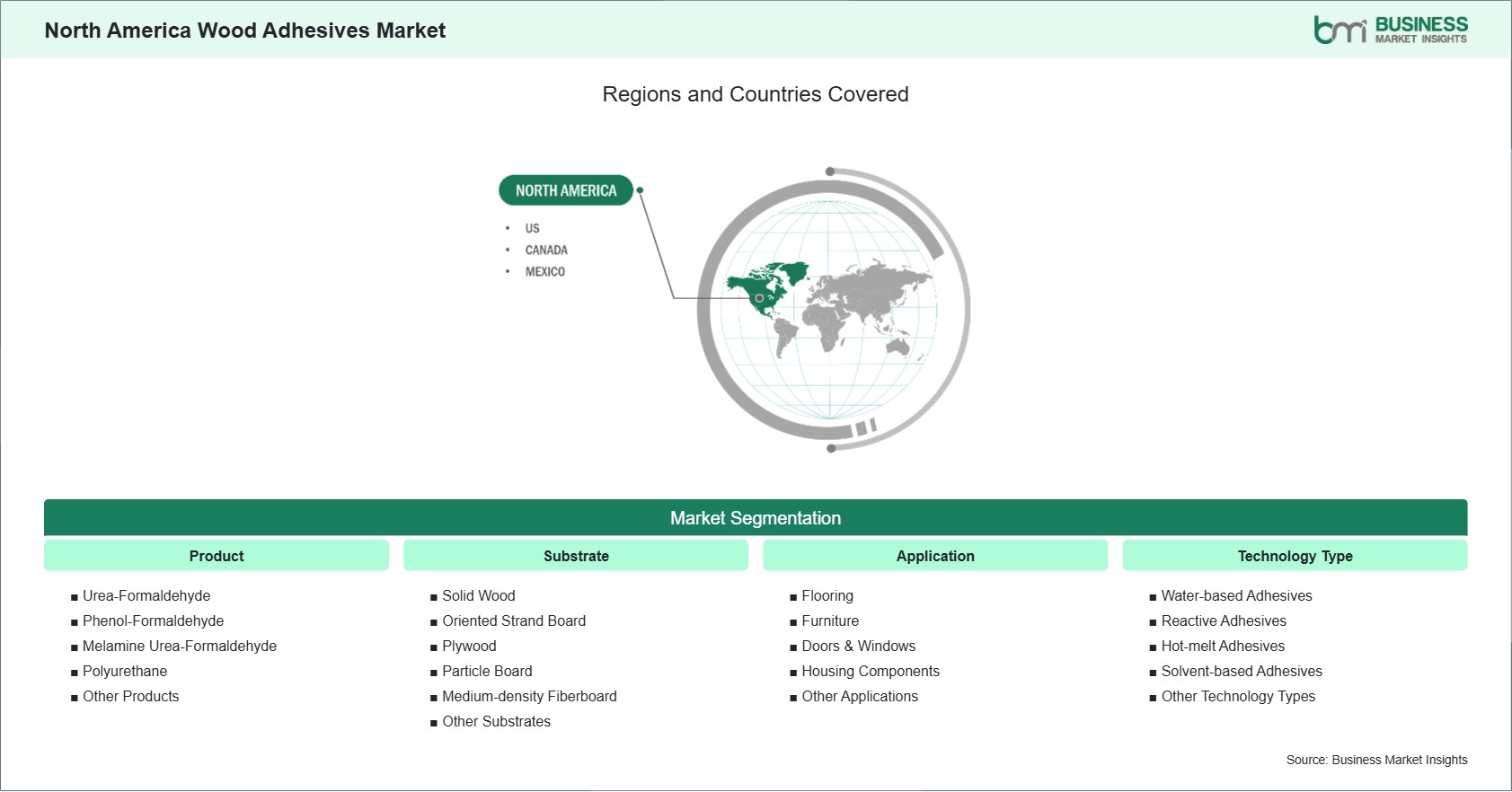
Key segments that contributed to the derivation of the North America wood adhesives market analysis are product, substrate, application, and technology type.
The North America wood adhesives market is expanding steadily due to rising demand for wood assemblies across residential, commercial, and industrial construction. Construction of buildings, renovations, and pre-fabricated building constructions remain high in North America. This increase in demand will promote the production of wood-based products such as plywood, oriented strand board, laminated veneer lumber, and cross-laminated timber. These materials require the use of adhesives to perform their functions effectively.
The use of prefabricated and modular construction techniques is becoming more widespread in order to increase efficiency and cut down project timeframes. This type of construction needs efficient adhesives that can withstand stress from the assembly of wood components. Adhesives are very crucial for ensuring consistent performance in load bearing components, floors, walls, among others.
Sustainability and building code compliance are also shaping market demand. The region places strong emphasis on low-emission materials and energy-efficient construction, encouraging the use of advanced adhesive systems with reduced formaldehyde content and improved environmental profiles. As construction practices continue to evolve toward engineered and prefabricated wood assemblies, demand for high-performance adhesives is expected to grow steadily across both the United States and Canada.
The expansion of decorative wood products is a key driver of the North America wood adhesives market. Rising consumer interest in interior design, home improvement, and aesthetic customization is increasing demand for wood-based decorative elements such as panels, moldings, furniture finishes, and cabinetry. These applications rely heavily on adhesives for bonding, surface finishing, and long-term durability.
There is huge potential in the US for decorative wood-based products because of their significant expenditure on interior improvement projects and home renovations. The increasing focus of the customers on building modern kitchens, installing built-ins and wall decor is an important factor, as well as the use of engineered wood in these interiors. The glue is essential to ensure that quality of the product.
Business locations such as offices, hotels, shops, and public buildings have also become important sources of growth. There is rising interest among Canadians in interior decoration products that not only have sustainability but also good looks, resulting in more uses of engineered wood products by design-oriented projects. Given the current preference for combining the natural look with good design, there is anticipated growth in the use of wood glues.

The wood adhesives market in North America is experiencing steady growth, with market size and share analysis reflecting evolving treatment preferences and competitive dynamics among key players. The report evaluates important subsegments categorized within product, substrate, application, and technology, highlighting their respective contributions to market performance.
By product, the urea-formaldehyde (UF) segment dominated the market in 2025, driven by sustained demand from large-scale engineered wood production supported by established housing and renovation cycles.
Based on substrate, the particle board (PB) segment dominated the market in 2025, driven by widespread use in cost-efficient furniture manufacturing and high-volume residential remodeling activity.
On the basis of application, the furniture segment dominated the market in 2025, driven by strong housing turnover and renovation spending, particularly in suburban and urban residential markets.
In terms of technology, the water-based adhesives segment dominated the market in 2025, driven by stringent environmental and formaldehyde emission standards encouraging adoption of low-toxicity adhesive formulations.
| Report Attribute | Details |
|---|---|
| Market size in 2025 | US$ 2,008.1 Million |
| Market Size by 2033 | US$ 3,704.7 Million |
| CAGR (2026 - 2033) | 8.0% |
| Historical Data | 2022-2024 |
| Forecast period | 2026-2033 |
| Segments Covered | By Product
|
|
Regions and Countries Covered
| |
| North America | US, Canada, Mexico |
| Market leaders and key company profiles |
|
The "North America Wood Adhesives Market Size and Forecast (2022–2033)" report provides a detailed analysis of the market covering below areas:
The geographical scope of the North America wood adhesives market report is divided into US, Canada, Mexico. US held the largest share in 2025.
United States is the dominant market in North America for wood adhesives, driven by large-scale residential construction, strong renovation activity, and extensive use of engineered wood products in structural applications such as OSB, plywood, and CLT used in housing and commercial buildings. The country’s well-established prefabricated and modular construction sector significantly increases adhesive consumption in wood assemblies, while strong demand for kitchen cabinets, flooring, and interior remodeling further supports market growth. Canada follows as a stable and sustainability-focused market, where strict building standards and environmental regulations encourage the use of low-emission and eco-friendly adhesive systems, particularly in engineered wood construction and energy-efficient housing projects. Mexico is an emerging contributor, supported by growing urban housing development, expanding furniture manufacturing, and increasing integration into North American supply chains, especially for cabinetry and flat-pack furniture production. Across the region, demand is strongly influenced by renovation trends, with the United States leading in home improvement spending that drives decorative wood product consumption such as panels, moldings, and custom interiors. Canada shows higher adoption of green building materials, while Mexico benefits from cost-competitive manufacturing and rising domestic construction activity. Overall, the United States remains the key growth engine for wood adhesives in North America due to its scale, construction innovation, and high consumption of engineered wood products, while Canada and Mexico provide complementary growth through sustainability-driven demand and expanding manufacturing capabilities.

The North America Wooden decking market is evaluated by gathering qualitative and quantitative data post primary and secondary research, which includes important corporate publications, association data, and databases. A few of the key developments in the North America Wooden decking market are:
The North America Wood Adhesives Market is valued at US$ 2,008.1 Million in 2025, it is projected to reach US$ 3,704.7 Million by 2033.
As per our report North America Wood Adhesives Market, the market size is valued at US$ 2,008.1 Million in 2025, projecting it to reach US$ 3,704.7 Million by 2033. This translates to a CAGR of approximately 8.0% during the forecast period.
The North America Wood Adhesives Market report typically cover these key segments-
The historic period, base year, and forecast period can vary slightly depending on the specific market research report. However, for the North America Wood Adhesives Market report:
The North America Wood Adhesives Market is populated by several key players, each contributing to its growth and innovation. Some of the major players include:
The North America Wood Adhesives Market report is valuable for diverse stakeholders, including:
Essentially, anyone involved in or considering involvement in the North America Wood Adhesives Market value chain can benefit from the information contained in a comprehensive market report.
Please tell us your area of interest
(Market Segments/ Regions and Countries/ Companies)