Wood Adhesives Market Outlook (2022-2033)

Historic Data: 2022-2024   |   Base Year: 2025   |   Forecast Period: 2026-2033
Report Content: Market Scope, Market Segmentation, Market Dynamics, and Competitive Analysis

Report Coverage:
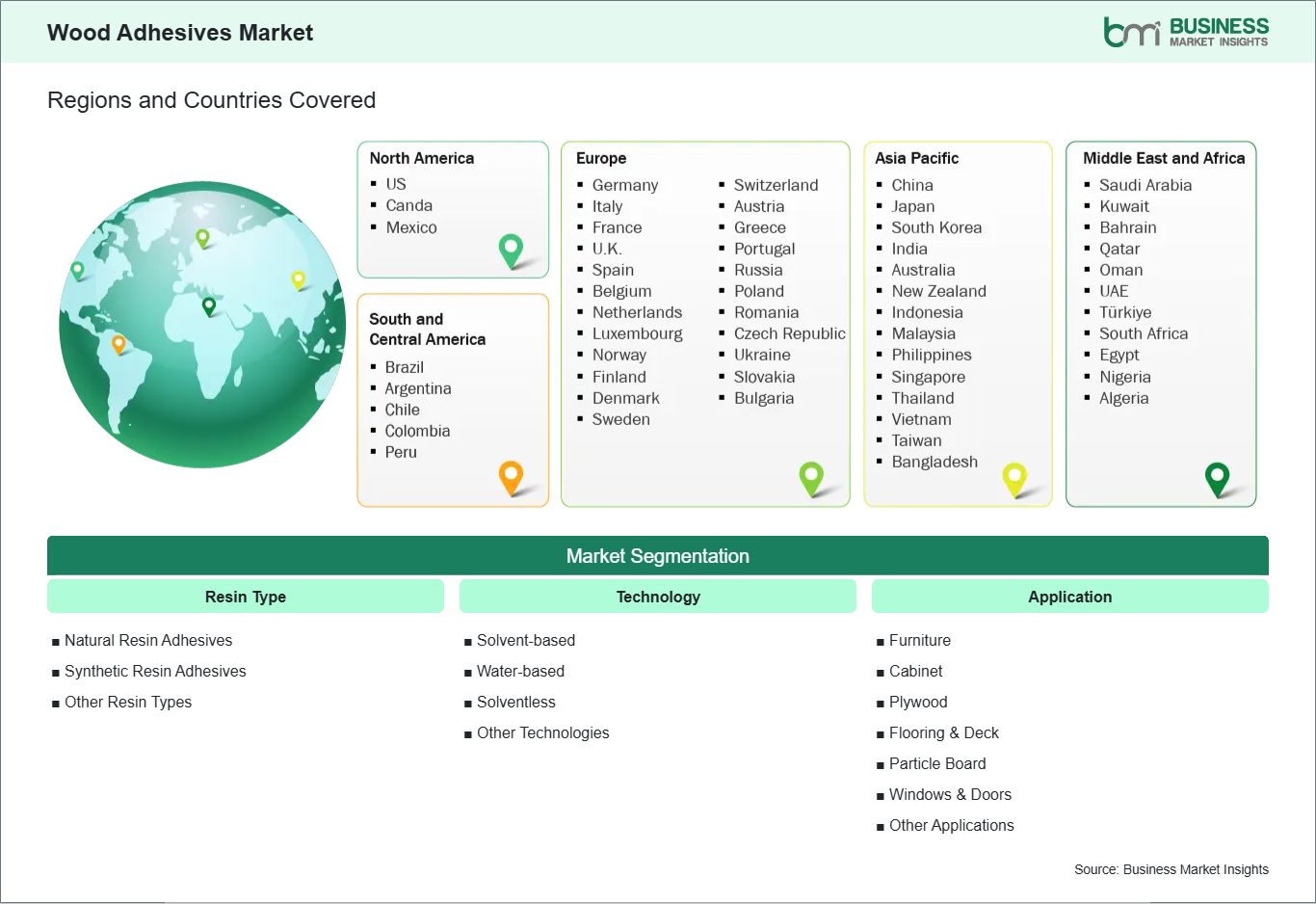
  • Resin Type (Natural Resin Adhesives, Synthetic Resin Adhesives, Other Resin Types)
  • Technology (Solvent-based, Water-based, Solventless, Other Technologies)
  • Application (Furniture, Cabinet, Plywood, Flooring & Deck, Particle Board, Windows & Doors, Other Applications)

No. of Pages: 415
Report Code: BMIPUB00034647
Category: Chemicals and Materials
Wood Adhesives Market

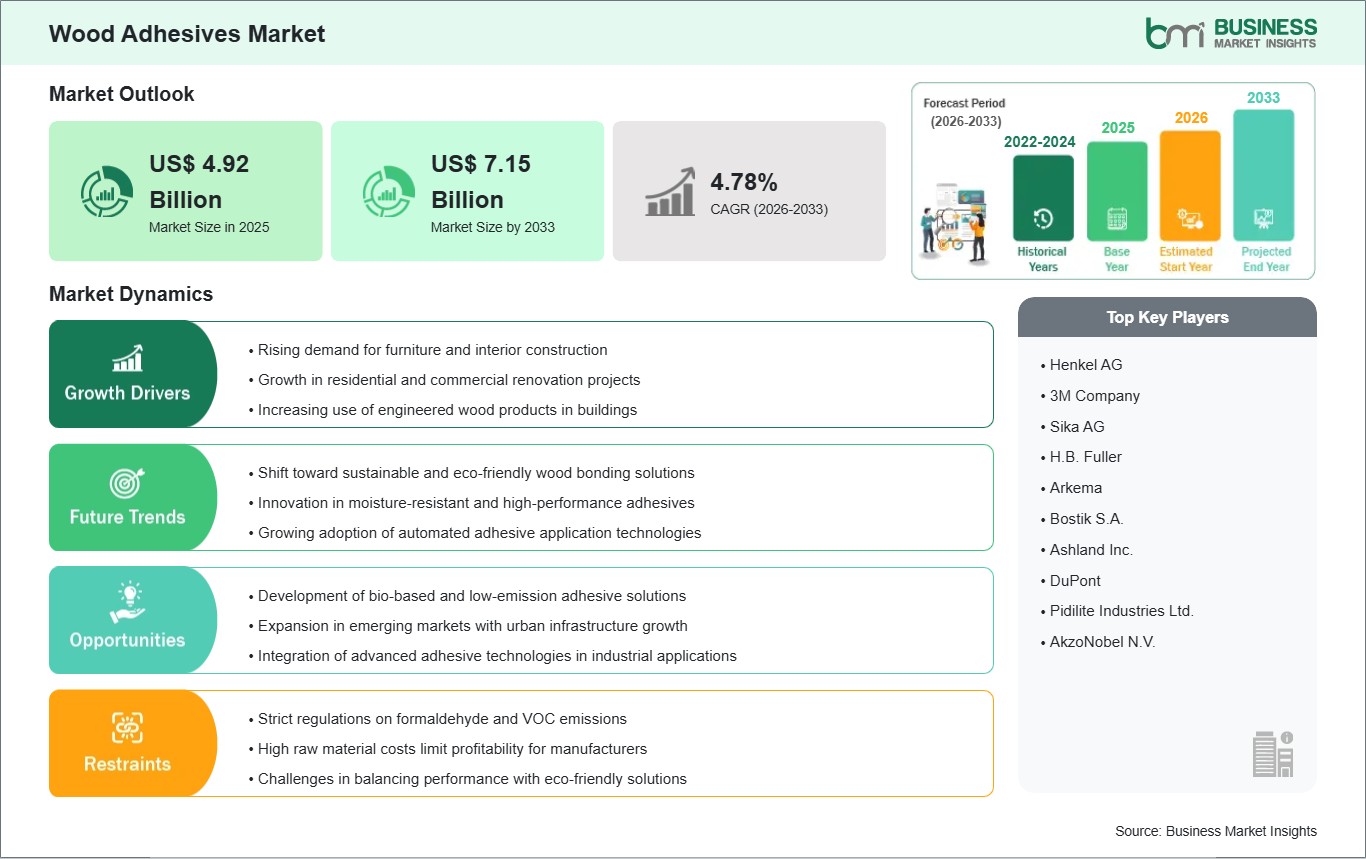
The Wood Adhesives Market size is expected to reach US$ 7.15 billion by 2033 from US$ 4.92 billion in 2025. The market is estimated to record a CAGR of 4.78% from 2026 to 2033.

Executive Summary and Global Market Analysis:

The world market for wood adhesives mainly relies on polymer-based bonding products, which manufacturers create to connect wooden materials and engineered wood items used in residential, commercial and industrial buildings. Wood adhesives serve as essential materials for producing furniture and cabinetry, flooring, plywood, particleboard and all engineered wood products. The performance characteristics of these materials, which include strong bond strength, moisture resistance, rapid curing and long-term durability, make these materials essential for achieving quality and safety and sustainability standards that various industries across the globe require. The market includes multiple adhesive technologies, which contain formaldehyde-based resins and polymer emulsions and polyurethane systems and specialty bio-based adhesives to provide customers with different performance levels and pricing options to meet their manufacturing needs.

The worldwide market operates because construction projects continue to require wood products and engineered timber products for residential buildings, commercial spaces and interior design purposes. Manufacturers adopt high-performance adhesives, which enable them to create aesthetically pleasing wood applications that withstand extended use because customers and businesses want sustainable products. The wood adhesives market has grown because North America, Europe and the Asia Pacific have experienced an increase in renovation activities, whereas wood adhesives provide essential bonding solutions which extend product life and improve performance. The market experiences positive drivers. However, the market encounters environmental restrictions and regulatory requirements that limit its growth potential. The adhesive industry has faced increased scrutiny of its traditional adhesive technologies, which use formaldehyde-based resins, because of their negative impact on indoor air quality and emissions.

The market for low-emission and bio-based adhesive systems has received increased investment. However, the market faces difficulties that require businesses to achieve optimal performance while managing their expenses. Manufacturers encounter additional obstacles because of supply chain changes and difficulties in obtaining raw materials and variations in polymer feedstock prices, which hinder their ability to deliver products with uniform quality at affordable rates. Sustainable innovation, together with worldwide wood product demand, creates a stable future for the wood adhesives market, which operates worldwide.

Wood Adhesives Market - Strategic Insights:

global-market-strategic-framework
Get more information on this report

Wood Adhesives Market Segmentation Analysis:

Key segments that contributed to the derivation of the wood adhesives market analysis are resin type, technology and application.

  • By resin type, the wood adhesives market is segmented into natural resin adhesives, synthetic resin adhesives, other resin types. The natural resin adhesives segment dominated the market in 2025.
  • Based on technology, the wood adhesives market is categorized into solvent‑based, water‑based, solventless, other technologies. The water‑based segment dominated the market in 2025.
  • In terms of application, the wood adhesives market is categorized into furniture, cabinet, plywood, flooring & deck, particle board, windows & doors, other applications. The furniture segment dominated the market in 2025.

Wood Adhesives Market Drivers and Opportunities:

Rising demand for furniture and interior construction

The global wood adhesives market experiences major growth because residential and commercial sectors show increasing demand for furniture and interior construction needs... Wood adhesives serve as vital bonding agents that create permanent connections for cabinetry, flooring, paneling and decorative wooden elements to maintain their strength and appearance. Consumers and businesses in North America and Europe prefer high-performance adhesives that comply with environmental regulations and provide long-term protection for their furniture and interior design components.

Asia Pacific has emerged as a key growth region because of rapid urbanization and rising middle-class populations, together with extensive housing development projects, which drive furniture manufacturing and interior construction activities. Advanced adhesives, which provide better moisture protection, improved structural strength and faster assembly for engineered wood products, have been adopted by manufacturers in China, India and Southeast Asia. The demand for urban housing in South and Central America has led to the development of affordable, efficient bonding solutions that help local furniture and interior design markets.

The trend extends to specialized sectors such as automotive and office interiors, which demand strong and durable yet safe adhesive solutions. High-quality wood adhesives see constant demand because people worldwide continue to repair and redesign their spaces. The growing demand for attractive indoor spaces, together with durable functioning products and regulatory compliance, drives furniture and interior construction to become the primary factor that drives the international wood adhesives market while creating new product development and market expansion opportunities in essential global regions.

Development of bio-based and low-emission adhesive solutions

A major global opportunity in the wood adhesives market lies in the development and commercialization of bio-based and low-emission adhesive solutions. Rising environmental awareness and stricter regulations on VOCs and formaldehyde emissions are motivating manufacturers to innovate safer, more sustainable products. Europe and North America lead in adopting low-emission adhesives, with companies introducing bio-based and formaldehyde-free solutions for furniture, flooring, and engineered wood applications.

Emerging markets also offer considerable potential. In Asia Pacific, urban expansion and industrial growth encourage manufacturers to integrate eco-friendly adhesive solutions into large-scale furniture and construction projects, balancing environmental compliance with high-performance requirements. Similarly, South America and parts of the Middle East are gradually exploring sustainable alternatives to traditional adhesives, driven by both government incentives and market preferences for greener products.

Advancements in chemical formulations now allow bio-based adhesives to achieve comparable bond strength and durability to conventional options, enabling broader application in wood products. The shift toward environmentally responsible adhesives not only addresses regulatory and safety concerns but also enhances brand value and market competitiveness. As sustainability becomes a global priority, bio-based and low-emission adhesives represent a significant growth avenue, shaping the long-term trajectory of the wood adhesives market across all regions.

Wood Adhesives Market Size and Share Analysis:

The wood adhesives market demonstrates steady growth, with size and share analysis highlighting evolving trends and competitive dynamics among key players. The report examines subsegments categorized within resin type, technology and application, offering insights into their contribution to overall market performance.

By resin type, the natural resin adhesives subsegment dominated the market in 2025, driven by growing demand for sustainable, biodegradable, and eco-friendly adhesive solutions.

Based on technology, the water‑based subsegment dominated the market in 2025, driven by increasing preference for low-VOC, environmentally safe, and regulation-compliant adhesives.

In terms of application, the furniture subsegment dominated the market in 2025, driven by high consumption of wood adhesives in furniture manufacturing due to strong global demand and production growth.

Wood Adhesives Market Report Highlights:

Report Attribute Details
Market size in 2025 US$ 4.92 Billion
Market Size by 2033 US$ 7.15 Billion
Global CAGR (2026 - 2033)4.78%
Historical Data 2022-2024
Forecast period 2026-2033
Segments Covered By Resin Type
  • Natural Resin Adhesives
  • Synthetic Resin Adhesives
  • Other Resin Types
By Technology
  • Solvent-based
  • Water-based
  • Solventless
  • Other Technologies
By Application
  • Furniture
  • Cabinet
  • Plywood
  • Flooring & Deck
  • Particle Board
  • Windows & Doors
  • Other Applications
Regions and Countries Covered
North America US, Canada, Mexico
Europe Belgium, Austria, Finland, Denmark, Greece, Poland, Romania, Russia, Ukraine, Czech Republic, Slovakia, Bulgaria, Italy, Luxembourg, Germany, Switzerland, France, Netherlands, Norway, Portugal, Spain, Sweden, United Kingdom
Asia-Pacific Australia, China, India, Japan, South Korea, Indonesia, Malaysia, Philippines, Singapore, Thailand, Vietnam, Bangladesh, New Zealand, Taiwan
South and Central America Brazil, Argentina, Peru, Chile, Colombia
Middle East and Africa Bahrain, Kuwait, Oman, Qatar, Saudi Arabia, United Arab Emirates, Turkiye, South Africa, Egypt, Algeria, Nigeria
Market leaders and key company profiles
  • Henkel AG
  • 3M Company
  • Sika AG
  • H.B. Fuller
  • Arkema
  • Bostik S.A.
  • Ashland Inc.
  • DuPont
  • Pidilite Industries Ltd.
  • AkzoNobel N.V.
Get more information on this report

Wood Adhesives Market Report Coverage and Deliverables:

The "Wood Adhesives Market Size and Forecast (2022 - 2033)" report provides a detailed analysis of the market covering below areas:

  • Wood Adhesives Market size and forecast at global, regional, and country levels for all the key market segments covered under the scope
  • Wood Adhesives Market trends, as well as drivers, restraints, and opportunities
  • Wood Adhesives Market analysis covering key trends, global and regional framework, major players, regulations, and recent developments
  • Industry landscape and competition analysis covering market concentration, heat map analysis, prominent players, and recent developments for the Wood Adhesives Market
  • Detailed company profiles, including SWOT analysis

Wood Adhesives Market Geographic Insights:

The geographical scope of the Wood Adhesives Market report is divided into North America, Asia Pacific, Europe, Middle East & Africa, and South & Central America. North America held the largest share in 2025.

North America dominates the global Wood Adhesives market because its wood products industry has developed fully, while construction and renovation processes operate at high levels, and environmental laws require businesses to use environmental-friendly adhesives that produce minimal emissions. The United States and Canada maintain their need for advanced formaldehyde-free and polyurethane-based adhesives, which furniture, cabinetry, flooring and engineered wood products use because these adhesives provide sustainable solutions with long-lasting performance.

Europe functions as a highly regulated market which utilizes advanced technology because Germany, France and the U.K. require eco-friendly bio-based materials and low-VOC adhesives to meet their strict emissions regulations while helping the furniture, construction and automotive industries.

Asia Pacific experiences active residential and commercial construction development, which especially affects China, India and Southeast Asia because these countries require affordable and flexible adhesive products that work with plywood and particleboard, MDF and laminated materials. The manufacturers develop high-performance adhesives that maintain their effectiveness under humidity and temperature changes because they need to satisfy the various climate and application needs that exist in this region. Infrastructure development, together with industrial woodworking and furniture manufacturing activities, which serve as the main drivers of the Middle East and Africa market, create demand that centers on three countries: the UAE, Saudi Arabia, and South Africa.

The region experiences growth because it imports advanced adhesive technologies and uses modern engineered wood products, even though regulatory agencies maintain less control than they do in North America and Europe. Urbanization, together with housing development, which drives furniture production, creates business opportunities in Brazil, Mexico, and Argentina, where companies choose local adhesive solutions that balance performance and cost. North America leads all regions in developing new technologies and meeting environmental standards while implementing advanced adhesive systems, but other areas of the world display different patterns as they grow their industrial base and adapt to new regulatory requirements while fulfilling various customer needs, which produces an interconnected but different wood adhesives market that exists across the globe.

global-market-geography
Get more information on this report

Wood Adhesives Market Research Report Guidance:

  • The report includes qualitative and quantitative data in the Wood Adhesives Market across resin type, technology, application and geography.
  • The report starts with the key takeaways (chapter 2), highlighting key trends and outlook of the Wood Adhesives Market.
  • Chapter 3 focuses on the research methodology of the study.
  • Chapter 4 includes ecosystem analysis.
  • Chapter 5 highlights the major industry dynamics in the Wood Adhesives Market, including factors that are driving the market, prevailing deterrents, potential opportunities, as well as future trends. Impact analysis of these drivers and restraints is also covered in this section.
  • Chapter 6 discusses the Wood Adhesives Market scenario, in terms of historical market revenues, and forecast till the year 2033.
  • Chapters 7 to 10 cover Wood Adhesives Market segments by resin type, technology, application and geography across North America, Asia Pacific, Europe, Middle East & Africa, and South & Central America. They cover the market revenue forecast and factors driving the market.
  • Chapter 11 describes the competitive analysis along with the heat map analysis for the key players operating in the market.
  • Chapter 12 describes the industry landscape analysis. It provides detailed descriptions of business activities such as market initiatives, new developments, mergers, and joint ventures globally, along with a competitive landscape.
  • Chapter 13 provides detailed profiles of the major companies operating in the Wood Adhesives Market. Companies have been profiled on the basis of their key facts, business descriptions, products, financial overview, SWOT analysis, and key developments.
  • Chapter 14, i.e., the appendix, is inclusive of a brief overview of the company, a list of abbreviations, and a disclaimer.

Wood Adhesives Market News and Key Development:

The Wood Adhesives Market is evaluated by gathering qualitative and quantitative data post primary and secondary research, which includes important corporate publications, association data, and databases. A few of the key developments in the wood adhesives market are:

  • In November 2023, Henkel announced the launch of its first bio‑based PUR wood adhesives, designed for load‑bearing timber construction, introducing Loctite HB S ECO and Loctite CR 821 ECO. These new engineered wood adhesive formulations significantly reduce CO₂ emissions compared to conventional fossil‑based versions and are positioned to support more sustainable timber construction projects worldwide.
  • In February 2026, Henkel and Sekab announced a strategic collaboration to accelerate the use of bio‑based chemicals in industrial adhesive production, targeting the replacement of traditional fossil‑based ethyl acetate with fossil‑free, bio‑based alternatives. This partnership underscores an industry shift toward sustainable raw materials that can be used in adhesive formulations, including wood adhesive applications.

Key Sources Referred:

  • World Health Organization (WHO)
  • Organisation for Economic Cooperation and Development (OECD)
  • The World Bank Group
  • Worldometer
  • The Lancet
  • International Bar Association
  • International Trade Administration
The List of Companies - Wood Adhesives Market
  • Henkel AG
  • 3M Company
  • Sika AG
  • H.B. Fuller
  • Arkema
  • Bostik S.A.
  • Ashland Inc.
  • DuPont
  • Pidilite Industries Ltd.
  • AkzoNobel N.V.
Frequently Asked Questions
How big is the Wood Adhesives Market?

The Wood Adhesives Market is valued at US$ 4.92 Billion in 2025, it is projected to reach US$ 7.15 Billion by 2033.

What is the CAGR for Wood Adhesives Market by (2026 - 2033)?

As per our report Wood Adhesives Market, the market size is valued at US$ 4.92 Billion in 2025, projecting it to reach US$ 7.15 Billion by 2033. This translates to a CAGR of approximately 4.78% during the forecast period.

What segments are covered in this report?

The Wood Adhesives Market report typically cover these key segments-

  • Resin Type (Natural Resin Adhesives, Synthetic Resin Adhesives, Other Resin Types)
  • Technology (Solvent-based, Water-based, Solventless, Other Technologies)
  • Application (Furniture, Cabinet, Plywood, Flooring & Deck, Particle Board, Windows & Doors, Other Applications)

What is the historic period, base year, and forecast period taken for Wood Adhesives Market?

The historic period, base year, and forecast period can vary slightly depending on the specific market research report. However, for the Wood Adhesives Market report:

  • Historic Period : 2022-2024
  • Base Year : 2025
  • Forecast Period : 2026-2033
  • Who are the major players in Wood Adhesives Market?

    The Wood Adhesives Market is populated by several key players, each contributing to its growth and innovation. Some of the major players include:

  • Henkel AG
  • 3M Company
  • Sika AG
  • H.B. Fuller
  • Arkema
  • Bostik S.A.
  • Ashland Inc.
  • DuPont
  • Pidilite Industries Ltd.
  • AkzoNobel N.V.
  • Who should buy this report?

    The Wood Adhesives Market report is valuable for diverse stakeholders, including:

    • Investors: Provides insights for investment decisions pertaining to market growth, companies, or industry insights. Helps assess market attractiveness and potential returns.
    • Industry Players: Offers competitive intelligence, market sizing, and trend analysis to inform strategic planning, product development, and sales strategies.
    • Suppliers and Manufacturers: Helps understand market demand for components, materials, and services related to concerned industry.
    • Researchers and Consultants: Provides data and analysis for academic research, consulting projects, and market studies.
    • Financial Institutions: Helps assess risks and opportunities associated with financing or investing in the concerned market.

    Essentially, anyone involved in or considering involvement in the Wood Adhesives Market value chain can benefit from the information contained in a comprehensive market report.

    Available Report Formats

    pdf-format excel-format pptx-format
    Buy Now
    Sales Assistance
    +1 646 791 7070 (US & UK)
    Customization Form

    Please tell us your area of interest
    (Market Segments/ Regions and Countries/ Companies)