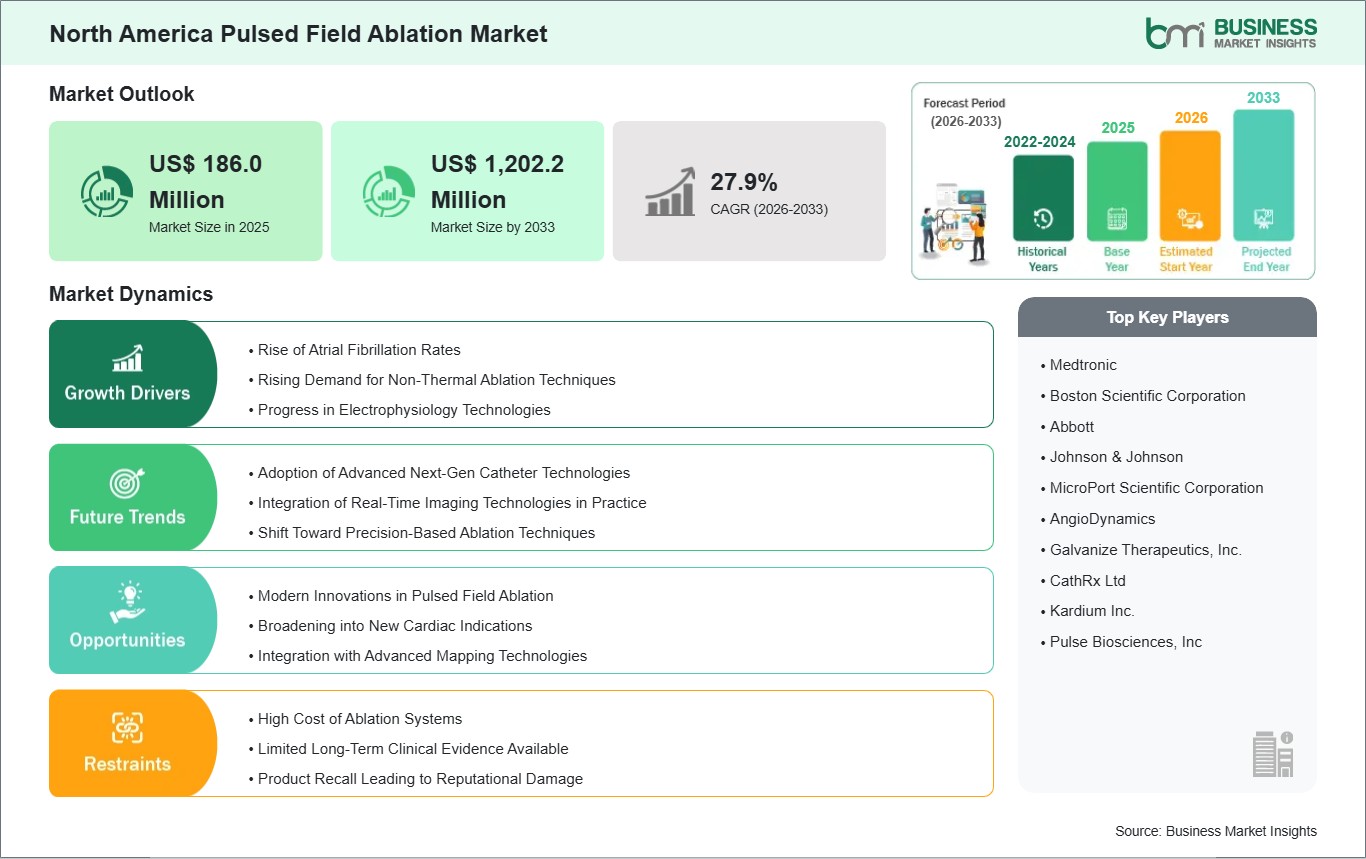
The North America pulsed field ablation market size is expected to reach US$ 1,202.2 million by 2033 from US$ 186.0 million in 2025. The market is estimated to register a CAGR of 27.9% from 2026 to 2033.
The North America pulsed field ablation Market is at the cutting edge of cardiovascular innovations, fueled by the superior health care system of North America, which prioritizes minimally invasive cardiovascular procedures. The increasing number of people suffering from conditions such as atrial fibrillation has boosted demand for treatment options that provide a degree of precision and safety, along with minimizing surgical complications. PFA fulfills the criteria since it provides a tissue-selective and non-thermal procedure that selectively destroys unhealthy heart tissues without damaging any healthy tissue, thus reducing the risk of complications.
Several factors contribute to the growth of the North America pulsed field ablation market, including widespread adoption of the latest electrophysiology labs, imaging modalities, and high-resolution mapping tools. There has been growing expertise among clinicians in conducting PFA-based procedures, along with the support of early clinical trials and pilot studies. Partnerships between healthcare institutions and medical device manufacturers have played an important role in boosting technology adoption. Despite strong growth potential, adoption is tempered by high costs associated with PFA systems and consumables, as well as the need for highly trained electrophysiologists. Smaller hospitals or centers with limited infrastructure may face barriers in implementing the technology. North America’s commitment to innovation, strong healthcare reimbursement policies, and a culture of early adoption of advanced cardiac therapies position the region as a global leader in PFA adoption, setting benchmarks in safety, procedural efficiency, and clinical outcomes.

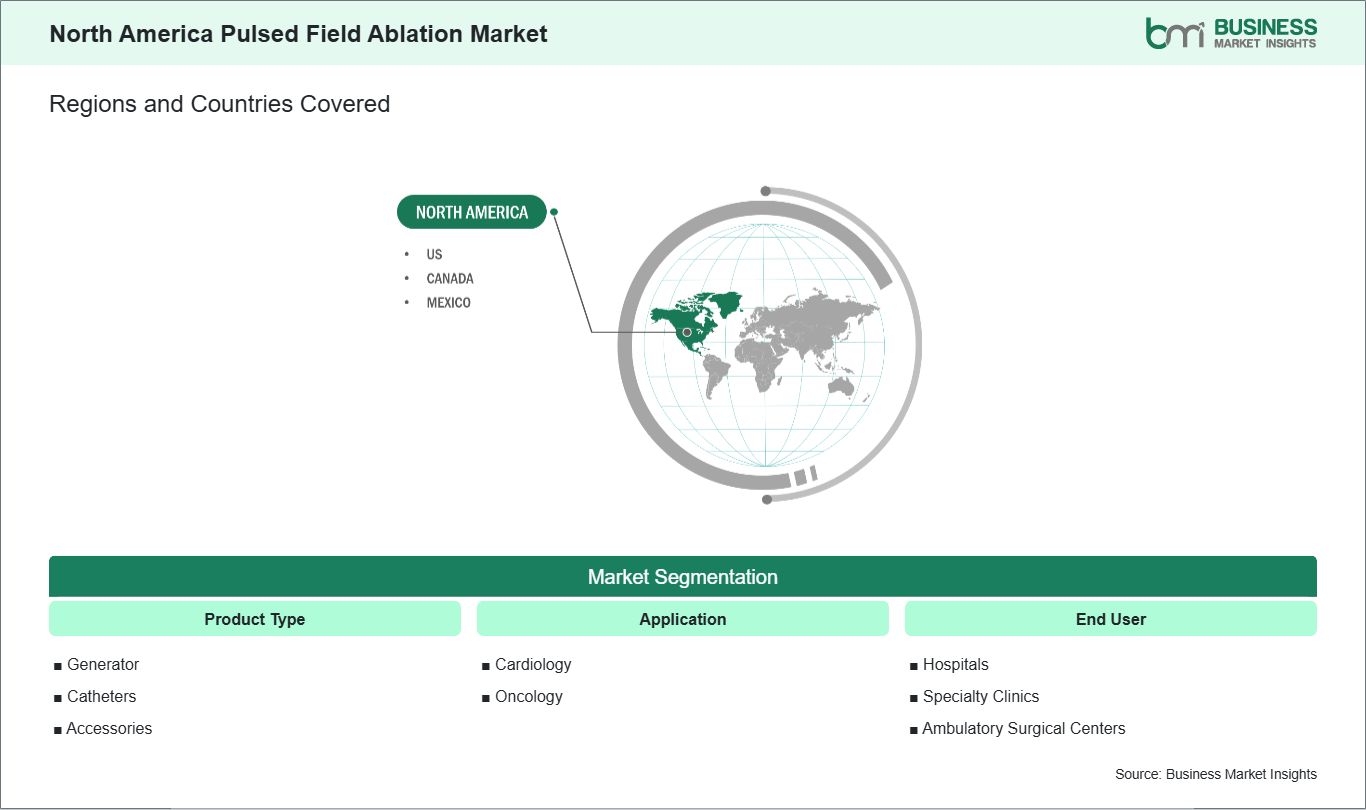
Key segments that contributed to the derivation of the North America pulsed field ablation market analysis are product type, application, and end user.
Atrial fibrillation (AFib) is increasingly a focal point of cardiovascular care in North America, driven by aging populations and shifting lifestyle factors. Clinicians are encountering more patients with irregular heart rhythms during routine wellness checks and cardiology referrals. Primary care physicians are more vigilant about screening for rhythm abnormalities, particularly among adults over 60, which has amplified the number of diagnoses entering electrophysiology pathways. Patients are also more informed about AFib risks, such as stroke and heart failure and are actively discussing therapeutic options with their care teams.
Lifestyle trends in North America, including a higher prevalence of obesity and metabolic syndrome, continue to shape the clinical landscape surrounding AFib. Individuals with sedentary work patterns, combined with diet‑related risk factors, are presenting with arrhythmia symptoms earlier than in past decades, prompting earlier intervention. Cardiologists are adapting to these shifts by recommending catheter‑based therapies sooner, especially in patients where medication alone offers limited symptom control.
As rates of AFib increase, there will be an increasing need for more sophisticated intervention procedures such as pulsed field ablation (PFA). Electrophysiologists at various top heart centers are beginning to include PFA in their range of services because of its promise of being selective when it comes to tissue and minimizing procedure-related risks. The variety of clinical settings from which these numbers emerge represents the active response of a North American market to AFib.
Pulsed field ablation technologies have seen fast progress in North America, where there has been a distinct trend towards developing highly precise devices. The first users of PFA devices were found in big cities such as New York, Toronto, and Los Angeles. They use these devices in their electrophysiology laboratories due to the clinicians’ desire for methods that will focus on the atrial tissues without affecting other parts of the body.
Modern systems for PFA provide more sophisticated catheter control, optimized energy delivery curves, and better real-time visualization capabilities. Physicians practicing cardiology in the US and Canada are using them in order to simplify the procedure of pulmonary vein isolation, which is essential for the procedure of AFib ablation. Combining PFA and cardiac mapping technology significantly helped physicians perform the procedure in a safe and reliable way. This innovation appeals greatly to physicians in North America due to its safety and reliability aspects.
Beyond hardware, software innovations, including lesion prediction algorithms and cloud‑based procedural analytics, are shaping how PFA is practiced in North America. Training and professional exchange through regional electrophysiology societies have accelerated adoption and helped clinicians refine techniques. As a result, pulsed field ablation is increasingly perceived not just as an alternative to thermal methods but as a core component of modern AFib care, reflecting the broader North American emphasis on innovation, evidence generation, and patient‑centric outcomes.

The North America pulsed field ablation market demonstrates steady growth, with size and share analysis highlighting evolving trends and competitive dynamics among key players. The report evaluates important subsegments categorized within product type, application, and end user, highlighting their respective contributions to overall market performance.
By product type, the catheters subsegment dominated the market in 2025. Catheter devices offer improved procedural efficiency, reduced risk of complications, and real-time control for electrophysiologists, making them a crucial component for effective PFA therapy and a key revenue driver for manufacturers.
In terms of application, the cardiology subsegment dominated the market in 2025. The leadership of cardiology applications is attributed to the rising prevalence of atrial fibrillation and other cardiac arrhythmias, growing preference for non-thermal and tissue-selective ablation techniques, and increasing awareness among healthcare providers about the clinical benefits of PFA.
Based on end user, the hospitals subsegment dominated the market in 2025. Hospitals maintain a stronghold due to their established cardiology and electrophysiology departments, access to advanced PFA systems, trained physicians and clinical staff, and the capability to perform specialized cardiac procedures with comprehensive patient monitoring and post-procedure care.
| Report Attribute | Details |
|---|---|
| Market size in 2025 | US$ 186.0 Million |
| Market Size by 2033 | US$ 1,202.2 Million |
| CAGR (2026 - 2033) | 27.9% |
| Historical Data | 2022-2024 |
| Forecast period | 2026-2033 |
| Segments Covered | By Product Type
|
|
Regions and Countries Covered
| |
| North America | US, Canada, Mexico |
| Market leaders and key company profiles |
|
The "North America Pulsed Field Ablation Market Size and Forecast (2022–2033)" report provides a detailed analysis of the market covering below areas:
The geographical scope of the North America Pulsed Field Ablation market report is divided into: The US, Canada, and Mexico. The US held the largest share in 2025.
The US plays a dominant role in the development of the North American pulsed field ablation industry owing to its well-developed healthcare sector, high incidence of heart arrhythmias among the population, and prompt application of innovative medical devices. Pulsed field ablation technology, which implies non-thermal ablation without affecting surrounding tissues, is highly efficient in treating the condition compared to traditional thermal procedures, thus being especially relevant in terms of clinical effectiveness.
Clinics in the US implement advanced systems for diagnosing cardiac arrhythmia, as well as modern electrophysiology laboratories, ensuring efficient integration of the procedure within the treatment framework. In addition, there are many opportunities for acquiring additional professional skills and cooperation between medical practitioners and manufacturers of pulsed field devices. However, the relatively high cost of the procedure and uneven distribution of experts specializing in electrophysiology might present barriers to the use of the new technology in rural clinics. The leading role of the US in the implementation of pulsed field ablation can be explained by its innovative culture, efficient financing policies, and early adoption of innovative devices. The country is capable of setting the pace for the region as it creates benchmarks in terms of adopting the procedure.

The North America pulsed field ablation market is evaluated by gathering qualitative and quantitative data post primary and secondary research, which includes important corporate publications, association data, and databases. A few of the key developments in the North America pulsed field ablation market are:
The North America Pulsed Field Ablation Market is valued at US$ 186.0 Million in 2025, it is projected to reach US$ 1,202.2 Million by 2033.
As per our report North America Pulsed Field Ablation Market, the market size is valued at US$ 186.0 Million in 2025, projecting it to reach US$ 1,202.2 Million by 2033. This translates to a CAGR of approximately 27.9% during the forecast period.
The North America Pulsed Field Ablation Market report typically cover these key segments-
The historic period, base year, and forecast period can vary slightly depending on the specific market research report. However, for the North America Pulsed Field Ablation Market report:
The North America Pulsed Field Ablation Market is populated by several key players, each contributing to its growth and innovation. Some of the major players include:
The North America Pulsed Field Ablation Market report is valuable for diverse stakeholders, including:
Essentially, anyone involved in or considering involvement in the North America Pulsed Field Ablation Market value chain can benefit from the information contained in a comprehensive market report.
Please tell us your area of interest
(Market Segments/ Regions and Countries/ Companies)