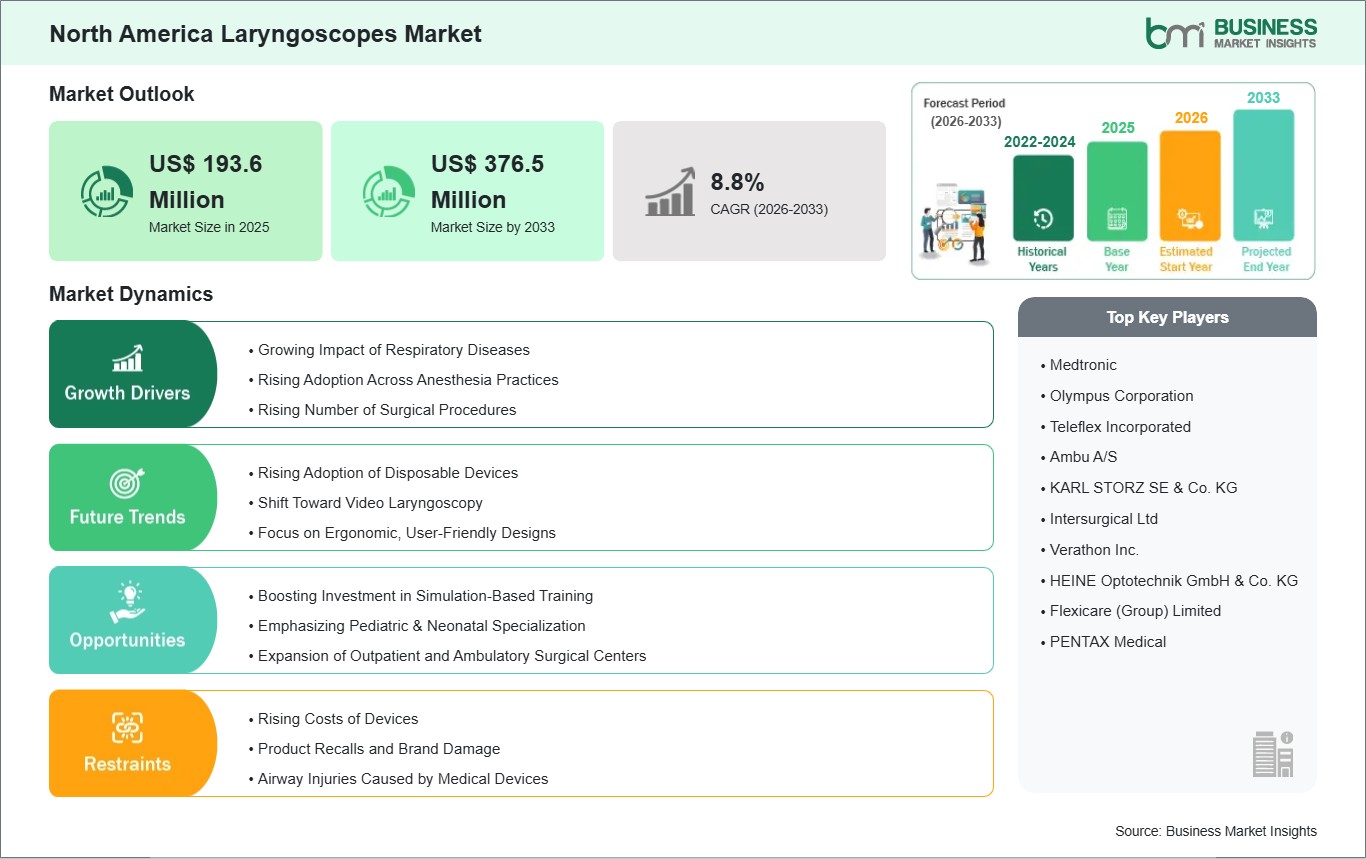
The North America laryngoscopes market size is expected to reach US$ 376.5 million by 2033 from US$ 193.6 million in 2025. The market is estimated to record a CAGR of 8.8% from 2026 to 2033.
The North America laryngoscopes market is characterized by state-of-the-art airway management techniques, robust clinical standards, and fast adoption of visual-based intubation devices. There is extensive usage of both traditional and video-integrated laryngoscopes in North America, where the preference for video laryngoscopy has emerged as an accepted technique in operating theaters, accident and emergency departments, and intensive care units. This is mainly due to the demand for better initial intubation success rates, greater patient safety, and lower risk of complications. The trend towards standardized airway management procedures in hospitals and surgical clinics in North America is aiding the adoption of sophisticated laryngoscope instruments.
The growing incidence of respiratory ailments, airway issues due to obesity, and the escalating number of surgeries and emergencies create a greater need for airway visualization instruments. The presence of robust healthcare systems and the timely adoption of novel medical equipment further drive the market growth. Nevertheless, the market growth is impeded by the somewhat expensive nature of cutting-edge video laryngoscopes, as well as the continuous need for education and experience with their use, especially in smaller healthcare facilities. The consistent focus on patient safety and operational efficiency maintains a healthy demand for these products in the region.

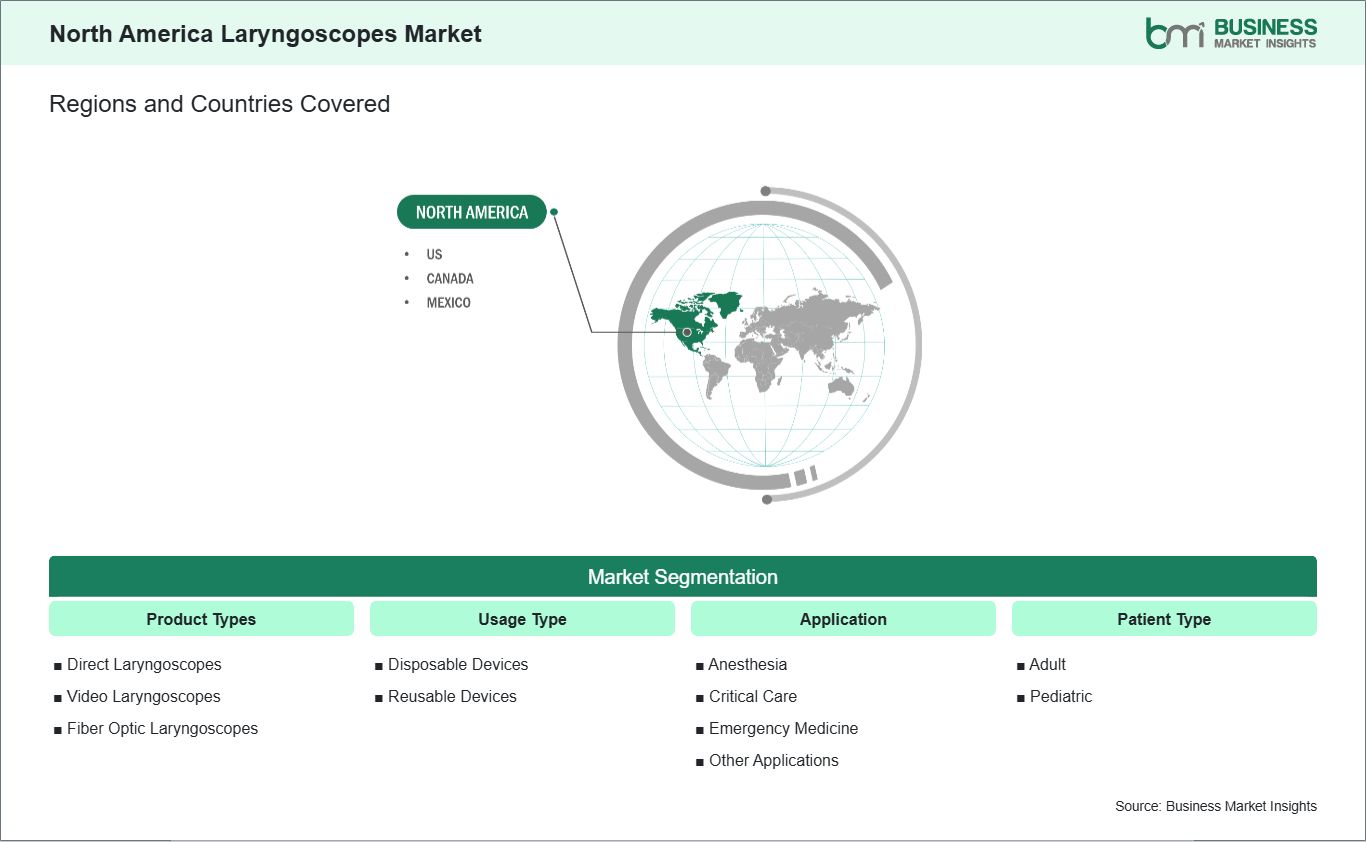
Key segments that contributed to the derivation of the North America laryngoscopes market analysis are product type, usage type, application, patient type, and end user.
North America continues to face a growing burden of respiratory diseases, largely influenced by urban air quality, aging populations, and lifestyle-related risk factors. In major metropolitan areas such as New York, Los Angeles, Toronto, and Mexico City, persistent exposure to vehicle emissions and industrial pollutants contributes to higher rates of asthma and chronic obstructive pulmonary disease (COPD). These conditions often escalate into acute respiratory distress, increasing the need for emergency airway interventions where laryngoscopes are essential in clinical practice.
Respiratory ailments continue to pose significant problems in the long term within both the United States and Canada. Chronic obstructive pulmonary disease continues to be among the most prevalent causes of admissions into hospitals, especially those who are older and have histories of either smoking or chronic exposure to pollutants. In the United States, there has been a significant level of asthma prevalence, especially within industrialized cities, necessitating repeat visits to the emergency room for airway management.
Environmental and demographic factors continue to make the provision of respiratory services necessary within North America. Exposure to seasonal wildfires in western Canada and the United States has led to respiratory distress in the population, while older populations in both regions have increased susceptibility to pneumonia and respiratory distress following surgery. Together with an increased admission rate in ICUs due to respiratory problems, these factors have continued to increase reliance on laryngoscope services.
North American healthcare systems are increasingly investing in simulations-based training programs in order to enhance their medical professionals' proficiency in performing their duties and providing safe patient care. Major hospitals in the US and Canada are constructing sophisticated simulation facilities that would provide practitioners with opportunities to rehearse their intubation skills in a simulated and secure environment.
This purchase is closely associated with the region's focus on the standardization of emergency and critical care procedures. The simulation exercises are incorporated into the anesthesia and emergency medicine residencies. Consequently, residents become familiar with both conventional and video laryngoscopy devices. In other words, the use of laryngoscopes during simulation training allows for an adequate level of familiarity with the devices employed in medical practice.
Moreover, hospitals in North America are gradually introducing the standardization of simulation training in accordance with the equipment and workflow in hospitals. Therefore, the close connection between simulation training and clinical practice minimizes the discrepancies between the skills obtained by clinicians during training and those required in emergency situations, especially when patients are admitted to ICUs and traumatology departments.
The North America Laryngoscopes market demonstrates steady growth, with size and share analysis highlighting evolving trends and competitive dynamics among key players. The report evaluates important subsegments categorized within product type, usage type, application, patient type, and end user, highlighting their respective contributions to overall market performance.
By product type, the video laryngoscopes subsegment dominated the laryngoscopes market in 2025. This is driven by the increasing demand for enhanced airway visualization, improved first-pass intubation success rates, and reduced complications in difficult airway management, making them a key revenue driver for manufacturers and supporting strong adoption in clinical practice.
In terms of usage type, the disposable devices subsegment led the market in 2025. The dominance of disposable devices is attributed to the growing emphasis on infection control, prevention of cross-contamination, and the operational convenience of eliminating reprocessing and sterilization requirements in high-volume healthcare settings.
Based on application, the anesthesia subsegment held the largest share in 2025. Hospitals and surgical centers widely rely on laryngoscopes during anesthesia procedures for airway management and intubation, supported by the rising number of surgeries and the increasing use of advanced airway management techniques.
In terms of patient type, the adult subsegment dominated the market in 2025. This is driven by the higher prevalence of surgical procedures, critical care admissions, and chronic respiratory conditions among adults, resulting in greater demand for airway management devices in this population group.
By end user, the hospitals subsegment held the largest share in 2025. Hospitals maintain leadership due to their advanced infrastructure, availability of skilled healthcare professionals, high patient inflow, and strong capability to perform complex surgical and emergency procedures requiring laryngoscopy.
| Report Attribute | Details |
|---|---|
| Market size in 2025 | US$ 193.6 Million |
| Market Size by 2033 | US$ 376.5 Million |
| CAGR (2026 - 2033) | 8.8% |
| Historical Data | 2022-2024 |
| Forecast period | 2026-2033 |
| Segments Covered | By Product Types
|
|
Regions and Countries Covered
| |
| North America | US, Canada, Mexico |
| Market leaders and key company profiles |
|
The "North America Laryngoscopes Market Size and Forecast (2022-2033)" report provides a detailed analysis of the market covering below areas:
The geographical scope of the North America Laryngoscopes market report is divided into: The US, Canada, and Mexico. The US held the largest share in 2025.
The US is a dominant player in the laryngoscopes market in North America, owing to its robust healthcare infrastructure, large number of hospitals, and focus on utilizing sophisticated clinical equipment. The use of video laryngoscopes is gaining momentum among hospitals and emergency care facilities in the US, with the devices being used not only in difficult cases of intubation but also routinely in many operations and intensive care units. The increased use of laryngoscopes is part of the growing trend of visualization-based airway management.
There is also the issue of enhanced country leadership due to high surgical case numbers, good trauma centers, and proper training programs, which ensure that doctors are familiar with the latest airway products. It has been observed that large hospitals and medical centers usually tend to become the first buyers of any new device, hence setting procurement trends for other hospitals within their countries. In addition, considerations relating to the costs of these items and hospital standardization have made it necessary to adopt both reusable and single-use laryngoscopes. The United States leads the growth in this regional market due to these reasons.

The North America Laryngoscopes market is evaluated by gathering qualitative and quantitative data post primary and secondary research, which includes important corporate publications, association data, and databases. A few of the key developments in the North America Laryngoscopes market are:
The North America Laryngoscopes Market is valued at US$ 193.6 Million in 2025, it is projected to reach US$ 376.5 Million by 2033.
As per our report North America Laryngoscopes Market, the market size is valued at US$ 193.6 Million in 2025, projecting it to reach US$ 376.5 Million by 2033. This translates to a CAGR of approximately 8.8% during the forecast period.
The North America Laryngoscopes Market report typically cover these key segments-
The historic period, base year, and forecast period can vary slightly depending on the specific market research report. However, for the North America Laryngoscopes Market report:
The North America Laryngoscopes Market is populated by several key players, each contributing to its growth and innovation. Some of the major players include:
The North America Laryngoscopes Market report is valuable for diverse stakeholders, including:
Essentially, anyone involved in or considering involvement in the North America Laryngoscopes Market value chain can benefit from the information contained in a comprehensive market report.
Please tell us your area of interest
(Market Segments/ Regions and Countries/ Companies)