Market Summary
Executive Summary and Market Analysis
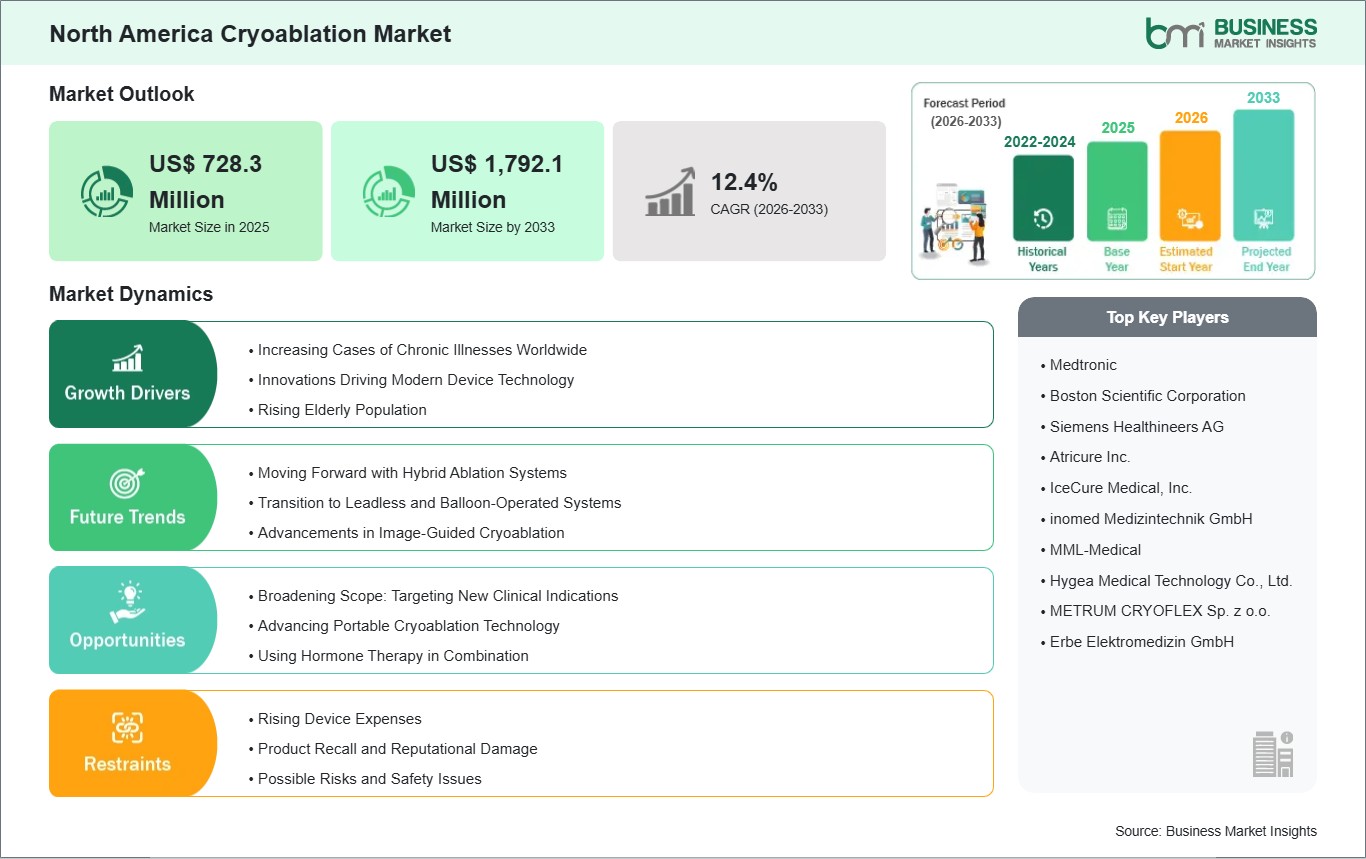
The North America cryoablation market is highly developed and technologically advanced, reflecting the region’s strong focus on minimally invasive therapeutic interventions. Cryoablation is widely used in cardiology, particularly for the management of complex arrhythmias, as well as in oncology for selected tumor ablations where precision and tissue preservation are critical. Market growth is driven by extensive hospital networks, well-established interventional cardiology and oncology programs, and high clinician familiarity with advanced procedural techniques. The preference for therapies that reduce patient recovery time, minimize complications, and integrate with outpatient care models further supports the adoption of cryoablation.
Despite the favorable environment, the market faces certain challenges. Procedural costs and the investment required for high-end cryoablation systems can limit access in smaller or rural hospitals. Additionally, competition from alternative ablation technologies, such as radiofrequency and microwave systems, continues to influence clinician preference and procedural selection. Regulatory processes and the need for ongoing professional training also affect adoption rates. Nevertheless, extensive healthcare infrastructure, proactive clinical education programs, and a strong culture of innovation collectively reinforce North America’s position as a leading and receptive market for cryoablation procedures.
Segment Analysis
North America Cryoablation Market Segmentation
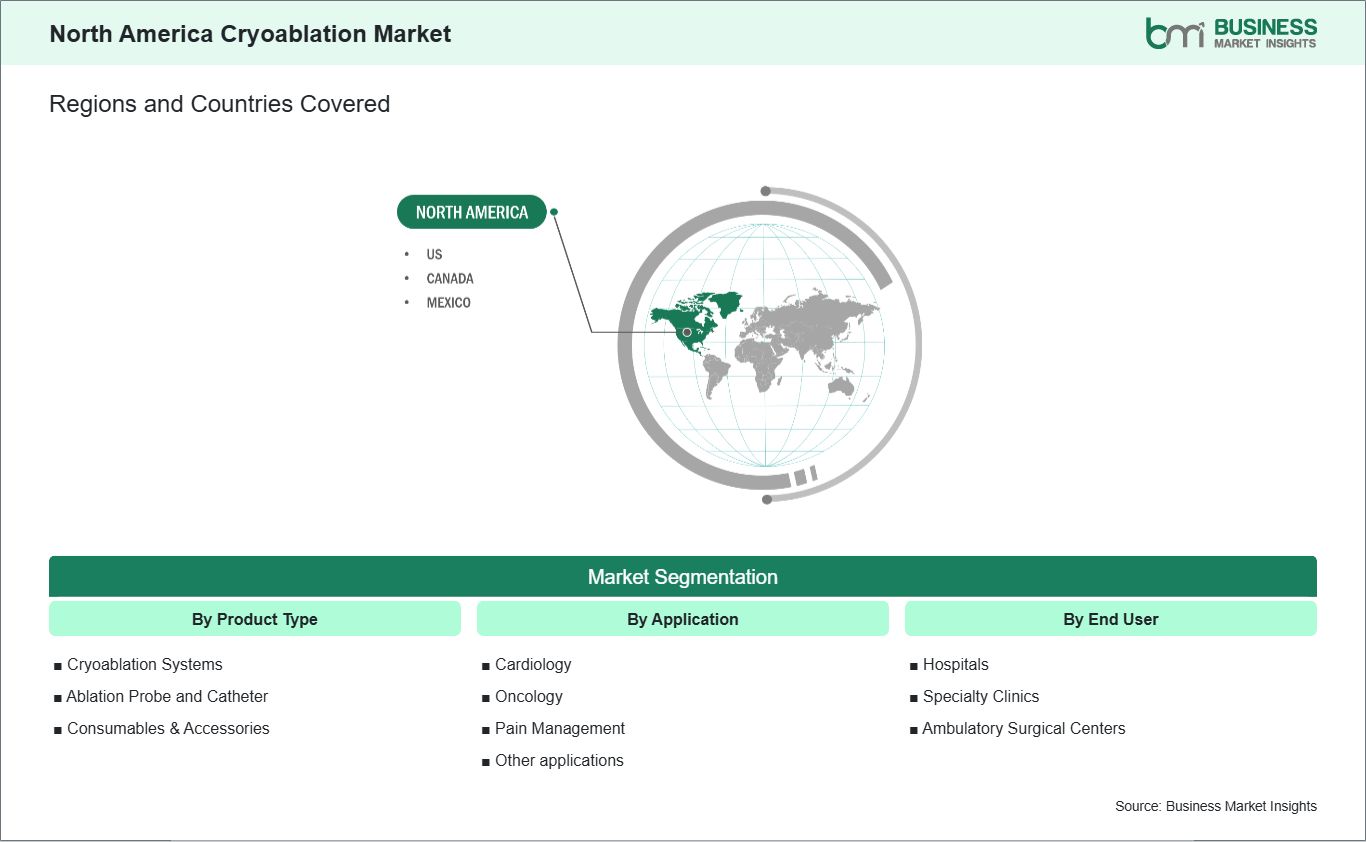
Key segments that contributed to the derivation of the North America cryoablation market analysis are product type, application, and end user.
- By product type, the cryoablation market is segmented into cryoablation systems, ablation probes and catheters, and consumables & accessories. The ablation probe and catheter segment dominated the market in 2025.
- Based on application, the cryoablation market is classified into cardiology, oncology, pain management, and other applications. The oncology segment dominated the market in 2025.
- In terms of end user, the cryoablation market is categorized into hospitals, specialty clinics, and ambulatory surgical centers. The hospitals segment dominated the market in 2025.
Market Forces
North America Cryoablation Market Drivers and Opportunities
Increasing Cases of Chronic Illnesses Worldwide
North America continues to face a growing burden of chronic health conditions that are driving clinical demand for advanced interventional therapies such as cryoablation. Cardiovascular disorders, particularly those requiring rhythm management and structural interventions, remain a prominent focus in cardiac care programs throughout the United States and Canada. Leading heart centers are integrating cryoablation technologies into electrophysiology suites to improve procedural outcomes and offer alternatives to more invasive surgical approaches.
Oncology care in North America is also evolving, with cancer centers and multidisciplinary clinics exploring locoregional therapies that complement systemic treatments. Cryoablation is being considered in the therapeutic mix for select solid tumors because of its minimally invasive profile and potential to target tumors while sparing adjacent healthy tissue. This makes it particularly appealing in settings where patients are seeking options with reduced recovery times compared to traditional surgery.
Beyond cardiac and oncological needs, aging populations and rising prevalence of chronic metabolic and degenerative conditions are increasing procedural volumes in tertiary care hospitals and specialty clinics. Providers are responding by broadening chronic disease management pathways and investing in technologies like cryoablation that can be applied across multiple specialties. As clinicians become more familiar with the clinical benefits, referral patterns are shifting, and cryoablation is gaining wider acceptance as part of comprehensive care strategies in North American health systems.
Broadening Scope: Targeting New Clinical Indications
Cryoablation use in North America is extending beyond its traditional applications into a wider array of clinical indications. Pain management is one such emerging area, where specialists in interventional pain clinics and multidisciplinary care programs are evaluating cryoablation for targeted relief of chronic and neuropathic pain. This diversification helps meet patient demand for minimally invasive options that can provide lasting relief without the need for more extensive surgical intervention.
Structural and soft‑tissue applications are also gaining traction, particularly in hospitals equipped with high‑resolution imaging and advanced procedural support. Clinicians are applying cryoablation techniques to address benign lesions and other localized conditions that are challenging to treat with conventional methods. These newer uses are helping institutions expand their service portfolios and attract referrals from both community providers and regional specialists.
Partnerships between device manufacturers and North American healthcare organizations are playing a key role in expanding clinical adoption. Collaborative training programs, procedural workshops, and clinical exchange initiatives are helping practitioners develop the skills needed to deploy cryoablation in emerging indications confidently. This ecosystem of clinical education and technology support is strengthening cryoablation’s position as a flexible therapeutic platform, capable of addressing an expanding range of clinical needs across the United States and Canada.
Size and Share Analysis
North America Cryoablation Market Size and Share Analysis
The North America cryoablation market demonstrates steady growth, with size and share analysis highlighting evolving trends and competitive dynamics among key players. The report evaluates important subsegments categorized within product type, application, and end user, highlighting their respective contributions to overall market performance.
By product type, the ablation probe and catheter subsegment dominated the market in 2025. This is driven by the recurring need for precise and reliable probes and catheters during cryoablation procedures, essential for effective freezing and destruction of targeted tissues, making them a key revenue driver for manufacturers and ensuring consistent demand in clinical settings.
In terms of application, the oncology subsegment dominated the market in 2025. The leadership of oncology applications is attributed to the rising incidence of cancer cases, growing preference for minimally invasive tumor ablation techniques, and increasing awareness among healthcare providers about the effectiveness of cryoablation in treating liver, kidney, prostate, and other solid tumors.
Based on end user, the hospitals subsegment dominated the market in 2025. Hospitals maintain a stronghold due to their well-established oncology and surgical departments, access to advanced cryoablation equipment, trained interventional radiologists and staff, and the capability to perform complex procedures with comprehensive patient care.
Report Coverage
North America Cryoablation Market Report Coverage and Deliverables
The "North America Cryoablation Market Size and Forecast (2022–2033)" report provides a detailed analysis of the market covering below areas:
- North America Cryoablation market size and forecast at regional and country levels for all market segments covered under the scope
- North America Cryoablation market trends, as well as drivers, restraints, and opportunities
- North America Cryoablation market analysis covering key trends, regional framework, major players, regulations, and recent developments
- Industry landscape and competition analysis covering market concentration, heat map analysis, prominent players, and recent developments for the North America Cryoablation market
- Detailed company profiles, including SWOT analysis
Geographic Insights
North America Cryoablation Market Geographic Insights
The geographical scope of the North America cryoablation market report is divided into: The US, Canada, and Mexico. The US held the largest share in 2025.
The US dominates the North American cryoablation market due to its advanced healthcare system, concentration of specialized hospitals, and leadership in clinical innovation. Major cardiac and oncology centers have integrated cryoablation into routine treatment protocols for complex arrhythmias and select tumor interventions, supported by state-of-the-art catheterization laboratories and advanced imaging technologies. Clinician expertise is strengthened through structured training programs, professional societies, and collaborations with medical device manufacturers, ensuring safe and effective procedural adoption. Multidisciplinary care teams work closely to optimize patient outcomes and procedural efficiency. Patient demand for minimally invasive therapies has also encouraged hospitals to expand cryoablation services and develop dedicated interventional units. While procedural costs and access disparities between urban and rural hospitals remain considerations, the US continues to set the benchmark for technological adoption, procedural innovation, and clinical best practices in the cryoablation market across North America.
Industry Activity
Recent Developments
The North America cryoablation market is evaluated by gathering qualitative and quantitative data post primary and secondary research, which includes important corporate publications, association data, and databases. A few of the key developments in the North America cryoablation market are:
- In February 2026, IceCure Medical announced that Thomas Hospital of Infirmary Health in Alabama installed the ProSense system, becoming the first hospital in the state to offer breast cancer cryoablation, marking further clinical adoption in the U.S. healthcare landscape.
- In December 2025, IceCure Medical announced that it expected to report record fourth‑quarter sales in North America driven by heightened demand for its ProSense cryoablation system and disposable cryoprobes following the recent FDA clearance for low‑risk breast cancer, with installations expanding at leading U.S. medical institutions.
- In October 2025, IceCure Medical announced that the U.S. Food and Drug Administration (FDA) granted marketing authorization for its ProSense cryoablation system for the local treatment of early‑stage, low‑risk breast cancer in women aged 70 and above, making it the first cryoablation device authorized in the U.S. for this indication.
Trust & Transparency
Research Methodology
The market analysis combines proprietary research with secondary data from government agencies, company disclosures, regulatory filings, industry databases and expert interviews. Market estimates are validated through data triangulation, cross-market benchmarking and analyst
review.
View Full Research Methodology
Key Sources Referred:
The World Bank World Health Organization (WHO) Center for Disease Control and Prevention (CDC) Food and Drug Administration (FDA) European Database on Medical Devices (EUDAMED) European Society of Cardiology (ESC) American College of Cardiology (ACC) American Heart Association (AHA) Company Websites Company Annual Reports Company Investor Presentations