Market Summary
Executive Summary and Global Market Analysis
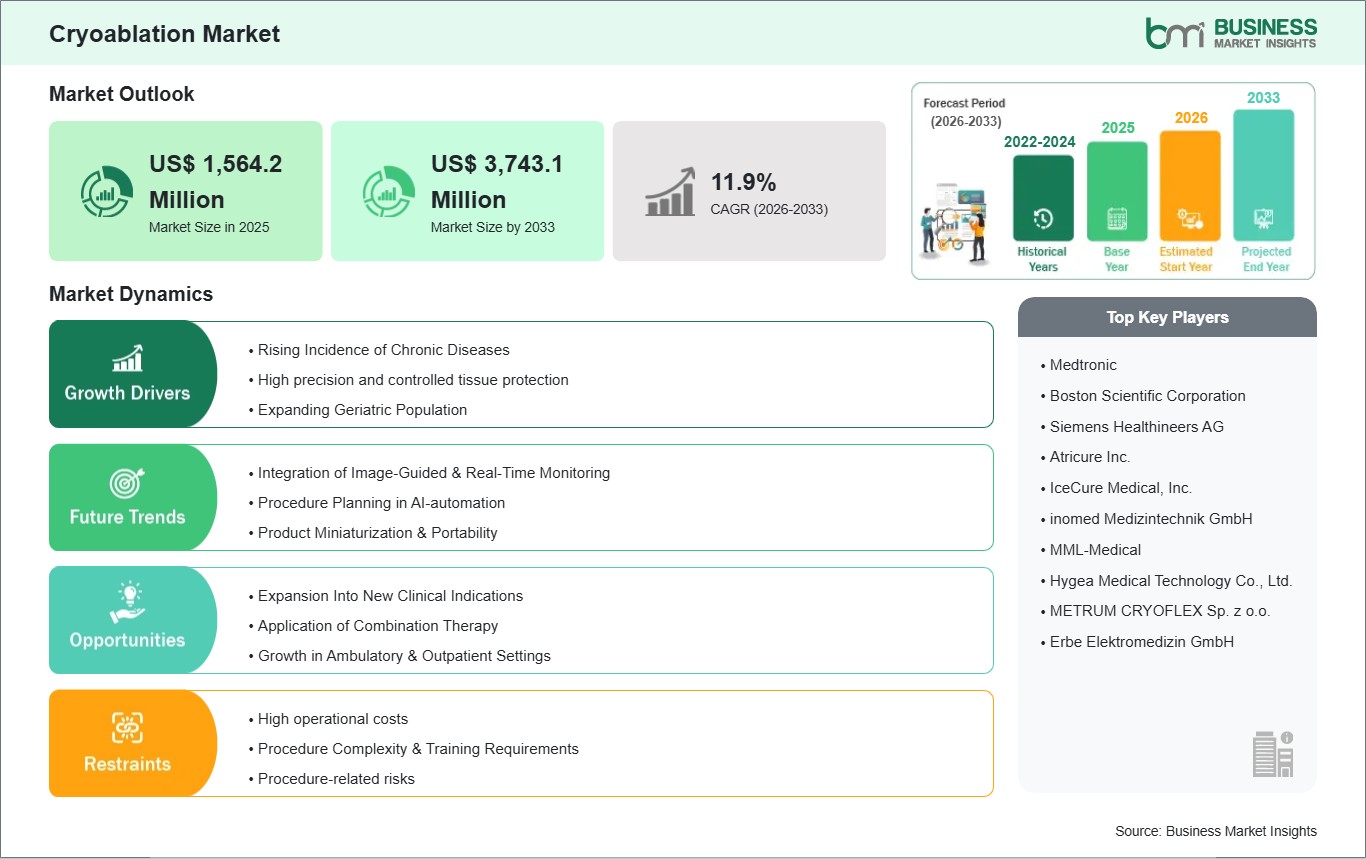
The cryoablation market has expanded recently as healthcare providers embrace minimally invasive therapies for treating a range of medical conditions. Cryoablation—which uses extreme cold to destroy abnormal tissues—has gained traction across oncology, cardiology, and pain management because of its precision, reduced procedural risk, and the potential for quicker patient recovery compared with traditional surgical interventions. Key drivers fueling market growth include rising prevalence of conditions treated with ablation, growing physician familiarity with cryoablation techniques, and continuous improvements in device technology that enhance clinical accuracy and safety. As physician education and patient awareness increase, so does market acceptance, particularly in developed healthcare systems where specialized centers routinely incorporate advanced energy‑based ablation into treatment pathways.
High capital expenditure required for cryoablation equipment acts as a barrier for smaller hospitals and clinics with limited budgets. Additionally, specialized training is necessary for optimal device operation, making adoption slower in regions with a shortage of skilled interventionalists. In some emerging markets, a lack of awareness and restricted access to advanced procedural technologies also pose challenges. Nonetheless, continued innovation and broader integration into multidisciplinary treatment strategies support the long‑term outlook of the global cryoablation market.
Segment Analysis
Cryoablation Market Segmentation
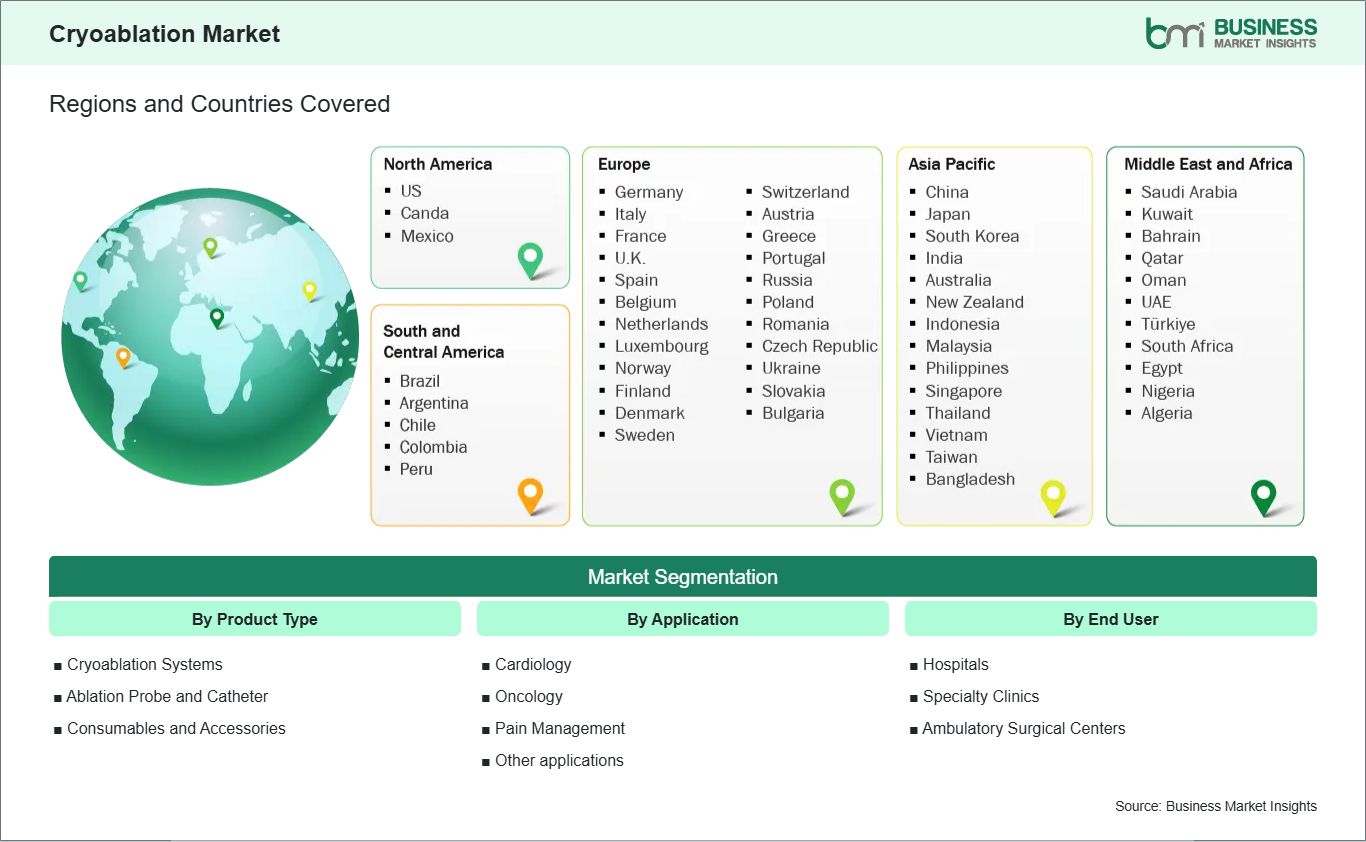
Key segments that contributed to the derivation of the Cryoablation market analysis are product type, application, and end user.
- By product type, the Cryoablation market is segmented into cryoablation systems, ablation probes and catheters, and consumables & accessories. The ablation probe and catheter segment dominated the market in 2025.
- Based on application, the Cryoablation market is classified into cardiology, oncology, and pain management. The oncology segment dominated the market in 2025.
- In terms of end user, the Cryoablation market is categorized into hospitals, specialty clinics, and ambulatory surgical centers. The hospitals segment dominated the market in 2025.
Market Forces
Cryoablation Market Drivers and Opportunities
Rising Incidence of Chronic Diseases
As more patients are diagnosed with tumors such as prostate, kidney, and liver cancers, clinicians are seeking minimally invasive alternatives to conventional surgery that reduce procedural risk and recovery time. Cryoablation offers precise targeting of diseased tissue while preserving surrounding healthy structures, making it a preferred choice for early-stage and complex cases.
Cardiovascular diseases, including arrhythmias such as atrial fibrillation, are also treated with cryoablation. The ability to safely isolate problematic cardiac tissue with controlled freezing has made the procedure an attractive option for patients who may not be suitable candidates for more invasive interventions. As a result, hospitals and clinics are incorporating cryoablation more widely into their standard care pathways for both oncology and cardiology patients.
The growing prevalence of chronic diseases has encouraged multidisciplinary collaboration in treatment planning. Patients are benefiting from combined strategies, where cryoablation is integrated with other therapies to optimize outcomes. This trend is driving a steady expansion of cryoablation procedures in both established and emerging healthcare settings worldwide.
Expansion into New Clinical Indications
Cryoablation is applied to a broader range of clinical indications beyond its traditional uses. In oncology, its application is expanding to tumors in challenging or sensitive locations, including bone lesions, lung tumors, and recurrent cancers. This versatility allows physicians to offer treatment options for patients who may not tolerate conventional surgery or other ablation methods.
In cardiology, the scope of cryoablation continues to grow, with applications extending to complex arrhythmias and structural heart conditions. Its precise, controlled freezing capabilities make it suitable for delicate procedures where minimizing collateral damage is critical. The adoption of cryoablation in these clinical scenarios is helping to improve patient outcomes while reducing recovery time and procedural risk.
Ongoing technological developments, such as improved imaging guidance and energy control systems, are enabling clinicians to tailor cryoablation treatments to individual patient needs. This ability to customize procedures enhances the safety and effectiveness of the therapy and contributes to its broader acceptance across a wide range of medical specialties.
Size and Share Analysis
Cryoablation Market Size and Share Analysis
The cryoablation market is experiencing steady growth, with market size and share analysis reflecting evolving treatment preferences and competitive dynamics among key players. The report evaluates important subsegments categorized within product type, application, and end user, highlighting their respective contributions to overall market performance.
By product type, the ablation probe and catheter subsegment dominated the market in 2025. This is driven by the recurring need for precise and reliable probes and catheters during cryoablation procedures, which are essential for effective freezing and destruction of targeted tissues, making them a key revenue driver for manufacturers and ensuring consistent demand in clinical settings.
In terms of application, the oncology subsegment dominated the market in 2025. The leadership of oncology applications is attributed to the rising incidence of cancer cases, growing preference for minimally invasive tumor ablation techniques, and increasing awareness among healthcare providers about the effectiveness of cryoablation in treating liver, kidney, prostate, and other solid tumors.
Based on end user, the hospitals subsegment dominated the market in 2025. Hospitals maintain a stronghold due to their well-established oncology and surgical departments, access to advanced cryoablation equipment, trained interventional radiologists and staff, and the capability to perform complex procedures with comprehensive patient care.
Report Coverage
Cryoablation Market Report Coverage and Deliverables
The "Cryoablation Market Size and Forecast (2022–2033)" report provides a detailed analysis of the market covering below areas:
- Cryoablation market size and forecast at global, regional, and country levels for all the key market segments covered under the scope
- Cryoablation market trends, as well as drivers, restraints, and opportunities
- Cryoablation market analysis covering key trends, regional framework, major players, regulations, and recent developments
- Industry landscape and competition analysis covering market concentration, heat map analysis, prominent players, and recent developments for the Cryoablation market
- Detailed company profiles, including SWOT analysis
Geographic Insights
Cryoablation Market Geographic Insights
The geographical scope of the Cryoablation market report is divided into five regions: North America, Asia Pacific, Europe, Middle East & Africa, and South & Central America. The cryoablation market in North America is expected to grow during the forecast period.
North America remains the dominant global region in the cryoablation market due to a combination of advanced healthcare infrastructure, high adoption of innovative medical technologies, and strong clinical expertise. The presence of well‑established oncology and cardiology treatment centers contributes to market leadership, as these facilities routinely incorporate cryoablation into comprehensive care protocols. In addition, structured physician training programs and early adoption of evidence‑based treatment guidelines have fostered widespread clinical confidence in cryoablation procedures.
Hospitals and specialized clinics in North America benefit from integrated health systems that facilitate coordinated care, enabling multidisciplinary teams to leverage cryoablation as a core therapeutic option for applicable indications. This integration enhances procedural efficiency and supports more seamless patient pathways from diagnosis to treatment and follow‑up. Another factor enabling regional dominance is the focus on research and clinical trials, which helps refine cryoablation applications, expand clinical evidence, and encourage broader acceptance among practitioners. However, the region also faces challenges, including the high cost of acquiring and maintaining advanced cryoablation systems, as well as the need for ongoing investments in clinician training. Despite these barriers, the robust healthcare ecosystem and emphasis on minimally invasive therapies ensure that North America continues to lead the global cryoablation market.
Industry Activity
Recent Developments
The cryoablation market is evaluated by gathering qualitative and quantitative data post primary and secondary research, which includes important corporate publications, association data, and databases. A few of the key developments in the cryoablation market are:
- In March 2025, IceCure Medical Ltd. announced that its ProSense cryoablation technology was featured in six global clinical studies presented at the 19th Annual St. Gallen Breast Cancer Conference in Vienna, with abstracts accepted for peer‑reviewed publication, highlighting broader clinical recognition and adoption of its cryoablation system.
- In February 2025, IceCure Medical Ltd. announced that it filed for regulatory approval with Israel’s Ministry of Health for its next‑generation XSense cryoablation system and CryoProbes, covering indications for which its existing ProSense system is already approved, including oncology, dermatology, thoracic surgery, gynecology, ENT, and urology.
Trust & Transparency
Research Methodology
The market analysis combines proprietary research with secondary data from government agencies, company disclosures, regulatory filings, industry databases and expert interviews. Market estimates are validated through data triangulation, cross-market benchmarking and analyst
review.
View Full Research Methodology
Key Sources Referred:
The World Bank World Health Organization (WHO) Center for Disease Control and Prevention (CDC) Food and Drug Administration (FDA) European Database on Medical Devices (EUDAMED) European Society of Cardiology (ESC) American College of Cardiology (ACC) American Heart Association (AHA) Company Websites Company Annual Reports Company Investor Presentations