Market Summary
Executive Summary and Market Analysis
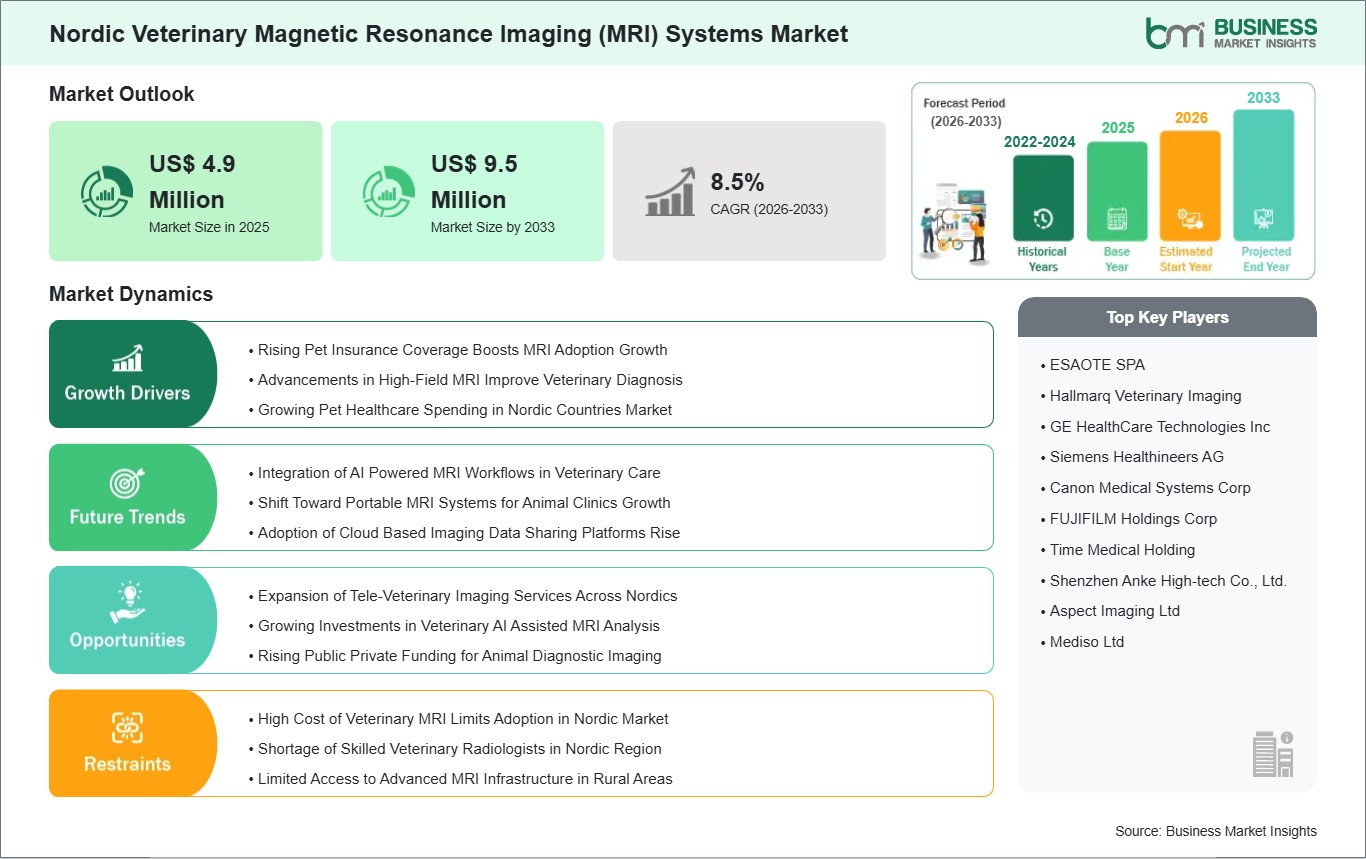
The Nordic Veterinary Magnetic Resonance Imaging (MRI) Systems Market operates as an advanced veterinary diagnostics field within the Nordic region because it first adopted most modern imaging techniques and maintains high standards of animal welfare. The veterinary healthcare systems in Sweden, Denmark, Norway, Finland and Iceland establish an effective structure that medical professionals use to deliver accurate diagnostic services and preventative healthcare solutions. The Nordic region uses its veterinary MRI systems mainly in specialty animal hospitals, university veterinary teaching hospitals and advanced referral centers, which demonstrate the region's commitment to research and clinical development in veterinary medicine. The market grows because the region maintains high veterinary care standards, which exist due to strict animal welfare laws, and people practice responsible pet care. Nordic pet owners show strong dedication to paying for sophisticated diagnostic tests, which leads veterinary clinics to implement high-end imaging systems like MRI for their neurological, musculoskeletal and oncological evaluations. The region develops MRI technology for animal healthcare through its research universities and their clinical programs, which drive both new technology adoption and technology enhancement. The region shows strong growth potential because it possesses advanced technology infrastructure, and its people prefer accurate diagnostic methods. Veterinary clinics in Nordic countries choose high-field MRI systems because these systems provide better imaging results, which help to diagnose difficult medical cases that need precise examination of soft tissue. The region experiences increased MRI system usage because digital veterinary workflows, together with human and veterinary imaging specialists, work together to create better MRI system operations. The present system functions as an environment that enables healthcare facilities to upgrade their imaging systems through new technology adoption at regular intervals. The market has various limitations because the veterinary patient base in this area is smaller than what exists in bigger geographical regions, which leads to reduced MRI system use in all areas except for major cities. The need for MRI machines requires veterinarians to spend large amounts of money, which creates operational challenges that need experts to handle equipment and operate advanced medical technology, who limit access to these resources in small veterinary clinics. The Nordic region has established itself as an innovation-driven market for diagnostic imaging technologies because it maintains strong institutional support and its focus on maintaining veterinary healthcare standards.
Segment Analysis
Nordic Veterinary Magnetic Resonance Imaging (MRI) Systems Market Segmentation
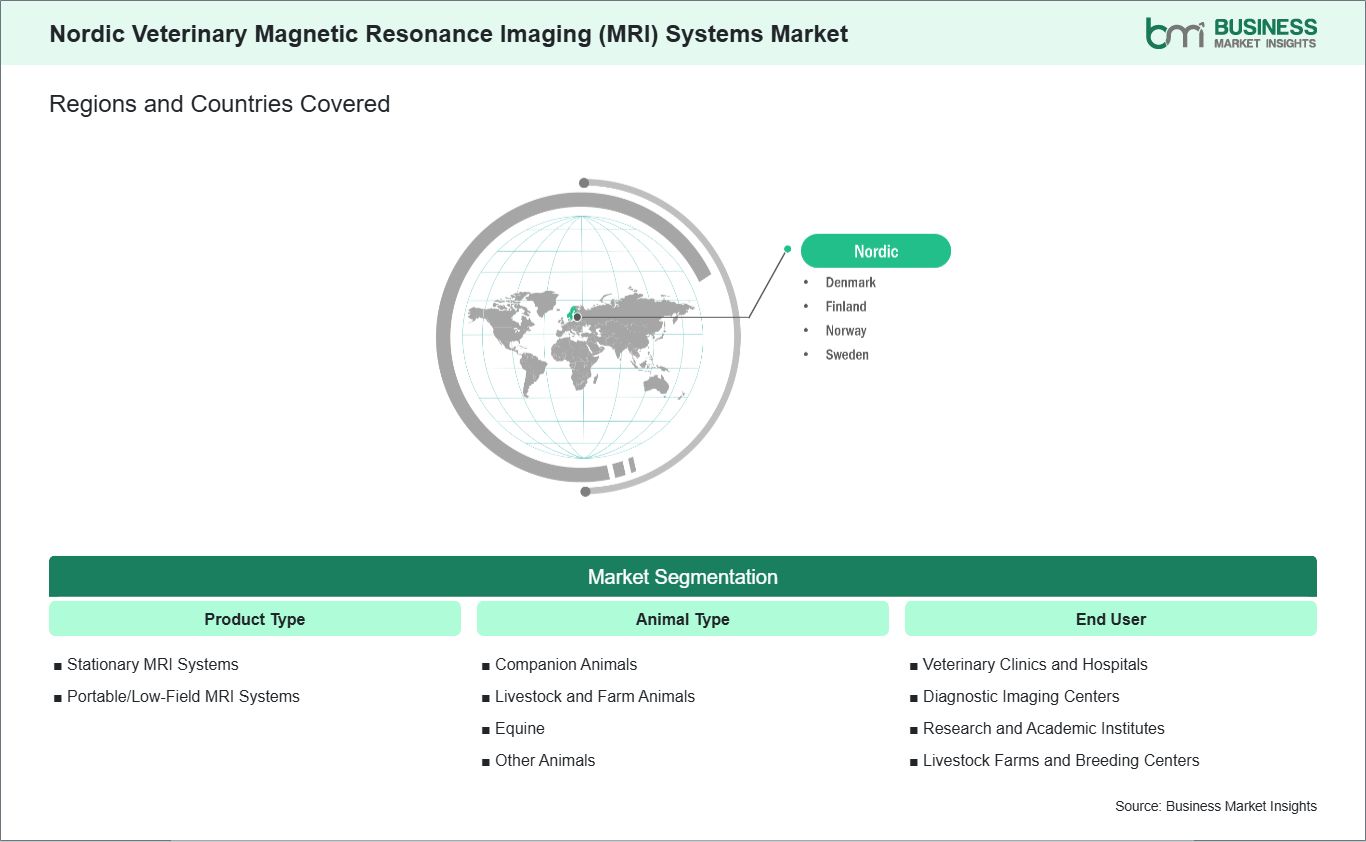
Key segments that contributed to the derivation of the Nordic veterinary magnetic resonance imaging (MRI) systems market analysis are product type, animal type, and end user.
- By product type, the veterinary magnetic resonance imaging (MRI) systems market is segmented into stationary MRI systems, portable/low-field MRI systems. The stationary MRI systems segment dominated the market in 2025.
- Based on animal type, the veterinary magnetic resonance imaging (MRI) systems market is categorized into companion animals, livestock and farm animals, equine, others. The companion animals segment dominated the market in 2025.
- In terms of end user, the veterinary magnetic resonance imaging (MRI) systems market is categorized into veterinary clinics and hospitals, diagnostic imaging centers, research and academic institutes, livestock farms and breeding centers. The veterinary clinics and hospitals segment dominated the market in 2025.
Market Forces
Nordic Veterinary Magnetic Resonance Imaging (MRI) Systems Market Drivers and Opportunities
Rising Pet Insurance Coverage Boosts MRI Adoption Growth
In the Nordic Veterinary MRI systems market, rising pet insurance penetration is significantly accelerating diagnostic imaging adoption. Pet owners in Sweden and Denmark can obtain advanced MRI scans because high companion animal insurance coverage allows them to pursue medical treatment without cost concerns. The trend demonstrates that veterinary hospitals and specialty clinics throughout the region are increasing their use of high-field MRI systems.
Developments in high-field MRI systems technology are helping Nordic veterinary professionals achieve better diagnostic results through enhanced MRI system performance. Norwegian and Finnish clinics are adopting 1.5T and 3T MRI units because these systems provide improved soft tissue imaging capabilities for their complex animal cases, which include orthopedic and neurological disorders. The system improves clinical results while providing high-quality veterinary care.
The deployment of MRI systems in veterinary networks throughout Nordic countries receives support from the increasing spending on companion animal medical services. Pet owners living in urban areas of Stockholm and Copenhagen show increased willingness to pay for advanced diagnostic services, which creates continuous market demand. The trend is driving the growth of dedicated veterinary imaging facilities.
Expansion of Tele-Veterinary Imaging Services Across Nordics
The Nordic region's tele-veterinary imaging service extension creates multiple new growth opportunities for MRI system operations. The veterinary clinics in rural Finland use remote diagnostic technology to work with specialists at Swedish centers to interpret their complex imaging data faster. The process decreases the time required for results while providing better access to specialized MRI knowledge.
The increasing funding for AI-powered veterinary imaging systems in Denmark and Norway operates as a complementary system to the existing tele-MRI services. The cloud-based system enables the sharing of MRI scans, which allows specialists to deliver second opinions without being restricted by location. The system proves especially useful in Nordic areas with low population density, where people cannot reach veterinary radiologist experts.
The Nordic veterinary market will see tele-veterinary imaging technology combine with mobile MRI systems and digital health solutions. The system will enable faster emergency diagnostics for companion animals while improving the cooperation between Stockholm urban hospitals and remote Icelandic and northern Norwegian clinics. The system will create stronger regional diagnostic networks.
Size and Share Analysis
Nordic Veterinary Magnetic Resonance Imaging (MRI) Systems Market Size and Share Analysis
The Nordic veterinary magnetic resonance imaging (MRI) systems market is experiencing steady growth, with market size and share analysis reflecting evolving treatment preferences and competitive dynamics among key players. The report evaluates important subsegments categorized within product type, animal type, and end user, highlighting their respective contributions to market performance.
By product type, the stationary MRI systems subsegment dominated the market in 2025, driven by higher image quality, greater throughput, and widespread adoption in hospitals for comprehensive diagnostic imaging.
Based on animal type, the companion animals subsegment dominated the market in 2025, driven by increasing pet ownership and rising demand for advanced diagnostic imaging in routine veterinary care.
In terms of end user, the veterinary clinics and hospitals subsegment dominated the market in 2025, driven by the widespread adoption of x-ray systems for comprehensive diagnostic and treatment services.
Report Coverage
Nordic Veterinary Magnetic Resonance Imaging (MRI) Systems Market Report Coverage and Deliverables
The "Nordic Veterinary Magnetic Resonance Imaging (MRI) Systems Market Size and Forecast (2022–2033)" report provides a detailed analysis of the market covering below areas:
- Market size and forecast at regional and country levels for all market segments covered under the scope
- Market trends, as well as drivers, restraints, and opportunities
- Market analysis covering key trends, regional framework, major players, regulations, and recent developments
- Market concentration, heat map analysis, prominent players, and recent developments for the Market
- Detailed company profiles, including SWOT analysis
Geographic Insights
Nordic Veterinary Magnetic Resonance Imaging (MRI) Systems Market Geographic Insights
The geographical scope of the Nordic Veterinary Magnetic Resonance Imaging (MRI) Systems Market report is divided into Sweden, Denmark, Norway, and Finland. Sweden held the largest share in 2025.
The Nordic veterinary Magnetic Resonance Imaging (MRI) systems market, which includes Sweden, Denmark, Norway and Finland, shows strong adoption of modern veterinary diagnostic methods and high animal health standards and developed public-private veterinary systems, yet demand remains niche because companion animal numbers in this region are smaller than those in larger European markets. The region experiences growth because pet owners develop stronger emotional bonds with their pets, and companion animals experience increased need for treatment of complex neurological and musculoskeletal disorders, and veterinary professionals deliver precise medical care through their advanced training. The Nordic market is led by Sweden, which has developed a network of veterinary specialty hospitals together with multiple advanced imaging centers and veterinary research partnerships that connect with academic institutions. The nation has developed high-field MRI systems in its referral clinics and university veterinary hospitals, which now provide advanced diagnostic services throughout Stockholm and Uppsala. Sweden maintains its leading position because pet owners display a higher willingness to invest in high-quality diagnostic tests, while a well-structured pet insurance system helps to reduce MRI testing expenses significantly. The Danish market functions as the second biggest market because its advanced veterinary care system, companion animal welfare regulations and increasing private specialty clinic investments generate stronger market performance than Sweden does. Norway maintains continuous economic expansion because its citizens have high disposable income, and the country maintains a strong animal welfare culture while urban veterinary centers develop more advanced imaging technology in Oslo and Bergen. Finland possesses advanced technology, yet its veterinary facilities implement MRI machines at a slower rate because of budget constraints and limited veterinary referral options. Through its specialty centers, Helsinki gradually introduces advanced imaging services to clients. Nordic countries experience growth through their strong veterinary education systems and high diagnostic standards and partnerships with human healthcare imaging providers, but they face challenges because of expensive equipment, restricted case volumes and their need to rely on imported MRI systems. Sweden maintains its position as the Nordic market leader in veterinary MRI systems because of better infrastructure development and greater demand from customers, and its use of advanced veterinary imaging systems for standard medical operations.
Industry Activity
Recent Developments
The Nordic Veterinary Magnetic Resonance Imaging (MRI) Systems Market is evaluated by gathering qualitative and quantitative data post primary and secondary research, which includes important corporate publications, association data, and databases. A few of the key developments in the Nordic veterinary magnetic resonance imaging (MRI) systems market are:
- In July 2025, Time Medical, announced that it had signed a strategic partnership agreement with Hawkcell, to integrate AI-powered imaging software (HawkAI) into veterinary MRI systems across installations in Europe and future systems.
- In February 2025, GE HealthCare, announced the launch of its Freelium MRI platform, designed to significantly reduce helium use in MRI systems, improving sustainability and operational efficiency across global markets including Europe, where veterinary MRI systems are deployed through regional healthcare and veterinary imaging channels.
Trust & Transparency
Research Methodology
The market analysis combines proprietary research with secondary data from government agencies, company disclosures, regulatory filings, industry databases and expert interviews. Market estimates are validated through data triangulation, cross-market benchmarking and analyst
review.
View Full Research Methodology
Key Sources Referred:
American College of Veterinary Radiology (ACVR)World Small Animal Veterinary Association (WSAVA)British Veterinary Association (BVA)International Veterinary Radiology Association (IVRA)American Veterinary Medical Association (AVMA)European College of Veterinary Diagnostic Imaging (ECVDI)World Organisation for Animal Health (WOAH / OIE)Veterinary Imaging & Radiation Oncology Society (VIROS)