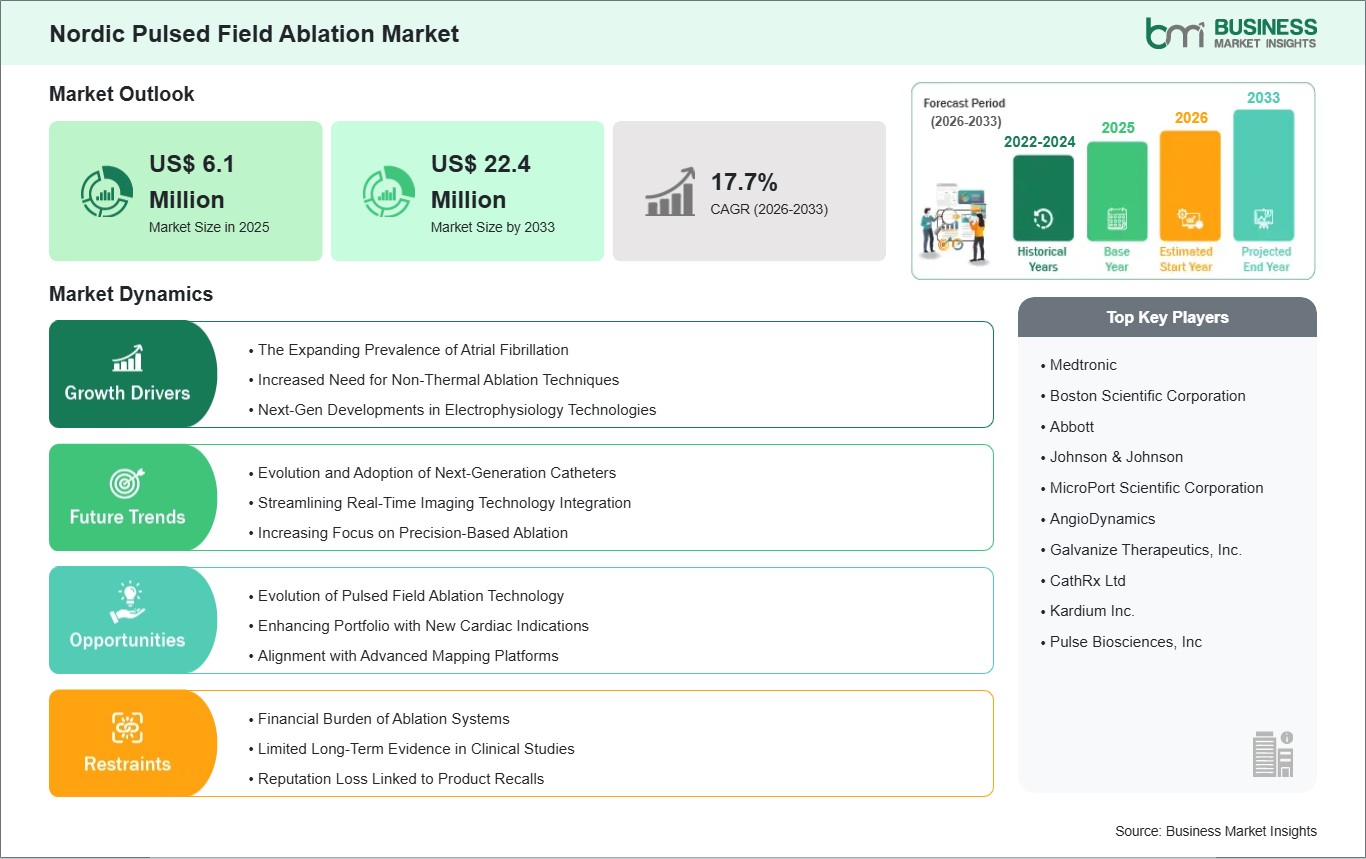
The Nordic pulsed field ablation market size is expected to reach US$ 22.4 million by 2033 from US$ 6.1 million in 2025. The market is estimated to register a CAGR of 17.7% from 2026 to 2033.
The Nordic pulsed field ablation market is considered one of the niches in cardiovascular treatment. This is due to the high level of development of the healthcare system in the Nordics, which focuses on the innovative treatment of diseases and improving the effectiveness of health services. The main factors stimulating market growth are the prevalence of atrial fibrillation and other arrhythmias and the desire to use innovative methods of minimally invasive treatment. The technology of pulsed field ablation allows performing ablation only on the target cardiac muscle without causing damage to surrounding tissues, which corresponds to the philosophy of treatment in Nordic hospitals.
In addition, Nordic hospitals have invested considerable resources in creating advanced electrophysiology laboratories and cardiac mapping systems. There is currently a program in place to introduce PFA technology in selected hospitals and train personnel in the procedure. In addition, hospitals have been collaborating with leading technology companies to develop experience in this area. However, adoption is moderated by high equipment and procedural costs, which limit accessibility primarily to tertiary care hospitals. The need for highly trained electrophysiologists further restricts broader integration in smaller medical centers. The Nordic market shows strong growth potential due to government support for innovative healthcare technologies, increasing clinical awareness, and a regional commitment to advancing minimally invasive cardiac care, suggesting steady expansion of PFA adoption.

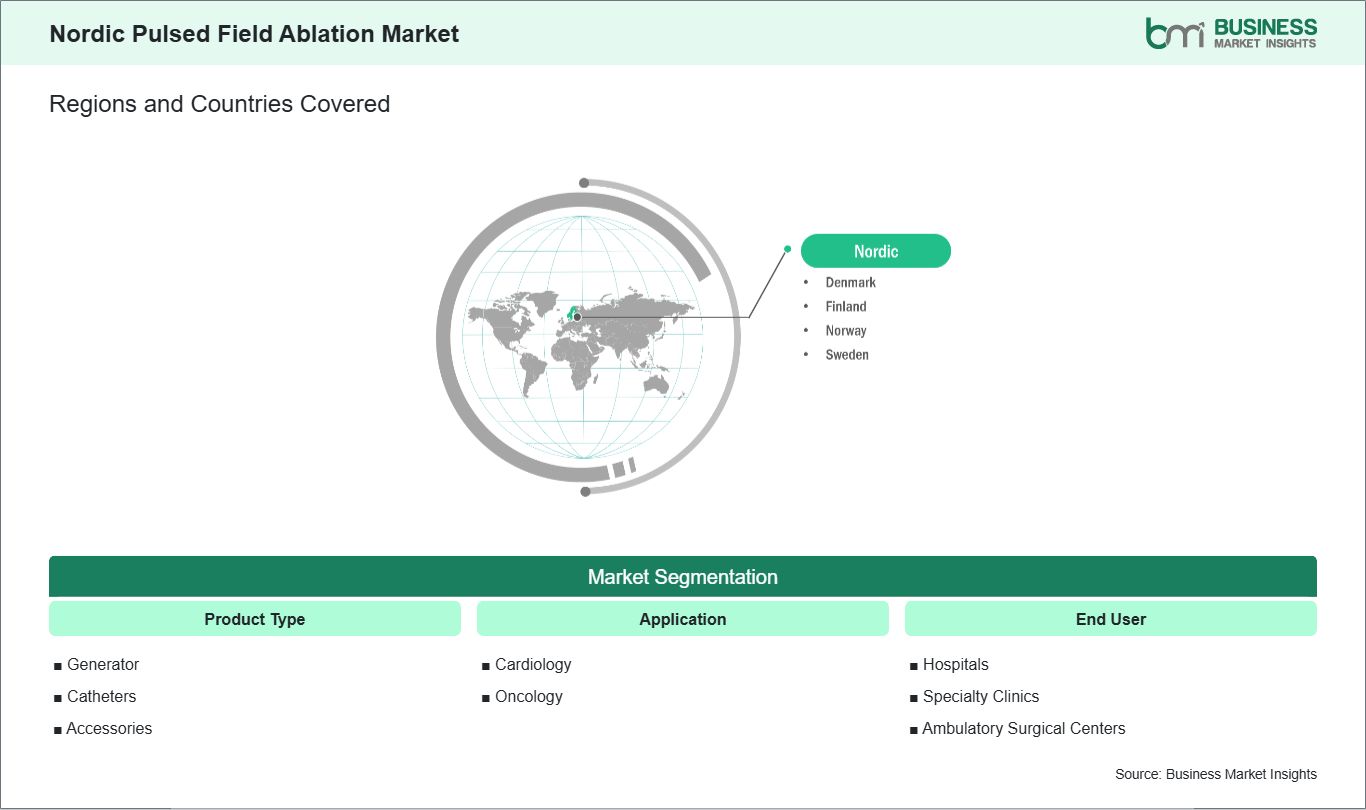
Key segments that contributed to the derivation of the Nordic pulsed field ablation market analysis are product type, application, and end user.
Across the Nordic countries, atrial fibrillation (AFib) is increasingly recognized as a significant cardiovascular concern, particularly as populations age and chronic disease patterns shift. In Sweden, Denmark, Norway, and Finland, public health initiatives have led to greater screening and earlier detection of heart rhythm abnormalities. As general practitioners and cardiologists collaborate more closely, more patients are being diagnosed at earlier stages, which in turn has increased demand for effective rhythm control approaches. Rather than relying solely on long‑term medication, there’s a growing interest in solutions that directly address the electrical triggers of AFib.
Lifestyle factors common in Nordic societies such as high rates of physical activity combined with stress from urban working environments have also spotlighted arrhythmias in both older and younger adults. Clinicians note that even active individuals sometimes present with atypical AFib symptoms, prompting referrals to specialized electrophysiology centers. With patient awareness rising through public health campaigns and national cardiac societies promoting arrhythmia education, health systems are seeing a steady increase in AFib clinic visits and procedural consultations.
In response to these trends, pulsed field ablation (PFA) is gaining traction as a treatment alternative that aligns with Nordic priorities of safety and innovation. Electrophysiologists in major centers across the region are beginning to adopt PFA for suitable AFib candidates, drawn by its promise of selective tissue targeting and reduced collateral damage. As AFib prevalence continues to expand in clinical practice, PFA is increasingly discussed in professional forums and incorporated into strategic treatment planning across the Nordic electrophysiology landscape.
Pulsed field ablation technology has evolved rapidly in recent years, and its development is closely watched by Nordic cardiac electrophysiology communities. Early iterations of PFA focused on proof‑of‑concept and safety, demonstrating how non‑thermal electrical pulses could isolate aberrant cardiac tissue without the risks associated with heat or extreme cold. As research progressed, Nordic centers involved in multicenter clinical initiatives began contributing experience that highlighted procedural nuances relevant to their patient population, such as thinner atrial walls and variable pulmonary vein anatomy.
In addition to technological advances, the current generation of PFA devices can deliver improved mapping capabilities, better catheter maneuverability, and customized energy delivery profiles, all of which are valued by electrophysiologists looking for greater accuracy. In Norway and Sweden, top arrhythmia physicians are conducting clinical assessments on these new technologies, providing information on how the workflow of PFA procedures might differ from traditional radiofrequency and cryoablation modalities.
Beyond hardware, digital innovations such as real‑time lesion assessment and advanced visualization tools have strengthened PFA’s clinical appeal in the region. Electrophysiology labs in Copenhagen, Helsinki, and Umea are increasingly adopting these next‑generation features, incorporating them into training and procedural planning. As PFA technology continues to mature, its evolution is shaping clinician preferences and helping define the future of arrhythmia management in the Nordics, with an emphasis on safer, more patient‑centric interventions.

The Nordic Pulsed Field Ablation market demonstrates steady growth, with size and share analysis highlighting evolving trends and competitive dynamics among key players. The report evaluates important subsegments categorized within product type, application, and end user, highlighting their respective contributions to overall market performance.
By product type, the catheters subsegment dominated the market in 2025. Catheter devices offer improved procedural efficiency, reduced risk of complications, and real-time control for electrophysiologists, making them a crucial component for effective PFA therapy and a key revenue driver for manufacturers.
In terms of application, the cardiology subsegment dominated the market in 2025. The leadership of cardiology applications is attributed to the rising prevalence of atrial fibrillation and other cardiac arrhythmias, growing preference for non-thermal and tissue-selective ablation techniques, and increasing awareness among healthcare providers about the clinical benefits of PFA.
Based on end user, the hospitals subsegment dominated the market in 2025. Hospitals maintain a stronghold due to their established cardiology and electrophysiology departments, access to advanced PFA systems, trained physicians and clinical staff, and the capability to perform specialized cardiac procedures with comprehensive patient monitoring and post-procedure care.
| Report Attribute | Details |
|---|---|
| Market size in 2025 | US$ 6.1 Million |
| Market Size by 2033 | US$ 22.4 Million |
| CAGR (2026 - 2033) | 17.7% |
| Historical Data | 2022-2024 |
| Forecast period | 2026-2033 |
| Segments Covered | By Product Type
|
|
Regions and Countries Covered
| |
| Nordic | Sweden, Denmark, Norway, Finland |
| Market leaders and key company profiles |
|
The "Nordic Pulsed Field Ablation Market Size and Forecast (2022–2033)" report provides a detailed analysis of the market covering below areas:
The geographical scope of the Nordic pulsed field ablation market report is divided into: Sweden, Norway, Denmark, and Finland. Sweden held the largest share in 2025.
The Swedish market for pulsed field ablation is driven by the country’s advanced healthcare facilities, cardiac disease management, and an inclination towards adopting new-age technologies in the industry. There is an increased number of people suffering from atrial fibrillation and arrhythmia-related disorders who require efficient treatments, which can be provided only through a non-thermal, tissue-specific technique such as PFA that enables targeting specific areas in the body, reduces risks, and improves treatment outcomes.
Advanced facilities like specialized labs equipped for electrophysiology, high-quality mapping, and imaging technology have been developed in order to cater to the needs of sophisticated ablation procedures. There are specialized training programs for cardiologists that help ensure proper use of PFA equipment, besides collaborations between local and international companies manufacturing devices. Challenges include high procedural costs and the concentration of trained electrophysiologists in major hospitals, which limit broader adoption across smaller clinics or regional centers. Sweden’s emphasis on technological innovation in healthcare, proactive adoption of minimally invasive cardiac procedures, and strong regulatory support position it as the central driver of PFA adoption in the Nordic region. The country sets a benchmark for procedural safety and efficiency, paving the way for broader integration and expansion of pulsed field ablation across neighboring markets.

The Nordic pulsed field ablation market is evaluated by gathering qualitative and quantitative data post primary and secondary research, which includes important corporate publications, association data, and databases. A few of the key developments in the Nordic pulsed field ablation market are:
The Nordic Pulsed Field Ablation Market is valued at US$ 6.1 Million in 2025, it is projected to reach US$ 22.4 Million by 2033.
As per our report Nordic Pulsed Field Ablation Market, the market size is valued at US$ 6.1 Million in 2025, projecting it to reach US$ 22.4 Million by 2033. This translates to a CAGR of approximately 17.7% during the forecast period.
The Nordic Pulsed Field Ablation Market report typically cover these key segments-
The historic period, base year, and forecast period can vary slightly depending on the specific market research report. However, for the Nordic Pulsed Field Ablation Market report:
The Nordic Pulsed Field Ablation Market is populated by several key players, each contributing to its growth and innovation. Some of the major players include:
The Nordic Pulsed Field Ablation Market report is valuable for diverse stakeholders, including:
Essentially, anyone involved in or considering involvement in the Nordic Pulsed Field Ablation Market value chain can benefit from the information contained in a comprehensive market report.
Please tell us your area of interest
(Market Segments/ Regions and Countries/ Companies)