Market Summary
Executive Summary and Market Analysis
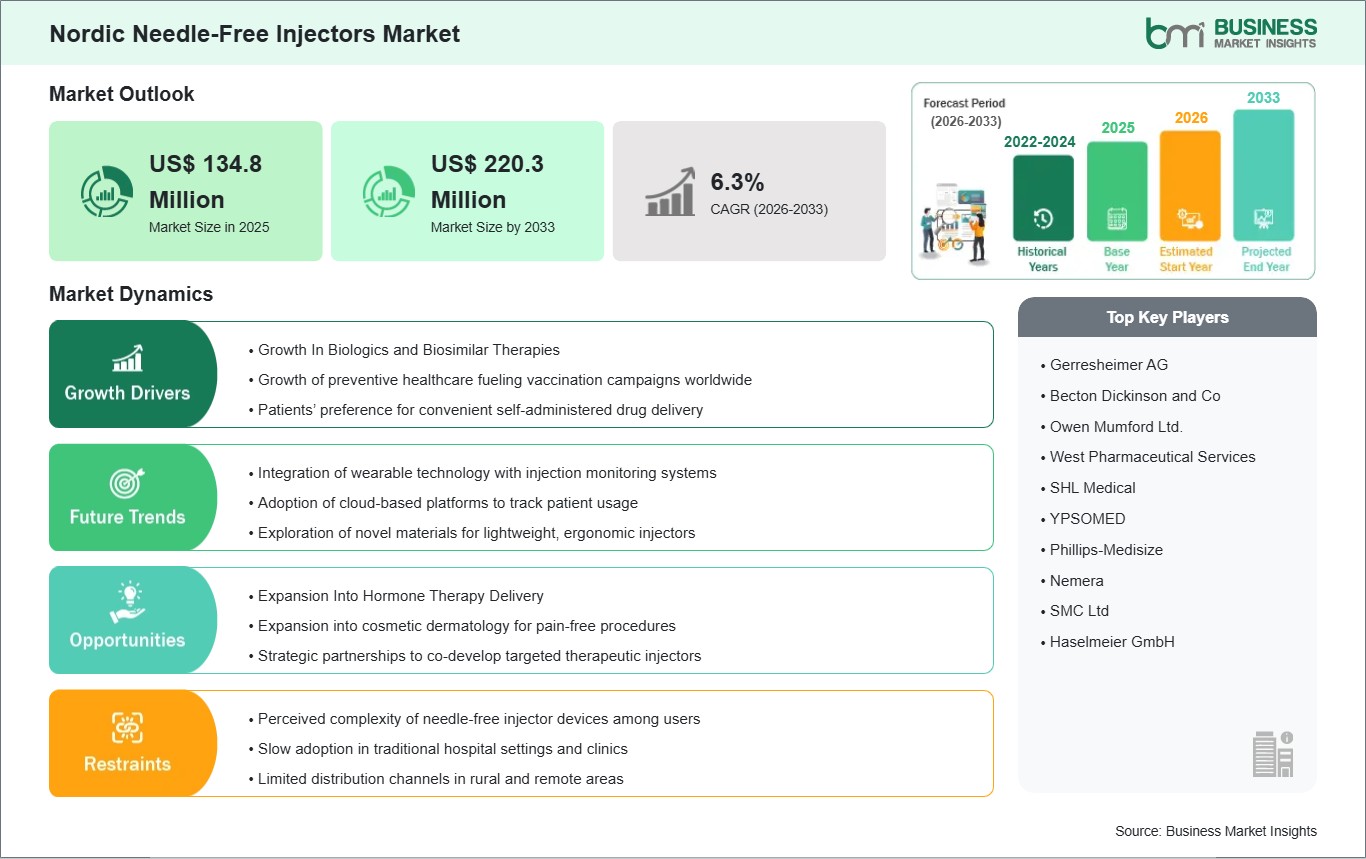
Countries such as Sweden, Denmark, Norway, Finland, and Iceland are leading early adoption of needle-free technologies across hospitals, outpatient clinics, and preventive healthcare programs. Market dynamics are shaped by collaborations between multinational manufacturers and regional distributors who prioritize regulatory compliance, technological innovation, and operational efficiency. Clinical adoption is driven by evidence demonstrating reduced needle-stick injuries, improved patient comfort, and accurate dosing, particularly in immunization campaigns and biologics delivery. Regulatory oversight in the region is stringent, emphasizing safety, efficacy, and post-market surveillance, which influences procurement timelines and adoption strategies. Key operational considerations include ease of device use, compatibility with multiple drug viscosities, minimal training requirements, and lifecycle management. Innovation is a defining factor, with emphasis on ergonomic designs, reusable and disposable systems, digital integration for adherence monitoring, and environmentally sustainable consumables. Pilot projects and hospital-based demonstration programs play a significant role in establishing trust among healthcare professionals. The total cost of ownership—including device maintenance, training, and consumables—remains a critical evaluation criterion. The Nordic market reflects a technologically sophisticated, regulation-driven environment where patient safety, workflow integration, and operational efficiency define competitive advantage and adoption potential.
Segment Analysis
Nordic Needle-Free Injectors Market Segmentation
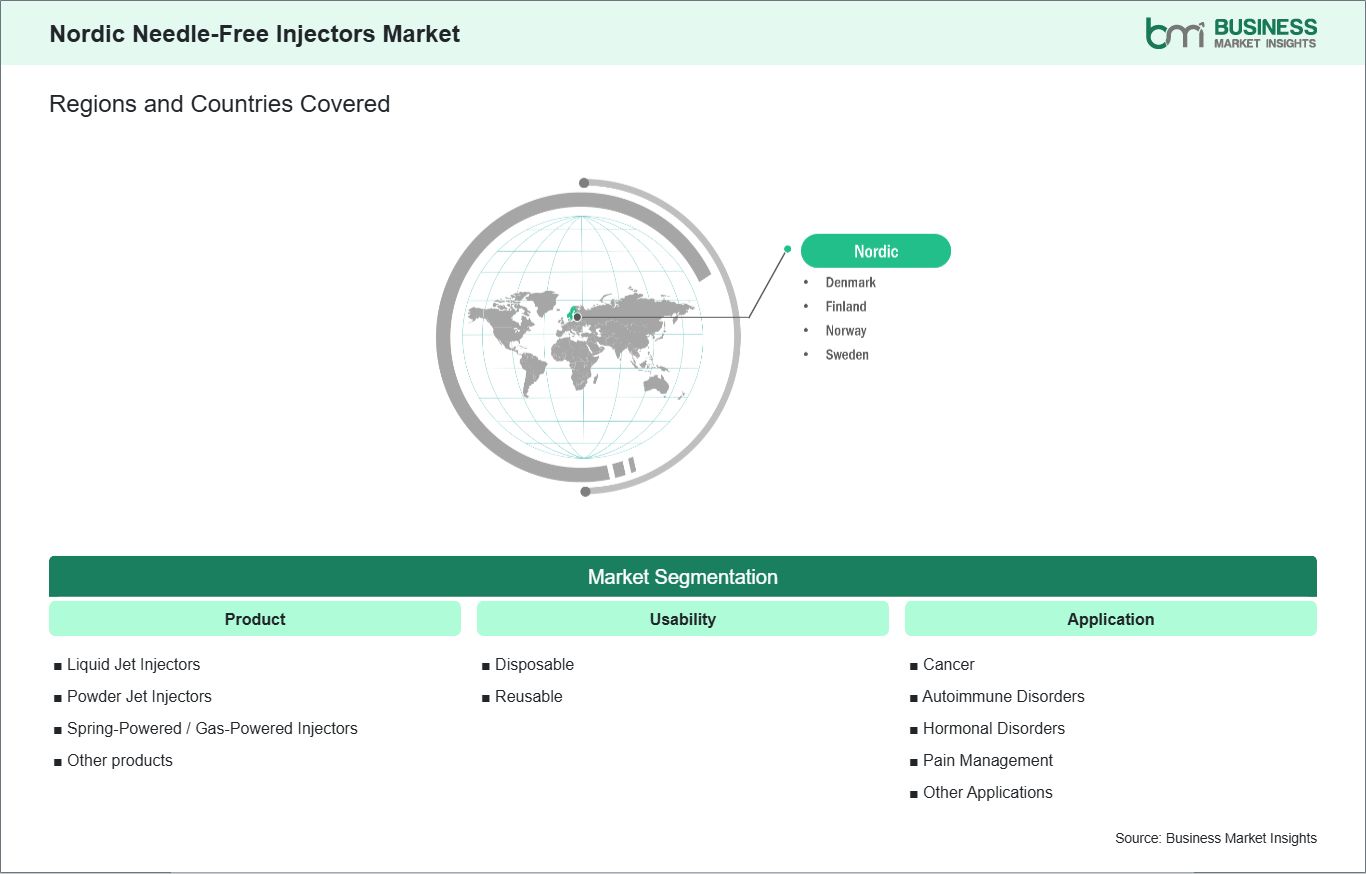
Key segments that contributed to the derivation of the Nordic needle-free injectors market analysis are product, usability, and application.
- By product, the needle-free injectors market is segmented into liquid jet injectors, powder jet injectors, spring-powered / gas-powered injectors, and other products. The liquid jet injectors segment dominated the market in 2025.
- Based on usability, the needle-free injectors market is categorized into disposable and reusable. The disposable segment dominated the market in 2025.
- In terms of application, the market is classified into cancer, autoimmune disorders, hormonal disorders, pain management, and other applications. The autoimmune disorders segment dominated the market in 2025.
Market Forces
Nordic Needle-Free Injectors Market Drivers and Opportunities
Growth In Biologics and Biosimilar Therapies
Countries such as Sweden, Norway, and Denmark are investing in advanced treatments for chronic and complex diseases, including autoimmune disorders and cancer. Needle-free injectors are used to administer these therapies, as they enable accurate dosing and reduce discomfort associated with traditional injections, improving patient adherence and outcomes. Healthcare providers are prioritizing patient-centric solutions, particularly for treatments requiring frequent injections. Biologics demand precise administration and careful handling, and needle-free injectors provide a reliable alternative to conventional syringes. Their ability to minimize pain and anxiety is important in maintaining long-term compliance, which is crucial for the success of complex therapeutic regimens. The presence of well-established healthcare infrastructure and supportive regulatory frameworks encourages the integration of needle-free technologies for biologics and biosimilars. Nordic healthcare systems emphasize safety, efficiency, and patient comfort, creating an environment conducive to the adoption of needle-free injectors. As the market for biologics and biosimilars continues to expand, these devices are expected to play a key role in improving therapeutic delivery and patient experience in the region.
Expansion Into Hormone Therapy Delivery
Hormone therapies, including treatments for growth disorders, reproductive health, and endocrine disorders, are being administered using needle-free injectors in the region. The ability to provide pain-free, precise, and controlled doses makes these devices suitable for long-term hormone therapy, improving adherence and patient satisfaction. Countries such as Finland, Sweden, and Norway are leveraging needle-free technology to enhance the administration of both pediatric and adult hormone therapies. Home-based hormone treatment programs are gaining traction, and needle-free injectors facilitate self-administration with minimal supervision. Patients benefit from reduced discomfort, lower risk of errors, and improved independence, while healthcare providers can monitor adherence and adjust treatment plans. This trend aligns with the Nordic emphasis on patient empowerment and decentralized care models, where technologies supporting safe home-based administration are valued. Innovation in needle-free injector design supports the expanding hormone therapy market by offering customizable dosing options and compatibility with various hormone formulations. The adoption of these devices aligns with regional healthcare priorities, including reducing clinical workload, enhancing patient comfort, and improving long-term treatment outcomes. As hormone therapies become prevalent in the region, needle-free injectors are expected to play a critical role in clinical and home-care settings, supporting patient-friendly drug delivery.
Size and Share Analysis
Nordic Needle-Free Injectors Market Size and Share Analysis
The Nordic Needle-free Injectors Market demonstrates steady growth, with size and share analysis highlighting evolving trends and competitive dynamics among key players. The report examines subsegments categorized within product, usability, and application, offering insights into their contribution to overall market performance.
By product, the liquid jet injectors subsegment dominated the market in 2025, driven by their ability to deliver precise, fast, and painless doses, making them suitable for clinical and home-based treatments.
Based on usability, the disposable subsegment dominated the market in 2025, driven by the emphasis on hygiene, infection prevention, and user convenience in hospitals, clinics, and home-care settings.
In terms of application, the autoimmune disorders subsegment dominated the market in 2025, driven by the need for frequent, long-term medication administration where patient comfort, adherence, and safety are critical for disease management.
Report Coverage
Nordic Needle-Free Injectors Market Report Coverage and Deliverables
The "Nordic Needle-free Injectors Market Size and Forecast (2022–2033)" report provides a detailed analysis of the market covering below areas:
- Nordic Needle-free Injectors Market size and forecast at regional and country levels for all market segments covered under the scope
- Nordic Needle-free Injectors Market trends, as well as drivers, restraints, and opportunities
- Nordic Needle-free Injectors Market analysis covering key trends, regional framework, major players, regulations, and recent developments
- Industry landscape and competition analysis covering market concentration, heat map analysis, prominent players, and recent developments for the Nordic Needle-free Injectors Market
- Detailed company profiles, including SWOT analysis
Geographic Insights
Nordic Needle-Free Injectors Market Geographic Insights
The geographical scope of the Nordic Needle-free Injectors Market report is divided into Sweden, Denmark, Norway, and Finland. Sweden held the largest share in 2025.
Sweden represents the most mature market, with hospitals, outpatient clinics, and research centers emphasizing device reliability, patient comfort, and workflow integration. Denmark demonstrates strong uptake in preventive care and chronic therapy programs, with adoption influenced by hospital pilot projects and public health initiatives. Norway prioritizes digital integration and sustainability, with devices featuring adherence tracking, reusable components, and eco-friendly consumables. Finland exhibits gradual adoption, primarily in urban hospitals and vaccination campaigns, where clinical validation studies influence procurement. Iceland reflects an early adopter approach through hospital-based pilots and integration of digital monitoring systems. Across all countries, after-sales support, clinician training, and distributor reliability are critical for adoption, particularly for complex therapies and multi-use devices. Urban healthcare centers act as reference hubs, facilitating technology transfer to smaller hospitals and regional clinics. Regulatory alignment, environmental considerations, and operational efficiency guide purchasing decisions, highlighting the region’s focus on evidence-based, sustainable, and patient-centric healthcare solutions. Sweden and Denmark lead in scale and sophistication, and the region values innovation, clinical validation, and workflow efficiency, requiring manufacturers to tailor strategies to each country’s healthcare infrastructure and policy priorities.
Industry Activity
Recent Developments
The Nordic Needle-free Injectors Market is evaluated by gathering qualitative and quantitative data post primary and secondary research, which includes important corporate publications, association data, and databases. A few of the key developments in the Nordic needle-free injectors market are:
- In October 2025, Danish research and innovation in needle-free drug delivery technologies continued through academic and research projects (e.g., microjet and microfluidics work funded by European and Nordic research programs) aimed at enabling controlled, painless medicine injection without needles — foundational work that could lead to future commercial needle-free systems originating in Nordic laboratories.
- In February 2022, Injeq Oy (Finland) entered a commercial partnership by signing a regional distributor agreement with Swedish firm Nords Medical to bring its IQ-Tip smart needle system into the Nordic healthcare market. This collaboration expanded access to the CE-certified IQ-Tip product across Finland, Sweden, Norway, and Denmark for clinical injection safety, strengthening market presence and distribution logistics in the Nordic region’s medical device segment. Although this product is not a needle-free injector, it is one of the few documented engagements in advanced injection technologies reported publicly.
Trust & Transparency
Research Methodology
The market analysis combines proprietary research with secondary data from government agencies, company disclosures, regulatory filings, industry databases and expert interviews. Market estimates are validated through data triangulation, cross-market benchmarking and analyst
review.
View Full Research Methodology
Key Sources Referred:
World Health Organization (WHO)Organisation for Economic Cooperation and Development (OECD)The World Bank GroupWorldometerThe LancetInternational Bar AssociationInternational Trade Administration