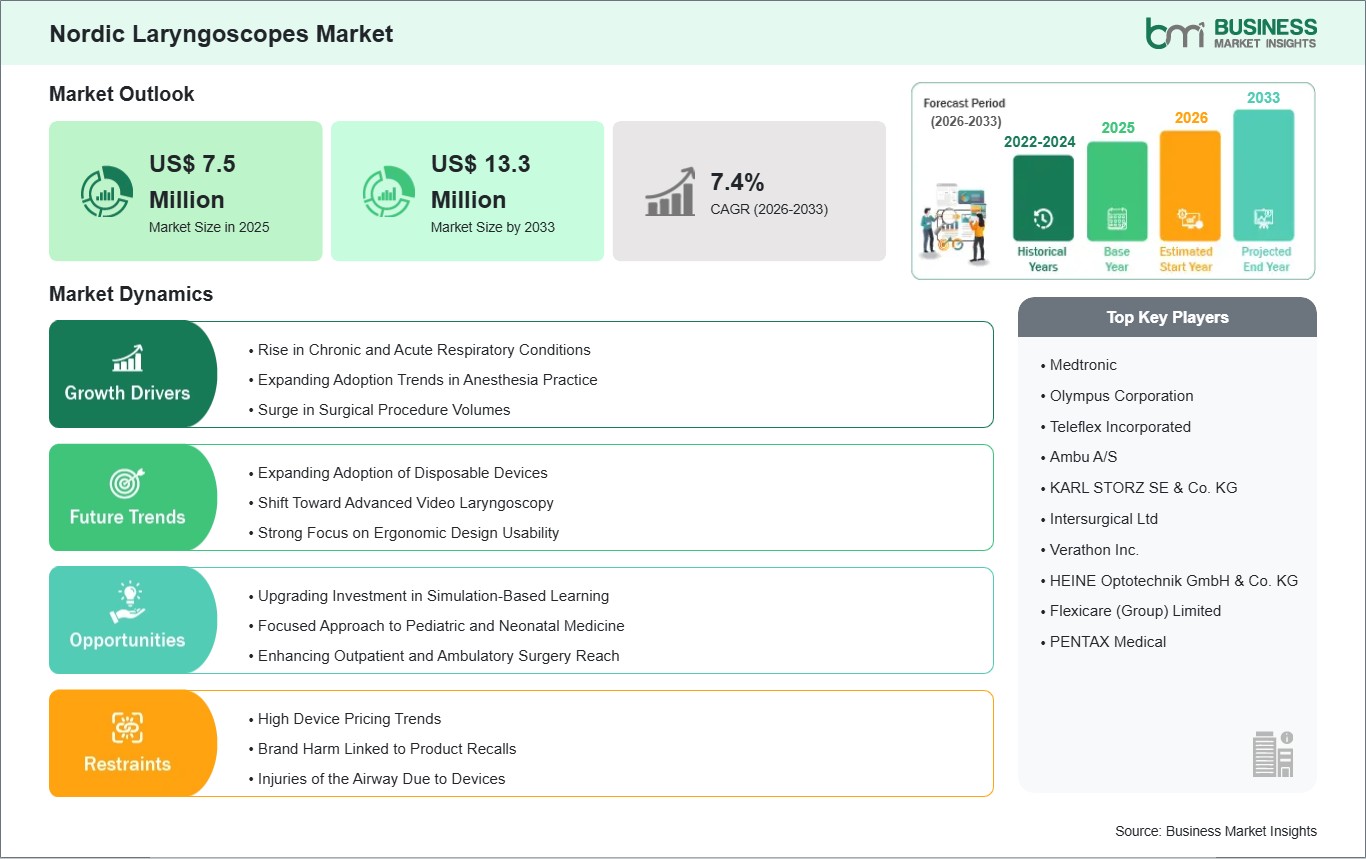
The Nordic laryngoscopes market size is expected to reach US$ 13.3 million by 2033 from US$ 7.5 million in 2025. The market is estimated to record a CAGR of 7.4% from 2026 to 2033.
The Nordic laryngoscope market represents an environment where healthcare is quite sophisticated, with airway management techniques very much consistent with the practice guidelines of anesthesiology and critical care. Given the high importance of patient safety, diagnosis, and minimally invasive techniques in the Nordic region, it comes as no surprise that advanced laryngoscope techniques like video-assisted laryngoscopes have found acceptance among hospitals in this region. In fact, these laryngoscopy tools are being extensively used for routine surgical procedures as well as emergencies.
One of the major drivers for this market is the presence of highly developed hospitals that perform complex surgeries regularly, such as in tertiary care hospitals. Well-structured clinical education and the practice of following international airway management guidelines contribute to maintaining regular usage of these devices. Moreover, there is increasing emphasis on preventive infection techniques, leading to greater consumption of disposables such as blades. The major barrier faced by this market is the high cost associated with acquiring advanced video laryngoscopes. However, this does not impact device usage, as this region values quality over quantity.

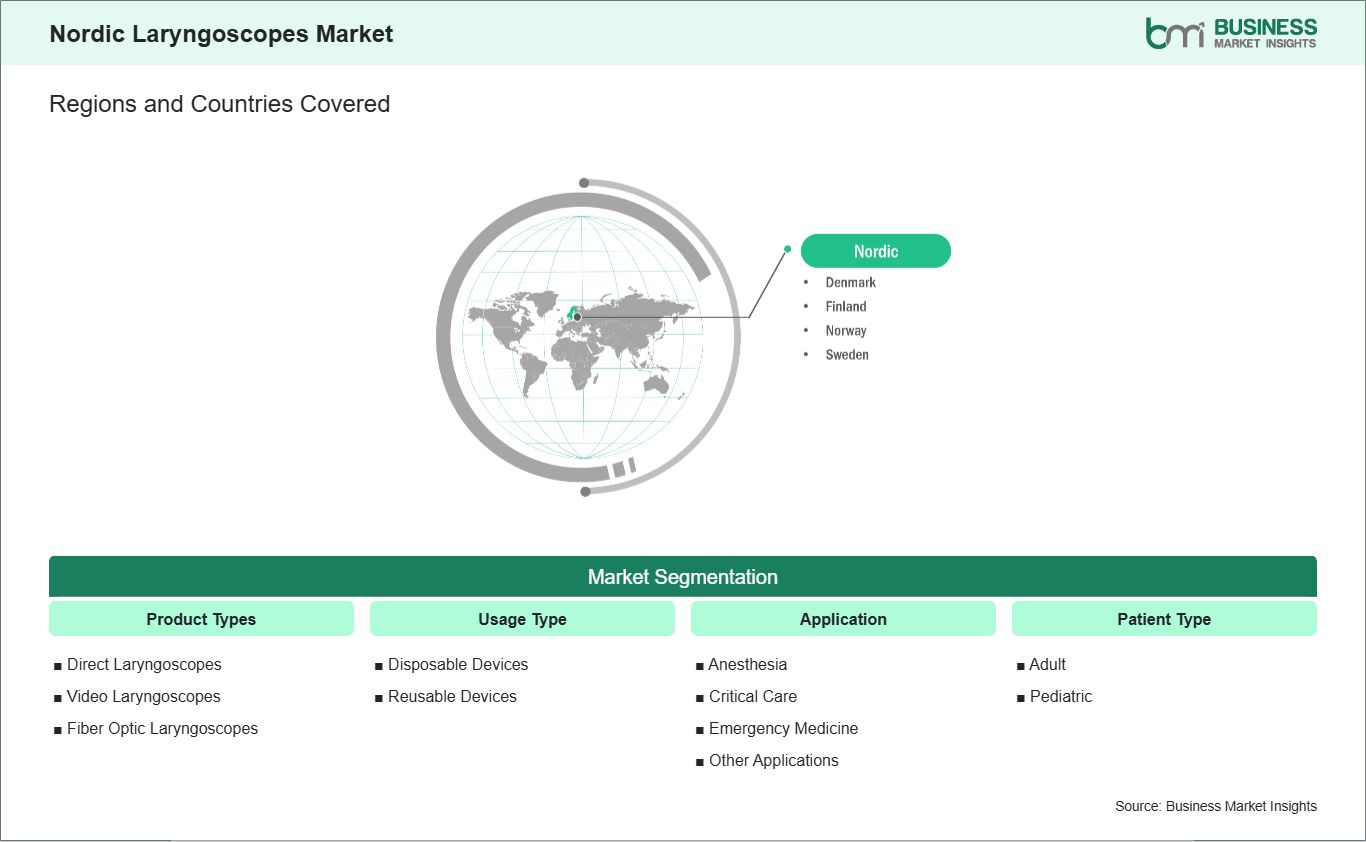
Key segments that contributed to the derivation of the Nordic laryngoscopes market analysis are product type, usage type, application, patient type, and end user.
The Nordic region is experiencing a steady increase in respiratory conditions, shaped by cold climate patterns, aging populations, and strong urban environmental controls that still face seasonal challenges. Countries such as Sweden, Norway, Finland, Denmark, and Iceland see recurring spikes in respiratory infections during long winter periods, where influenza and pneumonia place consistent pressure on emergency and hospital services. These acute episodes often require rapid airway management, making laryngoscopes an essential tool in critical care and anesthetic practice.
In addition to acute respiratory illness, chronic diseases affecting the lungs, such as asthma and COPD, are also prevalent in the Nordic health care systems. While effective preventive treatment is known and used widely, certain elements within people's lifestyles, such as previous smoking and workplace environments in sectors such as shipping, mining, and manufacture are responsible for chronic respiratory disease. For instance, Swedish and Finnish physicians frequently deal with patients with chronic lung diseases that can progress to acute respiratory failure and require intubation.
The highly developed yet extremely centralized critical care system is another element that should be considered. Although intensive care units in Nordic hospitals are very advanced when it comes to procedures like ventilation and airway management, the increasing need for ICUs for aged individuals with several co-morbidities makes these interventions relatively frequent. Thus, using reliable laryngoscopes in both surgical and emergency situations becomes absolutely crucial.
Nordic healthcare systems are increasingly prioritizing simulation-based education as part of their commitment to patient safety and clinical excellence. Countries such as Norway, Sweden, and Finland have well-established simulation networks integrated into university hospitals, where clinicians regularly train in airway management scenarios using high-fidelity mannequins and scenario-driven learning environments. This is particularly important for refining intubation skills in high-risk, low-frequency emergency cases.
Another factor contributing to the financial and institutional investments in simulation training in the region is the high level of emphasis placed on teamwork and standardization of procedures within the medical setting. The anesthesiology and intensive care training are often combined in Nordic countries, which implies that medical practitioners must possess advanced skills in airway management. In other words, the utilization of simulation training facilities is aimed at not only enhancing technical skills but also promoting effective communication, crisis management, and coordination during airway emergencies.
Moreover, the collaborative efforts of the Nordic countries facilitate the further development of simulation training programs. In particular, the existence of common clinical practice guidelines and well-coordinated healthcare systems ensures that medical practitioners from all Nordic countries gain experience working with laryngoscopes. Consequently, the implementation of simulation training becomes instrumental in familiarizing medical professionals with modern laryngoscopes.

The Nordic Laryngoscopes market demonstrates steady growth, with size and share analysis highlighting evolving trends and competitive dynamics among key players. The report evaluates important subsegments categorized within product type, usage type, application, patient type, and end user, highlighting their respective contributions to overall market performance.
By product type, the video laryngoscopes subsegment dominated the laryngoscopes market in 2025. This is driven by the increasing demand for enhanced airway visualization, improved first-pass intubation success rates, and reduced complications in difficult airway management, making them a key revenue driver for manufacturers and supporting strong adoption in clinical practice.
In terms of usage type, the disposable devices subsegment led the market in 2025. The dominance of disposable devices is attributed to the growing emphasis on infection control, prevention of cross-contamination, and the operational convenience of eliminating reprocessing and sterilization requirements in high-volume healthcare settings.
Based on application, the anesthesia subsegment held the largest share in 2025. Hospitals and surgical centers widely rely on laryngoscopes during anesthesia procedures for airway management and intubation, supported by the rising number of surgeries and the increasing use of advanced airway management techniques.
In terms of patient type, the adult subsegment dominated the market in 2025. This is driven by the higher prevalence of surgical procedures, critical care admissions, and chronic respiratory conditions among adults, resulting in greater demand for airway management devices in this population group.
By end user, the hospitals subsegment held the largest share in 2025. Hospitals maintain leadership due to their advanced infrastructure, availability of skilled healthcare professionals, high patient inflow, and strong capability to perform complex surgical and emergency procedures requiring laryngoscopy.
| Report Attribute | Details |
|---|---|
| Market size in 2025 | US$ 7.5 Million |
| Market Size by 2033 | US$ 13.3 Million |
| CAGR (2026 - 2033) | 7.4% |
| Historical Data | 2022-2024 |
| Forecast period | 2026-2033 |
| Segments Covered | By Product Types
|
|
Regions and Countries Covered
| |
| Nordic | Sweden, Denmark, Norway, Finland |
| Market leaders and key company profiles |
|
The "Nordic Laryngoscopes Market Size and Forecast (2022-2033)" report provides a detailed analysis of the market covering below areas:
The geographical scope of the Nordic Laryngoscopes market report is divided into: Sweden, Norway, Denmark, and Finland. Sweden held the largest share in 2025.
The Swedish country occupies the dominant position in the Nordic laryngoscopes market because of the organization and high priority of perioperative patient safety and intensive care innovations in its healthcare system. Swedish healthcare facilities have a high readiness rate regarding complex airway situations and provide wide availability of laryngoscopy devices in operating theaters, intensive care units, and emergency departments. The current practice of intubation procedures includes the usage of innovative airway visualization technology, such as video laryngoscopes, especially when implementing the intubation process during critical situations.
The Swedish market refers to the slow shift towards more technologically advanced airway management, utilizing both reusable airway management devices and disposable items, depending on the context of the case. Clinical hospitals and regional health centers tend to be the pioneers in such innovations, thus shaping national purchase trends. On the other hand, the pressure towards controlling costs in the public health sector makes it imperative to have a balanced approach in adopting airway technologies, which should not only include modern but also more traditional laryngoscopes.

The Nordic Laryngoscopes market is evaluated by gathering qualitative and quantitative data post primary and secondary research, which includes important corporate publications, association data, and databases. A few of the key developments in the Nordic Laryngoscopes market are:
The Nordic Laryngoscopes Market is valued at US$ 7.5 Million in 2025, it is projected to reach US$ 13.3 Million by 2033.
As per our report Nordic Laryngoscopes Market, the market size is valued at US$ 7.5 Million in 2025, projecting it to reach US$ 13.3 Million by 2033. This translates to a CAGR of approximately 7.4% during the forecast period.
The Nordic Laryngoscopes Market report typically cover these key segments-
The historic period, base year, and forecast period can vary slightly depending on the specific market research report. However, for the Nordic Laryngoscopes Market report:
The Nordic Laryngoscopes Market is populated by several key players, each contributing to its growth and innovation. Some of the major players include:
The Nordic Laryngoscopes Market report is valuable for diverse stakeholders, including:
Essentially, anyone involved in or considering involvement in the Nordic Laryngoscopes Market value chain can benefit from the information contained in a comprehensive market report.
Please tell us your area of interest
(Market Segments/ Regions and Countries/ Companies)