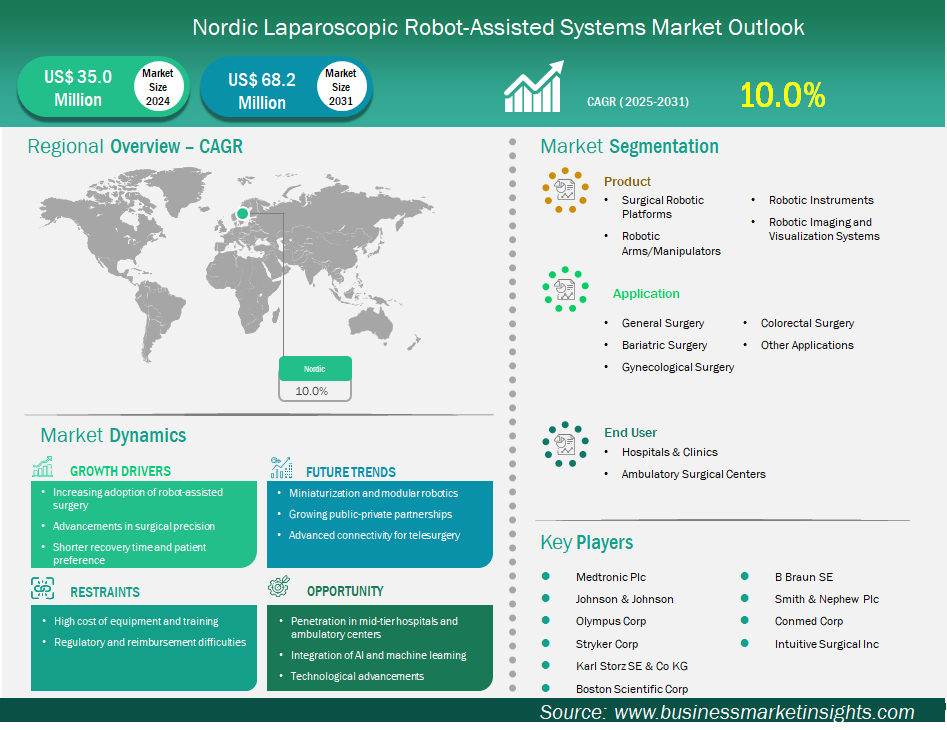
The Nordic laparoscopic robot-assisted systems market size is expected to reach US$ 68.2 million by 2031 from US$ 35.0 million in 2024. The market is estimated to record a CAGR of 10.0% from 2025 to 2031.
Executive Summary and Nordic Laparoscopic Robot-Assisted Systems Market Analysis:
The laparoscopic robot-assisted systems market in Nordic is experiencing significant growth driven by increasing adoption of robotic-assisted surgery, advancements in surgical precision, and shorter recovery times and patient preference. The Nordic laparoscopic robot-assisted systems market is defined by robust adoption, which is mainly due to the region's advanced level of healthcare infrastructure, high technology readiness, and the prioritization of quality patient outcomes. Public healthcare systems in Sweden, Denmark, Norway, and Finland are mature and they support the use of minimally invasive surgical procedures in order to save the time of recovering patients and to promote clinical effectiveness. The wide penetration of digital health technology and the surgical innovation investment is the foundation of the demand for robotic-assisted laparoscopic surgery to keep increasing. The most developed medical specialties for the use of robotic platforms are urology and gynecology, however, the application of general surgery is rapidly expanding.
One of the most influential factors driving the market is the region's strong regulatory framework that ensures high safety and performance levels and at the same time, facilitates a fairly rapid device approval process. The Nordic countries also have comprehensive surgeon training programs, which have been set up through joint efforts of hospitals, universities, and orthopaedic device companies. There are some challenges, nevertheless, for instance, the high-cost of the initial investment and maintenance, which requires a well-thought-out budget and also needs to be justified through increased patient throughput and clinical results. Although reimbursement models are well-established, they differ slightly from one country to another and usually require a significant amount of documentation of cost-effectiveness. Among the competitive forces, there is a group of major global players providing robotic surgery platforms and a group of emerging competitors who offer more universal and affordable solutions tailored to the Nordic healthcare sectors. In general, the Nordic market represents an environment that is advanced and driven by innovation, growth is supported by technology adoption, strict regulation, and sound clinical expertise.
Nordic Laparoscopic Robot Assisted Systems Market Segmentation Analysis:
Key segments that contributed to the derivation of the laparoscopic robot-assisted systems market analysis are product, application, and end user.
- By product, the laparoscopic robot-assisted systems market is segmented into surgical robotic platforms, robotic arms/manipulators, robotic instruments, and robotic imaging and visualization systems. The surgical robotic platforms segment dominated the market in 2024. Surgical robotic platforms are the largest segment by product, due to their essential role as core technology enabling a wide range of precision robotic-assisted surgical procedures across specialties.
- In terms of application, the market is segmented into general surgery, bariatric surgery, gynecological surgery, colorectal surgery, and other applications. The general surgery segment held the largest market share in 2024. General surgery is the largest segment by application, due to the high volume of minimally invasive procedures performed, supported by well-established clinical protocols and surgeon expertise in the region.
- By end user, the market is segmented into hospitals and clinics, and ambulatory surgical centers. The hospitals and clinics segment held the largest market share in 2024. Hospitals and clinics as the largest segment by end user, due to their advanced healthcare infrastructure, centralized surgical centers, and capacity to invest in cutting-edge robotic technologies.
Nordic Laparoscopic Robot-Assisted Systems Market Outlook
The increased incidence of chronic diseases such as prostate cancer and colorectal diseases is the major factor bolstering the demand for minimally invasive surgery, and hence, adoption is expected to spread beyond well-established specialties to general and oncologic surgical applications. Apart from that, technical advancements will still open up more possibilities of system functionalities through the implementation of artificial intelligence, advanced imaging techniques, and augmented reality, thus providing surgical planning and intraoperative decision-making guidance. In addition, the emphasis on multidisciplinary surgical platforms that are designed to be modular and scalable so as to keep up with the changing clinical requirements is also increasing. Moreover, Nordic healthcare providers are heavily investing in measures geared towards improved operational effectiveness, such as maximizing operating room productivity and minimizing procedure times, and this is where robotic systems show their potential. The increase in surgical training through virtual reality simulators and geographically dispersed programs will be instrumental in bridging skills gaps and creating the conditions for wider uptake. Financially, value-based care models, which are prevalent in the region, will be the main drivers of demand for products that provide tangible benefits to patient outcomes and cost savings. Among the obstacles are budget constraints in publicly funded health systems and the reluctance in introducing new technologies without having mature, long-term clinical data. Additionally, sustainability issues, as well as lifecycle management of the devices, are becoming factors that influence procurement decisions. The expansion of the Nordic market will be supported by technology-led innovation, outcome-based adoption, and transitioning financial models under a mature regulatory and healthcare environment.
Nordic Laparoscopic Robot-Assisted Systems Market Country Insights
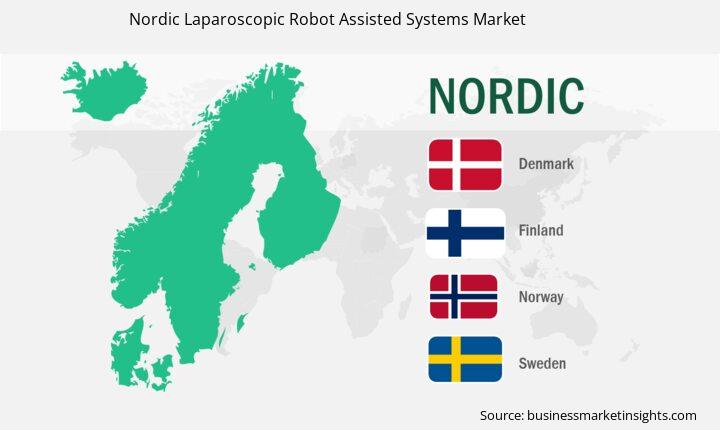
Based on country, the Nordic laparoscopic robot-assisted systems market is segmented into Sweden, Denmark, Norway, and Finland. Denmark held the largest share in 2024.
Nordic country-level insights reveal subtle variations that influence the adoption and utilization of laparoscopic robot-assisted systems. Denmark leads with robust investments in healthcare technology, centralized care provision, and well-developed networks of surgeon training. Sweden comes next in terms of robotic surgery uptake, largely due to its large population, sophisticated tertiary care facilities, and liberal government healthcare policies that promote digital change and innovation. The reimbursement policy is supportive overall, but varies somewhat in scope of coverage and procedural coding, which affects hospital purchasing options. Additionally, cultural determinants such as high patient knowledge and receptiveness to robotic surgery also favour demand. Lastly, every nation shows an increased interest in localizing components of the supply chain and service operations to reduce costs and support local economies. Generally, the Nordic market is a collective and diverse market environment where innovation, regulatory stringency, and consistency in healthcare policy all combine to promote the uptake of advanced laparoscopic robot surgery.
Nordic Laparoscopic Robot Assisted Systems Market Company Profiles
Medtronic Plc; Johnson & Johnson; Olympus Corp; Stryker Corp; Karl Storz SE & Co KG, Boston Scientific Corp, B Braun SE, Smith & Nephew Plc, Conmed Corp, and Intuitive Surgical Inc., are among the key players operating in the market. These players adopt strategies such as expansion, product innovation, and mergers and acquisitions to stay competitive in the market and offer innovative products to their consumers.
Nordic Laparoscopic Robot-Assisted Systems Market Research Methodology:
The following methodology has been followed for the collection and analysis of data presented in this report:
Secondary Research
The research process begins with comprehensive secondary research, utilizing both internal and external sources to gather qualitative and quantitative data for each market. Commonly referenced secondary research sources include, but are not limited to:
- Company websites, annual reports, financial statements, broker analyses, and investor presentations
- Industry trade journals and other relevant publications
- Government documents, statistical databases, and market reports
- News articles, press releases, and webcasts specific to companies operating in the market
Note: All financial data included in the Company Profiles section has been standardized to US$. For companies reporting in other currencies, figures have been converted to US$ using the relevant exchange rates for the corresponding year.
Primary Research
Business Market Insights conducts a significant number of primary interviews each year with industry stakeholders and experts to validate and analyze the data and gain valuable insights. These research interviews are designed to:
- Refine findings from secondary research
- Enhance the expertise and market understanding of the analysis team
- Gain insights into market size, trends, growth patterns, competitive dynamics, and future prospects
Primary research is conducted via email interactions and telephone interviews with industry experts across various markets, categories, segments, and sub-segments in different regions. Participants typically include:
- Industry stakeholders: Vice Presidents, business development managers, market intelligence managers, and national sales managers
- External experts: Valuation specialists, research analysts, and key opinion leaders with industry-specific expertise
Key Sources Referred:
- World Health Organization (WHO)
- The World Bank Group
- Worldometer
- The Lancet
- BMC Medical Education
- Eurostat
Nordic Laparoscopic Robot Assisted Systems Market Strategic Insights
Nordic Laparoscopic Robot Assisted SystemsMarket Report Highlights
| Report Attribute | Details |
| Market size in 2024 | US$ 35.0 Million |
| Market Size by 2031 | US$ 68.2 Million |
| CAGR (2025 - 2031) | 10.0% |
| Historical Data | 2021-2023 |
| Forecast period | 2025-2031 |
| Segments Covered |
By Product
|
|
Regions and Countries Covered
|
|
| Nordic | Sweden, Denmark, Norway, Finland |
| Market leaders and key company profiles |
|
Nordic Laparoscopic Robot Assisted Systems Market Country and Regional Insights