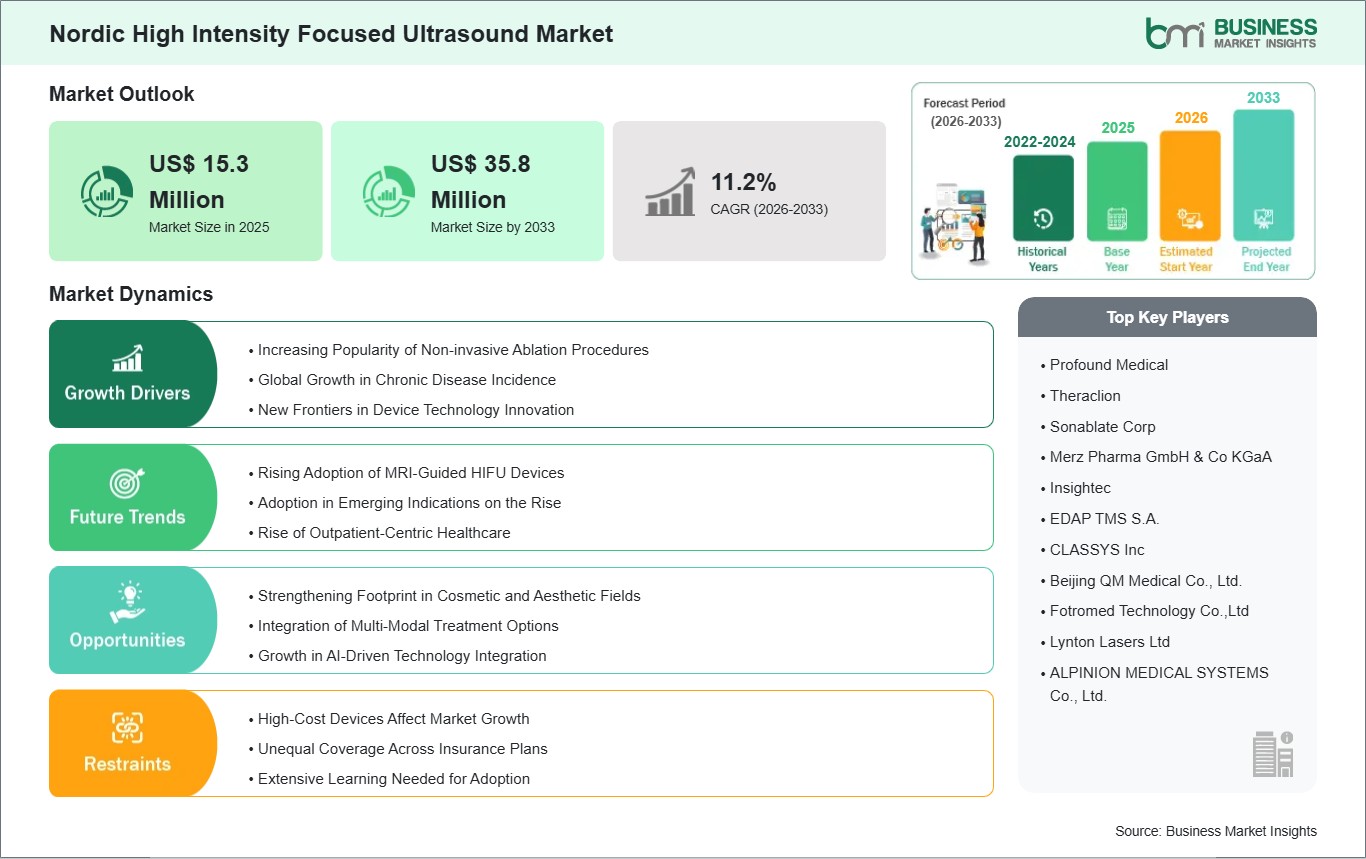
The Nordic high intensity focused ultrasound market size is expected to reach US$ 35.8 million by 2033 from US$ 15.3 million in 2025. The market is estimated to register a CAGR of 11.2% from 2026 to 2033.
The Nordic high intensity focused ultrasound market is distinguished by its advanced healthcare infrastructure, high technology adoption rates, and patient-centric approach to treatment. In this region, HIFU is gaining traction as a minimally invasive alternative to traditional surgical procedures, particularly in oncology, urology, and women’s health. The market is driven by well-established public healthcare systems that emphasize evidence-based, non-invasive interventions to reduce hospitalization times and improve patient quality of life. Increasing awareness among both clinicians and patients regarding the benefits of HIFU, including precise targeting of affected tissues and faster recovery, has further supported its adoption in leading hospitals and specialized medical centers. However, growth is moderated by the high upfront costs of HIFU equipment and the need for specialized operator training, which can slow integration across smaller hospitals or regional clinics. Additionally, stringent regulatory requirements for approval and reimbursement in Nordic countries can extend the time between technology introduction and clinical adoption. The combination of advanced healthcare policies, technological readiness, and strong patient demand makes the Nordic region a fertile ground for the expansion of HIFU applications, particularly in urban medical hubs and research-focused hospitals.

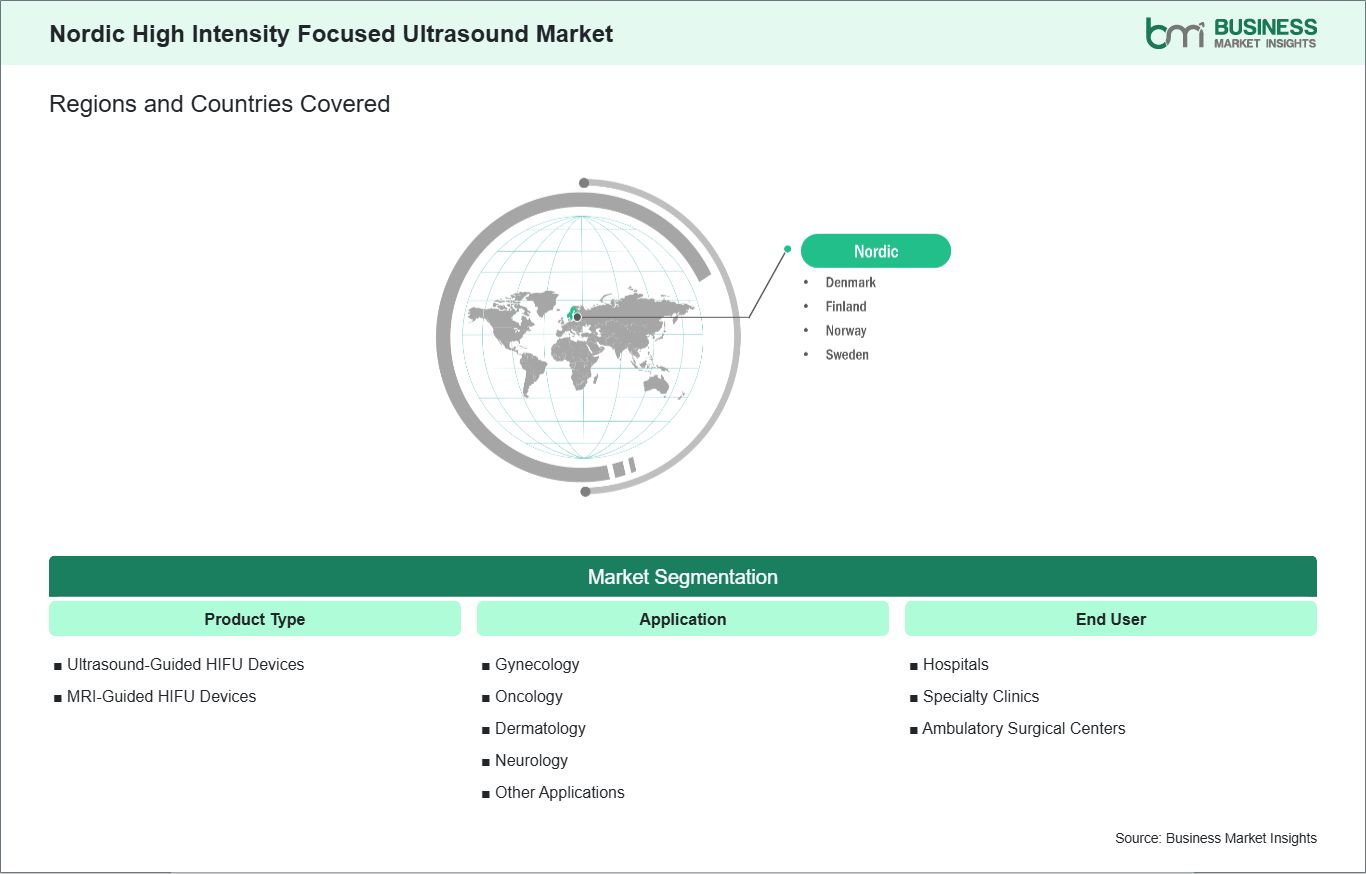
Key segments that contributed to the derivation of the Nordic high intensity focused ultrasound therapy market analysis are product type, application, and end user.
In the Nordic region, healthcare providers are showing growing interest in non‑invasive ablation procedures such as high intensity focused ultrasound (HIFU) as part of a broader shift toward minimally invasive care. Hospitals and specialist centers are integrating HIFU into their therapeutic offerings for conditions like localized tumors and uterine fibroids, where targeting tissue without open surgery can improve patient comfort and reduce recovery times. Clinicians in multidisciplinary teams are increasingly recognizing HIFU’s potential to complement existing treatment strategies, especially in environments that value patient safety and procedural efficiency.
Medical practitioners in the Nordics are also placing emphasis on optimizing clinical workflows that incorporate advanced imaging with focused ultrasound. By pairing HIFU with real‑time visualization tools, teams in radiology, oncology, and gynecology can more accurately focus energy on target tissue while sparing healthy structures. This precision is particularly valued in settings where healthcare systems prioritize evidence‑based, patient‑centric practices and high standards of procedural quality.
Collaborative efforts further support HIFU’s adoption, with healthcare professionals engaging in knowledge‑sharing through conferences, training initiatives, and cross‑institution forums. As clinical teams gain experience, they are refining best practices and expanding indications for HIFU within non‑invasive ablation protocols. This continuous professional development is helping to normalize focused ultrasound therapies as a trusted part of the Nordic clinical landscape, encouraging broader acceptance across hospital networks.
HIFU is also making notable progress in the cosmetic and aesthetic sector within the Nordic region. Aesthetic clinics and dermatology practices are increasingly offering focused ultrasound treatments for non‑surgical skin tightening, facial contouring, and body rejuvenation. These procedures appeal to clients seeking meaningful aesthetic results without undergoing invasive surgical interventions, aligning with regional trends toward wellness, self‑care, and non‑disruptive cosmetic enhancements.
Practitioners are integrating HIFU alongside other non‑invasive technologies, including radiofrequency and laser platforms, to develop comprehensive cosmetic treatment portfolios. This multi‑modality approach allows clinics to address a wider range of skin concerns while tailoring plans to individual client goals. It also supports a high level of customization, which is particularly valued in markets where personalization and quality of experience are key drivers of consumer choice.
Consumer awareness and education play an important role in HIFU’s growing popularity in aesthetic care. Clients frequently research cosmetic options and discuss experiences through online forums and social platforms, prompting clinics to provide more information about procedural benefits and expectations. As understanding grows, focused ultrasound is steadily being recognized as a mainstream non‑surgical aesthetic option in the Nordic beauty and wellness market, broadening its acceptance beyond traditional medical environments.

The Nordic high intensity focused ultrasound market demonstrates steady growth, with size and share analysis highlighting evolving trends and competitive dynamics among key players. The report evaluates important subsegments categorized within product type, application, and end user, highlighting their respective contributions to market performance.
By product type, the ultrasound-guided HIFU devices subsegment dominated the market in 2025. This is driven by the recurring need for precise and reliable imaging during HIFU procedures, which ensures accurate targeting and effective ablation of tissues, making these devices a key revenue driver for manufacturers and sustaining consistent demand in clinical settings.
In terms of application, the gynecology subsegment led the market in 2025. The dominance of gynecology applications is attributed to the rising prevalence of uterine fibroids and adenomyosis, growing adoption of non-invasive treatment methods, and increasing awareness among healthcare providers of HIFU’s effectiveness in providing safe, minimally invasive therapeutic options for women’s health conditions.
Based on end user, the hospitals subsegment held the largest share in 2025. Hospitals maintain leadership due to their well-established gynecology and surgical departments, access to advanced HIFU equipment, trained medical staff, and the capability to perform complex procedures while providing comprehensive patient care.
| Report Attribute | Details |
|---|---|
| Market size in 2025 | US$ 15.3 Million |
| Market Size by 2033 | US$ 35.8 Million |
| CAGR (2026 - 2033) | 11.2% |
| Historical Data | 2022-2024 |
| Forecast period | 2026-2033 |
| Segments Covered | By Product Type
|
|
Regions and Countries Covered
| |
| Nordic | Sweden, Denmark, Norway, Finland |
| Market leaders and key company profiles |
|
The "Nordic High Intensity Focused Ultrasound Market Size and Forecast (2022–2033)" report provides a detailed analysis of the market covering below areas:
The geographical scope of the Nordic High Intensity Focused Ultrasound market report is divided into: Sweden, Norway, Denmark, and Finland. Sweden held the largest share in 2025.
Sweden dominates the Nordic HIFU market, leveraging its strong healthcare system, advanced medical research ecosystem, and high patient acceptance of innovative therapies. Swedish hospitals, particularly in metropolitan areas like Stockholm and Gothenburg, are at the forefront of integrating HIFU into treatment pathways for prostate cancer, uterine fibroids, and other localized conditions. The country benefits from a coordinated approach to technology adoption, with centralized hospital networks enabling the efficient deployment of specialized devices and standardized training for clinicians. Sweden’s focus on evidence-based healthcare facilitates clinical trials and long-term studies that reinforce confidence in HIFU’s safety and efficacy, further encouraging its use in routine practice. Another factor driving adoption is Sweden’s emphasis on patient-centered care, where non-invasive procedures with reduced recovery time align with the national healthcare agenda. Challenges remain, including ensuring accessibility of HIFU technology in smaller hospitals outside major cities and balancing high initial investment costs with public healthcare budget constraints. Sweden’s leadership in clinical expertise, healthcare infrastructure, and research integration positions it as a central driver of HIFU adoption across the Nordic region, influencing treatment standards and technology acceptance in neighboring countries.

The Nordic high intensity focused ultrasound market is evaluated by gathering qualitative and quantitative data post primary and secondary research, which includes important corporate publications, association data, and databases. A few of the key developments in the Nordic High Intensity Focused Ultrasound market are:
The Nordic High Intensity Focused Ultrasound Market is valued at US$ 15.3 Million in 2025, it is projected to reach US$ 35.8 Million by 2033.
As per our report Nordic High Intensity Focused Ultrasound Market, the market size is valued at US$ 15.3 Million in 2025, projecting it to reach US$ 35.8 Million by 2033. This translates to a CAGR of approximately 11.2% during the forecast period.
The Nordic High Intensity Focused Ultrasound Market report typically cover these key segments-
The historic period, base year, and forecast period can vary slightly depending on the specific market research report. However, for the Nordic High Intensity Focused Ultrasound Market report:
The Nordic High Intensity Focused Ultrasound Market is populated by several key players, each contributing to its growth and innovation. Some of the major players include:
The Nordic High Intensity Focused Ultrasound Market report is valuable for diverse stakeholders, including:
Essentially, anyone involved in or considering involvement in the Nordic High Intensity Focused Ultrasound Market value chain can benefit from the information contained in a comprehensive market report.
Please tell us your area of interest
(Market Segments/ Regions and Countries/ Companies)