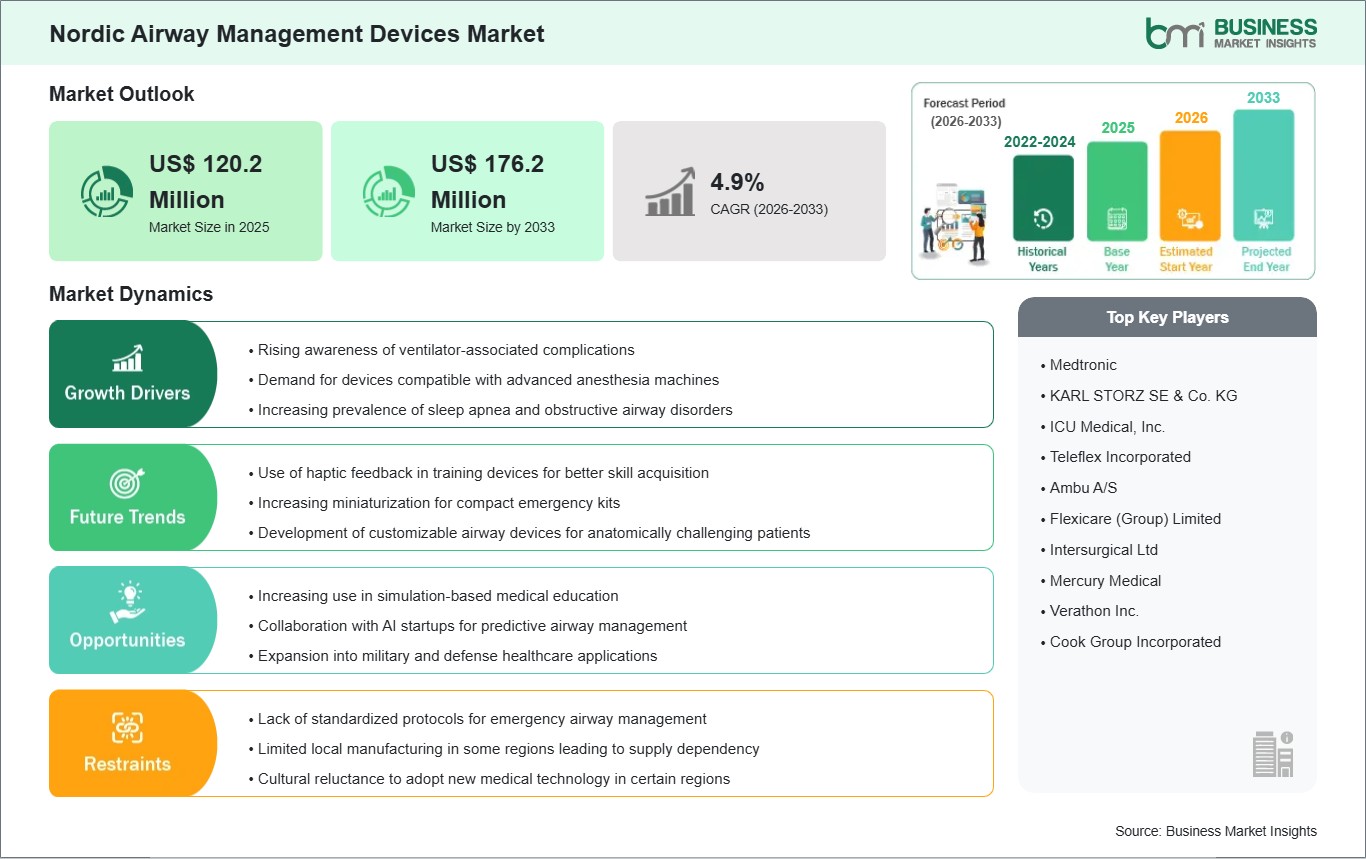
The Nordic Airway management devices market size is expected to reach US$ 176.2 million by 2033 from US$ 120.2 million in 2025. The market is estimated to record a CAGR of 4.9% from 2026 to 2033.
The Nordic airway management devices market reflects a mature, technology-driven healthcare landscape characterized by high clinical standards, robust hospital infrastructure, and a strong emphasis on patient safety. The region includes Sweden, Norway, Denmark, Finland, and Iceland, with Sweden dominating the market due to its advanced healthcare system, extensive research initiatives, and early adoption of innovative medical technologies. The factors driving the growth of the market include the increasing incidence of chronic respiratory diseases, the aging population that needs more surgeries, and a strong emphasis on preventing complications during anesthesia. Swedish hospitals and those in other Nordic nations have been incorporating sophisticated airway management systems like video laryngoscopes, second-generation supraglottic airway tools, and single-use intubation kits in their operations to enhance precision and minimize infections. The pre-hospital setting is equally well-structured, with ambulances in large cities having mobile airway devices. On the other hand, there are various factors that restrain the development of the market. These include high expenses related to the devices and rigorous regulatory policies that could hinder adoption in small hospitals or rural regions. Moreover, the need for state-of-the-art technologies will necessitate ongoing training for medical personnel, leading to possible shortages temporarily. Nonetheless, the market environment in the Nordic region is favorable due to consistent investments in health facilities, clinical awareness, and innovations.

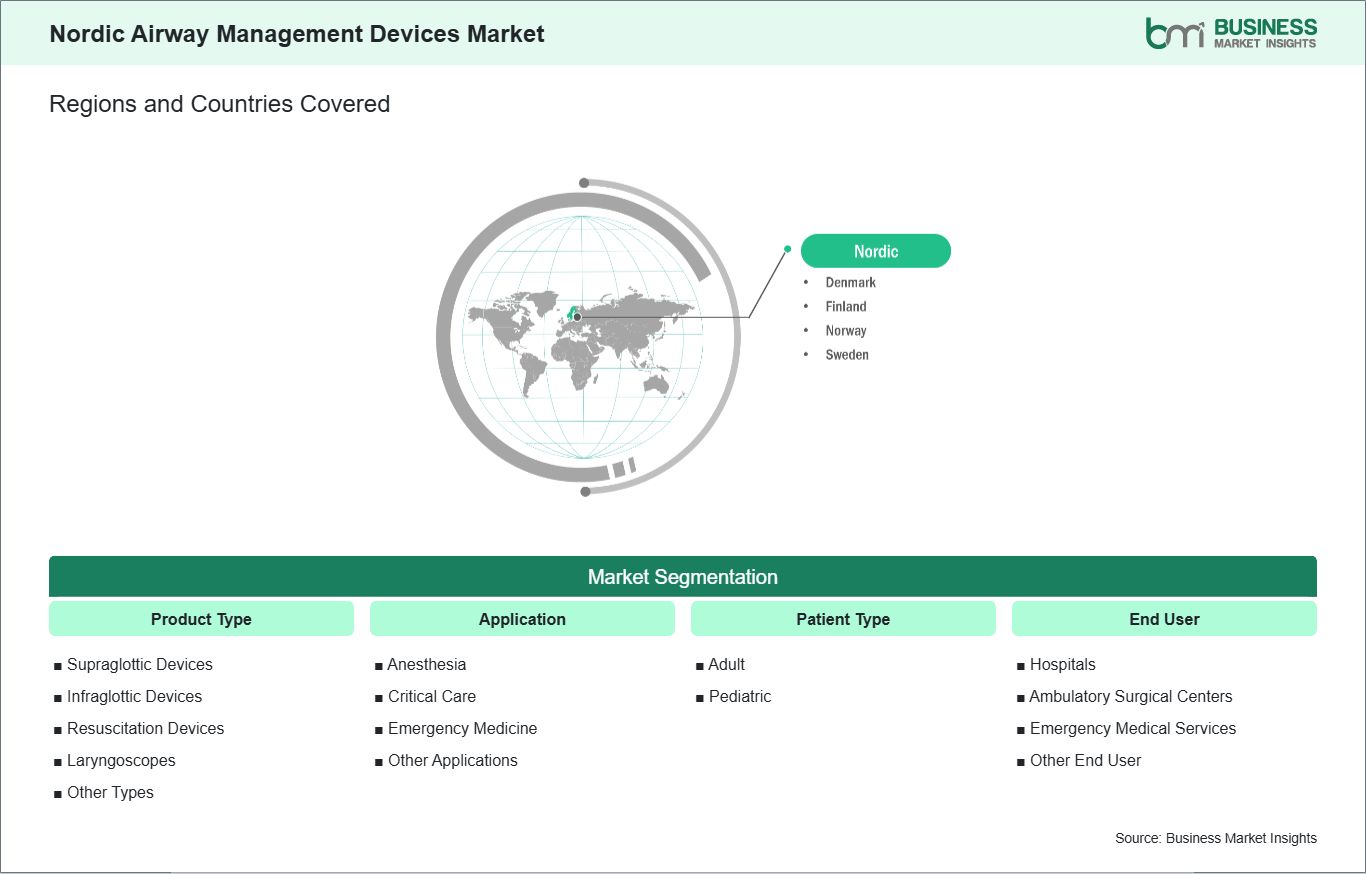
Key segments that contributed to the derivation of the airway management devices market analysis are product type, application, patient type, and end user.
In the Nordic airway management devices market, the growing trend in the medical community regarding ventilator-related complications has resulted in a change in hospitals' procurement and medical care practices in Sweden, Norway, Denmark, Finland, and Iceland. The healthcare facilities of these countries have placed high importance on mitigating risks associated with ventilator-related complications including infection and damage due to extended use of the equipment. As a result, the implementation of airway management devices that allow for lung-protective ventilation has been encouraged among intensive care units.
Stockholm, Oslo, and Copenhagen hospitals have started incorporating devices that offer real-time feedback systems informing healthcare providers of any initial signs of patient-ventilator asynchrony. There has also been increased utilization of supraglottic airway devices and high-flow nasal oxygen treatment as alternatives to mechanical ventilation where possible, with the use of such clinical protocols being guided by national recommendations based on patient safety and scientific evidence. Due to these developments, there has been a growing demand for airway devices enabling non-invasive ventilation and easier weaning from ventilation in intensive care settings.
Additionally, quality improvement projects in Finland and Iceland have included the use of ventilator-associated complications as criteria for evaluating hospital performance. In order to achieve safety standards at the national level, there has been an increasing inclination toward purchasing devices that are proven to significantly decrease the incidence of complications associated with ventilator use. The resulting outcome has been two-pronged, consisting of raising awareness among clinicians and facilitating the adoption of the latest generation of airway management devices.
Simulation-based education for airway management is increasingly forming part of clinical training in the Nordic countries. The universities and hospitals of Sweden, Denmark, and Norway are equipping their simulation laboratories with advanced models for training clinicians in airway management skills including techniques like intubation, inserting supraglottic devices, and gaining access to the airway in emergencies. This investment in education represents a dedication to excellence in patient safety in the Nordic area.
Helsinki and Reykjavik have simulation programs that include airway management for anesthesiologists and emergency physicians, ICU nurses, and paramedics. The inclusion of different healthcare professionals in the simulation program increases coordination among the team members, especially during emergencies. The adoption of clinical simulation training by healthcare institutions in these cities will increase the need for airway management devices that can be used during the simulations. Simulation centers are currently buying replicas of clinical devices that will reduce the number of clinical airway devices used during training sessions.
The requirement for continued education by hospitals and other healthcare organizations in Norway and Denmark will increase the demand for simulation-compatible airway devices. These healthcare institutions require their employees to undertake regular training, which involves the use of simulation models. There are also increased regulations from medical boards regarding the need for continued education. This regulation has encouraged the purchase of airway devices that can be used for simulation training.

The Nordic airway management devices market is experiencing steady growth, with market size and share analysis reflecting evolving treatment preferences and competitive dynamics among key players. The report evaluates important subsegments categorized within product type, application, patient type, and end user, highlighting their respective contributions to overall market performance.
By product type, the infraglottic devices subsegment dominated the market in 2025. In anesthesia practice, infraglottic devices provide protection against aspiration and enable precise airway management, driving higher adoption in operating rooms and critical care settings compared to supraglottic devices.
Based on application, the anesthesia subsegment dominated the market in 2025 due to the need for definitive airway control across a wide range of surgical procedures, from routine elective surgeries to complex interventions. Because infraglottic devices are essential for intubation during anesthesia, this segment experiences consistent, high-volume usage, making it the largest segment compared to emergency or general critical care.
In terms of patient type, the adult subsegment dominated the market in 2025. Most procedural training, device designs, and usage guidelines are optimized for adult anatomy and usage scenarios, reinforcing higher market volume.
Based on end user, the hospital subsegment dominated the market in 2025, as hospitals remain the central hub for airway management, handling scheduled surgeries, emergency admissions, ICU care, and trauma cases. Their larger budgets, need for extensive airway inventories, and availability of multidisciplinary professionals make them the largest purchasers compared to outpatient centers or EMS, where volume and purchasing power are comparatively lower.
| Report Attribute | Details |
|---|---|
| Market size in 2025 | US$ 120.2 Million |
| Market Size by 2033 | US$ 176.2 Million |
| CAGR (2026 - 2033) | 4.9% |
| Historical Data | 2022-2024 |
| Forecast period | 2026-2033 |
| Segments Covered | By Product Type
|
|
Regions and Countries Covered
| |
| Nordic | Sweden, Denmark, Norway, Finland |
| Market leaders and key company profiles |
|
The "Nordic Airway Management Devices Market Size and Forecast (2022–2033)" report provides a detailed analysis of the market covering below areas:
The geographical scope of the Nordic airway management devices market report is divided into: Sweden, Norway, Denmark, and Finland. Sweden held the largest share in 2025.
The Nordic region of airway management devices is dominated by Sweden because of its highly sophisticated healthcare sector with high density of hospitals. The hospitals in Stockholm, Gothenburg, Malmö and other parts of Sweden regularly implement new airway management methods like video laryngoscopes, supraglottic airway devices, and disposable intubation devices to increase efficiency and improve safety. Integration of technology into professional education has been a key element behind the leadership of Sweden in this market. Doctors and nurses receive training on how to use complex airway management equipment by utilizing simulations. Furthermore, the emphasis placed on evidence-based medical guidelines ensures the development of consistent practices that promote the uptake of quality airway products. Sweden’s pre-hospital emergency service is also well-developed, with ambulances having portable airway products that enable quick response during emergencies. Efficient local distribution channels as well as partnerships with both European and international producers of medical devices guarantee a constant supply of quality equipment. With regard to these factors, Sweden remains the dominant player in the Nordic region airway management devices market.

The Nordic airway management devices market is evaluated by gathering qualitative and quantitative data post primary and secondary research, which includes important corporate publications, association data, and databases. A few of the key developments in the Nordic airway management devices market are:
The Nordic Airway Management Devices Market is valued at US$ 120.2 Million in 2025, it is projected to reach US$ 176.2 Million by 2033.
As per our report Nordic Airway Management Devices Market, the market size is valued at US$ 120.2 Million in 2025, projecting it to reach US$ 176.2 Million by 2033. This translates to a CAGR of approximately 4.9% during the forecast period.
The Nordic Airway Management Devices Market report typically cover these key segments-
The historic period, base year, and forecast period can vary slightly depending on the specific market research report. However, for the Nordic Airway Management Devices Market report:
The Nordic Airway Management Devices Market is populated by several key players, each contributing to its growth and innovation. Some of the major players include:
The Nordic Airway Management Devices Market report is valuable for diverse stakeholders, including:
Essentially, anyone involved in or considering involvement in the Nordic Airway Management Devices Market value chain can benefit from the information contained in a comprehensive market report.
Please tell us your area of interest
(Market Segments/ Regions and Countries/ Companies)