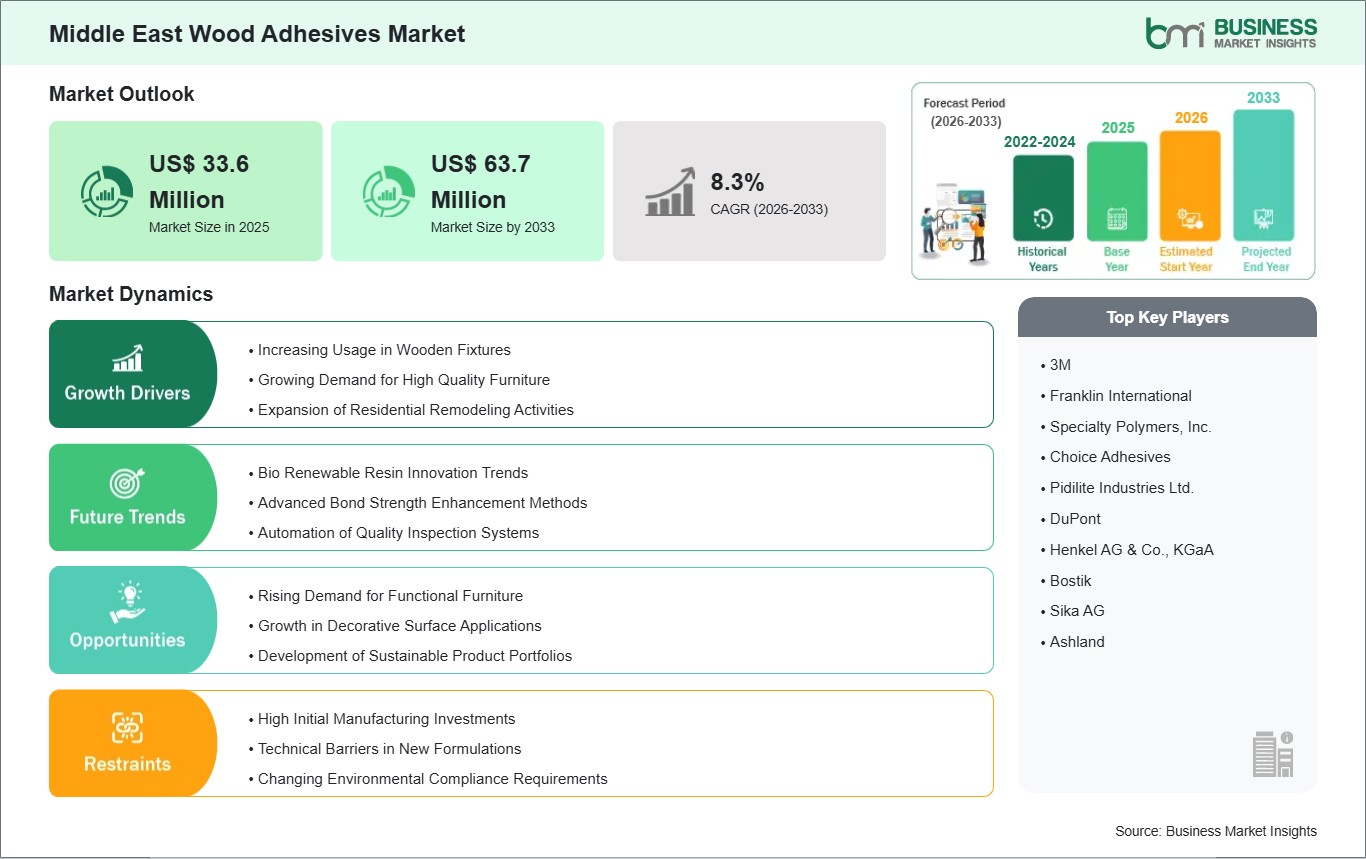
The Middle East wood adhesives market size is expected to reach US$ 912.1 million by 2033 from US$ 408.6 million in 2025. The market is estimated to register a CAGR of 10.6% from 2026 to 2033.
The Middle East wood adhesives market is expanding steadily, supported by large-scale construction activity, rapid urbanization, and rising demand for engineered wood products in residential, commercial, and hospitality sectors. Growth is strongly linked to infrastructure megaprojects and real estate development initiatives, particularly in high-value interior applications such as furniture, cabinetry, flooring, and decorative paneling. Market demand is increasingly shaped by the adoption of modular and prefabricated construction techniques, which require adhesives with fast curing times, strong bonding performance, and compatibility with automated assembly systems. In addition, harsh climatic conditions characterized by high temperatures and humidity fluctuations are driving preference for moisture-resistant and thermally stable adhesive formulations. Product innovation is focused on enhancing durability, chemical resistance, and application efficiency while maintaining compliance with evolving environmental expectations, including gradual interest in low-VOC and safer chemical compositions. The region’s reliance on imported engineered wood and specialty chemicals continues to influence pricing dynamics and supply chain strategies. Competitive activity is led by global chemical manufacturers and regional distributors that emphasize technical support, customized solutions, and strong distribution networks. Overall, the Middle East wood adhesives market is transitioning toward high-performance, climate-adapted, and application-specific adhesive systems aligned with ongoing construction diversification and modernization trends across the region.

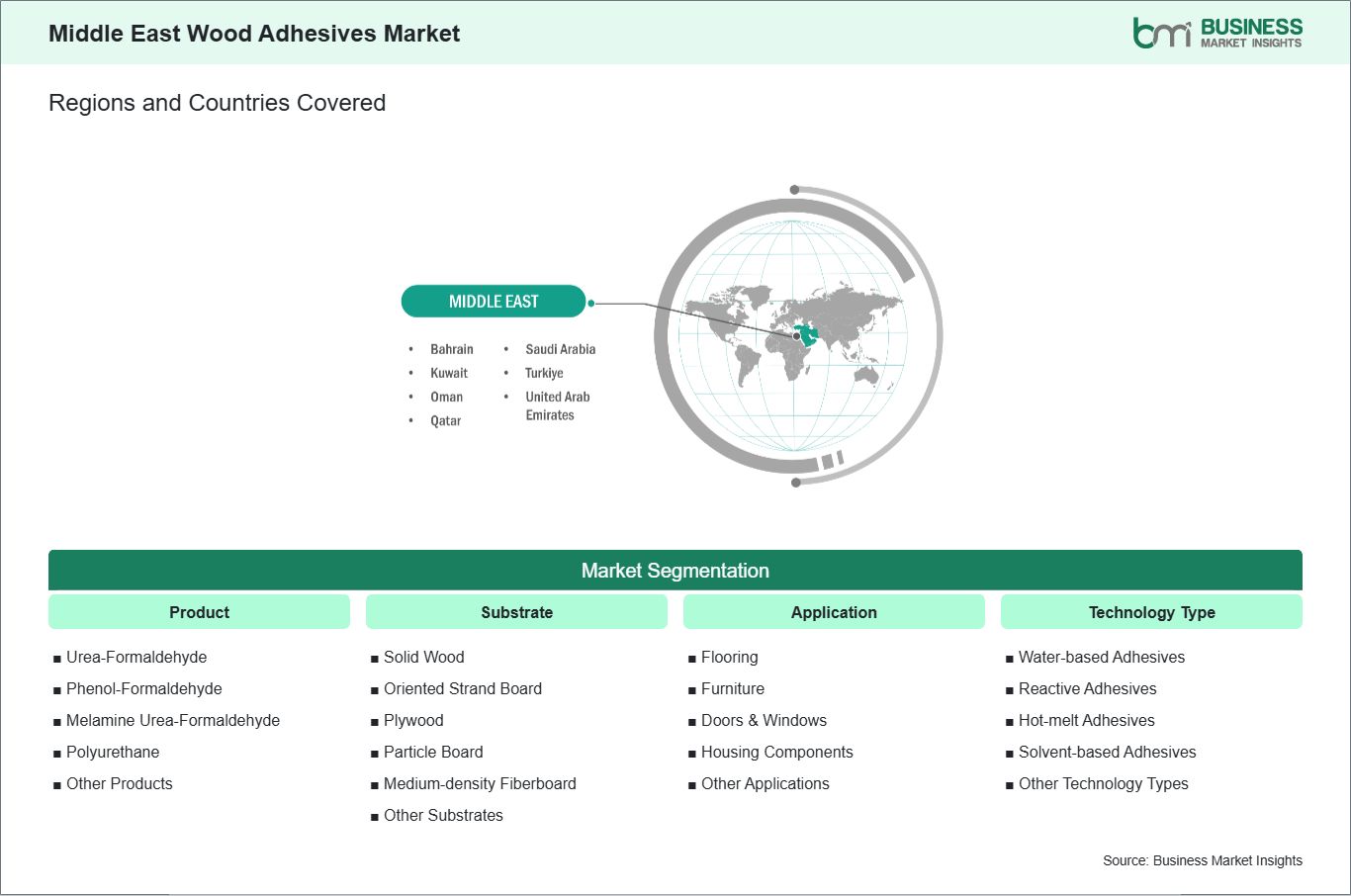
Key segments that contributed to the derivation of the Middle East wood adhesives market analysis are product, substrate, application, and technology type.
The Middle East wood adhesives market is experiencing steady growth due to the increasing use of wooden fixtures in residential, commercial, and institutional construction projects. In countries like UAE, Saudi Arabia, and Kuwait, wooden fixtures have found applications for doors, wall panelling, ceilings, and other architectural decoration. This is part of a growing trend to use natural material in contemporary interior design schemes.
Wood adhesives play an important role in the construction and assembly of fittings, since these help ensure bonding capacity, strength, and resilience against environmental factors. Due to the high temperatures prevalent in the area and due to the humidity in the coastal locations, there is rising demand for wood adhesives that offer stability. Adhesives are being developed to increase their bond strength and design capability.
Large-scale construction activity across the Middle East is further driving demand for wooden fixtures. Residential developments, luxury villas, commercial towers, and hospitality projects in cities like Dubai, Riyadh, and Doha are increasingly integrating engineered wood elements into interior and semi-structural applications. As construction standards evolve and design expectations rise, the use of advanced wood adhesives in fixture production is expected to grow steadily across the region.
The rising demand for functional furniture is a key driver of the Middle East wood adhesives market. Consumers and businesses are increasingly seeking furniture solutions that combine practicality, aesthetics, and space efficiency. This includes modular office furniture, storage systems, convertible home furniture, and customized interior solutions designed for modern urban living.
Furniture manufacturers in the region are adapting to changing lifestyle preferences by offering multi-purpose and ergonomic designs. These products rely heavily on adhesives to ensure structural strength, precise assembly, and long-term durability. As furniture design becomes more innovative, the need for high-performance adhesive systems continues to increase across manufacturing processes.
The hospitality, real estate, and corporate sectors are also contributing to demand growth. Hotels, serviced apartments, coworking spaces, and retail outlets across the Middle East are investing in customized furniture solutions that enhance user experience and visual appeal. With ongoing investments in tourism and commercial infrastructure, the demand for functional furniture—and consequently wood adhesives—is expected to remain strong across the region.

The wood adhesives market in Middle East is experiencing steady growth, with market size and share analysis reflecting evolving treatment preferences and competitive dynamics among key players. The report evaluates important subsegments categorized within product, substrate, application, and technology, highlighting their respective contributions to market performance.
By product, the urea-formaldehyde (UF) segment dominated the market in 2025, driven by strong demand from cost-sensitive construction and furniture manufacturing sectors supported by rapid urban development.
Based on substrate, the particle board (PB) segment dominated the market in 2025, driven by expanding use in interior fit-outs and affordable furniture driven by growing residential and commercial construction activity.
On the basis of application, the furniture segment dominated the market in 2025, driven by rising real estate development, hospitality sector expansion, and increasing demand for modern interior solutions.
In terms of technology, the water-based adhesives segment dominated the market in 2025, driven by increasing preference for low-emission, safer adhesive technologies aligned with improving environmental and indoor air quality standards.
| Report Attribute | Details |
|---|---|
| Market size in 2025 | US$ 408.6 Million |
| Market Size by 2033 | US$ 912.1 Million |
| CAGR (2026 - 2033) | 10.6% |
| Historical Data | 2022-2024 |
| Forecast period | 2026-2033 |
| Segments Covered | By Product
|
|
Regions and Countries Covered
| |
| Middle East | UAE, Saudi Arabia, Bahrain, Oman, Kuwait, Qatar, and Turkiye |
| Market leaders and key company profiles |
|
The "Middle East Wood Adhesives Market Size and Forecast (2022–2033)" report provides a detailed analysis of the market covering below areas:
The geographical scope of the Middle East wood adhesives market report is divided into UAE, Saudi Arabia, Bahrain, Oman, Kuwait, Qatar, and Turkiye. Saudi Arabia held the largest share in 2025.
Saudi Arabia leads the Middle East wood adhesives market, supported by large-scale construction megaprojects, rapid urban expansion, and rising adoption of engineered wood in residential, commercial, and institutional developments. Strong government-backed infrastructure programs and diversification initiatives are accelerating demand for high-performance adhesive solutions in modular construction and interior applications. The United Arab Emirates holds a significant position due to its advanced real estate sector, luxury hospitality developments, and high-end interior fit-out activities. Adhesive demand is driven by premium furniture manufacturing, architectural woodwork, and fast-track construction projects requiring durable and efficient bonding systems. Qatar shows steady consumption supported by ongoing infrastructure development, commercial construction, and increased use of prefabricated building materials. Kuwait’s demand is driven by residential construction projects and renovation activities, with gradual modernization of woodworking and furniture manufacturing processes. Oman and Bahrain exhibit moderate but stable growth, supported by infrastructure upgrades, retail construction, and expanding interior design sectors. Across the Middle East, market dynamics are influenced by harsh climatic conditions, leading to strong preference for moisture-resistant, heat-stable, and high-durability adhesive formulations. The region is witnessing a gradual shift toward advanced adhesive technologies aligned with sustainable construction practices, rising import of engineered wood products, and increasing adoption of modular building techniques across key Gulf economies.

The Middle East wood adhesives market is evaluated by gathering qualitative and quantitative data post primary and secondary research, which includes important corporate publications, association data, and databases. A few of the key developments in the Middle East wood adhesives market are:
The Middle East Wood Adhesives Market is valued at US$ 408.6 Million in 2025, it is projected to reach US$ 912.1 Million by 2033.
As per our report Middle East Wood Adhesives Market, the market size is valued at US$ 408.6 Million in 2025, projecting it to reach US$ 912.1 Million by 2033. This translates to a CAGR of approximately 10.6% during the forecast period.
The Middle East Wood Adhesives Market report typically cover these key segments-
The historic period, base year, and forecast period can vary slightly depending on the specific market research report. However, for the Middle East Wood Adhesives Market report:
The Middle East Wood Adhesives Market is populated by several key players, each contributing to its growth and innovation. Some of the major players include:
The Middle East Wood Adhesives Market report is valuable for diverse stakeholders, including:
Essentially, anyone involved in or considering involvement in the Middle East Wood Adhesives Market value chain can benefit from the information contained in a comprehensive market report.
Please tell us your area of interest
(Market Segments/ Regions and Countries/ Companies)